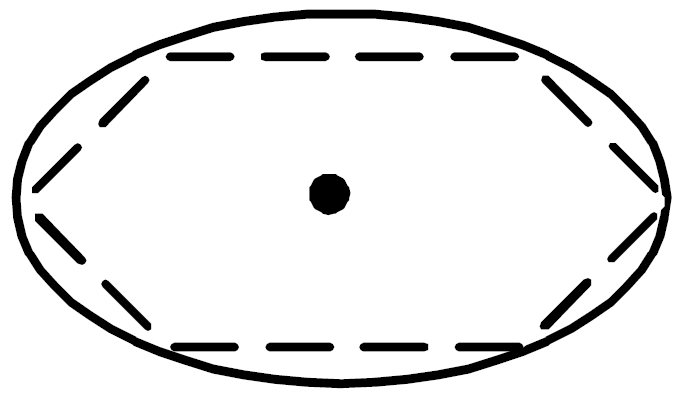
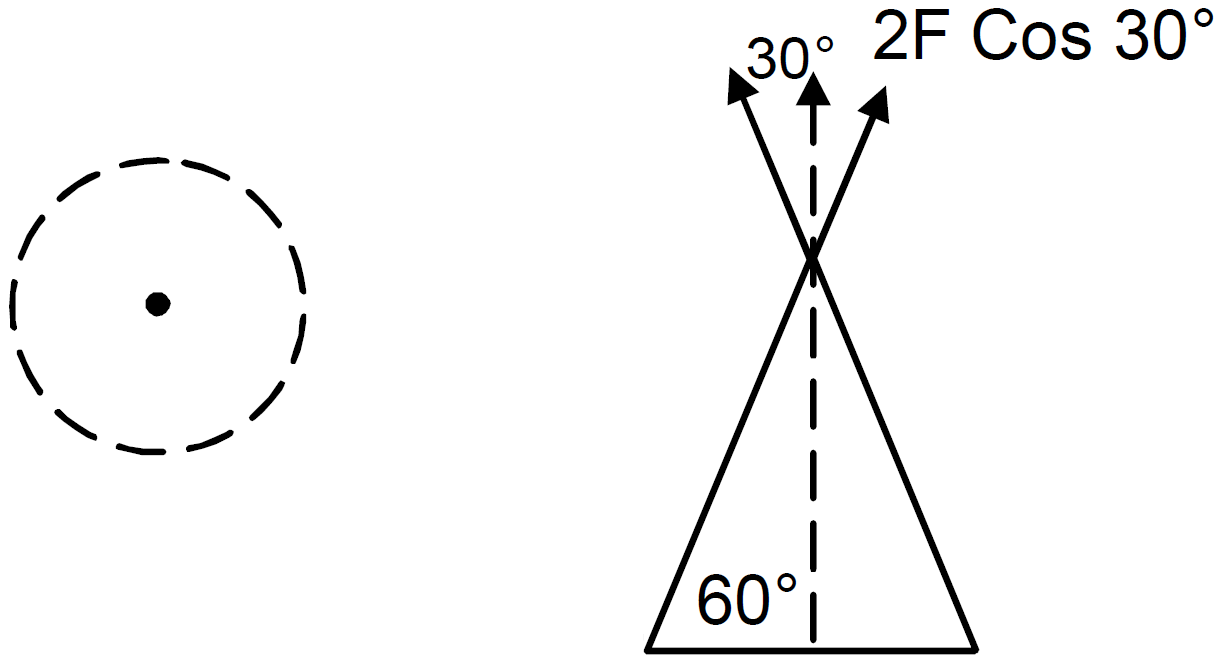
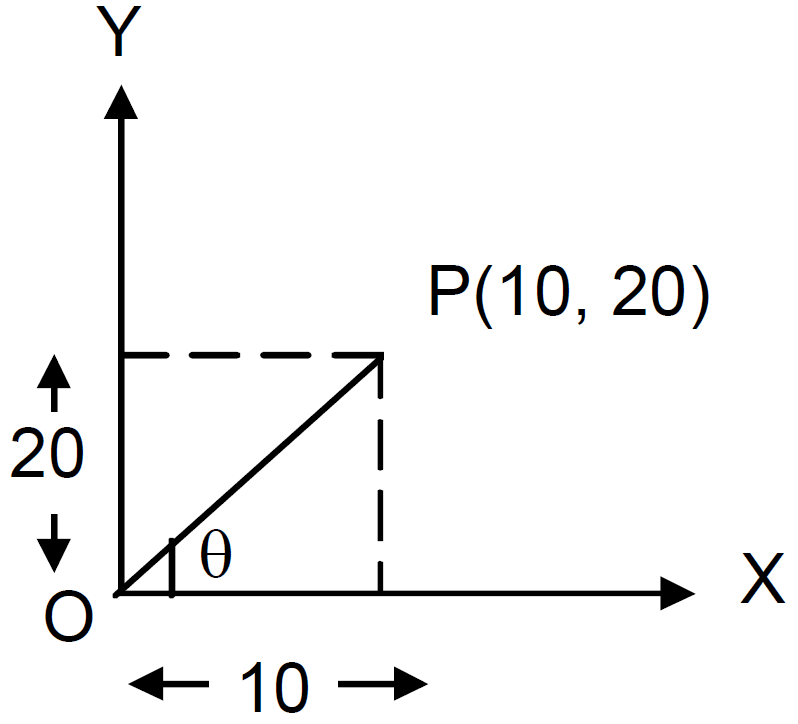
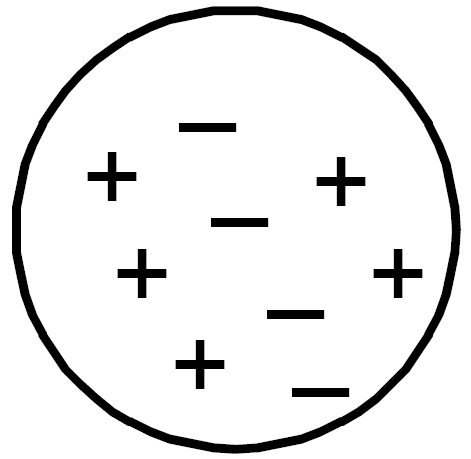
Since it is a regular hexagon. So, it forms an equipotential surface. Hence the charge at each point is equal. Hence the net entire field at the centre is Zero.
23 questions · self-marked practice — reveal the answer and mark yourself.
Since it is a regular hexagon. So, it forms an equipotential surface. Hence the charge at each point is equal. Hence the net entire field at the centre is Zero.
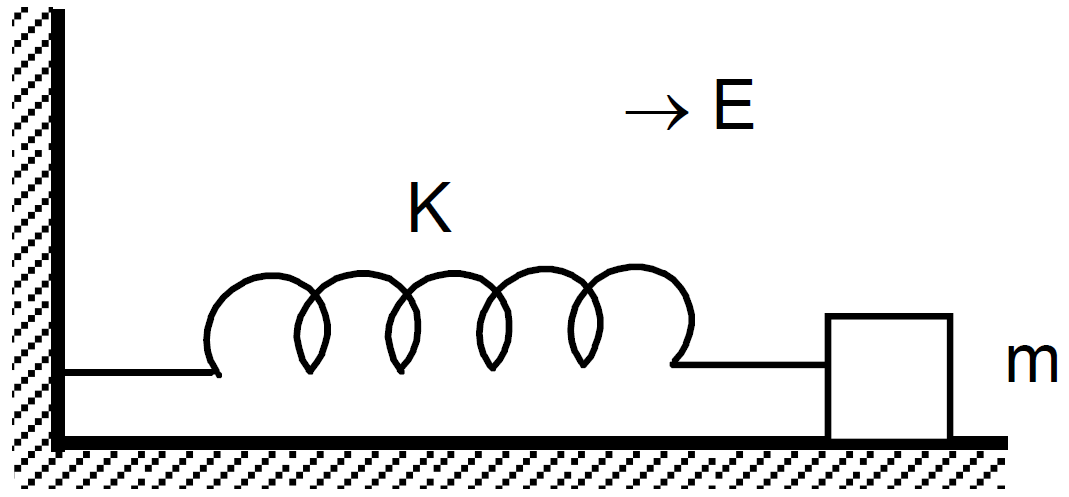
We know,
Electric field at a point due to a given charge
$'\text{E}'=\frac{\text{Kq}}{\text{r}^2}$ Where q = charge, r = Distance between the point and the charge
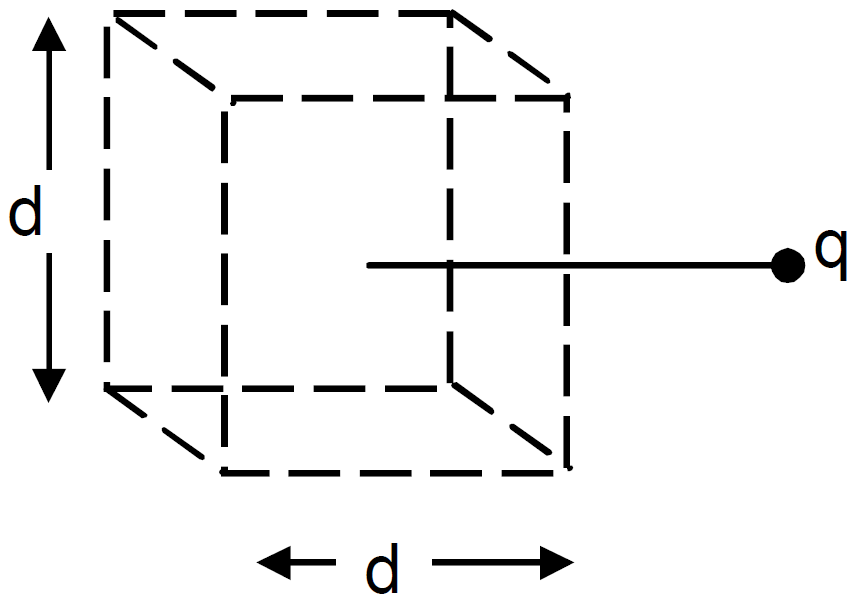
So, $'\text{E}'=\frac{1}{4\pi\in_0}\times\frac{\text{q}}{\text{d}^2}$ $[\therefore\text{r}=\text{‘d’}\text{here}]$

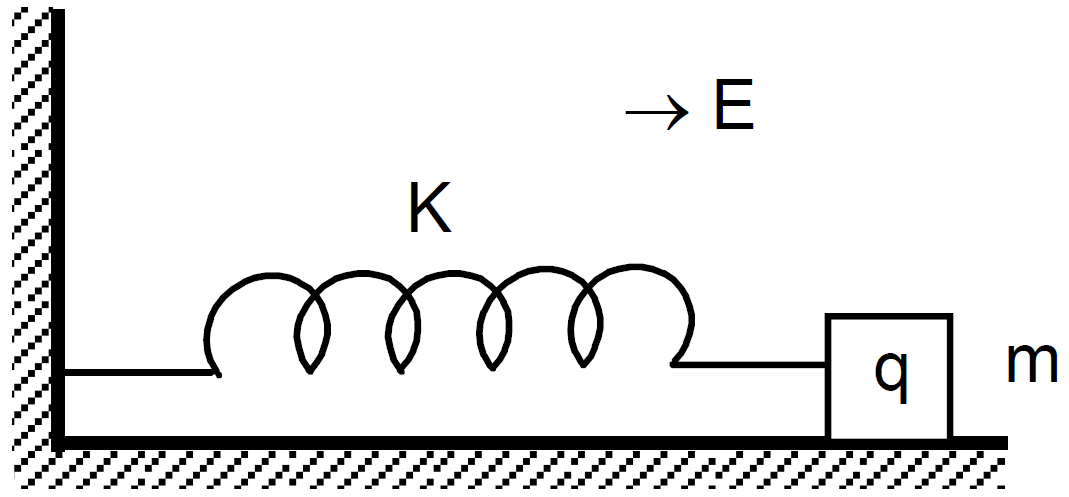
$\text{F}=\text{qE},\ \text{F}=-\text{Kx}$
Where x = amplitude
$\text{x}=\frac{-\text{qE}}{\text{K}}$


$\text{E}=\frac{1}{4\pi\in_0}\frac{\text{q}}{\text{r}^2}$
$\Rightarrow5.0=9\times10^9\times\frac{9}{(0.4)^2}$
$\Rightarrow\text{q}=8.9\times10^{-11}\text{C}$
$\text{E}=\vec{\text{i}}\times\text{Ax}=100\vec{\text{i}}$
$\int\limits_\text{v}^0\text{dv}=-\int\limits\text{E}\times\text{d}\ell$
$\text{V}=-\int\limits_0^{10}10\text{x}\times\text{dx}$
$=-\int\limits^{10}_0\frac{1}{2}\times10\times\text{x}^2$
$0-\text{V}=-\Big[\frac{1}{2}\times1000\Big]$
$=-500$
$\Rightarrow\text{V}=500\text{ Volts}$
Let two protons be at a distance be 13.8 femi,
$\text{F}=\frac{1}{4\pi\in_0}\frac{\text{q}_1\text{q}_2}{\text{r}^2}$
$\text{F}=\frac{9\times10^9\times1.6\times10^{-38}}{(14.8)^2\times10^{-30}}$
$\text{F}=1.2\text{N}$