Questions · Page 2 of 2

5 Marks Questions

Question 515 Marks
Two coils A and B have inductances 1.0H and 2.0H respectively. The resistance of each coil is $10\Omega.$ Each coil is connected to an ideal battery of emf 2.0V at t = 0 Let iA and iB be the currents in the two circuit at time t. Find the ratio $\frac{\text{i}_\text{A}}{\text{i}_\text{B}}$
  1. t = 100ms
  2. t = 200ms
  3. t = 1s.
Answer
$\text{L}_\text{a}=1.0\text{ H }; \text{ L}_\text{B}=2.0\text{H}; \ \text{R}=10\omega$

  1. $\text{t}=0.1\text{s}, \ \tau_\text{A}=0.1, \ \tau_\text{B}=\frac{\text{L}}{\text{R}}=0.2$

$\text{i}_{\text{A}}=\text{i}_0\Big(1-\text{e}^\frac{-\text{t}}{\tau}\Big)$

$=\frac{2}{10}\Big(1-\text{e}^\frac{-0.1\times10}{1}\Big)=0.2\Big(1-\text{e}^{-1}\Big)=0.126424111$

$\text{i}_\text{B}=\text{i}_0\Big(1-\text{e}\frac{-\text{t}}{\tau}\Big)$

$=\frac{2}{10}\Big(1-\text{e}^\frac{-0.1\times10}{2}\Big)=0.2\Big(1-\text{e}^\frac{-1}{2}\Big)=0.078693$

$\frac{\text{i}_\text{A}}{\text{i}_\text{B}}=\frac{0.12642411}{0.78693}=1.6$

  1. $\text{t}=200\text{ms}=0.2\text{s}$

$\text{i}_\text{A}=\text{i}_0\Big(1-\text{e}^\frac{-\text{t}}{\tau}\Big)$

$=0.2\Big(1-\text{e}^\frac{-0.2\times10}{1}\Big)=0.2\times0.864664716=0.172932943$

$\text{i}_\text{B}=0.2\Big(1-\text{e}^\frac{-0.2\times10}{2}\Big)=0.2\times0.632120=0.126424111$

$\frac{\text{i}_\text{a}}{\text{i}_\text{B}}=\frac{0.172932943}{0.126424111}=1.36=1.4$

  1. $\text{t}=1\text{s}$

$\text{i}_\text{A}=0.2\Big(1-\text{e}^\frac{-1\times10}{1}\Big)=0.2\times0.9999546=0.19999092$

$\text{i}_\text{B}=0.2\Big(1-\text{e}^\frac{-1\times10}{2}\Big)=0.2\times0.99326=0.19865241$

$\frac{\text{i}_\text{A}}{\text{i}_\text{B}}=\frac{0.19999092}{19865241}=1.0$

View full question & answer
Question 525 Marks
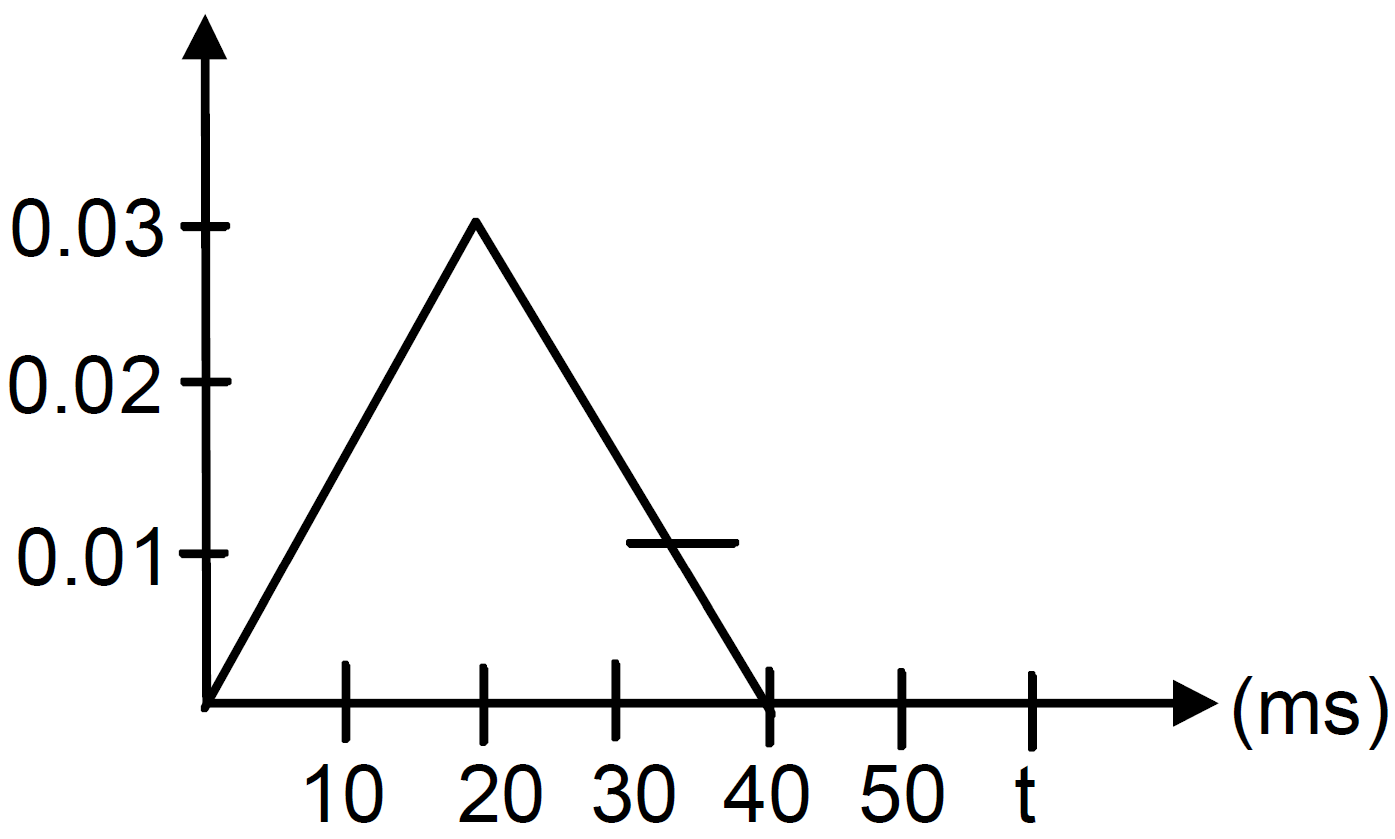
Find the total heat produced in the loop of the previous problem during the interval 0 to 30s if the resistance of the loop is $4.5\text{m}\Omega.$
Answer
As heat produced is a scalar prop.
So, net heat produced = Ha + Hb + Hc + Hd
$\text{R}=4.5\text{m}\Omega=4.5\times10^{-3}\Omega$
$\text{e}=3\times10^{-4}\text{V}$
$\text{i}=\frac{\text{e}}{\text{R}}=\frac{3\times10^{-4}}{4.5\times10^{-3}}=6.7\times10^{-2}\text{Amp}$
$\text{H}_{\text{a}}=(6.7\times10^{-2})^2\times4.5\times10^{-3}\times5$
$\text{H}_{\text{b}}=\text{H}_{\text{d}}=0$ [since emf is induced for 5sec]
$\text{H}_{\text{c}}=(6.7\times10^{-2})^2\times4.5\times10^{-3}\times5$
So Total heat $=\text{H}_{\text{a}}+\text{H}_{\text{c}}$
$=2\times(6.7\times10^{-2})^2\times4.5\times10^{-3}\times5=2\times10^{-4}\text{J}.$
View full question & answer
Question 535 Marks
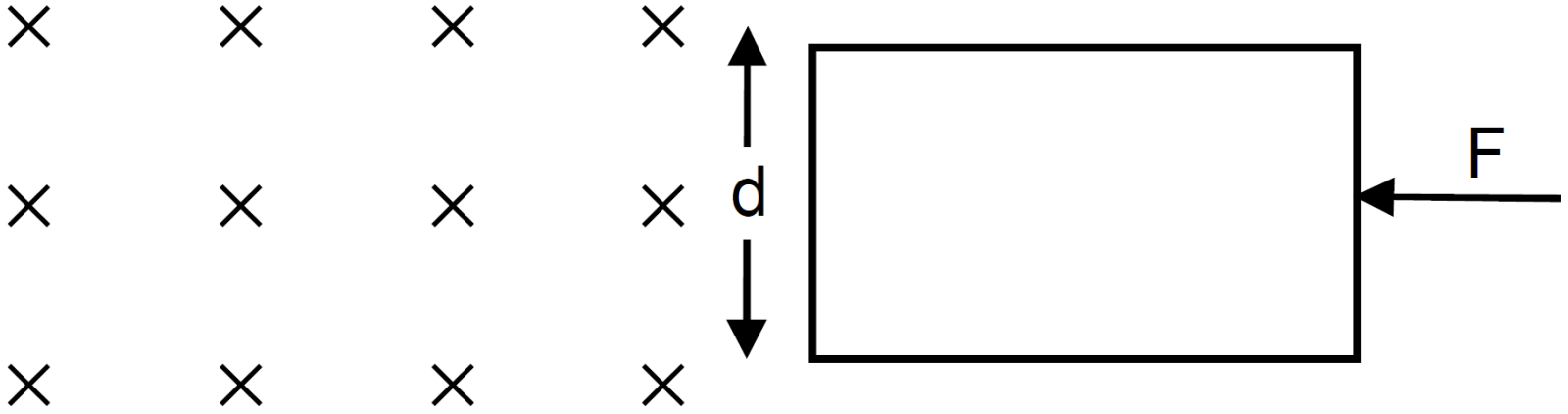
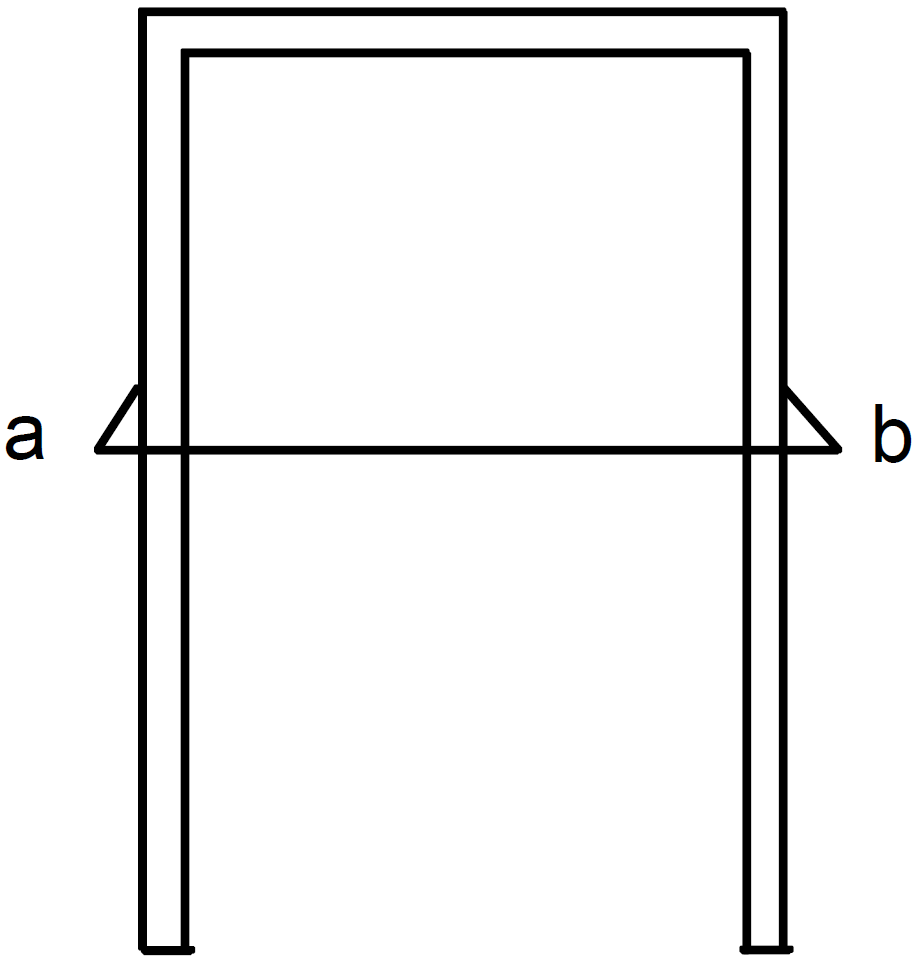
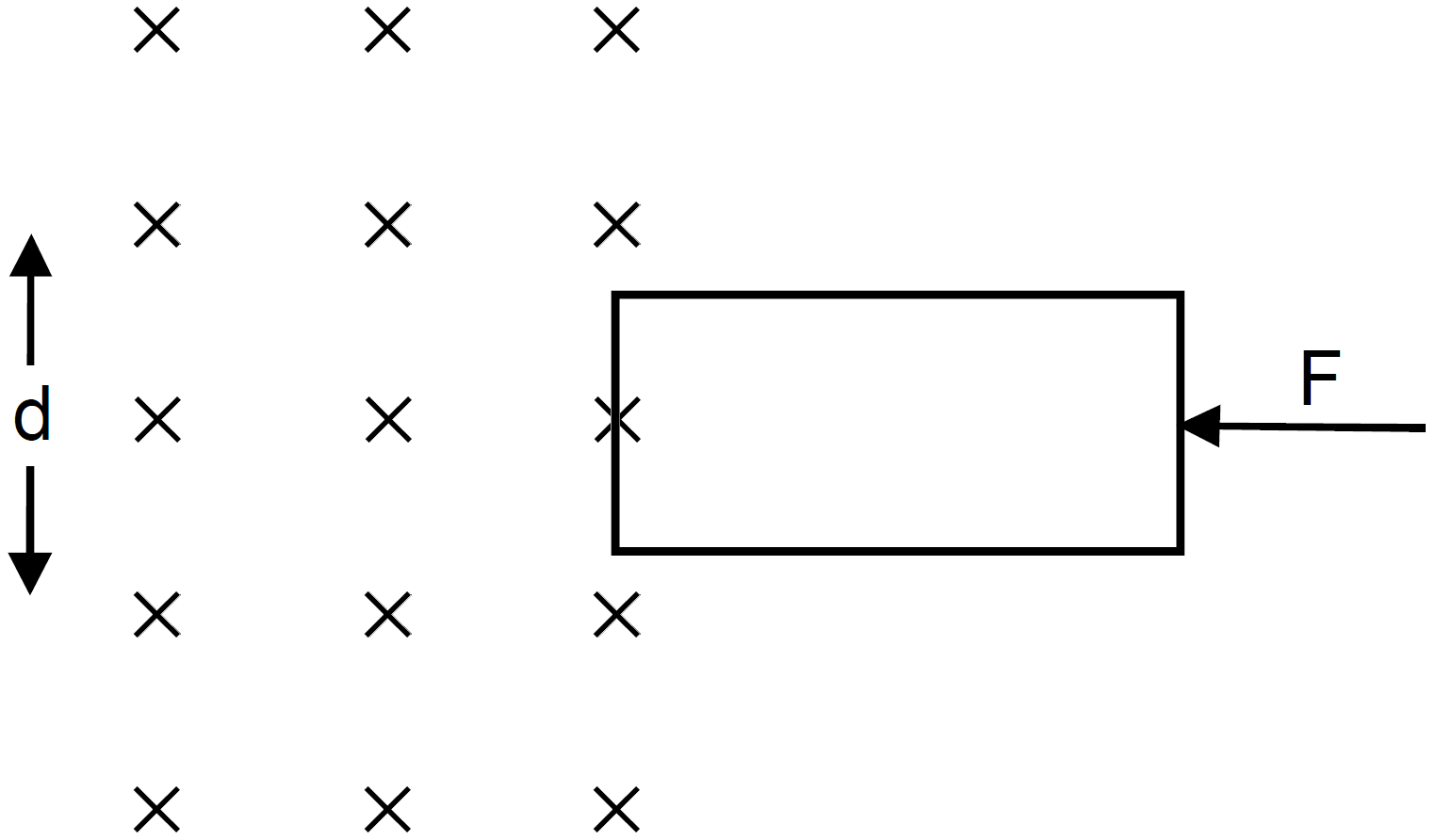
The rectangular wire-frame, shown in figure, has a width d, mass m, resistance R and a large length. A uniform magnetic field B exists to the left of the frame. A constant force F starts pushing the frame into the magnetic field at t = 0.
  1. Find the acceleration of the frame when its speed has increased to v.
  2. Show that after some time the frame will move with a constant velocity till the whole frame enters into the magnetic field. Find this velocity v0.
  3. Show that the velocity at time t is given by $\text{v}=\text{v}_0\Big(1-\text{e}^{-\frac{\text{ft}}{\text{mv}_0}}\Big)$

Answer

  1. emf developed = Bdv (when it attains a speed v)

Current $=\frac{\text{Bdv}}{\text{R}}$

Force $=\frac{\text{B}\text{d}^2\text{v}^2}{\text{R}}$

This force opposes the given force

Net F $=\text{F}-\frac{\text{B}\text{d}^2\text{v}^2}{\text{R}}=\text{RF}-\frac{\text{B}\text{d}^2\text{v}^2}{\text{R}}$

Net acceleration $=\frac{\text{RF}-\text{B}^2\text{d}^2\text{v}}{\text{mR}}$

  1. Velocity becomes constant when acceleration is 0.

$\frac{\text{F}}{\text{m}}-\frac{\text{B}^2\text{d}^2\text{v}_0}{\text{mR}}=0$

$\Rightarrow\frac{\text{F}}{\text{m}}=\frac{\text{B}^2\text{d}^2\text{v}_0}{\text{mR}}$

$\Rightarrow\text{v}_0=\frac{\text{FR}}{\text{B}^2\text{d}^2}$

  1. Velocity at line t

$\text{a}=-\frac{\text{dv}}{\text{dt}}$

$\Rightarrow\int_{0}^{\text{v}}\frac{\text{dv}}{\text{RF}-\text{l}^2\text{B}^2\text{v}}=\int_{0}^{\text{t}}\frac{\text{dt}}{\text{mR}}$

$\Rightarrow\Big[\text{l}_\text{n}\big[\text{RF}-\text{l}^2\text{B}^2\text{v}\big]\frac{1}{-\text{l}^2\text{B}^2}\Big]_0^{\text{v}} \ \Big[\frac{\text{t}}{\text{Rm}}\Big]_0^{\text{t}} $

$\Rightarrow\Big[\text{l}_\text{n}\big(\text{RF}-\text{l}^2\text{B}^2\text{v}\big)\Big]_{0}^{\text{v}}=\frac{-\text{tl}^2\text{B}^2}{\text{Rm}}$

$\Rightarrow\text{l}_\text{n}\big(\text{RF}-\text{l}^2\text{B}^2\text{v}\big)-\text{ln}(\text{RF})=\frac{-\text{t}^2\text{B}^2\text{t}}{\text{Rm}}$

$\Rightarrow1-\frac{\text{l}^2\text{B}^2\text{v}}{\text{Rf}}=\text{e}^{\frac {-\text{l}^2\text{B}^2\text{t}}{\text{Rm}}}$

$\Rightarrow\frac{\text{l}^2\text{B}^2\text{v}}{\text{Rf}}=1-\text{e}^{\frac {-\text{l}^2\text{B}^2\text{t}}{\text{Rm}}}$

$\Rightarrow\text{v}=\frac{\text{FR}}{\text{l}^2\text{B}^2}\Big(1-\text{e}^{\frac{-\text{l}^2\text{B}^2\text{v}_0\text{t}}{\text{Rv}_0\text{m}}}\Big)=\text{v}_0(1-\text{e}^{-\text{Fv}_0\text{m}})$

View full question & answer
Question 545 Marks
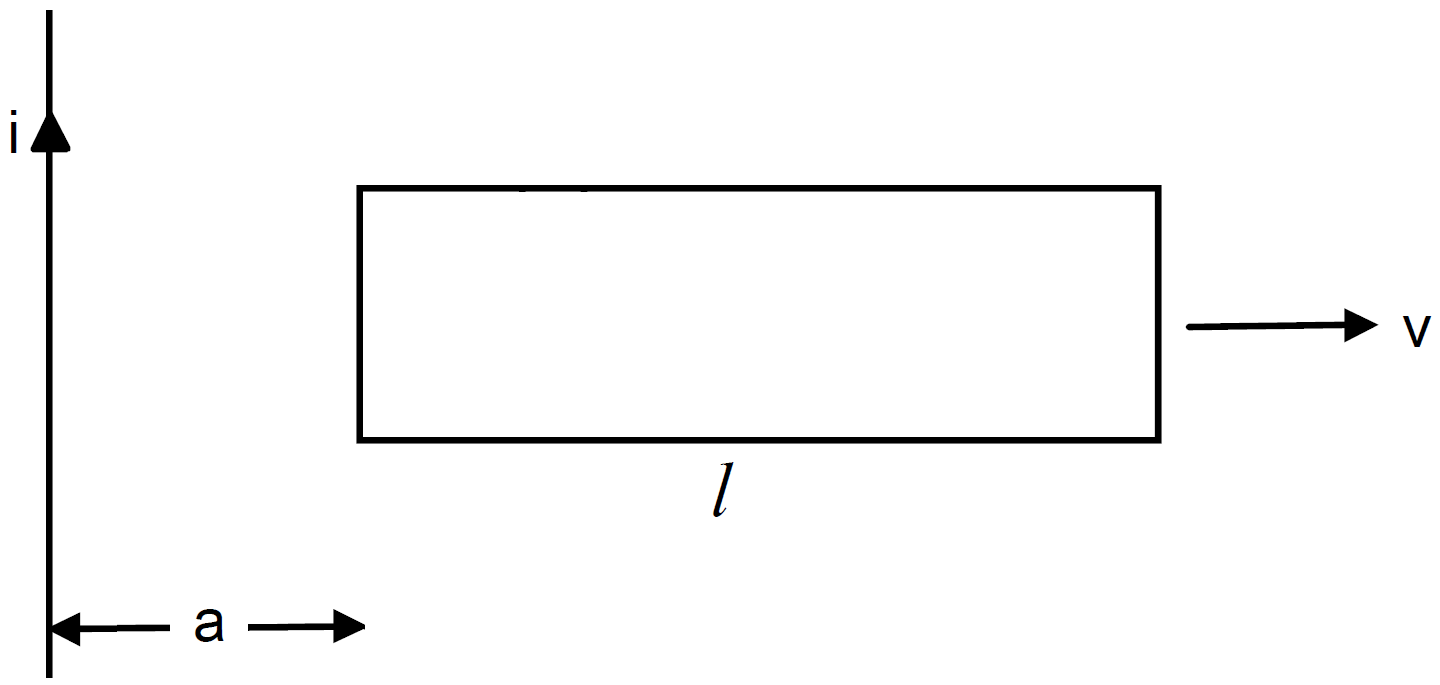
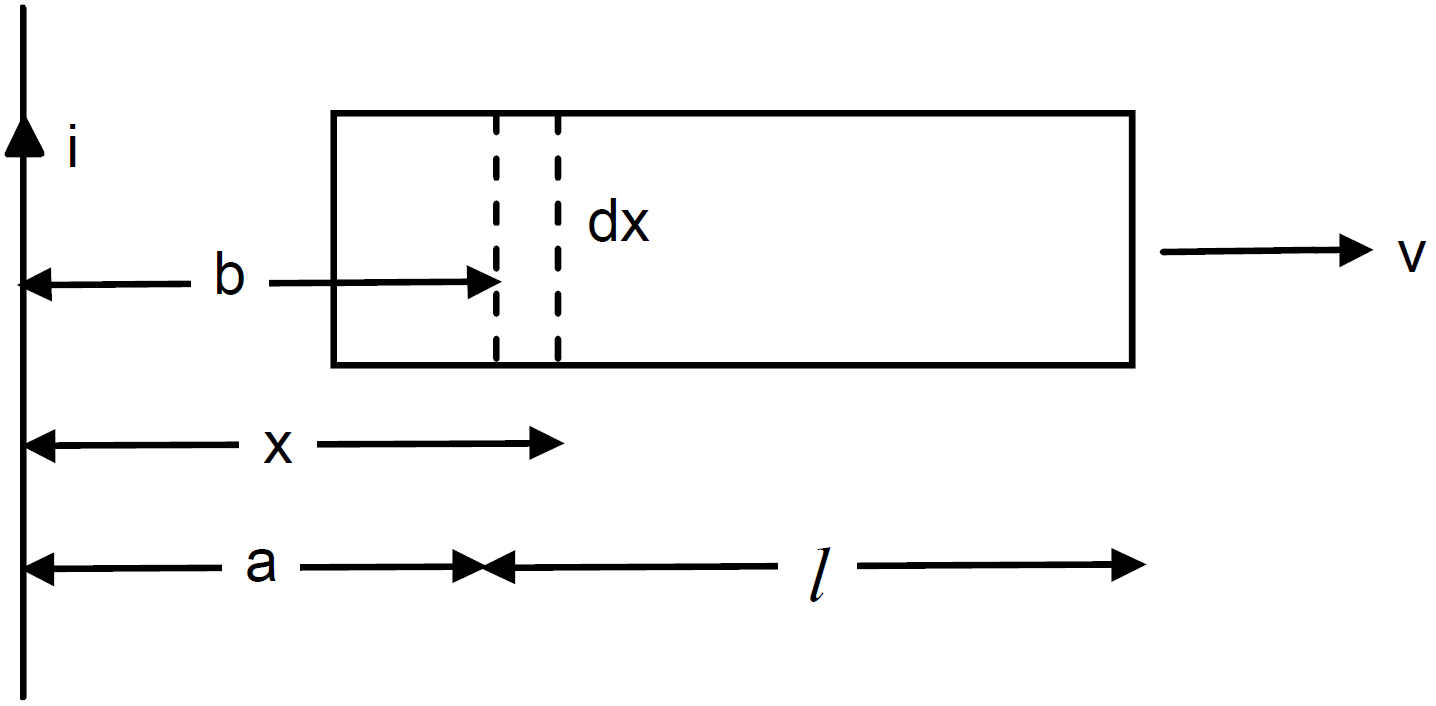
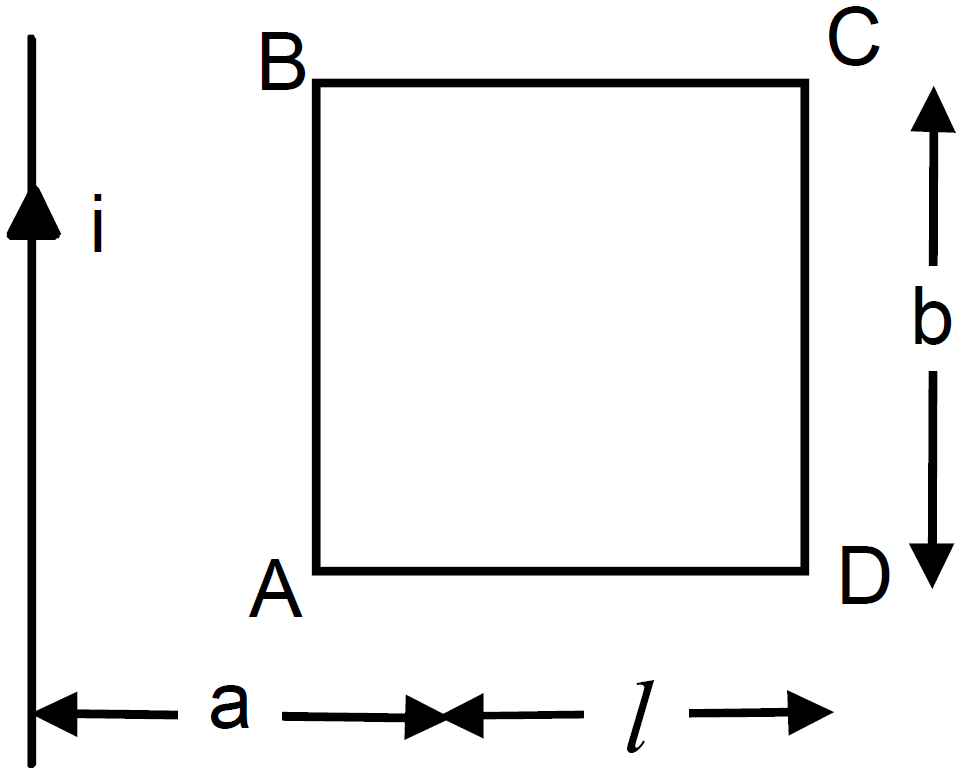
A rectangular metallic loop of length l and width b is placed coplanarly with a long wire carrying a current i. The loop is moved perpendicular to the wire with a speed v in the plane containing the wire and the loop. Calculate the emf induced in the loop when the rear end of the loop is at a distance a from the wire. Solve by using Faraday's law for the flux through the loop and also by replacing different segments with equivalent batteries.

Answer

Using Faraday’' law

Consider a unit length dx at a distance x

$\text{B}=\frac{\mu_0\text{i}}{2\pi\text{x}}$

Area of strip $=\text{b} \ \text{dx}$

$\text{d}\phi=\frac{\mu_0\text{i}}{2\pi\text{x}}\text{dx}$

$\Rightarrow\phi=\int\limits^{\text{a}+1}_\text{a}\frac{\mu_0\text{i}}{2\pi\text{x}}\text{bdx}$

$=\frac{\mu_o\text{i}}{2\pi}\text{b}\int\limits^{\text{a}+1}_\text{a}\Big(\frac{\text{dx}}{\text{x}}\Big)=\frac{\mu_0\text{ib}}{2\pi}\log\Big(\frac{\text{a}+\text{l}}{\text{a}}\Big)$

$\text{Emf}=\frac{\text{d}\phi}{\text{dt}}=\text{dt}\Big[\frac{\mu_0\text{ib}}{2\pi}\text{log}\Big(\frac{\text{a}+\text{l}}{\text{a}}\Big)\Big]$

$=\frac{\mu_0\text{ib}}{2\pi}\frac{\text{a}}{\text{a}+\text{l}}\Big(\frac{\text{va}-(\text{a}+\text{l})\text{v}}{\text{a}^2}\Big)$ $\Big($ Where $\frac{\text{da}}{\text{dt}}=\text{V}\Big)$

$=\frac{\mu_0\text{ib}}{2\pi}\frac{\text{a}}{\text{a}+\text{l}}\frac{\text{vl}}{\text{a}^2}=\frac{\mu_0\text{ibvl}}{2\pi(\text{a}+\text{l})\text{a}}$

The velocity of AB and CD creates the emf. since the emf due to AD and BC are equal and opposite to each other.

$\text{B}_{\text{AB}}=\frac{\mu_o\text{i}}{2\pi\text{a}} \ \Rightarrow \ \text{E.m.f.} \ \text{AB}=\frac{\mu_0\text{i}}{2\pi\text{a}}\text{bv}$

Length b, velocity v.

$\text{B}_{\text{CD}}=\frac{\mu_0\text{i}}{2\pi(\text{a}+\text{l})}$

$\Rightarrow \text{E.m.f.} \ \text{CD}=\frac{\mu_0\text{ibv}}{2\pi(\text{a}+\text{l})}$

Length b, velocity v.

Net emf $=\frac{\mu_0\text{i}}{2\pi\text{a}}\text{bv}-\frac{\mu_0\text{ibv}}{2\pi\text{a}(\text{a}+\text{l})}=\frac{\mu_0\text{ibvl}}{2\pi\text{a}(\text{a}+\text{l})}$

View full question & answer
Question 555 Marks
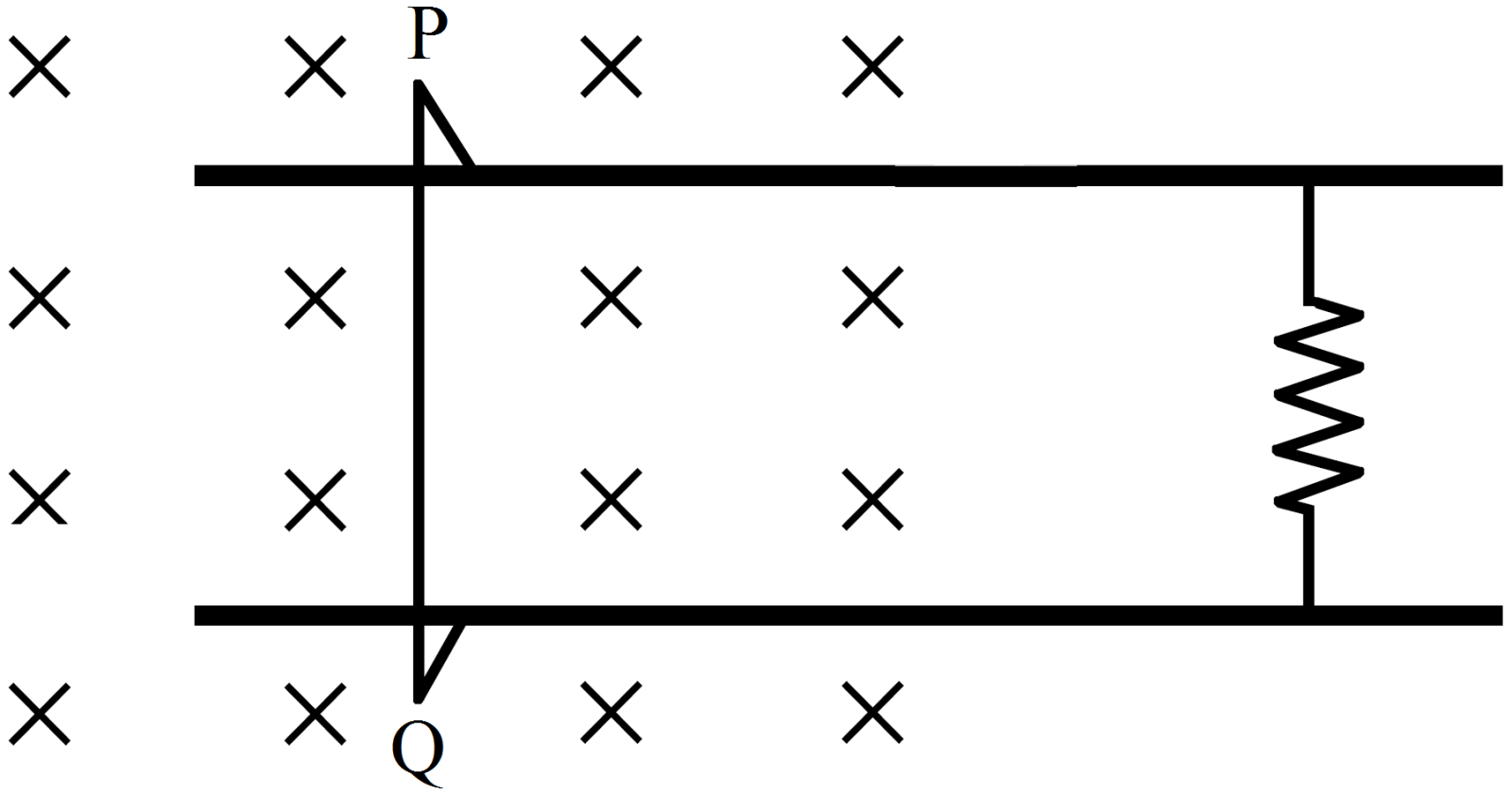
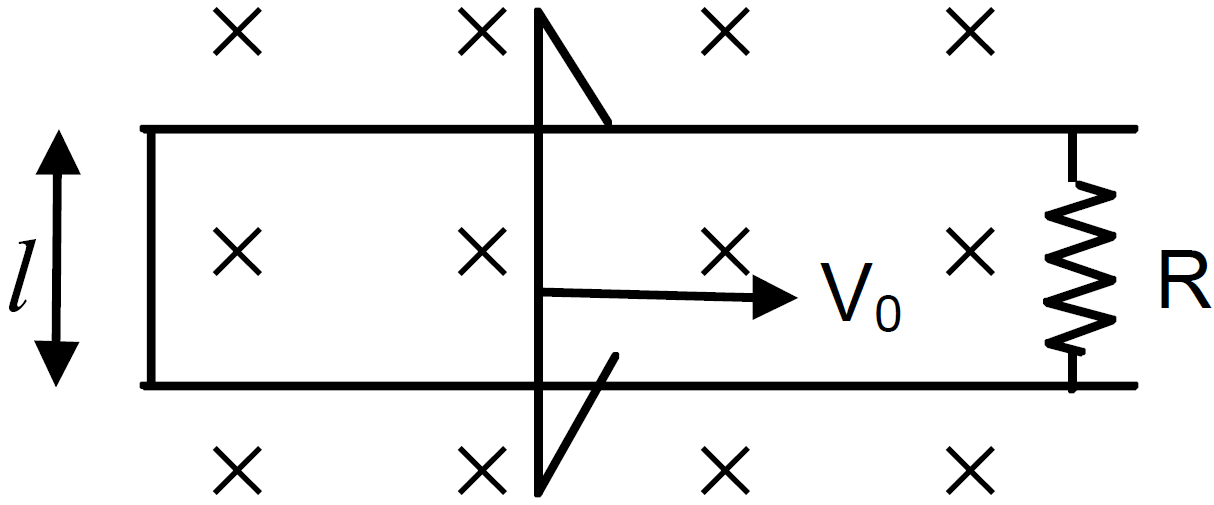
Consider the situation shown in figure. The wire PQ has mass m, resistance r and can slide on the smooth, horizontal parallel rails separated by a distance l. The resistance of the rails is negligible. A uniform magnetic field B exists in the rectangular region and a resistance R connects the rails outside the field region. At t = 0, the wire PQ is pushed towards right with a speed v0. Find

  1. The current in the loop at an instant when the speed of the wire PQ is v.
  2. The acceleration of the wire at this instant.
  3. The velocity vas a functions of x.
  4. The maximum distance the wire will move.

Answer

  1. When the speed is V

Emf = Blv

Resistance = r + r

Current $=\frac{\text{Blv}}{\text{r}+\text{R}}$

  1. Force acting on the wire =ilB

$=\frac{\text{BlvlB}}{\text{r}+\text{R}}=\frac{\text{B}^2\text{l}^2\text{v}}{\text{r}+\text{R}}$

Acceleration on the wire $=\frac{\text{B}^2\text{l}^2\text{v}}{\text{m}(\text{r}+\text{R})}$

  1. $\text{v}=\text{v}_0+\text{at}=\text{v}_0 -​​\frac{\text{B}^2\text{l}^2\text{v}}{\text{m}(\text{r}+\text{R})}\text{t}$ [force is opposite to velocity]

$=\text{v}_0 -​​\frac{\text{B}^2\text{l}^2\text{x}}{\text{m}(\text{r}+\text{R})}$

  1. $\text{a}=\text{v}\frac{\text{dv}}{\text{dx}}=​​\frac{\text{B}^2\text{l}^2\text{x}}{\text{m}(\text{r}+\text{R})}$

$\Rightarrow\text{dx}=\frac{\text{dvm}(\text{R}+\text{r})}{\text{B}^2\text{l}^2}$

$\Rightarrow\text{x}=\frac{\text{m}(\text{R}+\text{r})​​\text{v}_0}{\text{B}^2\text{l}^2}$

View full question & answer
Question 565 Marks
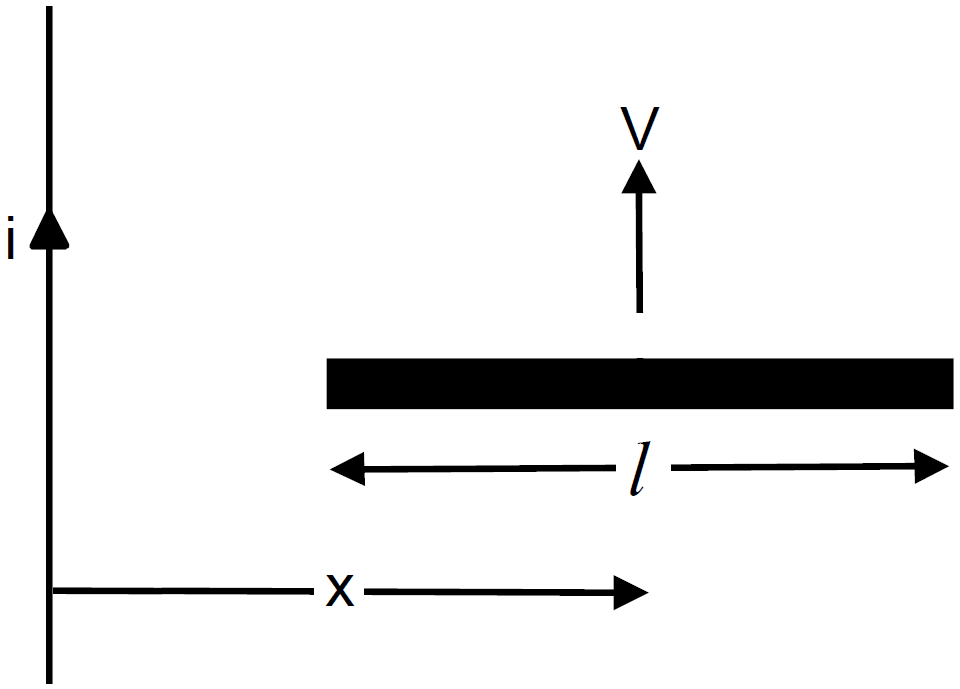
Figure shows a straight, long wire carrying a current i and a rod of length l coplanar with the wire and perpendicular to it. The rod moves with a constant velocity v in a direction parallel to the wire. The distance of the wire from the centre of the rod is x. Find motional emf induced in the rod.

Answer
In this case $\vec{\text{B}}$ varies
Hence considering a small element at centre of rod of length dx at a dist x from the wire.
$\vec{\text{B}}=\frac{\mu_0\text{i}}{2\pi\text{X}}$
so, $\text{de}=\frac{\mu_0\text{i}}{2\pi\text{x}}\times\text{vxdx}$
$\text{e}=\int\limits^\text{e}_0\text{de}=\frac{\mu_0\text{iv}}{2\pi}=\int\limits^{\text{x}+\frac{\text{t}}{2}}_{\text{x}-\frac{\text{t}}{2}}\frac{\text{dx}}{\text{x}}$
$=\frac{\mu_0\text{iv}}{2\pi}\bigg[\text{In}\Big(\text{x}+\frac{\text{l}}{2}\Big)\text{In}-\Big(\text{x}-\frac{\text{l}}{2}\Big)\bigg]$
$\frac{\mu_0\text{iv}}{2\pi}\text{In}\Bigg[\frac{\text{x}+\frac{\text{l}}{2}}{\text{x}-\frac{\text{l}}{2}}\Bigg]=\frac{\mu_0\text{iv}}{2\pi}\text{In}\Big(\frac{2\text{x}+\text{l}}{2\text{x}-\text{l}}\Big)$
View full question & answer
Question 575 Marks
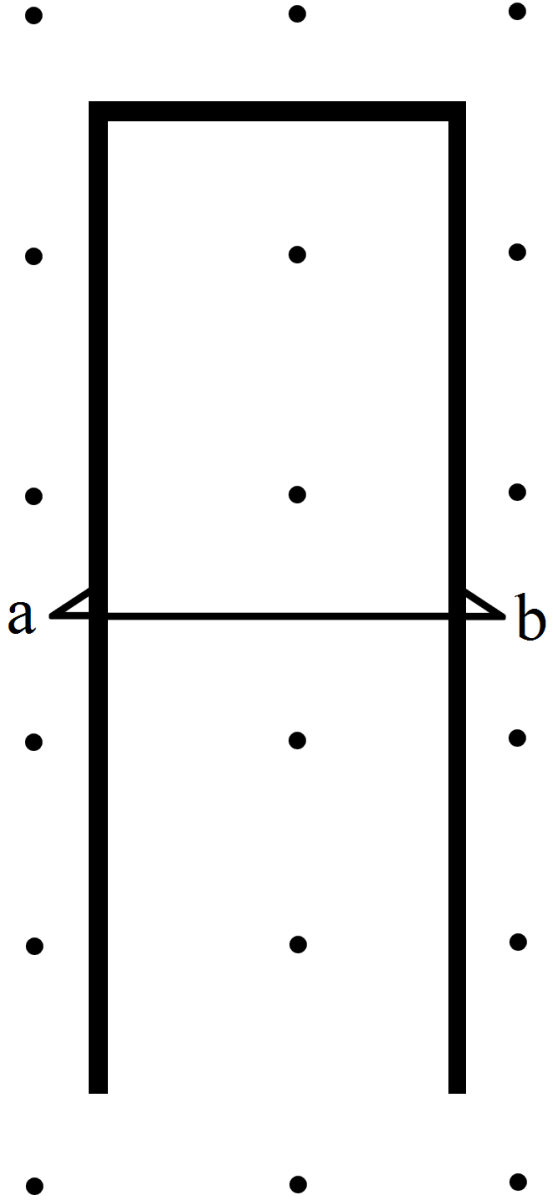
A conducting wire ab of length l, resistance r and mass m starts sliding at t = 0 down a smooth, vertical, thick pair of connected rails as shown in figure. A uniform magnetic field B exists in the space in a direction perpendicular to the plane of the rails.
  1. Write the induced emf in the loop at an instant t when the speed of the wire is v.
  2. What would be the magnitude and direction of the induced current in the wire?
  3. Find the downward acceleration of the wire at this instant.
  4. After sufficient time, the wire starts moving with a constant velocity. Find this velocity vm.
  5. Find the velocity of the wire as a function of time.
  6. Find the displacement of the wire as a function of time.
  7. Show that the rate of heat developed in the wire is equal to the rate at which the gravitational potential energy is decreased after steady state is reached.

Answer

  1. When the speed of wire is V

emf developed = BlV

  1. Induced current is the wire $=\frac{\text{Blv}}{\text{R}}$ (from b to a)
  2. Down ward acceleration of the wire

$=\frac{\text{mg}-\text{F}}{\text{m}}$ due to the current

$=\text{mg}-\text{il}\frac{\text{B}}{\text{m}}=\text{g}-\frac{\text{B}^2\text{l}^2\text{V}}{\text{Rm}}$

  1. Let the wire start moving with constant velocity. Then acceleration = 0

$\frac{\text{B}^2\text{l}^2\text{V}}{\text{Rm}}\text{m}=\text{g}$

$\Rightarrow\text{V}_\text{m}=\frac{\text{gRm}}{\text{B}^2\text{l}^2}$

  1. $\frac{\text{dV}}{\text{dt}}=\text{a}$

$\Rightarrow\frac{\text{dV}}{\text{dt}}=\frac{\text{mg}-\text{B}^2\text{l}^2\frac{\text{v}}{\text{R}}}{\text{m}}$

$\Rightarrow\frac{\text{dv}}{\frac{\text{mg}-\frac{\text{B}^2\text{l}^2\frac{\text{v}}{\text{R}}}{\text{R}}}{\text{m}}}=\text{dt}$

$\Rightarrow\int\limits_{0}^{\text{v}}\frac{\text{mdv}}{\text{mg}-\frac{\text{B}^2\text{l}^2\text{v}}{\text{R}}}=\int\limits_{0}^{\text{t}}\text{dt}$

$\Rightarrow\frac{\text{m}}{\frac{-\text{B}^2\text{l}^2}{\text{R}}}\Big(\log\text{mg}-\frac{\text{B}^2\text{l}^2\text{v}}{\text{R}}\Big)_{0}^{\text{v}}=\text{t}$

$\Rightarrow\frac{-\text{mR}}{\text{B}^2\text{l}^2}=\log\Big[\log\Big(\text{mg}-\frac{\text{B}^2\text{l}^2\text{v}}{\text{R}}\Big)-\log(\text{mg})\Big]=\text{t}$

$\Rightarrow\log\Bigg[\frac{\text{mg}-\frac{\text{B}^2\text{l}^2\text{v}}{\text{R}}}{\text{mg}}\Bigg]=\frac{-\text{tB}^2\text{l}^2}{\text{mR}}$

$\Rightarrow\log\Big[1-\frac{\text{B}^2\text{l}^2\text{v}}{\text{Rmg}}\Big]=\frac{-\text{tB}^2\text{l}^2}{\text{mR}}$

$\Rightarrow1-\frac{\text{B}^2\text{l}^2\text{v}}{\text{Rmg}}=\text{e}^{\frac{-\text{t}\text{B}^2\text{l}^2}{\text{mR}}}$

$\Rightarrow\bigg(1-\text{e}^{\frac{-\text{B}^2\text{l}^2}{\text{mR}}}\bigg)=\frac{\text{B}^2\text{l}^2\text{v}}{\text{Rmg}}$

$\Rightarrow\text{v}=\frac{\text{Rmg}}{\text{B}^2\text{l}^2}\Big(1-\text{e}^{-\frac{\text{B}^2\text{l}^2}{\text{mR}}}\Big)$

$\Rightarrow\text{v}=\text{v}_{\text{m}}\Big(1-\text{e}^{\frac{-\text{gt}}{\text{vm}}}\Big) \ \Big[\text{v}_\text{m}=\frac{\text{Rmg}}{\text{B}^2\text{l}^2}\Big]$

  1. $\frac{\text{ds}}{\text{dt}}=\text{v}\Rightarrow\text{ds}=\text{v} \ \text{dt}$

    $\Rightarrow\text{s}=\text{vm}\int\limits_0^\text{t}\Big(1-\text{e}^{\frac{-\text{gt}}{\text{vm}}}\Big)\text{dt}$

    $=\text{V}_\text{m}\Big(\text{t}-\frac{\text{V}_\text{m}}{\text{g}}\text{e}^\frac{\text{-gt}}{\text{vm}}\Big)=\Big(\text{V}_\text{m}\text{t}+\frac{\text{V}^2_\text{m}}{\text{g}}\text{e}^\frac{\text{-gt}}{\text{vm}}\Big)-\frac{\text{V}^2_\text{m}}{\text{g}}$

    $=\text{V}_\text{m}\text{t}-\frac{\text{V}^2_\text{m}}{\text{g}}\Big(1-\text{e}^\frac{\text{-gt}}{\text{vm}}\Big)$

  2. $\frac{\text{d}}{\text{dt}}=\text{mgs}=\text{mg}\frac{\text{ds}}{\text{dt}}=\text{mgV}_\text{m}\Big(1-\text{e}^\frac{\text{-gt}}{\text{vm}}\Big)$

$\frac{\text{d}_\text{H}}{\text{dt}}=\text{i}^2\text{R}=\text{R}\Big(\frac{\text{LBV}}{\text{R}}\Big)^2=\frac{\text{L}^2\text{B}^2\text{V}^2}{\text{R}}$

$\Rightarrow\frac{\text{L}^2\text{B}^2}{\text{R}}\text{V}^2_\text{m}\Big(1-\text{e}^\frac{\text{-gt}}{\text{vm}}\Big)^2$

After steady state i.e. $\text{T}\rightarrow\infty$

$\frac{\text{d}}{\text{dt}}\text{mgs}=\text{mgV}_\text{m}$

$\frac{\text{dH}}{\text{dt}}=\frac{\text{L}^2\text{B}^2}{\text{R}}\text{V}^2_\text{m}=\frac{\text{L}^2\text{B}^2}{\text{R}}\text{V}_\text{m}\frac{\text{mgR}}{\text{L}^2\text{B}^2}=\text{mgV}_\text{m}$

Hence after steady state $\frac{\text{dH}}{\text{dt}}=\frac{\text{d}}{\text{dt}}\text{mgs}$

View full question & answer
Question 585 Marks
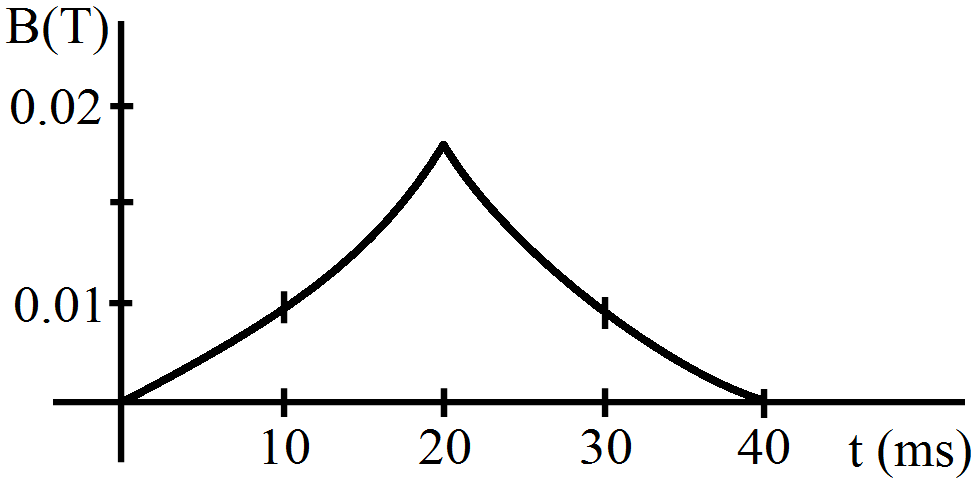
  1. The magnetic field in a region varies as shown in figure. Calculate the average induced emf in a conducting loop of area 2.0 × 10⁻³m2 placed perpendicular to the field in each of the 10ms intervals shown.
  2. In which intervals is the emf not constant? Neglect the behaviour near the ends of 10ms intervals.

Answer

  1. $\phi_2=\text{B}.\text{A}=0.01\times2\times10^{-3}=2\times10^{-5}$

$\phi_1=0$

$\text{e}=-\frac{\text{d}\phi}{\text{dt}}=\frac{-2\times10^{-5}}{10\times10^{-3}}=-2\text{mV}$

$\phi_3=\text{B}.\text{A}=0.03\times2\times10^{-3}=6\times10^{-5}$

$\text{d}\phi=4\times10^{-5}$

$\text{e}=-\frac{\text{d}\phi}{\text{dt}}=-4\text{mV}$

$\phi_4=\text{B}.\text{A}=0.01\times2\times10^{-3}=2\times10^{-5}$

$\text{d}\phi=-4\times10^{-5}$

$\text{e}=-\frac{\text{d}\phi}{\text{dt}}=4\text{mV}$

$\phi_5=\text{B}.\text{A}=0$

$\text{d}\phi=-2\times10^{-5}$

$\text{e}=-\frac{\text{d}\phi}{\text{dt}}=2\text{mV}$

  1. emf is not constant in case of → 10 - 20ms and 20 - 30ms as -4mV and 4mV.
View full question & answer
Question 595 Marks
An LR circuit with emf $\in$ is connected at t = 0.
  1. Find the charge Q which flows through the battery during 0 to t.
  2. Calculate the work done by the battery during this period.
  3. Find the heat developed during this period.
  4. Find the magnetic field energy stored in the circuit at time t.
  5. Verify that the results in the three parts above are consistent with energy conservation.
Answer
Emf = E LR circuit 

  1. $\text{dq}=\text{idt}$

$=\text{i}_0\Big(1-\text{e}^\frac{-\text{t}}{\tau}\Big)\text{dt} $

$=\text{i}_0\Big(1-\text{e}^{\text{-IR.L}}\Big)\text{dt} \ \Big[\therefore \ \tau=\frac{\text{L}}{\text{R}}\Big]$

$\text{Q}=\int\limits_\text{0}^\text{t}\text{dq}=\text{i}_0\Bigg[\int\limits_{0}^\text{t}\text{dt}-\int\limits_0^\text{t}\text{e}^\frac{\text{tR}}{\text{L}}\text{dt}\Bigg] $

$=\text{i}_0\Big[\text{t}\Big(\frac{-\text{L}}{\text{R}}\Big)\Big(\text{e}^\frac{-\text{IR}}{\text{L}}\Big)\text{t}_0\Big]$

$=\text{i}_0\Big[\text{t}-\frac{\text{L}}{\text{R}}\Big(1-\text{e}^\frac{-\text{IR}}{\text{L}}\Big)\Big] $

$\text{Q}=\frac{\text{E}}{\text{R}}\Big[\text{t}-\frac{\text{L}}{\text{R}}\Big(1-\text{e}^\frac{-\text{IR}}{\text{L}}\Big)\Big] $

  1.  Similarly as we know work done $=\text{Vl}=\text{El}$

$=\text{E}\text{ i}_0 \Big[\text{t}-\frac{\text{L}}{\text{R}}\Big(1-\text{e}^\frac{-\text{lR}}{\text{L}}\Big)\Big]$

$=\frac{\text{E}^2}{\text{R}}\Big[\text{t}-\frac{\text{L}}{\text{R}}\Big(1-\text{e}^\frac{-\text{lR}}{\text{L}}\Big)\Big]$

  1.  $\text{H}=\int\limits^\text{t}_0\text{i}^2\text{R}.\text{dt}=\frac{\text{E}^2}{\text{R}^2}.\text{R}.\int\limits^\text{t}_0\Big(1-\text{e}^\frac{-\text{tR}}{\text{L}}\Big)^2.\text{dt}$

$=\frac{\text{E}^2}{\text{R}}\int\limits^\text{t}_0\Big(1+\text{e}^\frac{\big(-2+\text{B}\big)}{\text{L}}-2\text{e}^\frac{-\text{tR}}{\text{L}}\Big).\text{dt}$

$=\frac{\text{E}^2}{\text{R}}\bigg(\text{t}-\frac{\text{L}}{2\text{R}}\text{e}^\frac{-2\text{tR}}{\text{L}}+\frac{2\text{L}}{\text{R}}.\text{e}^\frac{-\text{tR}}{\text{L}}\bigg)^\text{t}_0$

$=\frac{\text{E}^2}{\text{R}}\bigg(\text{t}-\frac{\text{L}}{-2\text{R}}\text{e}^\frac{-2\text{tR}}{\text{L}}+\frac{2\text{L}}{\text{R}}.\text{e}^\frac{-\text{tR}}{\text{L}}\bigg)-\bigg(-\frac{\text{L}}{2\text{R}}+\frac{2\text{L}}{\text{R}}\bigg)$

$=\frac{\text{E}^2}{\text{R}}\bigg[\bigg(\text{t}-\frac{\text{L}}{2\text{R}}\text{x}^2+\frac{2\text{L}}{\text{R}}.\text{x}\bigg)-\frac{3}{2}\frac{\text{L}}{\text{R}}\bigg]$

$=\frac{\text{E}^2}{2}\bigg(\text{t}-\frac{\text{L}}{2\text{R}}\big(\text{x}^2-4\text{x}+3\big)\bigg)$

  1.  $\text{E}=\frac{1}{2}\text{Li}^2$

$=\frac{1}{2}\text{L}.\frac{\text{E}^2}{\text{R}^2}.\Big(1-\text{e}^\frac{-\text{tR}}{\text{L}}\Big)^2$ $\bigg[\text{x}=\text{e}^\frac{-\text{tR}}{\text{L}}\bigg]$

$=\frac{\text{LE}^2}{2\text{R}^2}\Big(1-\text{x}\Big)^2$

  1.  Total energy used as heat as stored in magnetic field

$=\frac{\text{E}^2}{\text{R}}\text{T}-\frac{\text{E}^2}{\text{R}}.\frac{\text{L}}{2\text{R}}\text{x}^2+\frac{\text{E}^2}{\text{R}}\frac{\text{L}}{\text{r}}.4\text{x}^2$

$-\frac{3\text{L}}{2\text{R}}.\frac{\text{E}^2}{\text{R}}+\frac{\text{LE}^2}{2\text{R}^2}+\frac{\text{LE}^2}{2\text{R}^2}\text{x}^2-\frac{\text{LE}^2}{\text{R}^2}\text{x}$

$=\frac{\text{E}^2}{\text{R}}\text{t}+\frac{\text{E}^2\text{L}}{\text{R}^2}\text{x}-\frac{\text{LE}^2}{\text{R}^2}$

$=\frac{\text{E}^2}{\text{R}}\Big(\text{t}-\frac{\text{L}}{\text{R}}\big(1-\text{x}\big)\Big)$

= Energy drawn from battery

(Hence conservation of energy holds good).
View full question & answer
Question 605 Marks
 An inductor-coil of inductance 20mH having resistance $10\Omega$ is joined to an ideal battery of emf 5.0V. Find the rate of chenge of the induced emf at:
  1. t = 0
  2. t = 10ms
  3. t = 1.0s. 
Answer
$\text{L}=20\text{mH} ; \ \text{e}=5.0\text{V},\text{R}=10 \ \Omega$

$\tau=\frac{\text{L}}{\text{R}}=\frac{20\times10^{-3}}{10},\text{i}_0=\frac{5}{10}$

$\text{i}=\text{i}_0(1-\text{e}^{\frac{\text{t}}{\tau}})^2$

$\Rightarrow \ \text{i}=\text{i}_0-\text{i}_0\text{e}^{\frac{\text{-t}}{\tau^2}}$

$\Rightarrow\text{iR}=\text{i}_0\text{R}-\text{i}_0\text{R}\text{e}^{\frac{\text{-t}}{\tau^2}}$

  1. $10\times\frac{\text{di}}{\text{dt}}=\frac{\text{d}}{\text{dt}}\text{i}_0\text{R}+10\times\frac{5}{10}\times\frac{10}{20\times10^{-3}}\times\text{e}^{0\times\frac{10}{2\times10^{-2}}}$

$\frac{5}{2}\times10^{-3}\times1=\frac{5000}{2}=2500=2.5\times10^{-3}\text{V}/\text{s}.$

  1. $\frac{\text{Rdi}}{\text{dt}}=\text{R}\times\text{i}^0\times\frac{1}{\tau}\times\text{e}^{\frac{\text{-t}}{\tau}}$

$\text{t}=10\text{ms}=10\times10^{-3}\text{s}$

$\frac{\text{dE}}{\text{dt}}=10\times\frac{5}{10}\times\frac{10}{20\times10^{-3}}\times\text{e}^{-0.01\times\frac{2}{10^{-2}}}$

$=16.844=17\text{V}/'$

  1. $\text{For} \ \text{t} =1\text{s}$

$\frac{\text{dE}}{\text{dt}}=\frac{\text{Rdi}}{\text{dt}}=\frac{5}{2}10^3\times\text{e}^{\frac{10}{2\times10^{-2}}}=0.00\text{V}/\text{s}.$

View full question & answer