Questions · Page 3 of 9

M.C.Q (1 Marks)

Question 1011 Mark

A sinusoidal voltage of peak value 200 volt is connected to a diode and resistor R in the circuit shown so that half wave rectification occurs. If the forward resistance of the diode is negligible compared to R the rms voltage (in volt) across R is approximately
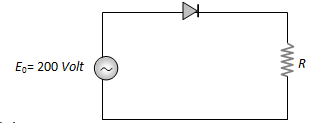
(a) 200

(b) 100

(c)  

(d) 280

Answer

(b) 100
View full question & answer
Question 1021 Mark

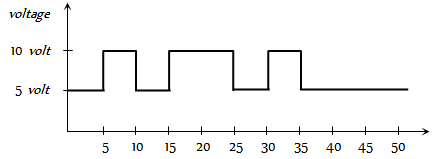
In a negative logic the following wave form corresponds to the

(a) 0000000000

(b) 0101101000

(c) 1111111111

(d) 1010010111

Answer

(d) 1010010111

View full question & answer
Question 1031 Mark

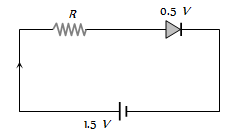
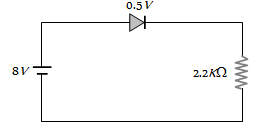
The diode used in the circuit shown in the figure has a constant voltage drop of 0.5 V at all currents and a maximum power rating of 100 milliwatts. What should be the value of the resistor R, connected in series with the diode for obtaining maximum current

(a) 1.5 W

(b) 5 W

(c) 6.67 W

(d) 200 W

Answer

(b) 5 W

View full question & answer
Question 1041 Mark

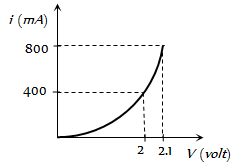
The i-V characteristic of a P-N junction diode is shown below. The approximate dynamic resistance of the P-N junction when a forward bias of 2volt is applied

(a)  1 W

(b)  0.25 W

(c)  0.5 W

(d)  5 W

Answer

(b)  0.25 W

View full question & answer
Question 1051 Mark

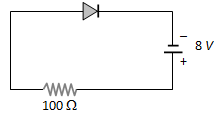
A source voltage of 8V drives the diode in fig. through a current-limiting resistor of 100 ohm. Then the magnitude of the slope load line on the V-I characteristics of the diode is

(a)  0.01

(b) 100

(c) 0.08

(d) 12.5

Answer

(a)  0.01

View full question & answer
Question 1061 Mark

The  relation between dynamic plate resistance (r) of  a vacuum diode and plate current in the space charge limited region, is

(a)  

(b)

(c)

(d)  

Answer

(d)  

View full question & answer
Question 1071 Mark

In NPN transistor, 1010 electrons enters in emitter region in 10–6 sec. If 2% electrons are lost in base region then collector current and current amplification factor (b) respectively are

(a) 1.57 mA, 49

(b) 1.92 mA, 70

(c) 2 mA, 25

(d) 2.25 mA, 100

Answer

(a) 1.57 mA, 49

View full question & answer
Question 1081 Mark

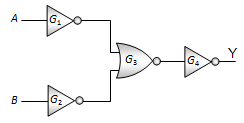
The combination of gates shown below produces

(a) AND gate

(b) XOR gate

(c) NOR gate

(d) NAND gate 

Answer

(d) NAND gate 

View full question & answer
Question 1091 Mark

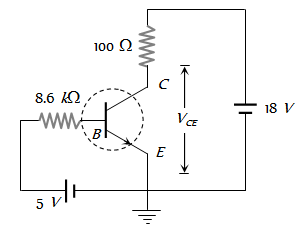
For the transistor circuit shown below, if b = 100, voltage drop between emitter and base is 0.7 V then value of VCE will be

(a) 10 V

(b) 5 V

(c) 13 V 

(d) 0 V

Answer

(c) 13 V 

View full question & answer
Question 1101 Mark

The contribution in the total current flowing through a semiconductor due to electrons and holes are   and   respectively. If the drift velocity of electrons is   times that of holes at this temperature, then the ratio of concentration of electrons and holes is

(a) 6 : 5

(b) 5 : 6

(c) 3 : 2

(d) 2 : 3

Answer

(a) 6 : 5

View full question & answer
Question 1111 Mark

A potential difference of 2V is applied between the opposite faces of a Ge crystal plate of area 1 cm2 and thickness 0.5 mm. If the concentration of electrons in Ge is 2 × 10¹⁹/m3 and mobilities of electrons and holes are 0.36   and 0.14   respectively, then the current flowing through the plate will be

(a) 0.25 A

(b) 0.45 A

(c) 0.56 A 

(d) 0.64 A

Answer

(d) 0.64 A

View full question & answer
Question 1121 Mark

The plate current ip in a triode valve is given   where ip is in milliampere and Vp and Vg are in volt. If rp = 104 ohm, and , then for   and , what is the value of K and grid cut off voltage

(a) – 6V, (30)3/2

(b) -6 V,

(c) + 6V, (30)3/2

(d) + 6V, (1/30)3/2

Answer

(b) -6 V,

View full question & answer
Question 1141 Mark

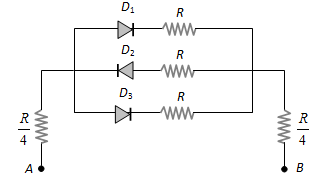
In the following circuits PN-junction diodes D1, D2 and D3 are ideal for the following potential of A and B, the correct increasing order of resistance between A and B will be

(i) – 10 V, – 5V (ii)  – 5V, – 10 V   (iii) – 4V, – 12V


(a) (i) < (ii) < (iii)

(b) (iii) < (ii) < (i)

(c) (ii) = (iii) < (i)

(d) (i) = (iii) < (ii)

Answer

(b) (iii) < (ii) < (i)

View full question & answer
Question 1151 Mark

The Bohr radius of the fifth electron of phosphorus (atomic number = 15) acting as dopant in silicon (relative dielectric constant = 12) is

(a) 10.6 Å

(b) 0.53 Å

(c) 21.2 Å                                           

(d) None of these

Answer

(a) 10.6 Å

View full question & answer
Question 1161 Mark

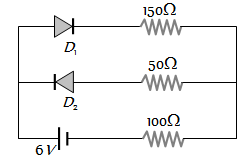
The circuit shown in following figure contains two diode D1 and D2 each with a forward resistance of 50 ohms and with infinite backward resistance. If the battery voltage is 6 V, the current through the 100 ohm resistance (in amperes) is

(a) Zero

(b) 0.02

(c) 0.03

(d) 0.036

Answer

(b) 0.02

View full question & answer
Question 1171 Mark

A transistor is used as an amplifier in CB mode with a load resistance of 5 k W the current gain of amplifier is 0.98 and the input resistance is 70 W, the voltage gain and power gain respectively are

(a) 70, 68.6

(b) 80, 75.6

(c) 60, 66.6

(d) 90, 96.6

Answer

(a) 70, 68.6

View full question & answer
Question 1181 Mark

The peak voltage in the output of a half-wave diode rectifier fed with a sinusoidal signal without filter is 10 V. The dc component of the output voltage is

(a) 10/ 

(b) 10/p V

(c) 10 V   

(d) 20/p V

Answer

(b) 10/p V

View full question & answer
Question 1191 Mark

The grid in a triode valve is used

(a) To increases the thermionic emission

(b) To control the plate to cathode current

(c) To reduce the inter-electrode capacity

(d) To keep cathode at constant potential

Answer

(b) To control the plate to cathode current

View full question & answer
Question 1211 Mark

A P-type semiconductor has acceptor levels 57 meV above the valence band. The maximum wavelength of light required to create a hole is (Planck’s constant h = 6.6  J-s)

(a) 57  

(b) 57  

(c) 217100

(d) 11.61  

Answer

(c) 217100

View full question & answer
Question 1221 Mark

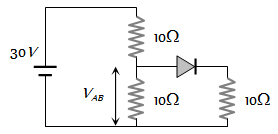
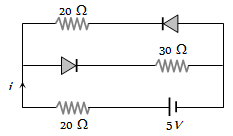
In the circuit, if the forward voltage drop for the diode is 0.5V, the current will be

(a) 3.4 mA

(b) 2 mA

(c) 2.5 mA

(d) 3 mA

Answer

(a) 3.4 mA

View full question & answer
Question 1231 Mark

The typical ionisation energy of a donor in silicon is

(a) 10.0 eV

(b) 1.0eV

(c) 0.1 eV

(d) 0.001 eV

Answer

(c) 0.1 eV

View full question & answer
Question 1241 Mark

The probability of electrons to be found in the conduction band of an intrinsic semiconductor at a finite temperature

(a) Decreases exponentially with increasing band gap

(b) Increases exponentially with increasing band gap

(c) Decreases with increasing temperature

(d) Is independent of the temperature and the band gap

Answer

(a) Decreases exponentially with increasing band gap

View full question & answer
Question 1251 Mark

A silicon speciman is made into a P-type semi-conductor by dopping, on an average, one Indium atom per 5  silicon atoms. If the number density of atoms in the silicon specimen is 5   then the number of acceptor atoms in silicon per cubic centimetre will be

(a) 2.5

(b) 1.0  

(c) 1.0  

(d) 2.5  

Answer

(c) 1.0  

View full question & answer
Question 1261 Mark

Select the correct statement

(a) In a full wave rectifier, two diodes work alternately

(b) In a full wave rectifier, two diodes work simultaneously

(c) The efficiency of full wave and half wave rectifiers is same

(d) The full wave rectifier is bi-directional

Answer

(a) In a full wave rectifier, two diodes work alternately

View full question & answer
Question 1271 Mark

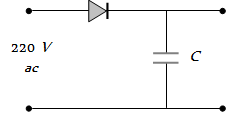
A diode is connected to 220 V (rms) ac in series with a capacitor as shown in figure. The voltage across the capacitor is

(a) 220 V

(b) 110 V

(c) 311.1 V

(d)  

Answer

(d)  

View full question & answer
Question 1281 Mark

The current in a triode at anode potential 100 V and grid potential – 1.2 V is 7.5 mA. If grid potential is changed to – 2.2 V, the current becomes 5.5 mA. the value of trans conductance (gm) will be

(a) 2 mili mho

(b) 3 mili mho

(c) 4 mili mho

(d) 0.2 mili mho

Answer

(a) 2 mili mho

View full question & answer
Question 1291 Mark

Plate voltage of a triode is increased from 200 V to 225 V. To maintain the plate current, change in grid voltage from 5V to 5.75 V is needed. The amplification factor is

(a) 40

(b) 45

(c) 33.3

(d) 25

Answer

(c) 33.3

View full question & answer
Question 1301 Mark

The plate resistance of a triode is 2.5 × 10⁴ W and mutual conductance is 2 × 10⁻³ mho. What will be the value of amplification factor

(a) 50

(b) 1.25 × 10⁷

(c) 75       

(d) 2.25 × 10⁷

Answer

(a) 50

View full question & answer
Question 1311 Mark

In a diode valve the cathode temperature must be (f = work function)

(a) High and  should be high

(b) High and should be low

(c) Low and should be high

(d) Low and should be high

Answer

(b) High and should be low

View full question & answer
Question 1321 Mark

The ripple factor in a half wave rectifier is

(a) 1.21

(b) 0.48

(c) 0.6

(d) None of these

Answer

(a) 1.21

View full question & answer
Question 1331 Mark

The transconductance of a triode amplifier is 2.5 mili mho having plate resistance of 20 KW, amplification 10. Find the load resistance

(a) 5 kW  

(b) 25 kW

(c) 20 kW

(d) 50 kW

Answer

(a) 5 kW  

View full question & answer
Question 1341 Mark

The slope of plate characteristic of a vacuum diode is  2   The plate resistance of diode will be

(a) 50 W

(b) 50 kW

(c) 500 kW

(d) 500 kW

Answer

(b) 50 kW

View full question & answer
Question 1351 Mark

The amplification factor of a triode is 50. If the grid potential is decreased by 0.20 V, what increase in plate potential will keep the plate current unchanged

(a) 5 V

(b) 10 V

(c) 0.2 V

(d) 50 V

Answer

(b) 10 V

View full question & answer
Question 1361 Mark

The thermionic emission of electron is due to

(a) Electromagnetic field

(b) Electrostatic field

(c) High temperature

(d) Photoelectric effect

Answer

(c) High temperature

View full question & answer
Question 1371 Mark

In a triode valve the amplification factor is 20 and mutual conductance is 10–3 mho. The plate resistance is

(a) 2 × 10³ W

(b) 4 × 10³ W

(c) 2 ×10⁴ W

(d) 2 ×10⁴ W

Answer

(c) 2 ×10⁴ W

View full question & answer
Question 1381 Mark

The voltage gain of a triode depends upon

(a) Filament voltage

(b) Plate voltage

(c) Plate resistance

(d) Plate current

Answer

(c) Plate resistance

View full question & answer
Question 1391 Mark

The electrical circuits used to get smooth d.c. output from a rectifier circuit is called

(a) Filter

(b) Amplifier

(c) Full wave rectifier

(d) Oscillator

Answer

(b) Amplifier

View full question & answer
Question 1401 Mark

For a given triode μ = 20. The load resistance is 1.5 times the anode resistance. The maximum gain will be

(a) 16

(b) 12

(c) 10       

(d) None of the above

Answer

(b) 12

View full question & answer
Question 1421 Mark

Plate resistance of two triode valves is 2 KW and 4 KW, amplification factor of each of the valves is 40. The ratio of voltage amplification, when used with 4 KW load resistance, will be

(a) 10  

(b)  

(c)   

(d)  

Answer

(c)   

View full question & answer
Question 1431 Mark

In a diode valve, the state of saturation can be obtained easily by

(a) High plate voltage and high filament current

(b) Low filament current and high plate voltage

(c) Low plate voltage and high cathode temperature

(d) High filament current and high plate voltage

Answer

(b) Low filament current and high plate voltage

View full question & answer
Question 1441 Mark

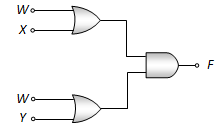
The diagram of a logic circuit is given below. The output F of the circuit is represented by

(a) W.(X + Y)

(b) W.(X.Y)

(c) W + (X.Y)

(d) W + (X + Y)

Answer

(c) W + (X.Y)

View full question & answer
Question 1461 Mark

Coating of strontium oxide on Tungsten cathode in a valve is good for thermionic emission because

(a) Work function decreases

(b) Work function increases

(c) Conductivity of cathode increases

(d) Cathode can be heated to high temperature

Answer

(a) Work function decreases

View full question & answer
Question 1471 Mark

The introduction of a grid in a triode valve affects plate current by

(a) Making the thermionic emission easier at low temperature

(b) Releasing more electrons from the plate

(c) By increasing plate voltage

(d) By neutralising space charge

Answer

(d) By neutralising space charge

View full question & answer
Question 1481 Mark

With a change of load resistance of a triode, used as an amplifier, from 50 kilo ohms to 100 kilo ohms, its voltage amplification changes from 25 to 30. Plate resistance of the triode is

(a) 25 kW

(b) 75 kW

(c) 7.5 kW

(d) 2.5 kW

Answer

(a) 25 kW

View full question & answer
Question 1491 Mark

The unit of mutual conductance of a triode valve is

(a) Siemen

(b) Ohm

(c) Ohm metre

(d) Joule Coulomb–1

Answer

(a) Siemen

View full question & answer
Question 1501 Mark

The triode constant is out of the following

(a) Plate resistance

(b) Amplification factor

(c) Mutual conductance

(d) All the above

Answer

(d) All the above

View full question & answer