Questions · Page 4 of 9

M.C.Q (1 Marks)

Question 1511 Mark

If the amplification factor of a triode (m) is 22 and its plate resistance is 6600 ohm, then the mutual conductance of this valve is mho is

(a)     
(b) 25  

(c)

(d)  

Answer

(a)     

View full question & answer
Question 1521 Mark

In the circuit of a triode valve, there is no change in the plate current, when the plate potential is increased from 200 volt to 220 volt and the grid potential is decreased from – 0.5 volt to –1.3 volt. The amplification factor of this valve is

(a) 15

(b) 20

(c) 25 

(d) 35

Answer

(c) 25 

View full question & answer
Question 1531 Mark

 electrons reach the anode per second. If the power consumed is 448 milliwatts, then the plate (anode) voltage is

(a) 150 V

(b) 200V

(c) 14 × 448 V

(d) 448/14V

Answer

(b) 200V

View full question & answer
Question 1541 Mark

The slope of plate characteristic of a vacuum tube diode for certain operating point on the curve is   The plate resistance of the diode and its nature respectively

(a) 100 kilo-ohms static

(b) 1000 kilo-ohms static

(c) 1000 kilo-ohms dynamic

(d) 100 kilo-ohms dynamic

Answer

(b) 1000 kilo-ohms static

View full question & answer
Question 1551 Mark

The amplification factor of a triode valve is 15. If the grid voltage is changed by 0.3 volt the change in plate voltage in order to keep the plate current constant (in volt) is

(a) 0.02

(b) 0.002

(c) 4.5

(d) 5.0

Answer

(c) 4.5

View full question & answer
Question 1561 Mark

In a triode valve

(a) If the grid voltage is zero then plate current will be zero

(b) If the temperature of filament is doubled, then the thermionic current will also be doubled

(c) If the temperature of filament is doubled, then the thermionic current will nearly be four times

(d) At a definite grid voltage the plate current varies with plate voltage according to Ohm’s law

Answer

(c) If the temperature of filament is doubled, then the thermionic current will nearly be four times

View full question & answer
Question 1571 Mark

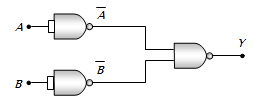
The combination of the gates shown in the figure below produces

(a) NOR gate

(b) OR gate

(c) AND gate

(d) XOR gate

Answer

(b) OR gate

View full question & answer
Question 1581 Mark

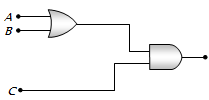
To get an output 1 from the circuit shown in the figure, the input must be

(a) A = 0, B = 1, C = 0

(b) A = 1, B = 0,  C = 0

(c) A = 1, B = 0, C = 1

(d) A = 1, B = 1, C = 0

Answer

(c) A = 1, B = 0, C = 1

View full question & answer
Question 1591 Mark

In a triode amplifier, the value of maximum gain is equal to

(a) Half the amplification factor      

(b) Amplification factor

(c) Twice the amplification factor

(d) Infinity

Answer

(b) Amplification factor

View full question & answer
Question 1601 Mark

In an experiment, the saturation in the plate current in a diode is observed at 240V. But a student still wants to increase the plate current. It can be done, if

(a) The plate voltage is increased further

(b) The plate voltage is decreased

(c) The filament current is decreased

(d) The filament current is increased

Answer

(d) The filament current is increased

View full question & answer
Question 1611 Mark

The amplification produced by a triode is due to the action of

(a) Filament

(b) Cathode

(c) Grid   

(d) Plate

Answer

(c) Grid   

View full question & answer
Question 1621 Mark

For a triode   kilo ohm and  milli mho. If the load resistance is double of plate resistance, then the value of voltage gain will be

(a) 10

(b) 20

(c) 15       

(d) 30

Answer

(b) 20

View full question & answer
Question 1631 Mark

The amplification factor of a triode is 20. If the grid potential is reduced by 0.2 volt then to keep the plate current constant its plate voltage is to be increased by

(a) 10 volt

(b) 4 volt

(c) 40 volt

(d) 100 volt

Answer

(b) 4 volt

View full question & answer
Question 1641 Mark

In a triode amplifier,  kilo ohm and load resistance   kilo ohm. If the input signal voltage is 0.5 volt, then output signal voltage will be

(a) 1.25 volt

(b) 5 volt

(c) 2.5 volt

(d) 10 volt

Answer

(c) 2.5 volt

View full question & answer
Question 1651 Mark

The amplification factor of a triode is 20 and trans-conductance is 3 milli mho and load resistance 3   then the voltage gain is

(a) 16.36 

(b) 28

(c) 78       

(d) 108

Answer

(a) 16.36 

View full question & answer
Question 1661 Mark

Following is the relation between current and charge   then value of VL will be

(a)  

(b)  

(c)   

(d)  

Answer

(c)   

View full question & answer
Question 1671 Mark

In an amplifier the load resistance   is equal to the plate resistance (. The voltage amplification is equal to

(a) μ

(b) 2 μ

(c) μ/2

(d) μ/4

Answer

(c) μ/2

View full question & answer
Question 1681 Mark

Number of secondary electrons emitted per number of primary electrons depends on

(a) Material of target

(b) Frequency of primary electrons

(c) Intensity

(d) None of the above

Answer

(c) Intensity

View full question & answer
Question 1691 Mark

Thermionic emission from a heated filament varies with its temperature T as

(a)  

(b) T

(c)  

(d)  

Answer

(c)  

View full question & answer
Question 1701 Mark

Which of the following logic gate is an universal gate

(a) OR

(b) NOT

(c) AND

(d) NOR

Answer

(d) NOR

View full question & answer
Question 1721 Mark

The output of OR gate is 1

(a) If both inputs are zero

(b) If either or both inputs are 1

(c) Only if both input are 1

(d) If either input is zero

Answer

(b) If either or both inputs are 1

View full question & answer
Question 1731 Mark

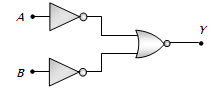
Which logic gate is represented by the following combination of logic gates

(a) OR

(b) NAND

(c) AND

(d) NOR

Answer

(c) AND

View full question & answer
Question 1741 Mark

A gate in which all the inputs must be low to get a high output is called

(a) A NAND gate

(b) An inverter

(c) A NOR gate

(d) An AND gate

Answer

(b) An inverter

View full question & answer
Question 1751 Mark

The output of a NAND gate is 0

(a) If both inputs are 0

(b) If one input is 0 and the other input is 1

(c) If both inputs are 1

(d) Either if both inputs are 1 or if one of the inputs is 1 and the other 0

Answer

(c) If both inputs are 1

View full question & answer
Question 1761 Mark

If A and B are two inputs in AND gate, then AND gate has an output of 1 when the values of A and B are

(a) A = 0, B = 0

(b) A = 1, B = 1

(c) A = 1, B = 0

(d) A = 0, B = 1

Answer

(b) A = 1, B = 1

View full question & answer
Question 1771 Mark

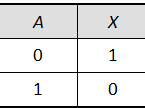
The given truth table is of

(a) OR gate

(b) AND gate

(c) NOT gate

(d) None of above

Answer

(c) NOT gate

View full question & answer
Question 1791 Mark

A gate has the following truth table

P

1

1

0

0

Q

1

0

1

0

R

1

0

0

0

The gate is

(a) NOR  

(b) OR

(c) NAND  

(d) AND

Answer

(d) AND

View full question & answer
Question 1801 Mark

A logic gate is an electronic circuit which

(a) Makes logic decisions

(b) Allows electrons flow only in one direction

(c) Works binary algebra

(d) Alternates between 0 and 1 values

Answer

(a) Makes logic decisions

View full question & answer
Question 1811 Mark

The logic behind ‘NOR’ gate is that it gives

(a) High output when both the inputs are low

(b) Low output when both the inputs are low

(c) High output when both the inputs are high

(d) None of these

Answer

(a) High output when both the inputs are low

View full question & answer
Question 1821 Mark

Boolean algebra is essentially based on

(a) Truth

(b) Logic 

(c) Symbol

(d) Numbers

Answer

(b) Logic 

View full question & answer
Question 1831 Mark

A truth table is given below. Which of the following has this type of truth table

A

0

1

0

1

B

0

0

1

1

y

1

0

0

0


(a) XOR gate

(b) NOR gate

(c) AND gate

(d) OR gate

Answer

(b) NOR gate

View full question & answer
Question 1841 Mark

In a transistor in CE configuration, the ratio of power gain to voltage gain is

(a) a        

(b) b / a

(c) ba

(d) b

Answer

(d) b

View full question & answer
Question 1851 Mark

NPN transistor are preferred to PNP transistor because they have

(a) Low cost

(b) Low dissipation energy

(c) Capability of handing large power

(d) Electrons having high mobility than holes

Answer

(d) Electrons having high mobility than holes

View full question & answer
Question 1861 Mark

Consider an NPN transistor amplifier in common-emitter configuration. The current gain of the transistor is 100. If the collector current changes by 1 mA, what will be the change in emitter current

(a) 1.1 mA

(b) 1.01 mA

(c) 0.01 mA

(d) 10 mA

Answer

(b) 1.01 mA

View full question & answer
Question 1871 Mark

While a collector to emitter voltage is constant in a transistor, the collector current changes by 8.2 mA when the emitter current changes by 8.3 mA. The value of forward current ratio hfe is

(a) 82

(b) 83

(c) 8.2

(d) 8.3

Answer

(a) 82

View full question & answer
Question 1881 Mark

Which of the following is used to produce radio waves of constant amplitude

(a) Oscillator

(b) FET

(c) Rectifier

(d) Amplifier

Answer

(a) Oscillator

View full question & answer
Question 1891 Mark

In an NPN transistor circuit, the collector current is 10 mA. If 90% of the electrons emitted reach the collector, the emitter current (iE) and base current (iB) are given by

(a) iE = – 1 mA, iB = 9 mA

(b) iE = 9 mA, iB = – 1 mA

(c) iE = 1 mA, iB = 11 mA

(d) iE = 11 mA, iB = 1 mA

Answer

(d) iE = 11 mA, iB = 1 mA

View full question & answer
Question 1901 Mark

In NPN transistor the collector current is 10 mA. If 90% of electrons emitted reach the collector, then

(a) Emitter current will be 9 mA

(b) Emitter current will be 11.1 mA

(c) Base current will be 0.1 mA

(d) Base current will be 0.01 mA

Answer

(b) Emitter current will be 11.1 mA

View full question & answer
Question 1911 Mark

If  are the lengths of the emitter, base and collector of a transistor then

(a)  

(b)  

(c)  

(d)  

Answer

(d)  

View full question & answer
Question 1921 Mark

When NPN transistor is used as an amplifier

(a) Electrons move from base to emitter

(b) Electrons move from emitter to base

(c) Electrons moves from base to emitter

(d) Holes moves from base to emitter

Answer

(b) Electrons move from emitter to base

View full question & answer
Question 1941 Mark

In case of NPN-transistors the collector current is always less than the emitter current because

(a) Collector side is reverse biased and emitter side is forward biased

(b) After electrons are lost in the base and only remaining ones reach the collector

(c) Collector side is forward biased and emitter side is reverse biased

(d) Collector being reverse biased attracts less electrons

Answer

(b) After electrons are lost in the base and only remaining ones reach the collector

View full question & answer
Question 1951 Mark

In a common base amplifier circuit, calculate the change in base current if that in the emitter current is 2 mA and a = 0.98

(a) 0.04 mA

(b) 1.96 mA

(c) 0.98 mA

(d) 2 mA

Answer

(a) 0.04 mA

View full question & answer
Question 1961 Mark

For a transistor, the current amplification factor is 0.8. The transistor is connected in common emitter configuration. The change in the collector current when the base current changes by 6 mA is

(a) 6 mA

(b) 4.8 mA

(c) 24 mA

(d) 8 mA

Answer

(c) 24 mA

View full question & answer
Question 1971 Mark

The part of a transistor which is heavily doped to produce a large number of majority carriers, is

(a) Base

(b) Emitter

(c) Collector

(d) None of these

Answer

(b) Emitter

View full question & answer
Question 1981 Mark

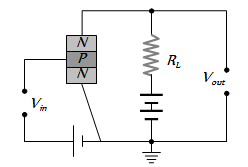
An NPN-transistor circuit is arranged as shown in figure. It is

(a) A common base amplifier circuit

(b) A common emitter amplifier circuit

(c) A common collector amplifier circuit

(d) Neither of the above

Answer

(b) A common emitter amplifier circuit

View full question & answer
Question 1991 Mark

The most commonly used material for making transistor is

(a) Copper

(b) Silicon

(c) Ebonite

(d) Silver

Answer

(b) Silicon

View full question & answer
Question 2001 Mark

In a PNP transistor the base is the N-region. Its width relative to the P-region is

(a) Smaller

(b) Larger

(c) Same 

(d) Not related

Answer

(a) Smaller

View full question & answer