Questions · Page 2 of 2

2 Marks Questions

Question 512 Marks
A point charge Q is placed at the origin. Find the electrostatic energy stored outside the sphere of radius R centred at the origin.
Answer
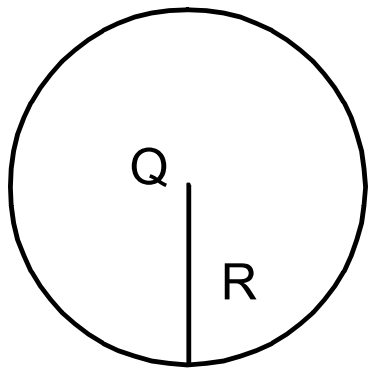
Charge = Q

Radius of sphere = R

$\therefore$ Capacitance of the sphere $=\text{C}=4\pi\in_0\text{R}$

Energy $=\frac{1}{2}\frac{\text{Q}^2}{\text{C}}=\frac{1}{2}\frac{\text{Q}^2}{4\pi\in_0\text{R}}=\frac{\text{Q}^2}{8\pi\in_0\text{R}}$
View full question & answer
Question 522 Marks
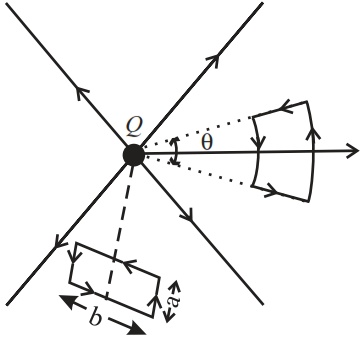
A test charge q is made to move in the electric field of a point charge Q along two different closed paths Fig. First path has sections along and perpendicular to lines of electric field. Second path is a rectangular loop of the same area as the first loop. How does the work done compare in the two cases?

Answer
Work done will be zero in both the cases.
Explanation: The electrostatic field is conservative, and in this field work done by electric force on the charge in a closed loop is zero. In this question both are closed paths, hence the work done in both the cases will be zero.
View full question & answer
Question 532 Marks
How does the electric field inside a dielectric decrease when it is placed in an external electric field?
Answer
When a dielectric is placed in an external electric field, the charges are induced on the faces of dielectric which produce opposite electric field in the dielectric. Thus net electric field inside the dielectric is reduced.
View full question & answer
Question 542 Marks
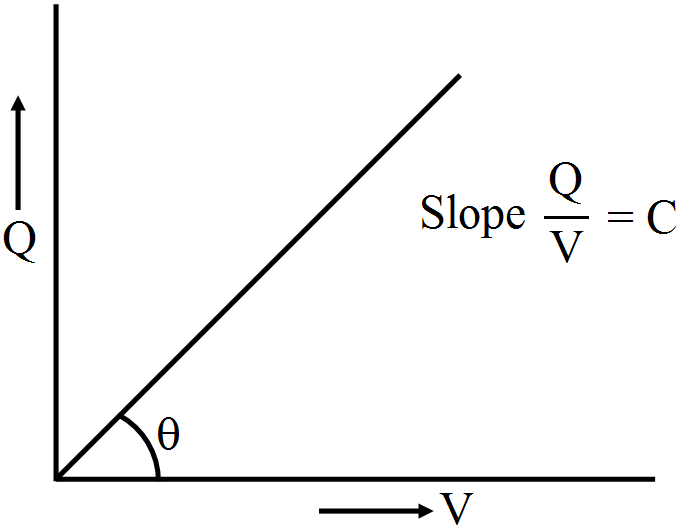
Sketch graph to show how charge Q given to a capacitor of capacitance C varies with the potential difference.
Answer
The graph of charge (Q) versus potential difference (V) is a straight line whose slope is equal to capacitance ‘C’.

View full question & answer
Question 552 Marks
Can there be a potential difference between two adjacent conductors carrying the same charge?
Answer
In a uniform electric field, free electrons move opposite to the direction of electric field.
As the electric field is always direct from higher potential to lower travel so, electrons move from lower potential to higher potential.
View full question & answer
Question 562 Marks
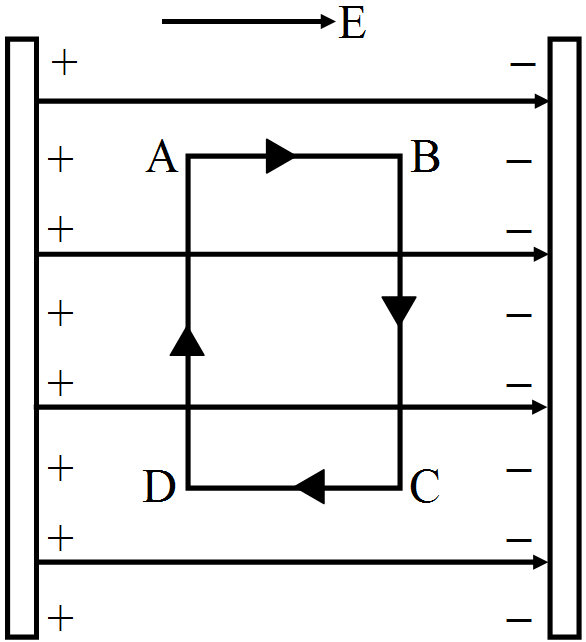
A uniform electric field exists between two charged plates as shown in the fig. What should be the work done in moving a charge q along the closed rectangular path ABCDA?

Answer
Work done in an electric field is independent of the path and depends only on the initial and final positions.
Here initial and final points are coincident,
Work = q × (Vfinal - Vinitial)
= q(VA - VA)
So, net work done is zero.
View full question & answer
Question 572 Marks
Can the potential function have a maximum or minimum in free space?
Answer
No, the potential function does not have a maximum or minimum in free space, it is because the absence of atmosphere around conductor prevents the phenomenon of electric discharge or potential leakage.
View full question & answer
Question 582 Marks
Two protons are brought nearer; what will be the effect on potential energy of system?
Answer
A repulsive force acts between protons, if they are brought nearer, work must be done by external force; hence the potential energy of system increases.
View full question & answer
Question 592 Marks
A point charge is taken from a point A to a point B in an electric field. Does the work done by the electric field depend on the path of the charge?
Answer
Electrostatic field is a conservative field. Therefore, work done by the electric field does not depend on the path followed by the charge. It only depends on the position of the charge, from which and to which the charge has been moved.
View full question & answer
Question 602 Marks
An electric field $\vec{\text{E}}=(\vec{\text{i}}20+\vec{\text{j}}30)\text{N}\text{C}^{-1}$ exists in the space. If the potential at the origin is taken to be zero, find the potential at (2m, 2m).
Answer
$\text{E}=\big(\hat{\text{i}}120+\hat{\text{j}}\big)\text{N/CV}$

$=\text{at}(2\text{m},2\text{m})\text{r}=(2\text{i}+2\text{j})$

So, $\text{V}=-\vec{\text{E}}\times\vec{\text{r}}$

$=-(\text{i}20+30\text{J})(2\hat{\text{i}}+2\text{j})$

$=-(2\times20+2\times30)$

$=-100\text{V}$

View full question & answer
Question 612 Marks
A cylindrical capacitor is constructed using two coaxial cylinders of the same length 10cm and of radii 2mm and 4mm:
  1. Calculate the capacitance.
  2. Another capacitor of the same length is constructed with cylinders of radii 4mm and 8mm. Calculate the capacitance.
Answer
  1. $\text{C}=\frac{2\in_0\text{L}}{\text{ln}\big(\frac{\text{R}_2}{\text{R}_1}\big)}=\frac{\text{e}\times3.14\times8.85\times10^{-2}\times10^{-1}}{\text{ln}2}$ $[\text{ln 2}=0.6932]$

$=80.17\times10^{-13}$

$\Rightarrow8\text{PF}$

  1. Same as $\frac{\text{R}_2}{\text{R}_1}$ will be same.
View full question & answer
Question 622 Marks
A uniform electric field of 10NC-1 exists in the vertically downward direction. Find the increase in the electric potential as one goes up through a height of 50cm.
Answer
$\text{E}=10\text{n/c},\ \text{S}=50\text{cm}=0.1\text{m}$

$\text{E}=\frac{\text{dV}}{\text{dr}}$

Or,

$\text{V}=\text{E}\times\text{r}$

$\text{r}=10\times0.5$

$=5\text{cm}$

View full question & answer
Question 632 Marks
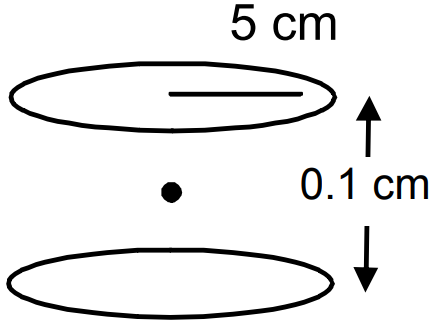
The plates of a parallel-plate capacitor are made of circular discs of radii 5.0cm each. If the separation between the plates is 1.0mm, what is the capacitance?
Answer

$\text{A}=\pi\text{r}^2=25\pi\text{m}^2$

$\text{d}=0.1\text{cm}$

$\text{c}=\frac{\in_0\text{A}}{\text{d}}$

$=\frac{8.854\times10^{-12}\times25\times3.14}{0.1}$

$=6.95\times10^{-5}\mu\text{F}$

View full question & answer
2 Marks Questions - Page 2 - Physics STD 12 Science Questions - Vidyadip