Questions · Page 2 of 14

M.C.Q (1 Marks)

Question 511 Mark

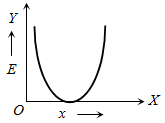
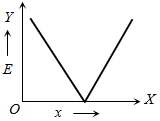
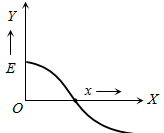
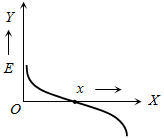
Two identical point charges are placed at a separation of d. P is a point on the line joining the charges, at a distance x  from any one charge. The field at P is E, E is plotted against x for values of x from close to zero to slightly less than d. Which of the following represents the resulting curve

(a)

(b)

(c)

(d)

Answer

(d)

View full question & answer
Question 521 Mark

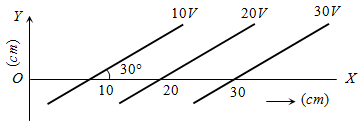
Equipotential surfaces are shown in figure. Then the electric field strength will be

(a) 100 Vm–1 along X-axis

(b) 100 Vm–1 along Y-axis

(c) 200 Vm–1 at an angle 120o with X-axis

(d) 50 Vm–1 at an angle 120o with X-axis

Answer

(c) 200 Vm–1 at an angle 120o with X-axis

View full question & answer
Question 531 Mark

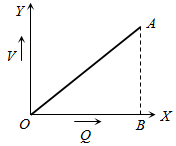
Change Q on a capacitor varies with voltage V as shown in the figure, where Q is taken along the X-axis and V along the Y-axis. The area of triangle OAB represents

(a) Capacitance

(b) Capacitive reactance

(c) Magnetic field between the plates

(d) Energy stored in the capacitor

Answer

(d) Energy stored in the capacitor

View full question & answer
Question 541 Mark

To form a composite 16Μf, 1000 V  capacitor from a supply of identical capacitors marked 8 μF, 250 V we require a minimum number of capacitors

(a) 40

(b) 32

(c) 8  

(d) 2

Answer

(b) 32

View full question & answer
Question 551 Mark

A capacitor of capacitance C1 = 1mF can with stand maximum voltage V1 = 6kV (kilo-volt) and another capacitor of capacitance C2 = 3mF can withstand maximum voltage V2 = 4 kV. When the two capacitors are connected in series, the combined system can withstand a maximum voltage of

(a) 4kV

(b) 6kV

(c) 8kV

(d) 10kV

Answer

(c) 8kV

View full question & answer
Question 561 Mark

A parallel plate capacitor is connected to a battery. The plates are pulled apart with a uniform speed. If x is the separation between the plates, the time rate of change of electrostatic energy of capacitor is proportional to

(a) x–2

(b) x

(c) x–1

(d) x2

Answer

(a) x–2

View full question & answer
Question 571 Mark

Capacitance of a capacitor made by a thin metal foil is 2μF. If the foil is folded with paper of thickness 0.15 mm, dielectric constant of paper is 2.5 and width of paper is 400 mm , then length of foil will be

(a) 0.34 m

(b) 1.33 m

(c) 13.4 m

(d) 33.9 m

Answer

(d) 33.9 m

View full question & answer
Question 581 Mark

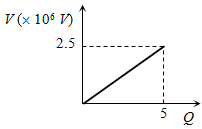
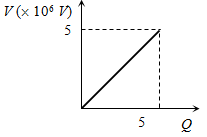
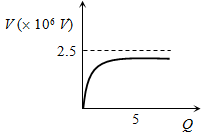
A condenser of 2mF capacitance is charged steadily from 0 to 5 Coulomb. Which of the following graphs correctly represents the variation of potential difference across its plates with respect to the charge on the condenser

(a)

(a)

(c)

(d)

Answer

(a)

View full question & answer
Question 591 Mark

A dielectric slab of thickness d  is inserted in a parallel plate capacitor whose negative plate is at x = 0 and positive plate is at x = 3d. The slab is equidistant from the plates. The capacitor is given some charge. As one goes from 0 to  3d

(a) The magnitude of the electric field remains the same

(b) The direction of the electric field remains the same

(c) The electric potential increases continuously

(d) b, c

Answer

(d) b, c

View full question & answer
Question 601 Mark

A parallel plate air capacitor has a capacitance of 100 μμF.  The plates are at a distance d apart. If a slab of thickness   t( t d) and dielectric constant 5 is introduced between the parallel plates, then the capacitance will be

(a) 50 μμF

(b) 100 μμF

(c) 200 μμF

(d) 500 μμF

Answer

(c) 200 μμF

View full question & answer
Question 611 Mark

Four charges equal to – Q are placed at the four corners of a square and a charge q is at its centre. If the system is in equilibrium the value of q is

(a)  

(b)  

(c) -  

(d)  

Answer

(b)  

View full question & answer
Question 621 Mark

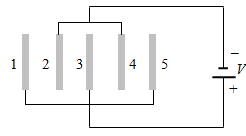
Five identical plates each of area A are joined as shown in the figure. The distance between the plates is d. The plates are connected to a potential difference of V volts. The charge on plates 1 and 4 will be

(a)  

(b)  

(c)  

(d)  

Answer

(c)  

View full question & answer
Question 631 Mark

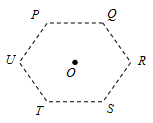
Six charges, three positive and three negative of equal magnitude are to be placed at the vertices of a regular hexagon such that the electric field at O is double the electric field when only one positive charge of same magnitude is placed at R. Which of the following arrangements of charges is possible for P, Q, R, S, T and U respectively

(a) +, -, +, -, -, +

(b) +, -, +, -, +, -

(c) +, +, -, +, -, -

(d) -, +, +, -, +, -

Answer

(d) -, +, +, -, +, -

View full question & answer
Question 641 Mark

Two point charges (+Q)  and (-2Q) are fixed on the X-axis at positions a and 2a  from origin respectively. At what positions on the axis, the resultant electric field is zero

(a) Only x =  

(b) Only x = - 

(c) Both x = ± 

(d) x =  only

Answer

(b) Only x = - 

View full question & answer
Question 651 Mark

A piece of cloud having area 25   and electric potential of  volts. If the height of cloud is 0.75 km, then energy of electric field between earth and cloud will be

(a) 250 J  

(b) 750 J

(c) 1225 J

(d) 1475 J

Answer

(d) 1475 J

View full question & answer
Question 661 Mark

Two condensers of capacities 2C and C are joined in parallel and charged upto potential V. The battery is removed and the condenser of capacity C is filled completely with a medium of dielectric constant K. The p.d. across the capacitors will now be

(a)  

(b)

(c)

(d)

Answer

(a)  

View full question & answer
Question 671 Mark

A point charge of 40 stat coulomb is placed 2 cm in front of an earthed metallic plane plate of large size. Then the force of attraction on the point charge is

(a) 100 dynes

(b) 160 dynes

(c) 1600 dynes

(d) 400 dynes

Answer

(a) 100 dynes

View full question & answer
Question 681 Mark

A solid conducting sphere having a charge Q is surrounded by an uncharged concentric conducting hollow spherical shell. Let the potential difference between the surface of the solid sphere and that of the outer surface of the hollow shell be V.  If the shell is now given a charge of –3Q, the new potential difference between the same two surfaces is

(a) V 

(b) 2V

(c) 4V

(d) – 2V

Answer

(a) V 

View full question & answer
Question 691 Mark

Assertion  :   The lightening conductor at the top of high building has sharp pointed ends.

Reason     : The surface density of charge at sharp points is very high resulting in setting up of electric wind.

(a) If both assertion and reason are true and the reason is the correct explanation of the assertion.

(b) If both assertion and reason are true but reason is not the correct explanation of the assertion.

(c) If assertion is true but reason is false.

(d) If the assertion and reason both are false.

Answer

(a) If both assertion and reason are true and the reason is the correct explanation of the assertion.

View full question & answer
Question 701 Mark

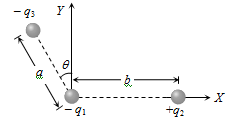
Three charges - and  are placed as shown in the figure. The x-component of the force on - is proportional to

(a)  

(b)  

(c)

(d)

Answer

(c)

View full question & answer
Question 711 Mark

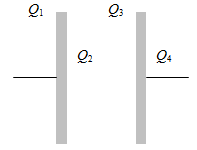
In an isolated parallel plate capacitor of capacitance C, the four surface have charges  and  as shown. The potential difference between the plates is

(a)

(b) 

(c)

(d)

Answer

(c)

View full question & answer
Question 721 Mark

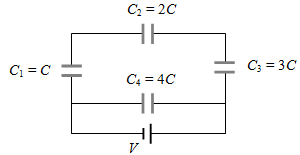
A network of four capacitors of capacity equal to   and   are conducted in a battery as shown in the figure. The ratio of the charges on   and   is

(a)  

(b)  

(c)   

(d)  

Answer

(b)  

View full question & answer
Question 731 Mark

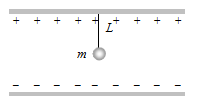
A small sphere carrying a charge ‘q’ is hanging in between two parallel plates by a string of length L. Time period of pendulum is . When parallel plates are charged, the time period changes to T . The ratio   is equal to

(a)

(b)

(c)

(d) None of these

Answer

(c)

View full question & answer
Question 741 Mark

An electric dipole is situated in an electric field of uniform intensity E whose dipole moment is p and moment of inertia is I. If the dipole is displaced slightly from the equilibrium position, then the angular frequency of its oscillations is

(a)

(b)

(c)

(d)

Answer

(a)

View full question & answer
Question 751 Mark

An elementary particle of mass  m and charge +e  is projected with velocity v at a much more massive particle of charge Ze,  where Z > 0. What is the closest possible approach of the incident particle

(a)  

(b)

(c)

(d)

Answer

(a)  

View full question & answer
Question 761 Mark

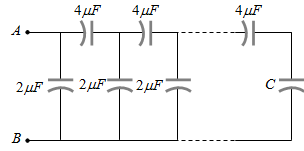
A finite ladder is constructed by connecting several sections of 2μF,4 μF  capacitor combinations as shown in the figure. It is terminated by a capacitor of capacitance C. What value should be chosen for C such that the equivalent capacitance of the ladder between the points A and B becomes independent of the number of sections in between

(a) 4μF

(b) 2 μF

(c) 18 μF

(d) 6 μF

Answer

(a) 4μF

View full question & answer
Question 771 Mark

Two equal point charges are fixed at x = -a  and x = +a  on the x-axis. Another point charge Q is placed at the origin. The Change in the electrical potential energy of Q, when it is displaced by a small distance x along the x-axis, is approximately proportional to

(a) x 

(b)  

(c)  

(d) 1/x

Answer

(b)  

View full question & answer
Question 781 Mark

The electric potential at a point (x, y) in the  x - y  plane is given by V = -kxy. The field intensity at a distance r from the origin varies as

(a)  

(b) r

(c)   

(d)  

Answer

(b) r

View full question & answer
Question 791 Mark

A uniform electric field pointing in positive x-direction exists in a region. Let A be the origin, B be the point on the x-axis at x = +1 cm and C be the point on the y-axis at y = +1 cm. Then the potentials at the points A, B and C satisfy

(a)  

(b)  

(c)  

(d)  

Answer

(b)  

View full question & answer
Question 801 Mark

Consider two points 1 and 2 in a region outside a charged sphere. Two points are not very far away from the sphere. If E and V represent the electric field vector and the electric potential, which of the following is not possible

(a) | | =  | |,

(b) | |   | |,

(c) | |   | |,

(d) | | =  | |,

Answer

(d) | | =  | |,

View full question & answer
Question 811 Mark

Charge q  is uniformly distributed over a thin half ring of radius R. The electric field at the centre of the ring is

(a)  

(b)

(c)             

(d)

Answer

(a)  

View full question & answer
Question 821 Mark

The electric field in a region is radially outward with magnitude E = . The charge contained in a sphere of radius   centered at the origin is

(a)  

(b)  

(c)  

(d)  

Answer

(b)  

View full question & answer
Question 831 Mark

Assertion :   The force with which one plate of a parallel plate capacitor is attracted towards the other plate is equal to square of surface density per e per unit area.

Reason     : The electric field due to one charged plate of the capacitor at the location of the other is equal to surface density per e.

(a) If both assertion and reason are true and the reason is the correct explanation of the assertion.

(b) If both assertion and reason are true but reason is not the correct explanation of the assertion.

(c) If assertion is true but reason is false.

(d) If the assertion and reason both are false.

Answer

(d) If the assertion and reason both are false.

View full question & answer
Question 841 Mark

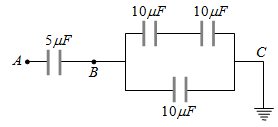
In the given circuit if point C is connected to the earth and a potential of +2000 V  is given to the point A, the potential at B is

(a) 1500 V

(b) 1000 V

(c) 500 V

(d) 400 V

Answer

(c) 500 V

View full question & answer
Question 851 Mark

The charge on 500 cc  of water due to protons will be

(a) 6.0  

(b) 2.67  

(c) 6  

(d) 1.67  

Answer

(b) 2.67  

View full question & answer
Question 861 Mark

A negatively charged plate has charge density of 2 . The initial distance of an electron which is moving toward plate, cannot strike the plate, if it is having energy of 200 eV

(a) 1.77 mm

(b) 3.51 mm

(c) 1.77 cm

(d) 3.51 cm

Answer

(a) 1.77 mm

View full question & answer
Question 871 Mark

A non-conducting solid sphere of radius R is uniformly charged. The magnitude of the electric field due to the sphere at a distance r  from its centre

(a) Increases as r increases for r < R

(b) Decreases as r  increases for 0 < r <

(c) Decreases as r  increases for R < r <

(d) a, c

Answer

(d) a, c

View full question & answer
Question 881 Mark

An electric line of force in the xy plane is given by equation . A particle with unit positive charge, initially at rest at the point x = 1, y = 0  in the xy plane

(a) Not move at all

(b) Will move along straight line

(c) Will move along the circular line of force

(d) Information is insufficient to draw any conclusion

Answer

(c) Will move along the circular line of force

View full question & answer
Question 891 Mark

There is a uniform electric field of strength   along y-axis. A body of mass 1g and charge is projected into the field from origin along the positive x-axis with a velocity 10m/s. Its speed in m/s after 10s is (Neglect gravitation)

(a) 10

(b) 5 

(c) 10 

(d) 20

Answer

(c) 10 

View full question & answer
Question 901 Mark

A solid metallic sphere has a charge +3Q. Concentric with this sphere is a conducting spherical shell having charge -Q. The radius of the sphere is a and that of the spherical shell is b(b > a). What is the electric field at a distance R(a < R  <  b)  from the centre

(a)  

(b)

(c)    

(d)

Answer

(c)    

View full question & answer
Question 911 Mark

Two equal charges  q of opposite sign separated by a distance 2a  constitute an electric dipole of dipole moment p. If  P is a point at a distance r from the centre of the dipole and the line joining the centre of the dipole to this point makes an angle θ  with the axis of the dipole, then the potential at P  is given by (r >> 2a)  (Where p = 2qa)

(a)   

(b)  

(c)

(d)  

Answer

(a)   

View full question & answer
Question 921 Mark

Two identical thin rings each of radius R meters are coaxially placed at a distance R meters apart. If Q1 coulomb and Q2 coulomb are respectively the charges uniformly spread on the two rings, the work done in moving a charge qfrom the centre of one ring to that of other is

(a) Zero

(b)  

(c)

(d)

Answer

(b)  

View full question & answer
Question 931 Mark

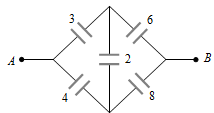
Effective capacitance between A and B in the figure shown is (all capacitance are in mF)

(a) 21 m

(b) 23 mF

(c) F  

(d)  

Answer

(d)  

View full question & answer
Question 941 Mark

Three capacitors 2, 3 and 6 mF are joined in series with each other. What is the minimum effective capacitance

(a) F                

(b) 1 mF

(c) 2 mF   

(d) 3 mF

Answer

(b) 1 mF

View full question & answer
Question 951 Mark

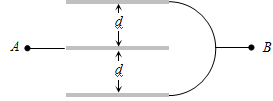
Three plates of common surface area A are connected as shown. The effective capacitance will be

(a)  

(b)

(c)

(d)

Answer

(d)

View full question & answer
Question 961 Mark

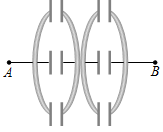
All six capacitors shown are identical, Each can withstand maximum 200 volts between its terminals. The maximum voltage that can be safely applied between A and B is

(a) 1200 V

(b) 400 V

(c) 800 V

(d) 200 V

Answer

(b) 400 V

View full question & answer
Question 971 Mark

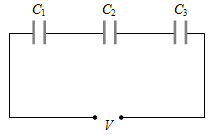
In the figure, three capacitors each of capacitance 6 pF are connected in series. The total capacitance of the combination will be

(a) 9  

(b) 6  

(c) 3 

(d) 2 

Answer

(d) 2 

View full question & answer
Question 981 Mark

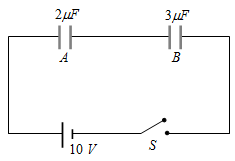
Two capacitors A and B are connected in series with a battery as shown in the figure. When the switch S is closed and the two capacitors get charged fully, then

(a) The potential difference across the plates of A is 4V and across the plates of B is 6V

(b) The potential difference across the plates of A is 6V and across the plates of B is 4V

(c) The ratio of electrical energies stored in A and B is 2 : 3

(d) The ratio of charges on A and B is 3 : 2

Answer

(b) The potential difference across the plates of A is 6V and across the plates of B is 4V

View full question & answer
Question 991 Mark

Two capacitors of capacitance 2 μF and 3μF  are joined in series. Outer plate first capacitor is at 1000 volt and outer plate of second capacitor is earthed (grounded). Now the potential on inner plate of each capacitor will be

(a) 700 Volt

(b) 200 Volt

(c) 600 Volt

(d) 400 Volt

Answer

(d) 400 Volt

View full question & answer
Question 1001 Mark

A series combination of three capacitors of capacities 1μF, 2 μF  and  8 μF is connected to a battery of e.m.f. 13 volt. The potential difference across the plates of 2 μF  capacitor will be

(a) 1 V

(b) 8V

(c) 4V

(d)  

Answer

(c) 4V

View full question & answer