Questions · Page 3 of 14

M.C.Q (1 Marks)

Question 1011 Mark

An ellipsoidal cavity is carved within a perfect conductor. A positive charge q is placed at the centre of the cavity. The points  A  and  B are on the cavity surface as shown in the figure. Then
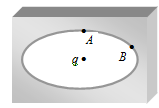
(a) Potential at A =  Potential at B

(b) Total electric field flux through the surface of the cavity is q/ 

(c) Electric field near A  in the cavity = Electric field near  B  in the cavity

(d) a, b

Answer

(d) a, b

View full question & answer
Question 1021 Mark

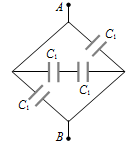
Four identical capacitors are connected as shown in diagram. When a battery of 6 V is connected between A and B, the charge stored is found to be 1.5. The value of  is

(a) 2.5  

(b) 15  

(c) 1.5  

(d)  0.1  

Answer

(d)  0.1  

View full question & answer
Question 1031 Mark

A capacitor of capacity  is charged upto V volt and then connected to an uncharged capacitor of capacity  . Then final potential difference across each will be

(a)  

(b)

(c)

(d)

Answer

(c)

View full question & answer
Question 1041 Mark

Three capacitors each of capacity 4μF  are to be connected in such a way that the effective capacitance is 6 μF. This can be done by

(a) Connecting them in parallel

(b) Connecting two in series and one in parallel

(c) Connecting two in parallel and one in series

(d) Connecting all of them in series

Answer

(b) Connecting two in series and one in parallel

View full question & answer
Question 1051 Mark

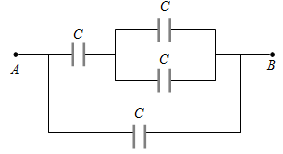
In the figure shown, the effective capacitance between the points A and B, if  each has capacitance C, is

(a) 2C

(b)    

(c) 5C       

(d)  

Answer

(a) 2C

View full question & answer
Question 1061 Mark

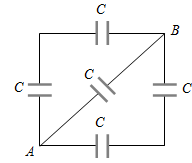
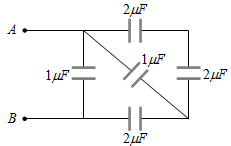
Four equal capacitors, each of capacity C, are arranged as shown. The effective capacitance between A and B is

(a)  

(b)  

(c)  

(d)  C

Answer

(c)  

View full question & answer
Question 1071 Mark

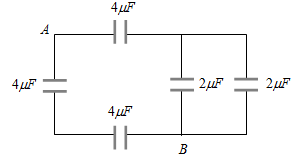
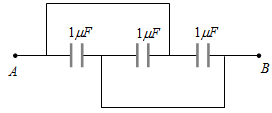
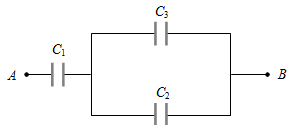
In the circuit as shown in the figure the effective capacitance between A and B is

(a) 3 μF

(b) 2 μF

(c) 4 μF

(d) 8 μF

Answer

(c) 4 μF

View full question & answer
Question 1081 Mark

Two capacitors of 1mF  and 2mF  are connected in series, the resultant capacitance will be

(a) 4μF

(b)  

(c)  

(d) 3 μF

Answer

(b)  

View full question & answer
Question 1091 Mark

A capacitor of 10mF charged up to 250 volts is connected in parallel with another capacitor of 5mF charged up to 100 volts. The common potential is

(a) 500 V

(b) 400 V

(c) 300 V 

(d) 200 V

Answer

(d) 200 V

View full question & answer
Question 1101 Mark

A positively charged ball hangs from a silk thread. We put a positive test charge  at a point and measure F/, then it can be predicted that the electric field strength E

(a)  

(b)  

(c)  

(d) Cannot be estimated

Answer

(a)  

View full question & answer
Question 1111 Mark

Two capacitors of capacitances 3 μF  and 6 μF  are charged to a potential of 12 V each. They are now connected to each other, with the positive plate of each joined to the negative plate of the other. The potential difference across each will be

(a) 6 volt

(b) 4 volt

(c) 3 volt 

(d) Zero

Answer

(b) 4 volt

View full question & answer
Question 1121 Mark

Three capacitors of 2μF, 3μF  and 6μF  are joined in series and the combination is charged by means of a 24 volt battery. The potential difference between the plates of the 6 μF  capacitor is

(a) 4 volt

(b) 6 volt

(c) 8 volt 

(d) 10 volt

Answer

(a) 4 volt

View full question & answer
Question 1131 Mark

The equivalent capacitance in the circuit between A and B will be

(a) 1 μF

(b) 2 μF

(c) 3 μF

(d)  

Answer

(c) 3 μF

View full question & answer
Question 1141 Mark

A parallel plate capacitor has capacitance C. If it is equally filled with parallel layers of materials of dielectric constants K1 and K2 its capacity becomes C1. The ratio of C1 to C is

(a)  

(b)  

(c)  

(d)  

Answer

(d)  

View full question & answer
Question 1151 Mark

A 20F capacitor is charged to 5V and isolated. It is then connected in parallel with an uncharged 30F capacitor. The decrease in the energy of the system will be

(a) 25 J

(b) 200 J

(c) 125 J  

(d) 150 J

Answer

(d) 150 J

View full question & answer
Question 1161 Mark

In the given figure each plate of capacitance C has partial value of charge

(a) CE

(b)  

(c)   

(d)

Answer

(c)   

View full question & answer
Question 1171 Mark

Assertion :   Mass of ion is slightly differed from its element.

Reason    : Ion is formed, when some electrons are removed or added so mass changes.

(a) If both assertion and reason are true and the reason is the correct explanation of the assertion.

(b) If both assertion and reason are true but reason is not the correct explanation of the assertion.

(c) If assertion is true but reason is false.

(d) If the assertion and reason both are false.

Answer

(a) If both assertion and reason are true and the reason is the correct explanation of the assertion.

View full question & answer
Question 1181 Mark

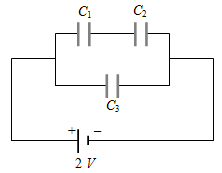
Two capacitors   and   in series, are connected in parallel to a third capacitor. This arrangement is then connected to a battery of e.m.f. = 2V, as shown in the figure. How much energy is lost by the battery in charging the capacitors

(a) 22  

(b) 11  

(c)  

(d)  

Answer

(b) 11  

View full question & answer
Question 1191 Mark

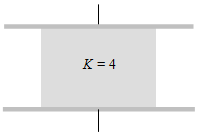
Consider a parallel plate capacitor of 10 μF  (micro-farad) with air filled in the gap between the plates. Now one half of the space between the plates is filled with a dielectric of dielectric constant 4, as shown in the figure. The capacity of the capacitor changes to

(a) 25 μF  

(b) 20 μF

(c) 40 μF

(d) 5 μF

Answer

(a) 25 μF  

View full question & answer
Question 1201 Mark

Three capacitors of capacitance 3 μF , 10 μF and 15 μF  are connected in series to a voltage source of 100V. The charge on 15 μF is

(a) 50 μC

(b) 100 μC

(c) 200 μC

(d) 280 μC

Answer

(c) 200 μC

View full question & answer
Question 1211 Mark

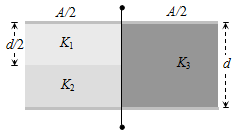
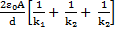
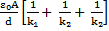
In the figure a capacitor is filled with dielectrics. The resultant capacitance is

(a)

(b)

(c) []

(d) None of these

Answer

(d) None of these

View full question & answer
Question 1221 Mark

Two capacitors of 10 μF  and 20 μF  are connected in series with a 30V battery. The charge on the capacitors will be, respectively

(a) 100 μC, 200 μC

(b) 200 μC, 100  μC

(c) 100 μC, 100 μC

(d) 200 μC, 200 μC

Answer

(d) 200 μC, 200 μC

View full question & answer
Question 1231 Mark

Equivalent capacitance between A and B is

(a) 8 μC

(b) 6 μF

(c) 26 μF

(d) 10/3 μF

Answer

(a) 8 μC

View full question & answer
Question 1241 Mark

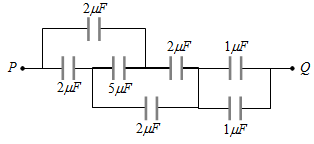
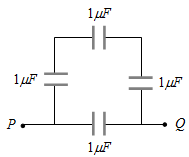
The effective capacitance between the points P  and  Q  of the arrangement shown in the figure is

(a)    

(b) 1 

(c) 2   

(d) 1.33  

Answer

(b) 1 

View full question & answer
Question 1251 Mark

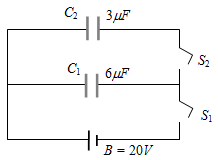
In the circuit shown here  and battery B = 20V. The switch  is first closed. It is then opened and afterwards   is closed. What is the charge finally on

(a) 120 μC

(b) 80 μC

(c) 40 μC

(d) 20 μC

Answer

(c) 40 μC

View full question & answer
Question 1261 Mark

The equivalent capacitance of three capacitors of capacitance   and   are connected in parallel is 12 units and product . When the capacitors   and   are connected in parallel, the equivalent capacitance is 6 units. Then the capacitance are

(a) 2, 3, 7

(b) 1.5, 2.5, 8

(c) 1, 5, 6

(d) 4, 2, 6

Answer

(d) 4, 2, 6

View full question & answer
Question 1271 Mark

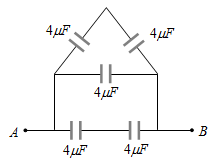
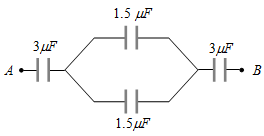
The capacitance between the points A and B in the given circuit will be

(a) 1 μF

(b) 2 μF

(c) 3 μF   

(d) 4 μF

Answer

(a) 1 μF

View full question & answer
Question 1281 Mark

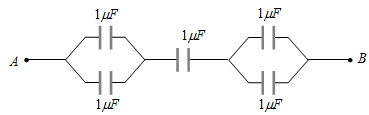
The equivalent capacitance between A and B is

(a) 2 μF

(b) 3 μF

(c) 5 μF   

(d) 0.5 μF

Answer

(d) 0.5 μF

View full question & answer
Question 1291 Mark

A capacitor of 20 μF  is charged to 500 volts  and connected in parallel with another capacitor of 10 μF and charged to 200 volts. The common potential is

(a) 200 volts

(b) 300 volts

(c) 400 volts

(d) 500 volts

Answer

(c) 400 volts

View full question & answer
Question 1301 Mark

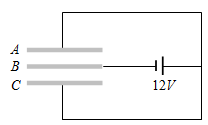
Three plates A, B, C each of area  have separation 3mm between A and  B and 3mm  between  B and C The energy stored when the plates are fully charged is

(a) 1.6  

(b) 2.1  

(c) 5  

(d) 7  

Answer

(b) 2.1  

View full question & answer
Question 1311 Mark

The combined capacity of the parallel combination of two capacitors is four times their combined capacity when connected in series. This means that

(a) Their capacities are equal

(b) Their capacities are 1 μF and 2 μF

(c) Their capacities are 0.5 μF  and 1 μF

(d) Their capacities are infinite

Answer

(a) Their capacities are equal

View full question & answer
Question 1321 Mark

A parallel plate capacitor of capacitance C is connected to a battery and is charged to a potential difference V. Another capacitor of capacitance 2C is connected to another battery and is charged to potential difference 2V. The charging batteries are now disconnected and the capacitors are connected in parallel to each other in such a way that the positive terminal of one is connected to the negative terminal of the other. The final energy of the configuration is

(a) Zero

(b)  

(c)    

(d)

Answer

(c)    

View full question & answer
Question 1331 Mark

Ten capacitor are joined in parallel and charged with a battery up to a potential V. They are then disconnected from battery and joined again in series then the potential of this combination will be

(a) V 

(b) 10V

(c) 5V   

(d) 2V

Answer

(b) 10V

View full question & answer
Question 1341 Mark

The combination of capacitors with   and   is charged by connecting AB to a battery. Consider the following statements

I.     Energy stored in  = Energy stored in   + Energy stored in  

II.    Charge on C1 = Charge on C2 + Charge on C3

III.  Potential drop across C1 = Potential drop across C2 = Potential drop across C3

Which of these is/are correct

(a) I and II

(b) II only

(c) I and III

(d) III only

Answer

(b) II only

View full question & answer
Question 1351 Mark

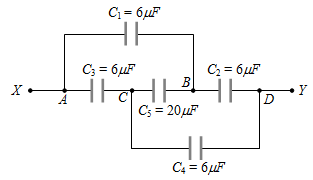
What is the effective capacitance between points X and  Y

(a) 24 μF   

(b) 18 μF

(c) 12 μF

(d) 6 μF

Answer

(d) 6 μF

View full question & answer
Question 1361 Mark

A 10 μF capacitor is charged to a potential difference of 50 V and is connected to another uncharged capacitor in parallel. Now the common potential difference becomes 20 volt. The capacitance of second capacitor is

(a) 10 μF  

(b) 20 μF

(c) 30 μF

(d) 15 μF

Answer

(d) 15 μF

View full question & answer
Question 1371 Mark

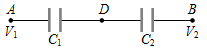
Two condensers  and   in a circuit are joined as shown in figure. The potential of point  A is   and that of  B is. The potential of point D will be

(a)  

(b)  

(c)

(d)

Answer

(c)

View full question & answer
Question 1381 Mark

A 10   capacitor and a 20  capacitor are connected in series across a 200 V supply line. The charged capacitors are then disconnected from the line and reconnected with their positive plates together and negative plates together and no external voltage is applied. What is the potential difference across each capacitor

(a)  

(b)   

(c) 400 V

(d) 200 V

Answer

(b)   

View full question & answer
Question 1391 Mark

Three identical capacitors are combined differently. For the same voltage to each combination, the one that stores the greatest energy is

(a) Two in parallel and the third in series with it

(b) Three in series

(c) Three in parallel

(d) Two in series and third in parallel with it

Answer

(c) Three in parallel

View full question & answer
Question 1401 Mark

A potential difference of 300 volts is applied to a combination of 2.0mF and 8.0mF capacitors connected in series. The charge on the 2.0mF capacitor is

(a) 2.4

(b) 4.8  

(c) 7.2

(d) 9.6

Answer

(b) 4.8  

View full question & answer
Question 1411 Mark

A condenser of capacity  is charged to a potential . The electrostatic energy stored in it is . It is connected to another uncharged condenser of capacity   in parallel. The energy dissipated in the process is

(a)   

(b) 

(c) 

(d) 

Answer

(a)   

View full question & answer
Question 1421 Mark

The total capacity of the system of capacitors shown in the adjoining figure between the points  A and  B is

(a) 1 μF

(b) 2 μF

(c) 3 μF

(d) 4 μF

Answer

(b) 2 μF

View full question & answer
Question 1431 Mark

Four capacitors are connected as shown in the equivalent capacitance between the points P and Q is

(a) 4 μF

(b)  

(c)  

(d)  

Answer

(d)  

View full question & answer
Question 1441 Mark

Two identical parallel plate capacitors are connected in series to a battery of 100 V. A dielectric slab of dielectric constant 4.0 is inserted between the plates of second capacitor.  The potential difference across the capacitors will now be respectively

(a) 50 V, 50 V

(b) 80 V, 20 V

(c) 20 V, 80 V

(d) 75 V, 25 V

Answer

(b) 80 V, 20 V

View full question & answer
Question 1451 Mark

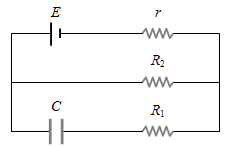
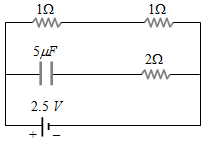
A capacitor of capacitance 5  is connected as shown in the figure. The internal resistance of the cell is 0.5 . The amount of charge on the capacitor plate is

(a) 0    

(b) 5  

(c) 10  

(d) 25  

Answer

(c) 10  

View full question & answer
Question 1461 Mark

Two capacitors of 3pF and 6pF are connected in series and a potential difference of 5000 V is applied across the combination. They are then disconnected and reconnected in parallel. The potential between the plates is

(a) 2250 V

(b) 2222 V

(c) 2.25  

(d) 1.1  

Answer

(b) 2222 V

View full question & answer
Question 1471 Mark

Assertion  :   A charged capacitor is disconnected from a battery. Now if its plate are separated farther, the potential energy will fall.

Reason     : Energy stored in a capacitor is equal to the work done in charging it.

(a) If both assertion and reason are true and the reason is the correct explanation of the assertion.

(b) If both assertion and reason are true but reason is not the correct explanation of the assertion.

(c) If assertion is true but reason is false.

(d) If assertion is false but reason is true.

Answer

(d) If assertion is false but reason is true.

View full question & answer
Question 1481 Mark

A capacitor 4 μF charged to 50  V is connected to another capacitor of 2 μF  charged to 100 V with plates of like charges connected together. The total energy before and after connection in multiples of  (  is

(a) 1.5 and 1.33

(b) 1.33 and 1.5

(c) 3.0 and 2.67

(d) 2.67 and 3.0

Answer

(a) 1.5 and 1.33

View full question & answer
Question 1491 Mark

0.2 Fcapacitor is charged to 600 V by a battery. On removing the battery, it is connected with another parallel plate condenser of 1F. The potential decreases to

(a) 100 volts

(b) 120 volts

(c) 300 volts

(d) 600 volts

Answer

(a) 100 volts

View full question & answer
Question 1501 Mark

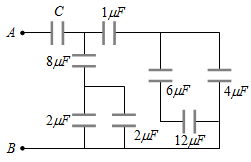
In the following circuit, the resultant capacitance between A  and  B is 1mF. Then value of  C is

(a)  μF 

(b)  μF 

(c)  μF 

(d)  μF

Answer

(d)  μF

View full question & answer