Questions

3 Marks Question

Take a timed test

9 questions · self-marked practice — reveal the answer and mark yourself.

Question 13 Marks
A magnetised needle in a uniform magnetic field experiences a torque but no net force. An iron nail near a bar magnet, however, experiences a force of attraction in addition to a torque. Why?
Answer
self
View full question & answer
Question 23 Marks
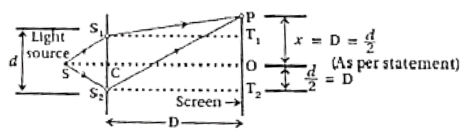
Consider a two slit interference arrangements (See figure), such that the distance of the screen from the slits is half the distance between the slits. Obtain the valus of $D$ in terms of such that the first minima on the screen falls at a distance $D$ from the centre $O$.
Image
Answer
Self
View full question & answer
Question 33 Marks
A $10 \mu F$ capacitor is connected to a $230 \cdot V, 50 Hz$ source. Find the capacitive reactance and the current (rms and peak) in the circuit. If the frequency is doubled what happens to the capacitive reactance and the current ?
Answer
Self
View full question & answer
Question 43 Marks
Explain the forward characteristics of the $p-n$ junction diode by drawing circuit and graph.
Answer
Self
View full question & answer
Question 53 Marks
It is found experimentally that 13.6 eV energy is required to separate a hydrogen atom into a proton and an electron. Compute the orbital radius and the velocity of the electron in a hydrogen atom.
Answer
Self
View full question & answer
Question 63 Marks
Monochromatic light of frequency $5.0 \times 10^{14} Hz$ is produced by a laser. The power emitted is 66 W . (a) What is the energy of a photon in the light beam ? (b) Hon many photons per second, on an average, are emitted by the source?
Answer
Self
View full question & answer
Question 83 Marks
(a) Calculate the potential at a point P due to a charge of $4 \times 10^{-7} C$ located 9 cm away.
(b) Hence obtain the work done in bringing a charge of $2 \times 10^{-9} C$ from infinity to the point $P$. Does the answer depend on the path along which the charge is brought?
Answer
Self
View full question & answer