Question
It is found experimentally that 13.6 eV energy is required to separate a hydrogen atom into a proton and an electron. Compute the orbital radius and the velocity of the electron in a hydrogen atom.

Answer

Self

Need a full question paper?

Generate a complete, print-ready paper with questions like this in minutes — across 16+ boards, with answer keys.
Start Generating Free

Similar questions

Figure shows a smooth track, a part of which is a circle of radius R. A block of mass m is pushed against a spring of spring constant k fixed at the left end and is then released. Find the initial compression of the spring so that the block presses the track with a force mg when it reaches the point P, where the radius of the track is horizontal.
A convex lens produces a double size real image when an object is placed at a distance of 18cm from it. Where should the object be placed to produce a triple size real image?
A source of ac voltage v = v0 $\sin\omega t$, is connected across a pure inductor of inductance L. Derive the expressions for the instantaneous current in the circuit. Show that average power dissipated in the circuit is zero.
An electric toaster uses nichrome for its heating element. When a negligibly small current passes through it, its resistance at room temperature $\left(27.0^{\circ} C \right)$ is found to be $75.3 \Omega$. When the toaster is connected to a $230 V$ supply, the current settles, after a few seconds, to a steady value of $2.68 A$. What is the steady temperature of the nichrome element? The temperature coefficient of resistance of nichrome averaged over the temperature range involved, is $1.70 \times 10^{-4}{ }^{\circ} C ^{-1}$.
Double - convex lenses are to be manufactured from a glass of refractive index 1.55, with both faces of the same radius of curvature. What is the radius of curvature required if the focal length is to be 20cm?
Draw the intensity distributions for (i) the fringes produced in interference, and (ii) the diffraction bands produced due to single slit. Write two points of difference between the phenomena of interference and diffraction.
A thin but long, hollow, cylindrical tube of radius r carries a current i along its length. Find the magnitude of the magnetic field at a distance $\frac{\text{r}}{2}$ from the surface (a) inside the tube (b) outside the tube.
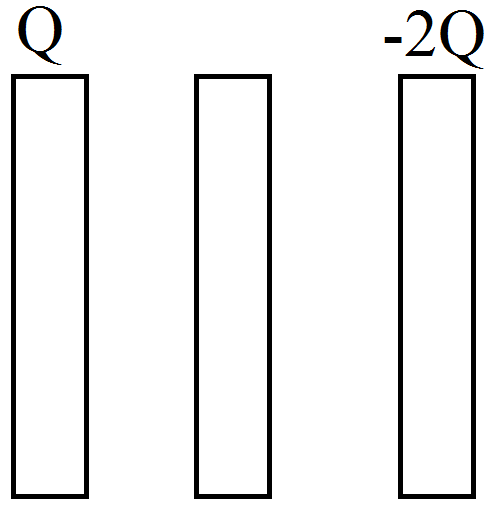
Three identical metal plates with large surface areas are kept parallel to each other as shown in figure. The leftmost plate is given a charge Q, the rightmost a charge -2Q and the middle one remains neutral. Find the charge appearing on the outer surface of the rightmost plate.

In a Geiger-Marsden experiment, what is the distance of closest approach to the nucleus of a $7.7 MeV \alpha$-particle before it comes momentarily to rest and reverse its direction?
A proton describes a circle of radius 1cm in a magnetic field of strength 0.10T. What would be the radius of the circle described by an α-particle moving with the same speed in the same magnetic field?