- is transverse to its initial velocity,
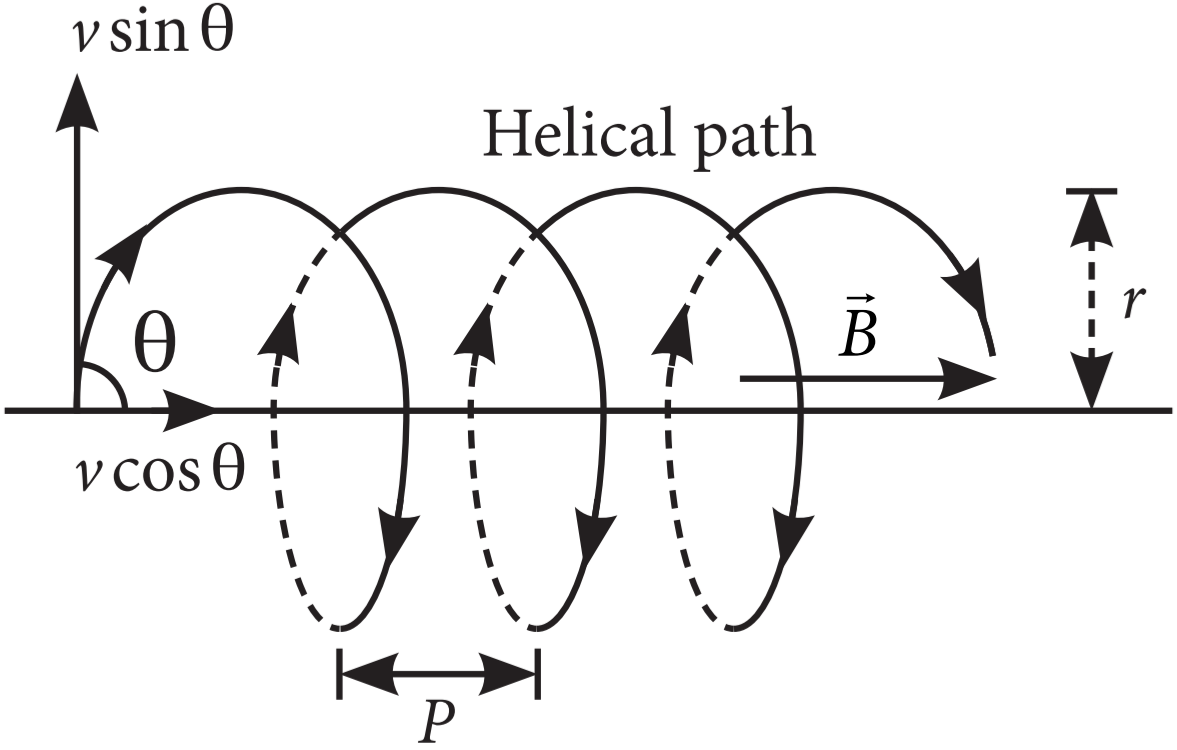
- makes an angle of 30º with the initial velocity.
Charge on the electron, e = 1.6 × 10⁻¹⁹ C
Mass of the electron, m = 9.1 × 10⁻³¹ kg
Potential difference, V = 2.0 kV = 2 × 10³ V
Thus, kinetic energy of the electron = eV
$\Rightarrow\text{eV}=\frac{1}{2}\text{mv}^{2}$
$\text{v}=\sqrt\frac{2\text{ev}}{\text{m}}.........(1)$
Where,
v = velocity of the electron
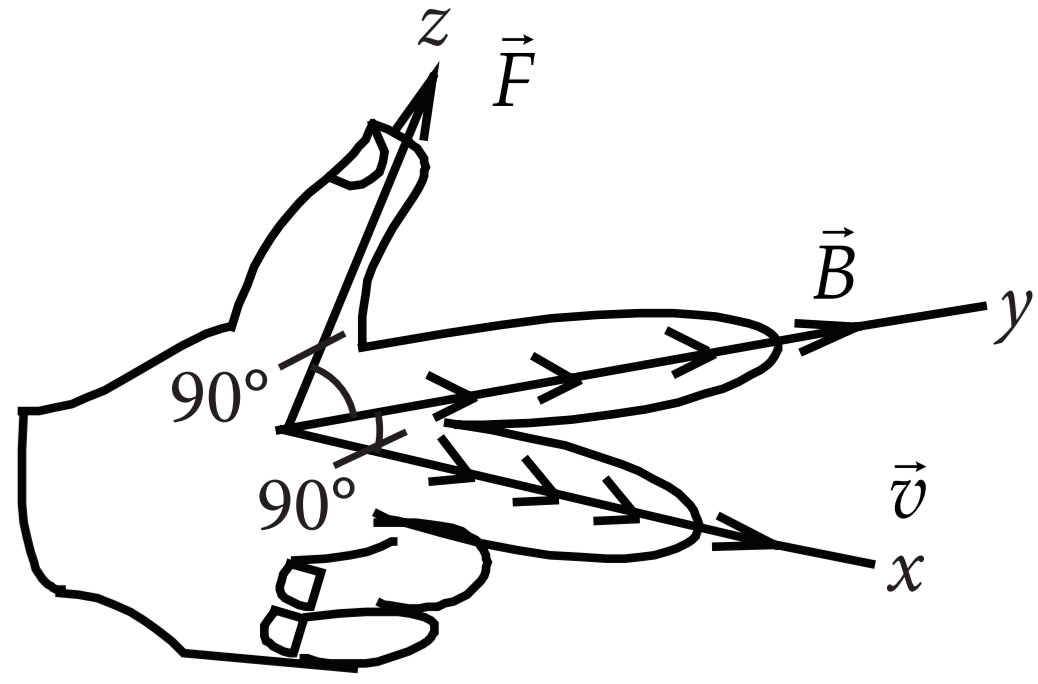
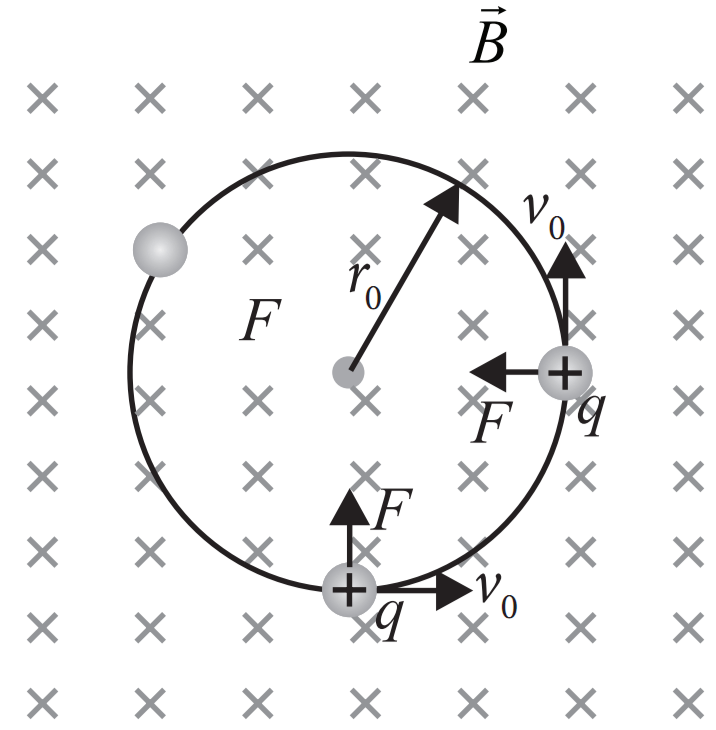
- Magnetic force on the electron provides the required centripetal force of the electron. Hence, the electron traces a circular path of radius r.
Magnetic force on the electron is given by the relation,
$\text{B ev}$
$\text{Centripetal force}=\frac{\text{mv}^{2}}{\text{r}}$
$\therefore\text{Bev}=\frac{\text{mv}^{2}}{\text{r}}$
$\text{r}=\frac{\text{mv}}{\text{Be}}.........(2)$
From equations (1) and (2), we get
$\text{r}=\frac{\text{m}}{\text{Be}}\Big[\frac{2\text{ev}}{\text{m}}\Big]^{\frac{1}{2}}$
$=\frac{9.1\times10^{-31}}{0.15\times1.6\times10^{-19}}\times\Big(\frac{2\times1.6\times10^{-19}\times2\times10^{3}}{9.1\times10^{-31}}\Big)^{\frac{1}{2}}$
$=100.55\times10^{-5}$
$=1.01\times10^{-3}\text{m}$
$=1\text{mm}$
Hence, the electron has a circular trajectory of radius 1.0 mm normal to the magnetic field.
- When the field makes an angle θ of 30° with initial velocity, the initial velocity will be,
$\text{v}_{1}=\text{v}\sin\theta$
From equation (2), we can write the expression for new radius as:
$\text{r}_{1}=\frac{\text{mv}_{1}}{\text{Be}}$$=\frac{\text{mv}\sin\theta}{\text{Be}}$
$=\frac{9.1\times10^{-31}}{0.15\times1.6\times10^{-19}}\times\Big(\frac{2\times1.6\times10^{-19}\times2\times10^{3}}{9\times10^{-31}}\Big)^{\frac{1}{2}}\times\sin30^{\circ}$
$=0.5\times10^{-31}\text{m}$
$=0.5\text{mm}$
Hence, the electron has a helical trajectory of radius 0.5 mm along the magnetic field direction.