Question
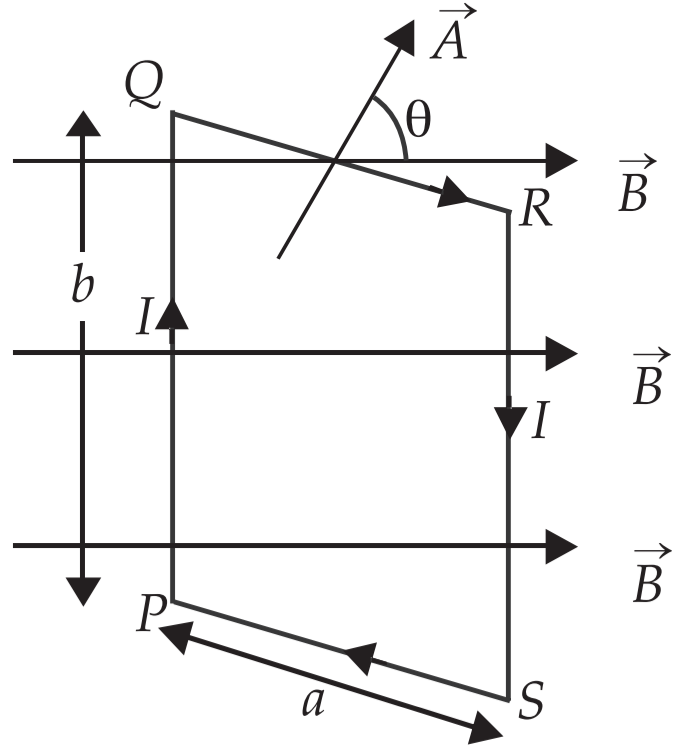
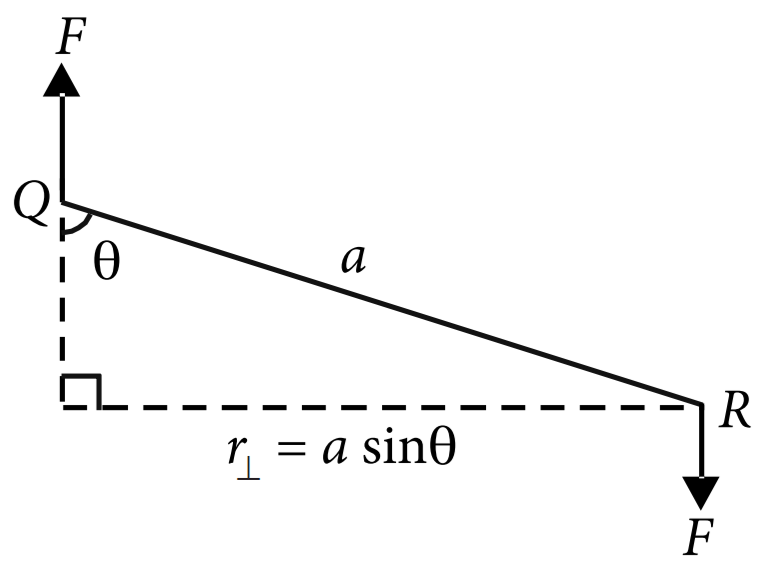
When a rectangular loop PQRS of sides' a' and' b' carrying current I is placed in uniform magnetic field B, such that area vector ii makes an angle 8 with direction of magnetic field, then forces on the arms QR and SP of loop are equal, opposite and collinear, thereby perfectly cancel each other, whereas forces on the arms PQ and RS of loop are equal and opposite but not collinear, so they give rise to torque on the loop.
- A circular loop of area 1cm2, carrying a current of 10A is placed in a magnetic field of 0.1T perpendicular to the plane of the loop. The torque on the loop due to the magnetic field is:
- Zero
- 10-4Nm
- 10-2Nm
- 1Nm
- Relation between magnetic moment and angular velocity is:
- $\text{m}\propto\omega$
- $\text{m}\propto\omega^2$
- $\text{m}\propto\sqrt{\omega}$
- None of these.
- A current loop in a magnetic field:
- Can be in equilibrium in two orientations, both the equilibrium states are unstable.
- Can be in equilibrium in two orientations, one stable while the other is unstable.
- Experiences a torque whether the field is uniform or non uniform in all orientations.
- Can be in equilibrium in one orientation.
- The magnetic moment of a current I carrying circular coil of radius rand number of turns N varies as:
- $\frac{1}{\text{r}^2}$
- $\frac{1}{\text{r}}$
- $\text{r}$
- $\text{r}^2$
- A rectangular coil carrying current is placed in a non-uniform magnetic field. On that coil the total:
- Force is non-zero.
- Force is zero.
- Torque is zero.
- ZNone of these.