Question
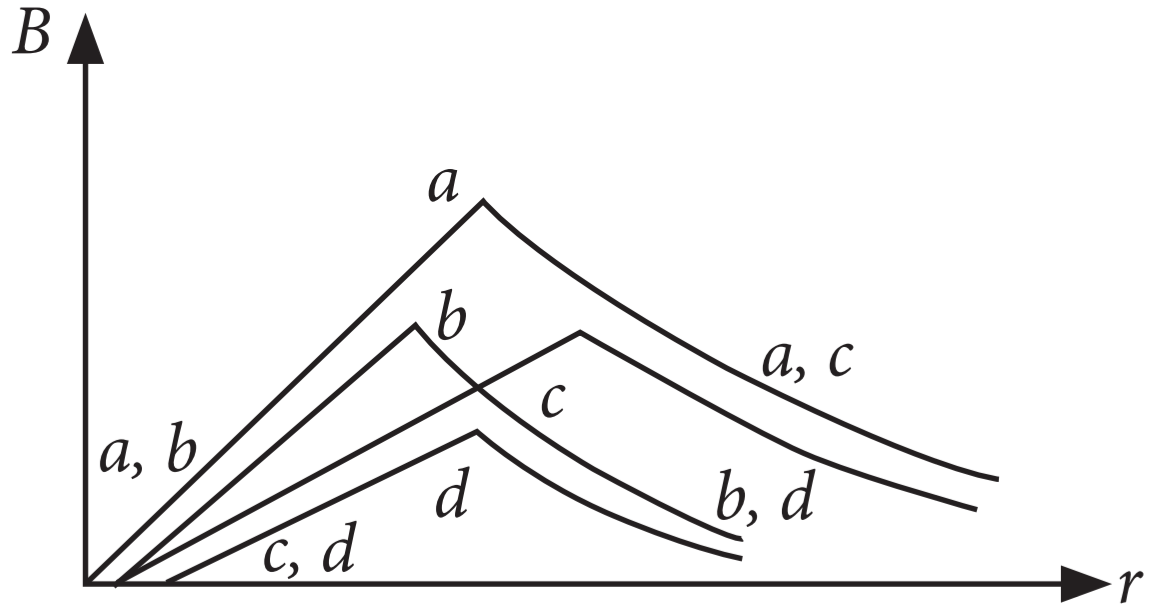
 A magnetic field can be produced by moving, charges or electric currents. The basic equation governing the magnetic field due to a current distribution is the Biot-Savart law. Finding the magnetic field resulting from a current distribution involves the vector product, and is inherently a calculas problem when the distance from the current to the field point is continuously changing. According to this law, the magnetic field at a point due to a current element of length $\text{d}\vec{\text{I}}$ carrying current I, at a distance r from the element is $\text{dB}=\frac{\mu_0}{4\pi}\frac{\text{I}(\text{d}{\vec{\text{I}}\times\vec{\text{r}}})}{\text{r}^3}$

Biot-Savart law has certain similarities as well as difference with Coloumb's law for electrostatic field e.g., there is an angle dependence in Biot-Savart law which is not present in electrostatic case.

  1. The direction of magnetic field $\text{d}\vec{\text{B}}$ due to a current element $\text{Id}\vec{\text{l}}$ at a point of distance $\vec{\text{r}}$ from it, when a current I passes through a long conductor is in the direction
  1. Of position vector $\vec{\text{r}}$ of the point.
  2. Of current element $\text{Id}\vec{\text{l}}$
  3. Perpendicular to both $\text{d}\vec{\text{l}}$ and $\vec{\text{r}}$
  4. Perpendicular to $\text{d}\vec{\text{l}}$ only.
  1. The magnetic field due to a current in a straight wire segment of length Lat a point on its perpendicular bisector at a distance r (r >> L)
  1. Decreases as $\frac{1}{\text{r}}$

  2. Decreases as $\frac{1}{\text{r}^2}$

  3. Decreases as $\frac{1}{\text{r}^3}$

  4. approaches a finite limit as $\text{r}\rightarrow\infty$
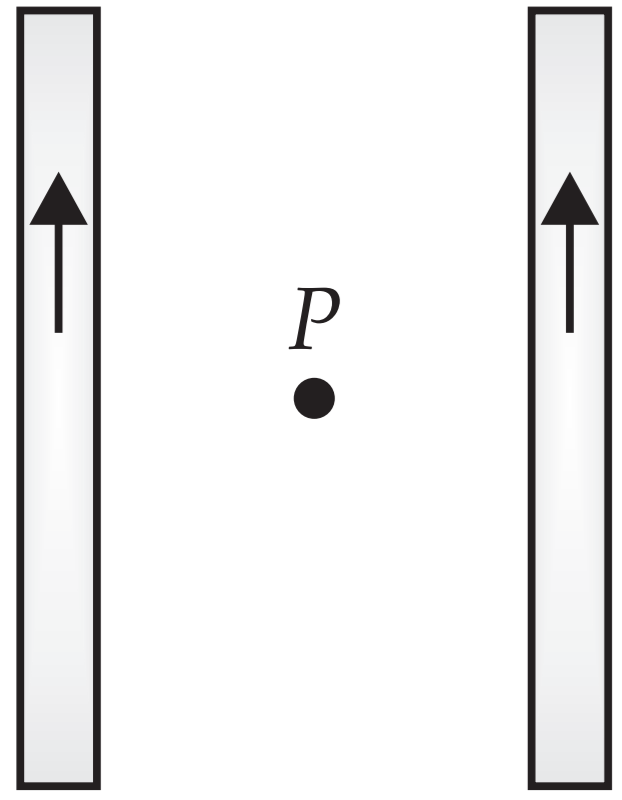
  1. Two long straight wires are set parallel to each other. Each carries a current i in the same direction and the separation between them is 2r. The intensity of the magnetic field midway between them is:
  1. $\mu_0\frac{\text{i}}{\text{r}}$

  2. $4\mu_0\frac{\text{i}}{\text{r}}$

  3. $\text{Zero}$

  4. $\mu_0\frac{\text{i}}{\text{4r}}$

  1. A long straight wire carries a current along the z-axis for any two points in the x - y plane. Which of the following is always false?
  1. The magnetic fields are equal.
  2. The directions of the magnetic fields are the same.
  3. The magnitudes of the magnetic fields are equal.
  4. The field at one point is opposite to that at the other point.
  1. Biot-Savart law can be expressed alternatively as:
  1. Coulomb's Law.
  2. Ampere's circuital law.
  3. Ohm's Law.
  4. Gauss's Law. 

Answer

  1. (c) Perpendicular to both $\text{d}\vec{\text{l}}$ and $\vec{\text{r}}$

Explanation:

According to Biot-Savart's law, the magnetic induction due to a current element is given by,

$\text{d}\vec{\text{B}}=\frac{\mu_0}{4\pi}\frac{\text{Id}\vec{\text{l}\times\text{r}}}{\text{r}^3}$

This is perpendicular to both $\text{d}\vec{\text{l}}$ and $\vec{\text{r}}.$

  1. (b) Decreases as

Explanation:

From Biot-savart's law, $\text{dB}=\frac{\mu_0}{4\pi}\frac{\text{Idl}}{\text{r}^2}\text{i.e. dB}\propto\frac{1}{\text{r}^2}$

  1. (c) $\text{Zero}$

Explanation:

$\text{B}=\frac{\mu_0}{2\pi}.\frac{\text{i}}{\text{r}}-\frac{\mu_0}{2\pi}.\frac{\text{i}}{\text{r}}=0$

  1. (a) The magnetic fields are equal.
  1. (b) Ampere's circuital law.

Explanation:

Biot-Savart law can be expressed alternatively as Ampere circuital law.

Need a full question paper?

Generate a complete, print-ready paper with questions like this in minutes — across 16+ boards, with answer keys.

Start Generating Free

Similar questions

The Q value of a nuclear reaction $A + b \rightarrow C +d$ is defined by $Q =\left[m_{ A }+\right.$ $\left.m_{ b }-m_{ C }-m_{ d }\right] c^2$ where the masses refer to the respective nuclei. Determine from the given data the Q -value of the following reactions and state whether the reactions are exothermic or endothermic.
(i) ${ }_1^1 H +{ }_1^3 H \rightarrow{ }_1^2 H +{ }_1^2 H$
(ii) ${ }_6^{12} C +{ }_6^{12} C \rightarrow{ }_{10}^{20} Ne +{ }_2^4 He$
Atomic masses are given to be :
$m \left({ }_1^2 H \right)=2.014102 u, m\left({ }_1^3 H \right)=3.016049 u$,$m \left({ }_6^{12} 12 C \right)=12.000000 u$ $m \left({ }_{10}^{20} Ne \right)=19.992439 u$
Two long bar magnets are placed with their axes coinciding in such a way that the north pole of the first magnet is 2·0cm from the south pole of the second. If both the magnets have a pole strength of 10A-m, find the force exerted by one magnet on the other.
Obtain the relation of phase between instantaneous current and voltage with the help of phase diagram for series LCR circuit.
Why do marine animals live deep inside a lake when the surface of the lake freezes?
An elevator is descending with uniform acceleration. To measure the acceleration, a person in the elevator drops a coin at the moment the elevator starts. The coin is 6ft above the floor of the elevator at the time it is dropped. The person observes that the coin strikes the floor in 1 second. Calculate from these data the acceleration of the elevator.
The photon picture of electromagnetic radiations and the characteristic properties of photons are as follows: ln the interaction ofradiation with matter, radiation behaves as ifit is made of particles like photons. 
Each photon has energy $\text{E}\Big(=\text{h}\upsilon=\frac{\text{hc}}{\lambda}\Big)$ and momentum $\text{p}\Big(=\frac{\text{h}\upsilon}{\text{c}}=\frac{\text{h}}{\lambda}\Big),$ where h is Planck's constant, $\upsilon$ and $\lambda$ are the frequency and wavelength of radiation and c is the velocity of light.
The photon energy is independent of the intensity of radiations.
All the photons emitted from a source of radiations travel through space with the same speed c. The frequency of photon gives the radiation, a definite energy (or colour) which does not change when photon travels through different media.
Photons are not deflected by electric and magnetic fields. This shows that photons are electrically neutral.
  1. Which one among the following shows particle nature of tight?
  1. Photoelectric effect
  2. Interference
  3. Refraction
  4. Polarization
  1. Which of the following statements about photon is incorrect?
  1. Photons exert no pressure.
  2. Momentum of photon is $\frac{\text{h}\upsilon}{\text{c}}$.
  3. Rest mass of photon is zero.
  4. Energy of photon is $\text{h}\upsilon$.
  1. The rest mass of photon is:
  1. $\frac{\text{h}\upsilon}{\text{c}}$
  2. $\frac{\text{h}\upsilon}{\text{c}^2}$
  3. $\frac{\text{h}\upsilon}{\lambda}$
  4. Zero
  1. ln a photon-particle collision (such as photon-electron collision), which of the following may not be conserved?
  1. Total energy.
  2. Number of photons.
  3. Total momentum.
  4. Both (a) and (b).
  1. 'n' photons of wavelength $'\lambda'$ are absorbed by a black body of mass 'm'. The momentum gained by the body is:
  1. $\frac{\text{h}}{\text{m}\lambda}$
  2. $\frac{\text{mnh}}{\lambda}$
  3. $\frac{\text{nh}}{\text{m}\lambda}$
  4. $\frac{\text{nh}}{\lambda}$
Power (P) of a lens is given by reciprocal of focal length (f) of the lens i.e. $\text{p}=\frac{1}{\text{f}},$ where f is in metre and P is in dioptre. For a convex lens, power is positive and for a concave lens, power is negative. When a number of thin lenses of powers P1, P2, P3, ...... are held in contact with one another, the power of the combination is given by algebraic sum of the powers of all the lenses i.e., P = P1 + P2 + P3 +......
  1. A convex and a concave lens separated by distance d are then put in contact. The focal length of the combination.
  1. Becomes 0.
  2. Remains the same.
  3. Decreases.
  4. Increases.
  1. If two lenses of power +1.5D and +1.0D are placed in contact, then the effective power of combination will be.
  1. 2.5D
  2. 1.5D
  3. 0.5D
  4. 3.25D
  1. If the power of a lens is +5 dioptre, what is the focal length of the lens?
  1. 10cm
  2. 20cm
  3. 15cm
  4. 5cm
  1. Two thin lenses of focal lengths +10cm and -5cm are kept in contact. The power of the combination is:
  1. -10D
  2. -20D
  3. 10D
  4. 15D
  1. A convex lens of focal length 25cm is placed coaxially in contact with a concave lens of focal length 20cm. The system will be.
  1. Converging in nature.
  2. Diverging in nature.
  3. Can be converging or divergin.
  4. None of the above.
A 4.0kg block is suspended from the ceiling of an elevator through a, string having a linear mass density of 19.2 × 10-3kg/m. Find the speed (with respect to the string) with which a wave pulse can proceed on the string if the elevator accelerates up at the rate of 2.0m/s2. Take g = 10m/s2.
Mention the changes occurring in the geomagnetic components.