MCQ 2011 Mark
Mass number is denoted by:
- AD
- BS
- CA
- DZ
Answer
View full question & answer→- A
Explanation:
The mass number (A) is the number of nucleons, which is the total number of protons and neutrons in the nucleus of an atom.
Explanation:
The mass number (A) is the number of nucleons, which is the total number of protons and neutrons in the nucleus of an atom.
Explanation:
The Q value for a reaction is the amount of energy released by that reaction.
In beta decay, a typical Q is around 1 MeV.
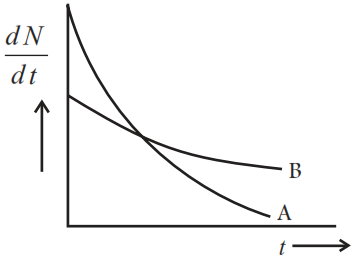
Solution:
It can be observed from the figure that the slope of curve A is greater that thet of curve B, it means the rate of decay is faster for A than that of B.
According to Rutherford and Soddy law for radioactive decay $-\Big(\frac{\text{dN}}{\text{dt}}\Big)\propto\lambda$, where decay,
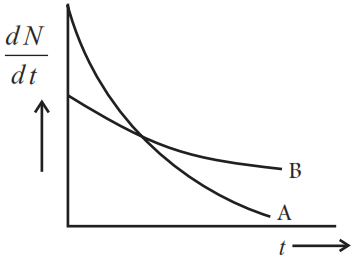
Hence at point P, rate of decay for both A and B is the same.
Explanation:
C13 + energy → C12 + n
Energy required to remove one neutron = Difference in total binding energy
= 13 × 7.74 − 12 × 7.68MeV
= 8.46MeV
Explanation:
Fusion reaction takes place at 107k
So, the correct choice is 3×10⁶K
Explanation:
In nuclear physics,nuclear fusion is a nuclear reaction in which two or more atomic nuclei collide at very high speed and join to form a new type of atomic nucleus. During this process matter is not conserved because some of the matter of fusing nuclei is converted to photons also known as thermonuclear reaction.
Explanation:
In a nuclear reactor, a large fissile atomic nucleus like uranium-235 absorbs a thermal neutron and undergoes a nuclear fission reaction. The heavy nucleus splits into two or more lighter nuclei releasing gamma radiation and free neutrons.
Explanation:
The atomic number = Z = no. of protons = p
The mass no. = A = no. of protons (p) + no. of neutrons(n) = n + p
Explanation:
The mass of 1 amu is equivalent to an energy of 931 MeV.
Explanation:
The order of magnitude of nuclear radii is 1 fermi = 10−15 meters.
Explanation:
Atomic mass (u) of Calcium is 40 u.
Explanation:
Deuterium: $\frac{2}{1}$H
Mass number: A = 2
Atomic number (or number of protons), Z = 1
Number of neutrons, Nn = A − Z = 2 − 1 = 1
Explanation:
Binding energy of a nucleus is defined as the energy required to break the nucleus into its constituents. It is also measured as the Q-value of the breaking of nucleus, i.e. the difference between the rest energies of reactants (nucleus) and the products (nucleons) or the difference between the kinetic energies of the products and the reactants.
Explanation:
Nuclear binding energy can be computed from the difference in mass of a nucleus, and the sum of the masses of the number of free neutrons and protons that make up the nucleus. Once this mass difference, called the mass defect or mass deficiency, is known, Einstein's mass-energy equivalence formula can be used to compute the binding energy of any nucleus.
Early nuclear physicists used to refer to computing this value as a "packing fraction" calculation.
Explanation:
Negative beta decay is given as
$\text{n}\rightarrow\text{p + e}^-+\bar{\text{v}}$
Neutron decays to produce proton, electron and anti-neutrino.
Explanation:
Isotopes are atoms of the same element having the same numbers of protons, but different numbers of neutrons. They have same chemical properties due to the same electronic configuration but different physical properties.
Explanation:
An exothermic reaction is that in which heat is released.
An exothermic reaction is that in which heat is absorbed.
In a nuclear reaction, if the mass of the product nucleus and outgoing particle is less than the mass of the target nucleus and bombarding particle, then energy is released (exothermic reaction), and Q-value is +ve.
Explanation:
Binding energy per nucleon varies in a way that it depends on the actual value of mass number (A). As the mass number (A) increases, the binding energy also increases and reaches its maximum value of 8.7MeV for A(50-80) and for A > 100. The binding energy per nucleon decreases as A increases and the nucleus breaks into two or more atoms of roughly equal parts so as to attain stability and binding energy of mass number between 50-80.
Explanation:
The mass of an atom expressed in amu is known as atomic mass. atomic mass unit defined as a unit of mass used to express atomic and molecular weights, equal to one-twelfth of the mass of an atom of carbon-12.