Questions · Page 2 of 11

M.C.Q (1 Marks)

Question 511 Mark

A luminous object is placed at a distance of 30 cm from the convex lens of focal length 20 cm. On the other side of the lens, at what distance from the lens a convex mirror of radius of curvature 10 cm be placed in order to have an upright image of the object coincident with it

(a) 12 cm

(b) 30 cm

(c) 50 cm

(d) 60 cm

Answer

(c) 50 cm

View full question & answer
Question 521 Mark

In a compound microscope, if the objective produces an image Iand the eye piece produces an image Ie, then

(a) Io is virtual but Ie is real  

(b) Io is real but Ie is virtual 

(c) Io and Ie are both real  

(d) Io and Ie are both virtual 

Answer

(b) Io is real but Ie is virtual 

View full question & answer
Question 531 Mark

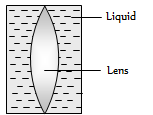
Shown in the figure here is a convergent lens placed inside a cell filled with a liquid. The lens has focal length + 20 cm when in air and its material has refractive index 1.50. If the liquid has refractive index 1.60, the focal length of the system is

(a) + 80 cm

(b) – 80 cm

(c) – 24 cm

(d) –100 cm

Answer

(d) –100 cm

View full question & answer
Question 541 Mark

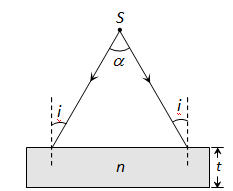
A diverging beam of light from a point source S having divergence angle a, falls symmetrically on a glass slab as shown.  The angles of incidence of the two extreme rays are equal.  If the thickness of the glass slab is t and the refractive index n, then the divergence angle of the emergent beam is

(a) Zero

(b) α

(c)  

(d) 2 

Answer

(b) α

View full question & answer
Question 551 Mark

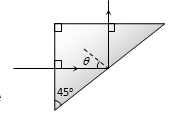
A triangular prism of glass is shown in the figure. A ray incident normally to one face is totally reflected, if θ = 45° . The index of refraction of glass is

(a) Less than 1.41

(b) Equal to 1.41

(c) Greater than 1.41

(d) None of the above

Answer

(c) Greater than 1.41

View full question & answer
Question 561 Mark

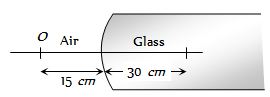
A point object O is placed in front of a glass rod having spherical end of radius of curvature 30 cm.  The image would be formed at

(a) 30 cm left

(b) Infinity

(c) 1 cm to the right

(d) 18 cm to the left

Answer

(a) 30 cm left

View full question & answer
Question 571 Mark

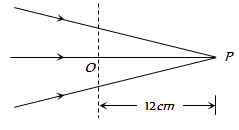
Figure given below shows a beam of light converging at point P.  When a convex lens of focal length 16 cm is introduced in the path of the beam at a place O shown by dotted line such that OP becomes the axis of the lens, the beam converges at a distance x from the lens.  The value x will be equal to

(a) 12 cm

(b) 24 cm

(c) 36 cm

(d) 48 cm

Answer

(d) 48 cm

View full question & answer
Question 581 Mark

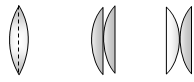
Two similar plano-convex lenses are combined together in three different ways as shown in the adjoining figure. The ratio of the focal lengths in three cases will be

(a) 2 : 2 : 1

(b) 1 : 1 : 1

(c) 1 : 2 : 2

(d) 2 : 1 : 1

Answer

(b) 1 : 1 : 1

View full question & answer
Question 591 Mark

A person can see clearly only upto a distance of 25 cm. He wants to read a book placed at a distance of 50 cm. What kind of lens does he require for his spectacles and what must be its power

(a)  Concave, – 1.0 D

(b)  Convex,  + 1.5 D

(c)  Concave, – 2.0 D

(d)  Convex, + 2.0 D

Answer

(c)  Concave, – 2.0 D

View full question & answer
Question 601 Mark

A short sighted person can see distinctly only those objects which lie between 10 cm and 100 cm from him. The power of the spectacle lens required to see a distant object is

(a) + 0.5 D

(b) – 1.0 D

(c)  – 10 D

(d)  + 4.0 D

Answer

(b) – 1.0 D

View full question & answer
Question 611 Mark

In human eye the focussing is done by

(a) To and fro movement of eye lens 

(b) To and fro movement of the retina  

(c) Change in the convexity of the lens surface 

(d) Change in the refractive index of the eye fluids

Answer

(c) Change in the convexity of the lens surface 

View full question & answer
Question 621 Mark

For which of the following colour, the magnifying power of a microscope will be maximum

(a) White colour 

(b)  Red colour 

(c) Violet colour 

(d)  Yellow colour 

Answer

(c) Violet colour 

View full question & answer
Question 631 Mark

A man is suffering from colour blindness for green colour. To remove this defect, he should use goggles of

(a) Green colour glasses 

(b) Red colour glasses 

(c) Smoky colour glasses  

(d) None of the above  

Answer

(d) None of the above  

View full question & answer
Question 641 Mark

The sensation of vision in the retina is carried to the brain by

(a) Ciliary muscles

(b)  Blind spot 

(c) Cylindrical lens

(d)  Optic nerve  

Answer

(d)  Optic nerve  

View full question & answer
Question 651 Mark

A person is suffering from myopic defect. He is able to see clear objects placed at 15 cm. What type and of what focal length of lens he should use to see clearly the object placed 60 cm away

(a) Concave lens of 20 cm focal length  

(b) Convex lens of 20 cm focal length  

(c) Concave lens of 12 cm focal length  

(d) Convex lens of 12 cm focal length 

Answer

(a) Concave lens of 20 cm focal length  

View full question & answer
Question 661 Mark

The impact of an image on the retina remains for

(a) 0.1 sec

(b)  0.5 sec  

(c) 10 sec

(d)  15 sec 

Answer

(a) 0.1 sec

View full question & answer
Question 671 Mark

The light when enters the human eye experiences most of the refraction while passing through

(a) Cornea  

(b)  Aqueous humour  

(c) Vitrous humour  

(d)  Crystalline lens  

Answer

(a) Cornea  

View full question & answer
Question 681 Mark

A presbyopic patient has near point as 30 cm and far point as 40 cm. The dioptric power for the corrective lens for seeing distant objects is

(a) 40 D   

(b)  4 D  

(c)   – 2.5 D

(d)  0.25 D  

Answer

(c)   – 2.5 D

View full question & answer
Question 691 Mark

If the distance of the far point for a myopia patient is doubled, the focal length of the lens required to cure it will become 

(a) Half  

(b) Double  

(c) The same but a convex lens  

(d) The same but a concave lens  

Answer

(b) Double  

View full question & answer
Question 701 Mark

A man suffering from myopia can read a book placed at 10 cm distance. For reading the book at a distance of 60 cm with relaxed vision, focal length of the lens required will be

(a) 45 cm  

(b) – 20 cm  

(c) – 12 cm  

(d) 30 cm  

Answer

(c) – 12 cm  

View full question & answer
Question 711 Mark

The far point of a myopia eye is at 40 cm. For removing this defect, the power of lens required will be

(a) 40 D   

(b) – 4  D

(c)  – 2.5 D

(d)   0.25 D

Answer

(c)  – 2.5 D

View full question & answer
Question 721 Mark

A man can see the object between 15 cm and 30 cm. He uses the lens to see the far objects. Then due to the lens used, the near point will be at 

(a)   cm  

(b) 30 cm  

(c) 15 cm  

(d)  cm  

Answer

(b) 30 cm  

View full question & answer
Question 731 Mark

A man can see the objects upto a distance of one metre from his eyes. For correcting his eye sight so that he can see an object at infinity, he requires a lens whose power is

(a) + 0.5 D

(b)  + 1.0 D  

(c) + 2.0 D

(d)  – 1.0 D 

Answer

(d)  – 1.0 D 

View full question & answer
Question 741 Mark

Image is formed for the short sighted person at

(a) Retina 

(b) Before retina 

(c) Behind the retina 

(d) Image is not formed at all 

Answer

(b) Before retina 

View full question & answer
Question 751 Mark

Astigmatism (for a human eye) can be removed by using

(a) Concave lens

(b) Convex lens 

(c) Cylindrical lens

(d) Prismatic lens 

Answer

(c) Cylindrical lens

View full question & answer
Question 761 Mark

Substance on the choroid is

(a) Japan black 

(b) Nigrim pigment 

(c) Carbon black 

(d) Platinum black

Answer

(b) Nigrim pigment 

View full question & answer
Question 771 Mark

For the myopic eye, the defect is cured by


(a) Convex lens

(b) Concave lens 

(c) Cylindrical lens

(d) Toric lens 

Answer

(b) Concave lens 

View full question & answer
Question 781 Mark

A far sighted man who has lost his spectacles, reads a book by looking through a small hole (3-4 mm) in a sheet of paper. The reason will be

(a) Because the hole produces an image of the letters at a longer distance 

(b) Because in doing so, the focal length of the eye lens is effectively increased 

(c)  Because in doing so, the focal length of the eye lens is effectively decreased

(d) None of these

Answer

(c)  Because in doing so, the focal length of the eye lens is effectively decreased

View full question & answer
Question 791 Mark

If refractive index of red, violet and yellow lights are 1.42, 1.62 and 1.50 respectively for a medium. Its dispersive power will be

(a) 0.4

(b) 0.3

(c) 0.2

(d) 0.1

Answer

(a) 0.4

View full question & answer
Question 801 Mark

Two lenses having   has combination to make no dispersion. Find the ratio of dispersive power of glasses used

(a) 2 :  3

(b) 3 : 2

(c) 4 : 9

(d) 9 : 4

Answer

(a) 2 :  3

View full question & answer
Question 811 Mark

For a medium, refractive indices for violet, red and yellow are 1.62, 1.52 and 1.55 respectively, then dispersive power of medium will be

(a) 0.65

(b) 0.22

(c) 0.18

(d) 0.02

Answer

(c) 0.18

View full question & answer
Question 821 Mark

The path of a refracted ray of light in a prism is parallel to the base of the prism only when the

(a) Light is of a particular wavelength

(b) Ray is incident normally at one face

(c) Ray undergoes minimum deviation

(d) Prism is made of a particular type of glass

Answer

(c) Ray undergoes minimum deviation

View full question & answer
Question 831 Mark

Line spectra are due to

(a) Hot solids

(b) Atoms in gaseous state

(c) Molecules in gaseous state

(d) Liquid at low temperature

Answer

(b) Atoms in gaseous state

View full question & answer
Question 841 Mark

Dark lines on solar spectrum are due to

(a) Lack of certain elements

(b) Black body radiation

(c) Absorption of certain wavelengths by outer layers

(d) Scattering

Answer

(c) Absorption of certain wavelengths by outer layers

View full question & answer
Question 851 Mark

A white screen illuminated by green and red light appears to be

(a) Green  

(b) Red

(c) Yellow

(d) White

Answer

(c) Yellow

View full question & answer
Question 861 Mark

The splitting of white light into several colours on passing through a glass prism is due to

(a) Refraction

(b) Reflection

(c) Interference

(d) Diffraction

Answer

(a) Refraction

View full question & answer
Question 871 Mark

Image formed on the retina is

(a) Real and inverted 

(b) Virtual and erect 

(c) Real and erect 

(d) Virtual and inverted

Answer

(a) Real and inverted 

View full question & answer
Question 881 Mark

A ray passes through a prism of angle 60° in minimum deviation position and suffers a deviation of 30°. What is the angle of incidence on the prism

(a) 30°

(b) 45°

(c) 60°

(d) 90°

Answer

(b) 45°

View full question & answer
Question 891 Mark

A source emits light of wavelength 4700Å, 5400 Å and 6500 Å. The light passes through red glass before being tested by a spectrometer. Which wavelength is seen in the spectrum

(a) 6500 Å

(b) 5400 Å

(c) 4700 Å

(d) All the above

Answer

(a) 6500 Å

View full question & answer
Question 901 Mark

Missing lines in a continuous spectrum reveal

(a) Defects of the observing instrument

(b) Absence of some elements in the light source

(c) Presence in the light source of hot vapours of some elements

(d) Presence of cool vapours of some elements around the light source

Answer

(d) Presence of cool vapours of some elements around the light source

View full question & answer
Question 911 Mark

How should people wearing spectacles work with a microscope

(a) They cannot use the microscope at all 

(b) They should keep on wearing their spectacles

(c) They should take off spectacles 

(d) (b) and (c) is both way 

Answer

(c) They should take off spectacles 

View full question & answer
Question 921 Mark

When light of wavelength λ  is incident on an equilateral prism kept in its minimum deviation position, it is found that the angle of deviation equals the angle of the prism itself. The refractive index of the material of the prism for the wavelength λ  is, then

(a)   

(b)  

(c) 2  

(d)  

Answer

(a)   

View full question & answer
Question 931 Mark

A thin prism  with angle 6° and made from glass of refractive index 1.54 is combined with another thin prism P2 of refractive index 1.72 to produce dispersion without deviation. The angle of prism   will be

(a) 5° 24’

(b) 4° 30’

(c) 6°

(d) 8°

Answer

(b) 4° 30’

View full question & answer
Question 941 Mark

White light is passed through a prism whose angle is 5°. If the refractive indices for rays of red and blue colour are respectively 1.64 and 1.66, the angle of deviation between the two colours will be

(a) 0.1 degree

(b) 0.2 degree

(c) 0.3 degree

(d) 0.4 degree

Answer

(a) 0.1 degree

View full question & answer
Question 951 Mark

The wavelength of emission line spectrum and absorption line spectrum of a substance are related as

(a) Absorption has larger value

(b) Absorption has smaller value

(c) They are equal

(d) No relation

Answer

(c) They are equal

View full question & answer
Question 961 Mark

A man can see only between 75 cm and 200 cm. The power of lens to correct the near point will be

(a) + 8/3 D

(b)  + 3 D

(c) – 3 D  

(d)  – 8/3 D

Answer

(a) + 8/3 D

View full question & answer
Question 971 Mark

A man who cannot see clearly beyond 5 m wants to see stars clearly. He should use a lens of focal length

(a) – 100 m

(b)  + 5 m

(c) – 5 m 

(d) Very large 

Answer

(c) – 5 m 

View full question & answer
Question 981 Mark

A person cannot see distinctly at the distance less than one metre. Calculate the power of the lens that he should use to read a book at a distance of 25 cm

(a) + 3.0 D

(b)  + 0.125 D

(c) – 3.0  D

(d)  + 4.0 D

Answer

(a) + 3.0 D

View full question & answer
Question 991 Mark

The refractive index of flint glass for blue F line is 1.6333 and red C line is 1.6161. If the refractive index for yellow D line is 1.622, the dispersive power of the glass is

(a) 0.0276

(b) 0.276

(c) 2.76

(d) 0.106

Answer

(a) 0.0276

View full question & answer
Question 1001 Mark

If there had been one eye of the man, then

(a) Image of the object would have been inverted

(b) Visible region would have decreased 

(c) Image would have not been seen three dimensional

(d) (b) and (c) both 

Answer

(d) (b) and (c) both 

View full question & answer