Questions · Page 2 of 2

3 Marks Question

Question 513 Marks
What is the shape of the wavefront on earth for sunlight?
Answer
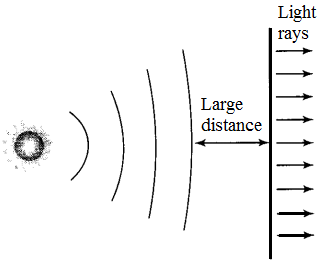
The sun is at very large distance from the earth. Assuming sun as spherical, it can be considered as point source situated at infinity. We can treat it like a point object as seen from the surface of earth.
Because of large distance, the radius of wavefront can be considered as Large (infinity) and hence, wavefront is almost plane.
View full question & answer
Question 523 Marks
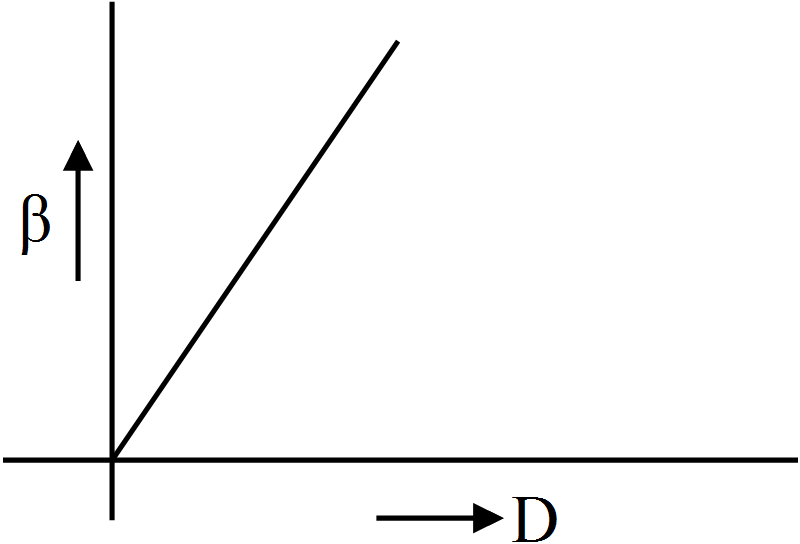
Sketch a graph showing the variation of fringe width versus the distance of the screen from the plane of the slits (keeping other parameters same) in Young’s double slit experiment. What information can one obtain from the slope of this graph?
Answer
We know that the fringe width is given by:

$\beta=\lambda\frac{\text{D}}{\text{d}}$

$\Rightarrow \beta=\frac{\lambda}{\text{d}}\text{D}$

The graph between β and D is shown alongside

The slope of graph $=\frac{\lambda}{\text{d}}$

Knowing d, the wavelength of light used can be calculated to be

$\lambda= \text{Slope of graph}\times \text{d.}$ 

View full question & answer
Question 533 Marks
In Young’s double slit experiment, explain with reason in each case, how the interference pattern changes, when :
  1. Width of the slits is doubled.
  2. Separation between the slits is increased.
  3. Screen is moved away from the plane of slits.
Answer
  1. The fringe width $\beta= \frac{\text{D}\lambda}{\text{d}}.$
  2. When the width of the slit is doubled; the intensity of interfering waves becomes four times, intensity of maxima becomes 16 times i.e., fringes become brighter.
  3. When separation between the slits is increased the fringe width decreases, i.e., fringes come closer.
  4. $\beta \alpha\text {D }$ when screen is moved away from the plane of the slits, the fringe width increases, i.e., fringes become farther away.
View full question & answer
Question 543 Marks
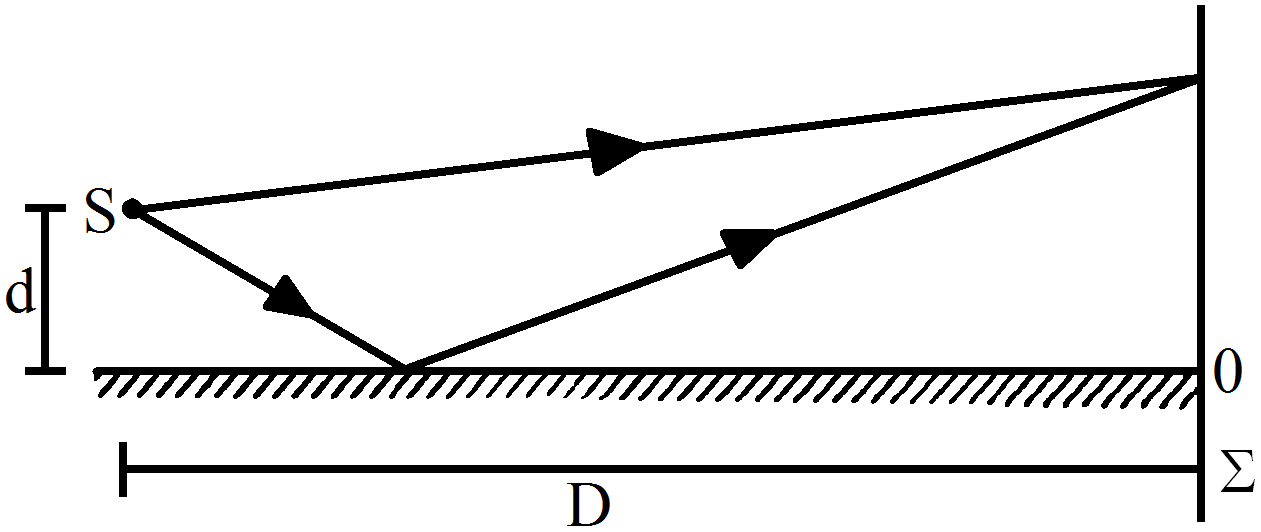
A narrow slit S transmitting light of wavelength $\lambda$ is placed a distance d above a large plane mirror as shown in figure (17-E1). The light coming directly from the slit and that coming after the reflection interfere at a screen $\sum$ placed at a distance D from the slit.

  1. What will be the intensity at a point just above the mirror, i.e., just above O?
  2. At what distance from 0 does the first maximum occur?
Answer
  1. Since, there is a phase difference of $\pi$ between direct light and reflecting light, the intensity just above the mirror will be zero.
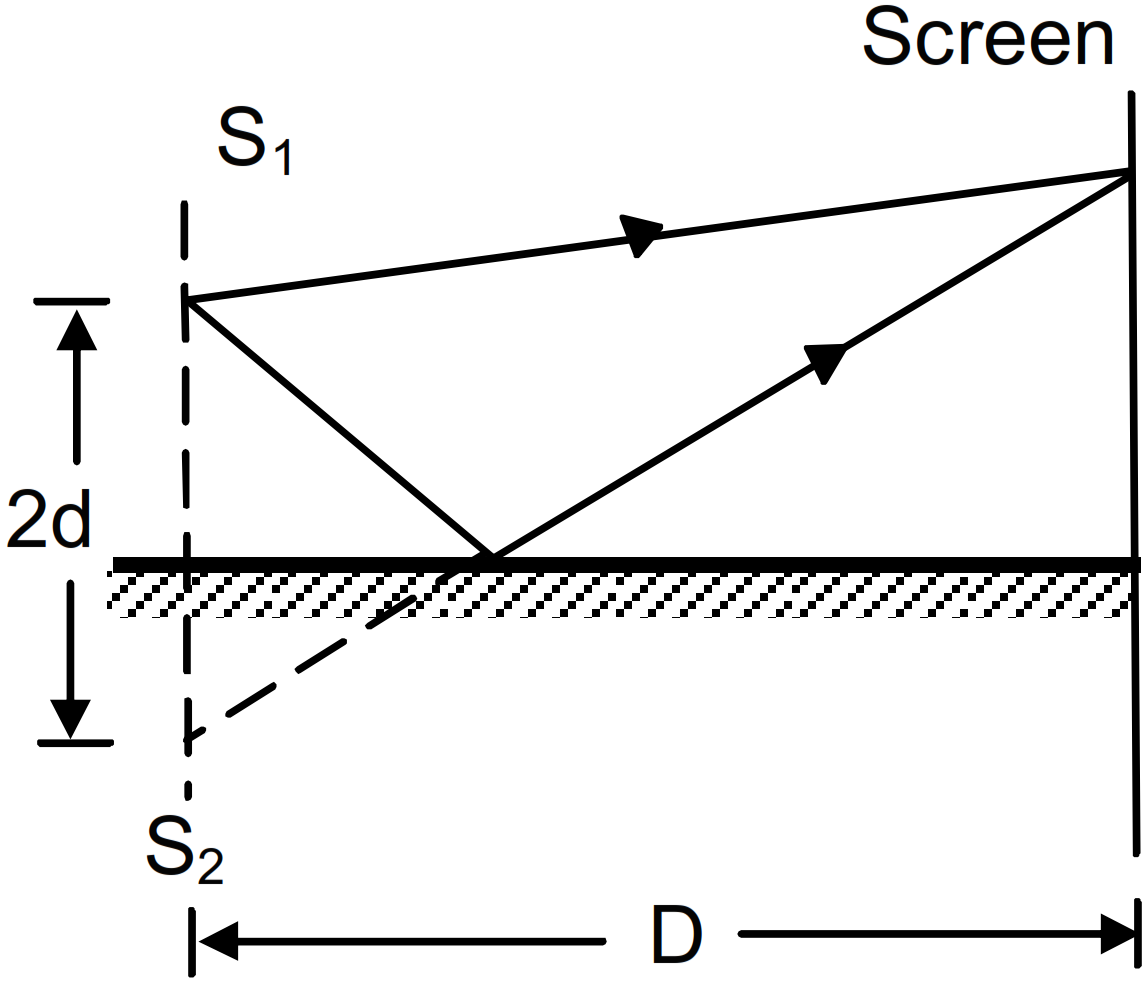
  2. Here, 2d = equivalent slit separation

D = Distance between slit and screen.

We know for bright fringe, $\Delta\text{x}=\frac{\text{y}\times2\text{d}}{\text{D}}=\text{n}\lambda$

But as there is a phase reversal of $\frac{\lambda}{2}.$

$\Rightarrow\frac{\text{y}\times2\text{d}}{\text{D}}+\frac{\lambda}{2}=\text{n}\lambda$

$\Rightarrow\frac{\text{y}\times2\text{d}}{\text{D}}=\text{n}\lambda-\frac{\lambda}{2}\Rightarrow\text{y}=\frac{\lambda\text{D}}{4\text{d}}$

View full question & answer
Question 553 Marks
The index of refraction of fused quartz is 1.472 for light of wavelength 400nm and is 1.452 for light of wavelength 760nm. Find the speeds of light of these wavelengths in fused quartz.
Answer
We know that, $\frac{\mu_2}{\mu_1}=\frac{\text{v}_1}{\text{v}_2}$

So, $\frac{1472}{1}=\frac{3\times10^8}{\text{v}_{400}}\Rightarrow\text{v}_{400}=2.04\times10^8\text{m/sec}.$

[because, for air, $\mu=1\ \text{and v}=3\times10^8\text{m/s}]$

Again, $\frac{1452}{1}=\frac{3\times10^8}{\text{v}_{760}}\Rightarrow\text{v}_{760}=2.07\times10^8\text{m/sec}.$

View full question & answer
3 Marks Question - Page 2 - Physics STD 12 Science Questions - Vidyadip