Questions · Page 3 of 4

M.C.Q (1 Marks)

MCQ 1011 Mark
A microscope is used with sodium light and its resolving power is not sufficiently large. Higher resolution will be obtained by using wavelength of:
  • A
    20 micron
  • B
    2 micron
  • C
    1 micron
  • D
    400$\mathring{\text{A}}$
Answer
  1. 400$\mathring{\text{A}}$

Explanation:

Since power of resolution is more for violet than for red, we conclude that resolving power is greater for light with lower wavelengths.

Wavelength of sodium light is around 589nm.

Hence resolving power increases for light with lower wavelength.
View full question & answer
MCQ 1021 Mark
Two nearby objects are just resolved, if the principle maximum in the diffraction pattern of one coincides with:
  • A
    Principal maxima of other
  • B
    First minimum of the other
  • C
    Half-way between principal maximum and first minimum.
  • D
    Second maximum of the other
Answer
  1. First minimum of the other

Explanation:

The Rayleigh criterion is the generally accepted criterion for the minimum resolvable detail - the imaging process is said to be diffraction-limited when the first diffraction minimum of the image of one source point coincides with the maximum of another.

View full question & answer
MCQ 1031 Mark
The magnitude of magnifying power of an astronomical telescope is 5, the focal power of its eyepiece is 10 diopters. The focal power of its objective (in diopters) is:
  • A
    1
  • B
    2
  • C
    3
  • D
    4
Answer
  1. 2

Explanation:

M = 5

Pe = 10

$\frac{1}{\text{f}_\text{e}}=10$

fe​ = $\frac{1}{10}$m = 10cm

M = $\frac{\text{f}_\text{0}}{\text{f}_\text{e}}$​​ =5

f​= 50cm

P = 2D

View full question & answer
MCQ 1041 Mark
A thin transparent sheet is placed in front of a Young's double slit. The fringe-width will:
  • A
    Increase.
  • B
    Decrease.
  • C
    Remain same.
  • D
    Become nonuniform.
Answer
  1. Remain same.

Explanation:

On the introduction of a transparent sheet in front of one of the slits, the fringe pattern will shift slightly but the width will remain the same.

View full question & answer
MCQ 1051 Mark
Which of the following is correct for light diverging from a point source?
  • A
    The intensity decreases in proportion for the distance squared.
  • B
    The wavefront is parabolic.
  • C
    The intensity at the wavelength does not depend on the distance.
  • D
    None of these.
Answer
  1. The intensity decreases in proportion for the distance squared.

Explanation:

A point source produces a spherical wavefront that moves in all the directions from the point.

Whereas the intensity at the wavelength is dependent on the distance and it follows the inverse square law. So, the intensity decreases with an increase in the distance from the source.

View full question & answer
MCQ 1061 Mark
In YDSE, the slit widths are in the ratio of 1:9. The ratio of intensity of the maxima to that of the minima is:
  • A
    81:1
  • B
    9:1
  • C
    4:1
  • D
    3:1
Answer
  1. 4:1

Explanation:

Intensity is proportional to the area of the slit.

As slit widths are in the ratio of 1:9

The areas are also in the ratio 1:9

Thus Intensities are in the ratio 1:9

amplitudes are square root of Intensities

Thus amplitudes are in ratio 1:3

Let amplitudes be x and 3x

At maxima the amplitudes get added up x + 3x = 4x

At minima they become x − 3x = −2x

Intensity of maxima to minima is $\frac{16\text{x}^2}{4\text{x}^2}=\frac{4}{1}$

View full question & answer
MCQ 1071 Mark
In optical instruments, the lenses are used to form images by:
  • A
    Reflection
  • B
    Refraction
  • C
    Dispersion
  • D
    Scattering
Answer
  1. Refraction

Explanation:

In optical instruments, the lenses are used to form images by Refraction.

View full question & answer
MCQ 1081 Mark
The interfering fringes formed by a thin oil film on water are seen in yellow light of sodium lamp. We find the fringes:
  • A
    Coloured
  • B
    Black and white
  • C
    Yellow and black
  • D
    Coloured white yellow
Answer
  1. Yellow and black

Explanation:

When the yellow light of sodium lamp interferes constructively we get yellow bright band, and when they interfere destructively we get black bark band.

View full question & answer
MCQ 1091 Mark
The speed at which the current travels in a conductor, is nearly.
  • A
    3×10⁴ms−1
  • B
    3×10⁵ms−1
  • C
    4×10⁶ms−1
  • D
    3×10⁸ms−1
Answer
  1. 3×10⁸ms−1

Explanation:

The speed of the current in the conductor is the same as the speed of light in the vacuum which is 3×10⁸$\frac{\text{m}}{\text{s}}$

View full question & answer
MCQ 1101 Mark
Anti-nodal curves represent the points joining:
  • A
    Destructive interference
  • B
    Constructive interference
  • C
    Equal pressure curves
  • D
    Zero pressure curves
Answer
  1. Constructive interference

Explanation:

Conceptual, anti node represents joining of all points in constructive interface as the amplitude is high.

View full question & answer
MCQ 1111 Mark
If a star emitting yellow light is accelerated towards earth, then to an observer on earth it will appear?
  • A
    Becoming orange
  • B
    Shining yellow
  • C
    Gradually changing to blue
  • D
    Gradually changing to red
Answer
  1. Gradually changing to blue

Explanation:

As the star coming closer to the earth, the frequency of the light increase and the wavelength decrease due to doppler effect. So the colour should gradually change to blue.

View full question & answer
MCQ 1121 Mark
Making a light wave vibrate in only one plane is known as:
  • A
    Refraction.
  • B
    Interference
  • C
    Diffraction
  • D
    Polarization.
Answer
  1. Polarization.

Explanation:

Light in the form of a plane wave in space is said to be linearly polarized. Light is a transverse electromagnetic wave, but natural light is generally unpolarized, all planes of propagation being equally probable.

The process of making the light wave vibrated in a single plane is known as polarization.

View full question & answer
MCQ 1131 Mark
Huygen's concept of wavelets is useful in:
  • A
    Explaining polarisation
  • B
    Determining focal length of lenses
  • C
    Determining chromatic aberration
  • D
    Geometrical reconstruction of a wavefront
Answer
  1. Geometrical reconstruction of a wavefront

Explanation:

Huygens considered that light was propagated in longitudinal waves.

Huygen's concept explained the direction of propagation of light waves by geometrical reconstruction of wavefront.

View full question & answer
MCQ 1141 Mark
When light falls on matter, it can produce:
  • A
    Mechanical effect
  • B
    Chemical effect
  • C
    Heating effect
  • D
    All the above
Answer
  1. All the above

Explanation:

since photons have momentum and energy, they can produce all the three stated effects.

View full question & answer
MCQ 1151 Mark
Who amongst the following used corpuscular theory to explain the nature of light?
  • A
    Max Planck
  • B
    Newton
  • C
    Young
  • D
    Einstein
Answer
  1. Newton

Explanation:

Newton was the first to use corpuscular theory to explain the nature of light. He was able to successfully reflection and refraction using this theory.

View full question & answer
MCQ 1161 Mark
In Young's double slit experiment, the interference pattern obtained with white light will be:
  • A
    The central fringe bright and alternate bright and dark fringes.
  • B
    The central fringe achromatic and coloured fringes for small path difference.
  • C
    The central fringe dark
  • D
    The central fringe coloured
Answer
  1. The central fringe achromatic and coloured fringes for small path difference.

Explanation:

If white light is used a white centre fringe is observed, but all the other fringes have coloured edges, the blue edge being nearer the centre. Eventually the fringes overlap and a uniform white light is produced.

View full question & answer
MCQ 1171 Mark
Which one of the following is more monocromatic?
  • A
    Laser beam
  • B
    White light
  • C
    Sodium light
  • D
    Mercury light
Answer
  1. Laser beam

Explanation:

Monochromatic light is light made up of one single pure frequency.white light, which is light that contains all frequencies, That means the sum of red, yellow, green, blue and violet. Some light sources send out monochromatic light such as lasers beam.

View full question & answer
MCQ 1181 Mark
The ability of an optical instruments to show the images of two adjacent point objects as separate is called:
  • A
    Dispersive power
  • B
    Magnifying power
  • C
    Resolving power
  • D
    None of these
Answer
  1. Resolving power

Explanation:

By definition, resolving power of an optical instrument is its ability to show two closely adjacent point (closely spaced) as distinct as possible.

View full question & answer
MCQ 1191 Mark
Two sources are called coherent if they produce waves:
  • A
    Of equal wavelength.
  • B
    Of equal velocity.
  • C
    Having same shape of wavefront.
  • D
    Having a constant phase difference.
Answer
  1. Having a constant phase difference.

Explanation:

For light waves emitted by two sources of light to remain coherent, the initial phase difference between waves should remain constant in time. If the phase difference changes continuously or randomly with time, then the sources are incoherent.

View full question & answer
MCQ 1201 Mark
Which of the following properties shows that light is a transverse wave?
  • A
    Reflection
  • B
    Interference
  • C
    Diffraction
  • D
    Polarization
Answer
  1. Polarization

Explanation:

The polarization phenomenon, verifies the transverse nature of light. Since sound has longitudinal nature, so it does not show polarization effect.

View full question & answer
MCQ 1211 Mark
Identify which of the following should be used for polarised light waves?
I. Sunglasses
II. Remove ultraviolet light
III. Reveal stress patterns
  • A
    I only
  • B
    II only
  • C
    I and III only
  • D
    I, II, and III
Answer
  1. I and III only

Explanation:

Polarizers are used in industry to reveal stress patterns in machinery and tools. Sunglasses are used to protect the eyes by polarizing the light to reduce glare using the tailor-made material of the glasses.

View full question & answer
MCQ 1221 Mark
The amplitude modulated (AM) radio wave bends appreciably round the corners of a 1m × 1m board but the frequency modulated (FM) wave only negligibly bends. If the average wavelengths of AM and FM waves are $\lambda_\text{a}$ and $\lambda_\text{f}:$
  • A
    $\lambda_\text{a}>\lambda_\text{f}$
  • B
    $\lambda_\text{a}=\lambda_\text{f}$
  • C
    $\lambda_\text{a}<\lambda_\text{f}$
  • D
    We don't have sufficient information to decide about the relation of $\lambda_\text{a}$ and $\lambda_\text{f}$
Answer
  1. $\lambda_\text{a}>\lambda_\text{f}$

Explanation:

An electromagnetic wave bends round the corners of an obstacle if the size of the obstacle is comparable to the wavelength of the wave. An AM wave has less frequency than an FM wave, So, an AM wave has a higher wavelength than an FM wave and it bends round the comers of a 1m × 1m board.

View full question & answer
MCQ 1231 Mark
Light waves travel in vacuum along the X-axis. Which of the following may represent the wavefronts?
  • A
    x = c.
  • B
    y = c.
  • C
    z = c.
  • D
    x + y + z = c.
Answer
  1. x = c.

Explanation:

​The wave is travelling along the X-axis. So, it'll have planar wavefront perpendicular to the X-axis.

View full question & answer
MCQ 1241 Mark
All particles of a wave front vibrate:
  • A
    In same phase
  • B
    In opposite phase
  • C
    Up and down
  • D
    Left and right
Answer
  1. In same phase

Explanation:

Wave front by definition is the locus of points having same phase.

View full question & answer
MCQ 1251 Mark
Sound waves in air cannot be polarized because:
  • A
    Their speed is small
  • B
    They require medium
  • C
    These are longitudinal
  • D
    Their speed is temperature dependent
Answer
  1. These are longitudinal

Explanation:

Sound waves are longitudinal waves.

View full question & answer
MCQ 1261 Mark
A wavefront is an imaginary surface where:
  • A
    Phase is same for all points.
  • B
    Phase changes at constant rate at all points along the surface.
  • C
    Constant phase difference continuously changes between the points.
  • D
    Phase changes all over the surface.
Answer
  1. Phase is same for all points.

Explanation:

The locus of all particles in a medium, vibrating in the same phase is called wave front.

The direction of propagation of light (ray of light) is perpendicular to the wave front.

A wave front is an imaginary surface where all particles lying on this vibrate in the same phase.

View full question & answer
MCQ 1271 Mark
Doppler's effect is sound in addition of relative velocity between source and observer, also depends while source and observer or both are moving. Doppler's effect in light depend only on the relative velocity of source and observer. The reason of this is.
  • A
    Einstein mass-energy relation.
  • B
    Einstein theory of relativity
  • C
    Photoelectric effect
  • D
    None of the above
Answer
  1. None of the above

Explanation:

Doppler effect refers to the change in wave frequency during the relative motion between a wave source and it's observer by considering that the Velocity of the observer with respect to the source velocity is negligible.

View full question & answer
MCQ 1281 Mark
Find out correct option which describe the Red shift of distant galaxies.
  • A
    Expansion of the universe
  • B
    The Uncertainty Principle
  • C
    Black holes
  • D
    Superconductivity
Answer
  1. Expansion of the universe

Explanation:

Red shift is the increase in wavelength of light observed due to Doppler Effect of light, observed when objects recede from each other.

The red shift as observed in distant galaxies suggests that the galaxies are moving away from us and from each other. This tells that the universe is expanding.

View full question & answer
MCQ 1291 Mark
The air film in a Newton's ring apparatus is replaced by an oil film. The radii of the rings:
  • A
    Remains the same
  • B
    Increases
  • C
    Decreases
  • D
    None of the above
Answer
  1. Decreases

Explanation:

Radius of nth order Newton's ring is proportional to $\sqrt{\lambda}$ which decreases in oil since $\lambda=\frac{\lambda_\text{vacuum}}{\mu}$​​. Thus the radius of newton's ring decreases in oil film.

View full question & answer
MCQ 1301 Mark
The wave front due to a source situated at infinity is:
  • A
    Spherical
  • B
    Cylindrical
  • C
    Planar
  • D
    None of these
Answer
  1. Planar

Explanation:

when you considered it a large distance and measuring justice Mall section of it then it can be considered to be plane wavefront source at Infinity example the one coming from sun to earth surface is considered to be plain VU friend from light diverging from a point source will be spherical.

So, the wave front due to a source situated at infinity is planar.

View full question & answer
MCQ 1311 Mark
Bartholinus discovered:
  • A
    Interference by splitting the wave front
  • B
    Polarisation by reflection
  • C
    Polarisation by refraction
  • D
    Polarisation by double refraction
Answer
  1. Polarisation by double refraction

Explanation:

In 1669, another Danish scientist, Erasmus Bartholinus discovered the polarization of light by double refraction in Iceland spar (calcite).

View full question & answer
MCQ 1321 Mark
Which of the following statements about the behaviour of light is not correct?
  • A
    Interference patterns are evident for light behaving as rays.
  • B
    Ray properties of light are useful for understanding how images are formed by optical devices such as eyes.
  • C
    Wave properties are important for observing the behaviour of light at a fine scale.
  • D
    Both wave and particle theories of light can be related to the colour sensations produced by light.
Answer
  1. Interference patterns are evident for light behaving as rays.

Explanation:

Interference patterns are explained using wave nature of light. You can learn more from youtube video "Interference of light".

View full question & answer
MCQ 1331 Mark
The wavefronts of light coming from a distant source of unknown shape are nearly:
  • A
    Plane.
  • B
    Elliptical.
  • C
    Cylindrical.
  • D
    Spherical.
Answer
  1. Plane.

Explanation:

Wave travelling from a distant source always has plane wavefront.

View full question & answer
MCQ 1341 Mark
The resolving power of a telescope depends on:
  • A
    Length of telescope
  • B
    Focal length of objective
  • C
    Diameter of the objective
  • D
    Focal length of eyepiece
Answer
  1. Diameter of the objective

Explanation:

Resolving power of telescope $\text{R}=\frac{1}{\Delta\theta}=\frac{\text{a}}{1.22\lambda}$

where, $\Delta\theta$ is angular separation between two objects.

a is the diameter of the objective.

$\lambda$ is wavelength of light.

So, clearly resolving power of a telescope depends on diameter of the objective.

View full question & answer
MCQ 1351 Mark
When the light source is moving away, the Doppler effect for light is known as:
  • A
    Red Shift
  • B
    Green Shift
  • C
    Yellow Shift
  • D
    Blue Shift
Answer
  1. Red Shift

Explanation:

When the wavelength of the light gets lengthened by the Doppler shift, we refer to the change as red shift.

View full question & answer
MCQ 1361 Mark
The wavefront is a surface in which:
  • A
    All points are in the same phase.
  • B
    There is a pair of points in opposite phase.
  • C
    There is a pair of points with phase difference $(\frac{\pi}{2})$.
  • D
    There is no relation between the phases.
Answer
  1. All points are in the same phase.

Explanation:

A wavefront is the locus of points characterized by propagation of position of the same phase:

a propagation of a line in 1D, a curve in 2D or a surface for a wave in 3D.

View full question & answer
MCQ 1371 Mark
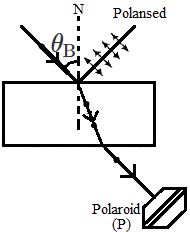
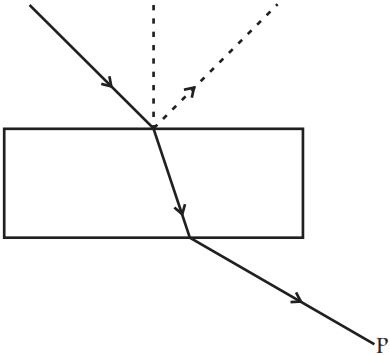
Consider a light beam incident from air to a glass slab at Brewster's angle as shown in Fig. A polaroid is placed in the path of the emergent ray at point P and rotated about an axis passing through the centre and perpendicular to the plane of the polaroid.

  • A
    For a particular orientation there shall be darkness as observed through the polaoid.
  • B
    The intensity of light as seen through the polaroid shall be independent of the rotation.
  • C
    The intensity of light as seen through the Polaroid shall go through a minimum but not zero for two orientations of the polaroid.
  • D
    The intensity of light as seen through the polaroid shall go through a minimum for four orientations of the polaroid.
Answer
  1. The intensity of light as seen through the Polaroid shall go through a minimum but not zero for two orientations of the polaroid.

Solution:

Hint: If a light beam incidents at Brewster's angle, then the transmitted beam is always unpolarised and reflected beam is always polarised.

In the given diagram, the light beam incident from air to the glass slab at Brewster's angle (ip). Therefore, the incident ray represented by dot (.), is unpolarised and the reflected light represented by arrow, is plane polarized.

Since, the emergent ray is unpolarised.

Hence, the intensity cannot be zero when passes through polaroid.

View full question & answer
MCQ 1381 Mark
In Young's double slit experiment the intensity of the maxima is I. If the width of each slit is doubled, the intensity of the maxima will be:
  • A
    $\frac{\text{I}}{2}$
  • B
    2I
  • C
    4I
  • D
    I
Answer
  1. 2I

Explanation:

I = Imax​ = 4I0​

Now, I0​ is increased to 2I0​

So, Imax ​= 4(2I0​) = 8I0​ = 2I

So, maximum intensity is 2I

View full question & answer
MCQ 1391 Mark
For the propagation of light wave, medium is required. This is according to:
  • A
    Maxwell's theory
  • B
    Huygen's theory
  • C
    Planck's theory
  • D
    Newton's theory
Answer
  1. Huygen's theory

Explanation:

Huygens suggested that light may be a wave phenomenon produced by mechanical vibrations of an all pervading hypothetical homogenous medium called eather just like those in solids and liguid .This medium was supposed to be mass less with extremely high elasticity and very low density.

View full question & answer
MCQ 1401 Mark
The parallel rays of white light are made an incident normally on an air film of uniform thickness. 250 fringes are seen in the transmitted light between 4000$\mathring{\text{A}}$ and 6500$\mathring{\text{A}}$. Thickness of air film is:
  • A
    1.3mm
  • B
    1.5mm
  • C
    0.13mm
  • D
    0.11mm
Answer
  1. 1.3mm

Explanation:

For a fringe to appear, the two wavelengths must interfere to give a maxima, which appears at a distance where the phase of both the rays are same, that is, at the least count multiple of the waves.

Therefore the first fringe appears at 5200$\mathring{\text{A}}$

To accommodate 250 fringes, the thickness of the film is 250 times the distance where the first fringe occurs.

Thus the thickness of the air film is 1.3mm

View full question & answer
MCQ 1411 Mark
In white light interference, nearest to the central (bright) fringe, will have which of the following colour:
  • A
    violet
  • B
    yellow
  • C
    red
  • D
    green
Answer
  1. violet
View full question & answer
MCQ 1421 Mark
Identify which of the following color light, when passed through a double-slit opening, will produce the widest central band of light on the screen?
  • A
    Red
  • B
    Orange
  • C
    Yellow
  • D
    Blue
Answer
  1. Red

Explanation:

Fringe width $\beta= \frac{\lambda\text{D}}{\text{d}}$ where λ is the wavelength of the light used

$\Rightarrow\beta\propto\lambda$

As wavelength of the red light is the largest among the visible light, thus fringe width is the greatest formed due to red light.

View full question & answer
MCQ 1431 Mark
The thinnest bubble film in air that can possibly strongly reflect red light because of constructive interference makes up a certain bubble. How could we create the thinnest bubble film that will strongly reflect purple light?
  • A
    Use a thicker film than the film used for the "red" bubble.
  • B
    Use a film with a higher index of refraction than the film used for the "red" bubble.
  • C
    Make a bubble smaller than the "red" bubble.
  • D
    Use a thinner film than the film used for the "red" bubble.
Answer
  1. Use a thicker film than the film used for the "red" bubble.

Explanation:

As to obtain a nice coloured pattern, the thickness of the film has to be similar to the wavelength of light and the bubbles are darkest where they are thinnest.

View full question & answer
MCQ 1441 Mark
Which of the following phenomena can be demonstrated by light. But not with sound waves in an air column? 
  • A
    Reflection
  • B
    Diffraction
  • C
    Refraction
  • D
    Polarization
Answer
  1. Polarization

Explanation:

As we know the reflection, refraction, diffraction can be demonstrated with sound waves in an air column but to have polarized waves, they first need to be transverse waves but sound waves are longitudinal. Sound waves are longitudinal so they cannot be polarised.

View full question & answer
MCQ 1451 Mark
Resolving power of a telescope increases with:
  • A
    Increase in focal length of eyepiece
  • B
    Increase in focal length of objective
  • C
    Increase in aperture of eyepiece
  • D
    Increase in aperture of objective
Answer
  1. Increase in aperture of objective

Explanation:

Resolving power of a telescope:

$\text{R}=\frac{\text{a}}{1.22\lambda}$

where, a is diameter of the objective

so, R increases when a is increased and a increases when aperture of objective is increased.

View full question & answer
MCQ 1461 Mark
The wave theory in its original form was first postulated by:
  • A
    Issac Newton
  • B
    Thomas Young
  • C
    Christian Huygens
  • D
    Augustine Jean Fresnel
Answer
  1. Christian Huygens

Explanation:

Christian Huygens postulated wave theory.

View full question & answer
MCQ 1471 Mark
Light travels faster in air than that in glass. This is accordance with:
  • A
    Wave theory of light
  • B
    Corpuscular theory of light
  • C
    Neither (a) nor (b)
  • D
    Both (a) and (b)
Answer
  1. Wave theory of light

Explanation:

Huygene's wave theory assumed that the light travels slower in glass than in air. That means for a given geometrical distance in glass, there will be more waves of light than in same distance in air. Consequently, it would seem that wavelength of light decreases as light propagates through air-glass interface.

View full question & answer
MCQ 1481 Mark
The interference of light was first demonstrated experimentally by:
  • A
    Sir Isaac Newton
  • B
    Michelson
  • C
    Fraunhoffer
  • D
    Thomas Young
Answer
  1. Thomas Young

Explanation:

Thomas Young demonstrated the phenomenon of interference in water waves.

In 1801, he presented a famous paper to the Royal Society entitled "On the Theory of Light and Colours" which described various interference phenomena, and in 1803 he performed his famous double-slit experiment.

View full question & answer
MCQ 1491 Mark
Which of the following properties of light conclusively support wave theory of light?
  • A
    Light obeys laws of reflection.
  • B
    Speed of light in water is smaller than the speed in vacuum.
  • C
    Light shows interference.
  • D
    Light shows photoelectric effect.
Answer
  1. Speed of light in water is smaller than the speed in vacuum.
  2. Light shows interference.

Explanation:

Snell's Law, which states that the speed of light reduces on moving from a rarer to a denser medium, can be concluded from Huygens' wave theory and interference of light waves is based on the wave properties of light.

View full question & answer
MCQ 1501 Mark
Which of the following is a unit for intensity of light?
  • A
    Candle power
  • B
    Lux
  • C
    Both A & B
  • D
    None of the above
Answer
  1. Both A & B

Explanation:

In photometry, luminous intensity is a measure of the wavelength-weighted power emitted by a light source in a particular direction per unit solid angle, based on the luminosity function, a standardized model of the sensitivity of the human eye. The SI unit of luminous intensity is the candela (cd), an SI base unit.

View full question & answer