Questions

2 Marks Questions

Take a timed test

53 questions · self-marked practice — reveal the answer and mark yourself.

Question 12 Marks
8% children of a class of 25 like getting wet in the rain. How many children like getting wet in the rain.
Answer
Given, children who like getting wet in the rain = 8% of 25
$=\frac{8}{100} \times 25=2$
Hence, 2 children like getting wet in the rain.
Alternate method
Out of 100, 8 children like getting wet in the rain
Therefore, out of 25, the number of children that like
getting wet in the rain $=\frac{8}{100} \times 25=2$
Hence, 2 children like getting wet in the rain.
View full question & answer
Question 22 Marks
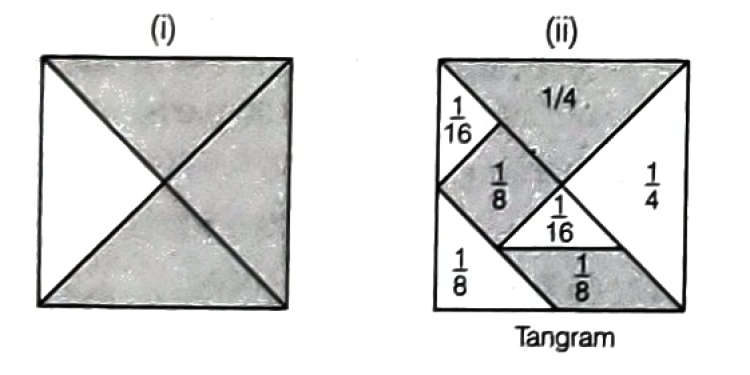
What per cent of these figures are shaded?
Image
Answer
(i) It is clear from the figure, that shaded parts are 3 out of 4
Shaded parts in fraction$=\frac{3}{4}$
$\therefore$ Percentage of shaded part $=\left(\frac{3}{4} \times 100\right) \%=75 \%$
Hence, 75% of the figure is shaded.
(ii) From the figure,
fraction of figure which is not shaded
$=\frac{1}{16}+\frac{1}{16}+\frac{1}{8}+\frac{1}{4}=\frac{1+1+2+4}{16}=\frac{8}{16}=\frac{1}{2}$
i.e. half of the figure is shaded.
Percentage of figure which is shaded
$=\left(\frac{1}{2} \times 100\right) \%=50 \%$
Hence, 50% of the figure is shaded.
View full question & answer
Question 32 Marks
If 65% of students in a class have a bicycle, what per cent of the students do not have bicycles?
Answer
Given, percentage of students having bicycle = 65%
This means that if there were 100 students in a class, out of them, 65 would have bicycles and then remaining students would not have bicycles.
$\therefore$ The remaining students would not have bicycle
$=100-65=35$
Hence, 35% of students do not have bicycles.
View full question & answer
Question 42 Marks
We have a basket full of apples, oranges and mangoes. If 50% are apples, 30% are oranges, then what per cent are mangoes?
Answer
According to the question, if there are 100 fruits in a basket, out of them 50 are apples and 30 are oranges, then remaining would be mangoes.
Now, mangoes = (100 - (50 + 30))%
= (100 - 80)% = 20%
Hence, there are 20% mangoes in the basket.
View full question & answer
Question 52 Marks
Mala has a collection of bangles. She has 20 gold bangles and 10 silver bangles. What is the percentage of bangles of each type? Can you put it in the tabular form as done in the above example?
Answer
Putting the data in the tabular form, we get
BangelsNumberFractionDenominator HundredIn Percentage
Gold20$\frac{20}{30}$$\frac{20}{30} \times \frac{100}{100}=\frac{200}{3} \times \frac{1}{100}$$66.67 \%$ or $66 \frac{2}{3} \%$
Silver10$\frac{10}{30}$$\frac{100}{30} \times \frac{100}{100}=\frac{100}{3} \times \frac{1}{100}$$33.33 \%$ or $33 \frac{1}{3} \%$
Total30
View full question & answer
Question 62 Marks
A collection of 10 chips with different colours is given 
Colour Number Fraction Denominator Hundred In Percentage
Green        
Blue        
Red        
Total        

Complete the table and find the percentage of chips of each colour.
Image
Answer
Given, table is completed as follows
ColourNumberFractionDenominator HundredIn Percentage
Green4$\frac{4}{10}$$\frac{4}{10} \times \frac{100}{100}=\frac{40}{100}$40%
Blue3$\frac{3}{10}$$\frac{3}{10} \times \frac{100}{100}=\frac{30}{100}$30%
Red3$\frac{3}{10}$$\frac{3}{10} \times \frac{100}{100}=\frac{30}{100}$30%
Total10
View full question & answer
Question 72 Marks
A shop has the following number of shoe pairs of different sizes.
Size 2:20
Size 3:30
Size 4:28
Size 5:14
Size 6:8
Write this information in tabular form as done earlier and find the percentage of each shoe sizes available In the shop.
Answer
Respective number of shoes of different sizes are out of 100 shoes. Therefore, percentage of each shoe size is shown in the following table
Size of ShoeNumber of Shoes availableIn fractionPercentage of each Shoe size
Size 220$\frac{20}{100}$20%
Size 330$\frac{30}{100}$30%
Size 428$\frac{28}{100}$28%
Size 514$\frac{14}{100}$14%
Size 68$\frac{8}{100}$8%
Total100  
View full question & answer
Question 82 Marks
Find the percentage of children of different heights for the following data
HeightNumber of ChildrenIn FractionIn Percentage
110cm22--
120cm25--
128cm32--
130cm21--
Total100--
Answer
Respective number of children of different heights are out of 100 children. Therefore, percentage of children of different heights are shown in the following table
HeightNumber of ChildrenIn FractionIn Percentage
110cm22$\frac{22}{100}$22%
120cm25$\frac{25}{100}$25%
128cm32$\frac{32}{100}$32%
130cm21$\frac{21}{100}$21%
Total100  
View full question & answer
Question 92 Marks
Consider the expenditure made on a dress. 20% on embroidery, 50% on cloth, 30% on stitching. Can you think of more such examples?
Answer
Yes, such type of examples are as follow
(i) In class VII, a test of Maths of 100 marks was conducted and observation was as follows 20% students got marks below 50. 36% students got marks between 60 and 75. 44% students got marks above 80 marks.
(ii) An alloy is made up of the following composition i.e. 35% copper, 43% nickel and 22% zinc.
View full question & answer
Question 102 Marks
(i) Can you eat 50% of a cake?
Can you eat 100% of a cake?
Can you eat 150% of a cake?
(ii) Can a price of an item go up by 50%?
Can a price of an item go up by 100%?
Can a price of an item go up by 150%?
Answer
(i) Yes, we can eat 50% of a cake because 50 parts out of 100 parts of given cake are possible.
Yes, we can eat 100% of a cake i.e. whole cake can be eaten.
No, we cannot eat 150% of a cake because 150 parts out of 100 parts of given cake are not possible.
Hence, 150% of a cake cannot be eaten.
(ii) Yes, a price of an item can go up by 50%.
Yes, a price of an item can go up by 100%.
Yes, a price of an item can go up by 150% because price or increment can be more than 100%.
View full question & answer
Question 112 Marks
Look at the examples below and in each of them, discuss which is better for comparison.
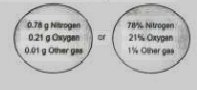
(i) In the atmosphere, 1 g of air contains
Image
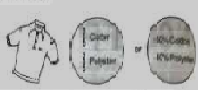
(ii) A shirt has
Image
Answer
(i) Here, second one (i.e. in per cent) is better for comparison. In the atmosphere, the quantity of air contents in per cent is better for comparison. It means that out of 100 parts of air; 78 parts are of nitrogen, 21 parts are of oxygen and 1 part is of other gas
(ii) Quantity of blending of cotton and polyster in a shirt is easy to understand in terms of percentage. It shows that out of 100 parts of a shirt; 60 parts are of cotton and 40 parts are of polyster.
View full question & answer
Question 122 Marks
The population of a city decreased from 25000 to 24500. Find the percentage decrease.
Answer
Initial population of the city = 25000
Decreased population of the city = 24500
Thus, decrease in population = 25000 - 24500 = 500
$\therefore$ Percentage decrease in population
$=\left(\frac{\text { Decrease in population }}{\text { Initial population }} \times 100\right) \%$
$=\left(\frac{500}{25000} \times 100\right) \%=\left(\frac{50}{25}\right) \%=2 \%$
Hence, the percentage decrease in population is 2%.
View full question & answer
Question 132 Marks
If Meena gives an interest of ₹ 45 for 1 yr at 9% rate p.a.. What is the sun she has borrowed?
Answer
Let the sum borrowed by Meena be ₹ x.
Rate of interest, R = 9%; Time, T = 1yr, Interest, I = ₹ 45
$\therefore$  $I =\frac{P \times R \times T}{100}$
$\Rightarrow$ $45 =\frac{P \times 9 \times 1}{100}$
$\Rightarrow$ $9P = 45 \times 100$
$\Rightarrow$ $P =\frac{4500}{9}$
$\Rightarrow$ $P =$ ₹ $500$
Hence the sum borrowed by Meena is ₹ $500.$
View full question & answer
Question 142 Marks
What rate gives ₹ 280 as interest on a sum of ₹ 56000 in 2 yr?
Answer
Given, Principal, P = ₹ 56000, Interest, f = ₹ 280,
Time, T = 2yr
Let rate of interest be R% p. a..
Now, I=$\frac{P \times R \times T}{100}$
$\Rightarrow\quad$ R=$\left(\frac{I \times 100}{P \times T}\right) \%$
=$\left(\frac{280 \times 100}{56000 \times 2}\right) \%$
=$\left(\frac{28}{56 \times 2}\right) \%$
=$\frac{1}{4}\%~$$=0.25\%$
Hence, the rate of interest is $0.25\%$.
View full question & answer
Question 152 Marks
Find the amount to be paid at the end of 3 yr in each case.
(i) Principal P = ₹ 1200 at 12% p.a.
(ii) Principal P =₹ 7500 at 5% р.а.
Answer
(i) Given, Principal, P = ₹ 1200; Rate of interest, R = 12%'
Time, T = 3yrs
$\therefore$ I = $\frac{P \times R \times T}{100}$
= $\frac{1200 \times 12 \times 3}{100}$
= $144 \times 3$ = ₹ 432
Now, Amount = Principal + Interest = ₹ 1200 + ₹ 432
= ₹ 1632
Hence, the amount paid at the end of 3 yr is ₹ 1632.
View full question & answer
Question 162 Marks
Amina buys a book for ₹ 275 and sells it at a loss of 15%. How much does she sell it for?
Answer
Given, CP of a book $=$ ₹ $275$; Loss per cent $=15 \%$
$\therefore$ Loss $=15 \%$ of CP
$=\frac{15}{100} \times 275=\frac{4125}{100}=$ ₹ $41.25$
Now, SP of a book $=C P-$ Loss $=$ ₹ $(275-41.25)$
$=$ ₹ $233.75$
Hence, Amina sells the book for ₹ $233.75$
View full question & answer
Question 172 Marks
(i) Chalk contains calcium, carbon and oxygen in the ratio 10 : 3 : 12. Find the percentage of carbon in chalk.
(ii) If in a stick of chalk, carbon is 3g, what is the weight of the chalk stick?
Answer
(i) Given, ratio of calcium, carbon and oxygen in a chalk stick are 10 : 3 : 12.
Sum of the parts = 10 + 3 + 12 = 25
$\therefore\quad$ Percentage of carbon in chalk stick
=$\left(\frac{\text { Part of carbon in chalk stick }}{\text { Total part of chalk }} \times 100\right) \%$
=$\left(\frac{3}{25} \times 100\right) \%$
=$(3 \times 4) \%=12 \%$
Hence, the percentage of carbon in chalk stick is 12%
(ii) Let the weight of the chalk stick be x g.
Now, weight of carbon = 3g (which is 12% of chalk)
$\therefore \quad 12 \%$ of $x=3$
$\Rightarrow \frac{12}{100} \times x=3$
$\Rightarrow\quad$$x=\frac{3 \times 100}{12}=25 g$
Hence, the weight of the chalk stick is 25 g.
View full question & answer
Question 182 Marks
Juhi sells a washing machine for ₹13500. She loses 20% in the bargain. What was the price at which she bought it?
Answer
Given, SP of washing machine = ₹ 13500
Loss per cent 20%
Now, $\quad S P=C P-$ Loss $\Rightarrow S P=C P-20 \%$ of $C P$
$\Rightarrow\quad$13500 = CP -$\frac{20}{100} \times C P$
$\Rightarrow\quad$13500 = CP - $\frac{1}{5} \times C P$
$\Rightarrow\quad$13500 = CP$\left(1-\frac{1}{5}\right)$
$\Rightarrow\quad$13500 = CP$\left(\frac{5-1}{5}\right)$
$\Rightarrow\quad$13500 = $\frac{4}{5}$CP
$\Rightarrow\quad$CP = $\frac{13500 \times 5}{4}$=$3375 \times 5$
$\Rightarrow\quad$CP = ₹ 16875
Hence, Juhi bought a washing machine for ₹ 16875.
View full question & answer
Question 192 Marks
On a certain sum, the interest paid after 3 yr is ₹ 450 at 5% rate of interest per annum. Find the sum
Answer
Let the sum be ₹ P.
Rate of interest, R = 5% Time, T = 3yr Interest, I = ₹ 450
$\therefore\quad$ I = $\frac{P \times R \times T}{100}$ $\quad\Rightarrow\quad$ 450 = $\frac{P \times 5 \times 3}{100}$
$\Rightarrow P \times 15=450 \times 100\quad$ $\Rightarrow\quad$$P=\frac{45000}{15}$ = ₹ 3000
Hence, the required sum is ₹ 3000.
View full question & answer
Question 202 Marks
You have ₹2400 in your account and the interest rate is 5%. After how many years would you earn ₹240 as interest?
Answer
Given, Principal, P = ₹ 2400; Rate of interest, R = 5% Interest, I = ₹ 240; Time, T = ?
$\therefore\quad$ Interest , I = $\frac{P \times R \times T}{100}$
$\Rightarrow\quad$240 = $\frac{2400 \times 5 \times T}{100}$
$\Rightarrow\quad$$240 \times 100$ = $2400 \times 5 \times T$
$\Rightarrow\quad$T=$\frac{240 \times 100}{2400 \times 5}$$\Rightarrow$ T =$\frac{10}{5}$= 2 yr
Hence, the required time is 2 yr.
View full question & answer
Question 212 Marks
₹  10000 is Invested at 5% interest rate p.a. Find the Interest at the end of 1 yr.
Answer
Given, Principal, P = ₹ 10000; Rate of interest, R = 5%;
Time T = 1yr
$\therefore$ Intrest ,I =$\frac{P \times R \times T}{100}$=$\frac{10000 \times 5 \times 1}{100}$
= 100 ×5 = ₹ 500
Hence, the interest at the end of 1 yr is ₹ 500.
View full question & answer
Question 222 Marks
₹7000 is borrowed at 3.5% rate of interest p.a.. borrowed for 2 yr. Find the amount to be paid at the end of the 2nd yr.
Answer
Given, Principal, P= ₹7000 ; Rate of interest, R = 3.5%;
Time, T = 2yr;
$\therefore\quad$ Interest I = $\frac{P \times R \times T}{100}$= $\frac{7000 \times 35 \times 2}{100}$ = $70 \times 7$ = ₹490.
$\therefore\quad$ Amount = Principal + Interest
$\therefore\quad$ ₹7000 + ₹490 = ₹7490
Hence, the amount paid at the end of 2 yr is ₹7490.
View full question & answer
Question 232 Marks
₹ 6050 is borrowed at 6.5% rate of interest p.a. Find the interest and the amount to be paid at the end of 3 yr.
Answer
Given, Principal, P $=$ ₹ $6050 ;$ Rate of interest, $R=6.5 \%$
Time, $T=3 yr$
$\therefore$ Interest, I =$\frac{P \times R \times T}{100}$= $\frac{6050 \times 6.5 \times 3}{100}$ = $\frac{117975}{100}$
= ₹ 1179.75
$\therefore$ Amount = Principal + Interest
= ₹ 6050 + ₹ 1179.75 = ₹ 7229.75.
Hence, the interest and amount at the end of 3 yr are ₹ 1179.75 and ₹ 7229.75, respectively.
View full question & answer
Question 242 Marks
Cost of an item is ₹  50. It was sold with a profit of 12%. Find the selling price.
Answer
Given, CP of an item = ₹  50; Profit % = 12%
$\therefore$ Profit=12% of CP of an item
= 12% of ₹ 50=$\frac{12}{100} \times 50$=$\frac{600}{100}$=₹ 6
$\therefore$ SP of an itam = CP + Profit = ₹ 50 + ₹ 6 = ₹ 56
View full question & answer
Question 252 Marks
A shopkeeper bought a chair for ₹ 375 and sold it for ₹ 400. Find the gain percentage.
Answer
Given, CP (cost price) of a chair = ₹ 375
SP (selling price) of a chair = ₹ 400
Here, SP > CP
So, gain $=S P-C P=$ ₹ $(400-375)=$ ₹ $25$
$\begin{aligned} \text { Now, gain percentage } & =\left(\frac{\text { Gain }}{ CP \text { of a chair }} \times 100\right) \% \\ & =\left(\frac{25}{375} \times 100\right) \%=\frac{100}{15} \% \\ & =\frac{20}{3} \%=6 \frac{2}{3} \%\end{aligned}$
Hence, the gain percentage is $6 \frac{2}{3} \%$
View full question & answer
Question 262 Marks
My mother says, in her childhood petrol was ₹ 1 a litre. It is ₹ 52 per litre today. By what percentage has the price gone up?
Answer
Old price of 1 L petrol = ₹ 1
Present price of 1 L petrol = ₹ 52
Change in price = ₹ (52-1) = ₹ 51
$\begin{aligned} \therefore \text { Percentage increase } & =\left(\frac{\text { Change in price }}{\text { Old price of petrol }} \times 100\right) \% \\ & =\frac{51}{1} \times 100=5100 \%\end{aligned}$
Hence, the price has gone up by 5100%
View full question & answer
Question 272 Marks
Find percentage of increase or decrease.
(i) Price of shirt decreased from ₹ 280 to ₹ 210.
(ii) Marks in a test increased from 20 to 30.
Answer
(i) Decreased price of shirt $=$ ₹ $(280-210)$
$=$ ₹ $70$
$\therefore$ Percentage of decrease
$ \begin{array}{l} =\left(\frac{\text { Amount of change }}{\text { Original amount }} \times 100\right) \% \\ =\left(\frac{70}{280} \times 100\right) \%=25 \% \end{array}$
(ii) Increased marks $=30-20=10$
$\therefore$ Percentage of increase
$\begin{array}{l}=\left(\frac{\text { Increased marks }}{\text { Original marks or Initial marks }} \times 100\right) \% \\ =\left(\frac{10}{20} \times 100\right) \%=50 \%\end{array}$
View full question & answer
Question 282 Marks
Divide 15 sweets between Manu and Sonu so that they get 20% and 80% of them, respectively.
Answer
Total number of sweets = 15
$\begin{aligned} \text { Number of sweets, Manu gets } & =20 \% \text { of } 15=\frac{20}{100} \times 15 \\ & =\frac{15}{5}=3 \text { sweets }\end{aligned}$
and number of sweets, Sonu gets = 80%  of  15
$\begin{array}{l}=\frac{80}{100} \times 15=\frac{120}{10} \\ =12 \text { sweets }\end{array}$
Hence, Manu and Sonu get 3 sweets and 12 sweets, respectively.
View full question & answer
Question 292 Marks
Convert the given fractional numbers to per cents.
(i) $\frac{1}{8}$
(ii) $\frac{5}{4}$
(ii) $\frac{3}{40}$
(iv) $\frac{2}{7}$
Answer
(i) $\frac{1}{8}=\left(\frac{1}{8} \times 100\right)\% =\left(\frac{100}{8}\right) \%=\frac{25}{2} \%=12.5 \%$
(ii) $\frac{5}{4}=\left(\frac{5}{4} \times 100\right) \%=(5 \times 25) \%=125 \%$
(iii) $\frac{3}{40}=\left(\frac{3}{40} \times 100\right) \%=\left(\frac{3}{4} \times 10\right) \%=\frac{15}{2} \%=7.5 \%$
(iv) $\frac{2}{7}=\left(\frac{2}{7} \times 100\right) \%=\frac{200}{7} \times=28 \frac{4}{7} \%$
View full question & answer
Question 302 Marks
A local cricket team played 20 matches in one season. It won 25% of them. How many matches did they win?
Answer
Given, total number of matches = 20
Percentage of won matches = 25%
$\begin{aligned} \therefore \text { Total number of winning matches } & =25 \% \text { of } 20 \\ & =\frac{25}{100} \times 20 \\ & =\frac{25}{5}=5\end{aligned}$
Hence, the team won 5 matches.
View full question & answer
Question 312 Marks
Meeta saves ₹ 4000 from her salary. If this is 10% of her salary. What is her salary?
Answer
Let Meeta's salary be ₹ x.
Meeta saves ₹ 4000 which is 10% of her salary
$\therefore 10 \%$ of $x=$ ₹ $4000$
$\Rightarrow \frac{10}{100} \times x=4000$
$\Rightarrow x=\frac{4000 \times 100}{10}=40000$
Hence, Meeta's salary is ₹ 40000.
View full question & answer
Question 322 Marks
Out of 15000 voters in a constituency, 60% voted. Find the percentage of voters who did not vote. Can you now find how many actually did not vote?
Answer
Given, 60% voters voted.
This means that, if there were 100 voters, out of them 60 voted and remaining did not vote.
Then, voters who did not vote = (100 - 60)% = 40%
Now, actual number of voters who did not vote
= 40% of 15000
$\begin{array}{l}=\frac{40}{100} \times 15000 \\ =40 \times 150=6000\end{array}$
Hence, 6000 voters did not vote.
View full question & answer
Question 332 Marks
In a city, 30% are females, 40% are males and remaining are childrens. What per cent are childrens
Answer
Given, percentage of females = 30%
Percentage of males 40% and remaining are childrens.
This means that, if the total population of city is 100, out of them 30 are females, 40 are males and remaining childrens.
Then, number of childrens = 100-(30+40)
= 100-70=30
Hence, there are 30% childrens in a city.
View full question & answer
Question 342 Marks
Convert given per cents to decimal fractions and also to fractions in simplest forms.
(i) 25%
(ii) 150%
(iii) 20%
(iv) 5%
Answer
Per CentsFractionsDecimals
(i)25%$\frac{25}{100}=\frac{1}{4}$0.25
(ii)150%$\frac{150}{100}=\frac{3}{2}$1.50
(iii)20%$\frac{20}{100}=\frac{1}{5}$0.20
(iv)5%$\frac{5}{100}=\frac{1}{20}$0.05
View full question & answer
Question 352 Marks
Find
75% of 1 kg
Answer
We have. $75 \%$ of $1 kg=\frac{75}{100} \times 1 kg=0.75 kg$
In terms of gram,
75% of 1kg = 75% of 1000 g $\qquad$[$\because$ 1kg = 1000g]
$=\frac{75}{100} \times 1000 g=750 g$
Hence, 75% of 1 kg is 0.75 kg or 750 g
View full question & answer
Question 362 Marks
Find
20% of ₹ 2500
Answer
We have, $20 \%$ of ₹ $2500=\frac{20}{100} \times$ ₹ $2500=$ ₹ $(20 \times 25)$
$=$ ₹ $500$
Hence, 20% of ₹ 2500 is = ₹ 500.
View full question & answer
Question 372 Marks
Find
1% of 1 hour
Answer
We have, 1% of 1 hour
In terms of $min , 1 \%$ of $1 h=\frac{1}{100} \times 60 min\qquad$[$\therefore$ 1h=60 min]
$=\frac{6}{10} \min =\frac{3}{5}$ min
In terms of second, $1 \%$ of $1 h=\left(\frac{1}{100} \times 3600\right)$ $
\begin{array}{l}
=36 s \\
{[\because 1 h=60 \times 60 s=3600 s]}
\end{array}
$
Hence, $1 \%$ of 1 h is $\frac{3}{5} min$ or 36 s .
View full question & answer
Question 382 Marks
Find
15% of 250
Answer
We have, $15 \%$ of $250=\frac{15}{100} \times 250$
$=\frac{375}{10}=37.5$
Hence, 15% of 250 is 37.5.
View full question & answer
Question 392 Marks
Convert the given decimal fractions to per cents.
(i) 0.65
(ii) 2.1
(iii) 0.02
(iv) 12.35
Answer
(i) $0.65=(0.65 \times 100) \%=\left(\frac{65}{100} \times 100\right) \%=65 \%$
(ii) $2.1=(2.1 \times 100) \%=\left(\frac{21}{10} \times 100\right) \%=210 \%$
(iii) $0.02=(0.02 \times 100) \%=\left(\frac{2}{100} \times 100\right) \%=2 \%$
(iv) $12.35=(12.35 \times 100) \%=\left(\frac{1235}{100} \times 100\right) \%=1235 \%$
View full question & answer
Question 402 Marks
What per cent of 1 day is 1 min?
Answer
Let x % of 1 day is 1 min.
$\because 1 \text { day }=24 h=24 \times 60 min $
$ \Rightarrow 1 \text { day }=1440 min $
$ \therefore \frac{x}{100} \times 1440 min=1 min$
$\Rightarrow x=\frac{100}{1440}=\frac{10}{144} \Rightarrow x=0.069 \%$
Hence, 0.069% of 1 day is 1 min.
View full question & answer
Question 412 Marks
What per cent of 1 h is 30 min?
Answer
Let x% of 1 h is 30 min.
So, $\quad \frac{x}{100} \times 1 h=30 min$
$\therefore \frac{x}{100} \times 60 min=30 min \quad[\because 1 h=60 min]$
$\Rightarrow x=\frac{30 \times 100}{60}$
$\Rightarrow x=\frac{100}{2}=50 \%$
Hence, 50% of 1 h is 30 min.
View full question & answer
Question 432 Marks
Answer
The complete table is shown below
ColourNumber of TilesRate per HundredFractionWritten asRead as
Yellow1414$\frac{14}{100}$14%14 percent
Green2626$\frac{26}{100}$26%26 percent
Red3535$\frac{35}{100}$35%35 percent
Blue2525$\frac{25}{100}$25%25 percent
Total100
View full question & answer
Question 442 Marks
In an examination, a student must get 40% marks to pass. A student gets 48 marks out of 200. Express his marks as a percentage. How many more marks should he got to pass the examination?
Answer
Pass percentage = 40%
Total marks of examination = 200
Student's marks = 48
Passing marks $=40 \%$ of $200=\frac{40}{100} \times 200$
$=40 \times 2=80\text{ marks}$
$\therefore$ Percentage of marks got by student
$=\frac{48}{200} \times 100=24 \%$
Hence, student needed atleast $=80-48= 32$ marks to pass the examination.
View full question & answer
Question 452 Marks
₹ 5000 amounts to 6000 in 5 yr. What will ₹ 8000 amount be at the same rate of interest in 6 yr.
Answer
Given, amount ₹ $5000$ became ₹ $6000$ in 5 yr.
So, Principal $=$ ₹ $5000$, Time period $=5\text{ yrs}$
$\therefore \text {Interest}=$ ₹ $6000-$ ₹ $5000=$ ₹ $1000$
Let rate of interest be $R \%$ per annum.
$\therefore SI =\frac{P \times R \times T}{100} \Rightarrow 1000=\frac{5000 \times R \times 5}{100}$
$\Rightarrow R=\frac{100000}{5000 \times 5}=\frac{20}{5}=4 \%$
So, SI for the amount ₹ $8000$ will be at same rate for 6 yr.
$\therefore SI =\frac{P \times R \times T}{100}=\frac{8000 \times 4 \times 6}{100}$
$=80 \times 4 \times 6=80 \times 24=$ ₹ $1920$
$\therefore 8000$ amounts to ₹ $9920$ in 6 yr.
View full question & answer
Question 462 Marks
On what principal, the interest is ₹ 1750 for 7 yr at 5% per annum simple interest?
Answer
Let the principal be ₹ $x.$ Simple interest $=$ ₹ $1750$
Time period for principal(T) $=7\text{ yr}$
Rate of Interest $(R)=5 \%$ per annum
$\therefore$ Simple Interest $=\frac{P \times R \times T}{100}$
$\Rightarrow 1750=\frac{x \times 5 \times 7}{100}$
$\Rightarrow 175000=35 x$
$\Rightarrow x=\frac{175000}{35}=5000$
$\therefore$ Principal $=$ ₹ $5000$
View full question & answer
Question 472 Marks
Find the Sl on ₹ 500 for 3 yr at 5% per annum.
Answer
Given, Principal $(P)=$ ₹ $500$
Time $(T)=3\text{ yr};$
Rate of Interest $(R)=5 \%$
Simple interest $( SI )=\frac{P \times R \times T}{100}$
$\therefore SI =\frac{500 \times 5 \times 3}{100}=5 \times 5 \times 3=$ ₹ $75$
Hence, simple interest is ₹ $75.$
View full question & answer
Question 482 Marks
An article is sold for ₹ 1980 at 10% profit. What is the cost price?
Answer
Selling price of the article $=$ ₹ $1980$
Profit $\%=10$
$\because$ Cost price $= SP -\frac{10}{100} CP$
$\Rightarrow C P+\frac{10 CP }{100}= SP$
$\therefore CP =\frac{100}{100+10} \times 1980$
$=\frac{100}{110} \times 1980=$ ₹ $1800$
View full question & answer
Question 492 Marks
The cost price of a scooter is ₹ 20000 and the profit percentage is 12%. What is the selling price?
Answer
Cost price of a scooter $=$ ₹ $20000$, Profit $=12 \%$
$\because$ Selling price $=C P+\frac{12}{100} C P$
$=\left(\frac{100+12}{100}\right) C P$
$\therefore SP =\frac{100+12}{100} \times 20000=\frac{112}{100} \times 20000$
$=112 \times 200=$ ₹ $22400$
View full question & answer
Question 502 Marks
A shopkeeper purchased eggs at the rate of 10 for ₹ 6 and sells them at 6 for ₹ 10. Find his profit or loss per cent.
Answer
Cost price of one egg = ₹$\frac{6}{10}$
Selling price of one egg = ₹$\frac{10}{6}$
Profit on each egg=$\frac{10}{6}-\frac{6}{10}$=$\frac{100-36}{60}=\frac{64}{60}$
$\therefore$ Profit$\%=\frac{\frac{64}{60}}{\frac{6}{10}} \times 100$
$=\frac{64}{60} \times \frac{10}{6} \times 100=\frac{6400}{36} \%$ or $\frac{1600}{9} \%$
View full question & answer
Question 512 Marks
A person sells a watch costing ₹ 750 for ₹ 840. Find his profit or loss per cent.
Answer
$\text {Cost price of watch} =$ ₹ $750$
$\text {Selling price} =$ ₹ $840$
$\because$ Profit $= \text{SP} - \text{CP} =840-750=$ ₹ $90$
$\therefore$ Profit$\%=\frac{\text { Profit }}{\text{CP}} \times 100$
$=\frac{90}{750} \times 100=\frac{900}{75}=12 \%$
View full question & answer
Question 522 Marks
What per cent of ₹ 80 is ₹ 100?
Answer
Let x % of ₹ 80 is ₹ 100.
$\therefore \frac{x}{100} \times 80=100$
$\Rightarrow x=\frac{100 \times 100}{80}=\frac{10000}{80}$ $\Rightarrow x=125 \%$
Hence, 125% of ₹ 80 is ₹ 100.
View full question & answer
Question 532 Marks
Find the whole value/quantities if
(i) 5% of it is 500
(ii) 30% of it is 900 km
(iii) 70% of it is 14 h
(iv) 6% of it is 48 km
Answer
(i) Given, 5% of it is 500.
Let x be the number.
So, 5% of x = 500
$\therefore \frac{5}{100} \times x=500$
$\Rightarrow \quad x=\frac{500 \times 100}{5} \Rightarrow x=10000$
(ii) Given, 30% of it is 900 km.
Let x be the kilometre distance.
So, 30% of x = 900km
$\frac{30}{100} \times x=900$ $\Rightarrow \frac{30 x}{100}=900$
$\Rightarrow \quad 30 x=900 \times 100$
$\Rightarrow \quad x=\frac{900 \times 100}{30}$=$\frac{9000}{3}=3000$
$\Rightarrow \quad x=3000 km$
(iii) Given, 70% of it is 14 h.
Let x be the hours.
So, 70% of x = 14h
$\therefore \quad \frac{70}{100} \times x=14$ $\Rightarrow x=\frac{14}{70} \times 100$
$\Rightarrow x=\frac{14}{7} \times 10=20$ $\Rightarrow x=20 h$
(iv) Given, $6 \%$ of it is 48 km.
Let $x$ be the kilometre distance.
So, $6 \%$ of $x=48 km$
$\therefore \frac{6}{100} \times x=48 \Rightarrow x=\frac{48}{6} \times 100 $
$ \Rightarrow x=8 \times 100=800 $
$ \Rightarrow x=800 km$
View full question & answer