Question 13 Marks
Compare the following numbers.
$2.7 \times 10^{12} ; 1.5 \times 10^8$
AnswerWe have, $2.7 \times 10^{12}, 1.5 \times 10^8$
$2.7 \times 10^{12}=2.7 \times 10 \times 10 \times 10 \times 10 \times 10 \times 10^7$
$=\frac{27}{10} \times 10 \times 10 \times 10 \times 10 \times 10 \times 10^7$
$=270000 \times 10^7$
and $1.5 \times 10^8=\frac{15}{10} \times 10 \times 10^7=15 \times 10^7$
$\because \quad 270000>15$
$\therefore \quad 270000 \times 10^7>15 \times 10^7$
or $\quad 2.7 \times 10^{12}>1.5 \times 10^8$
Hence, $2.7 \times 10^{12}$ is greater than $1.5 \times 10^8$.
View full question & answer→Question 23 Marks
Express each of the following as product of powers of their prime factors.
648
AnswerWe have, 648
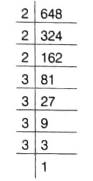
$=2 \times 2 \times 2 \times 3 \times 3 \times 3 \times 3=2^3 \times 3^4$
Hence, the number 648 can be expressed as $2^3 \times 3^4$, which is the required form. View full question & answer→Question 33 Marks
Express
(i) 729 as a power of 3.
(ii) 128 as a power of 2.
(iii) 343 as a power of 7
Answer(i) We have, $729=3 \times 3 \times 3 \times 3 \times 3 \times 3=3^6$
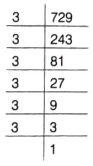
Here, base = 3 and exponent = 6, since 3 repeated 6 times.
(ii) Base = 2 and exponent = 7, since 2 repeated 7 times.
(iii) Base 7 and exponent = 3, since 7 repeated 3 times. View full question & answer→Question 43 Marks
Express the following numbers in standard form.
(i) 7647000
(ii) 81900000
(iii) 583000000000
(iv) 24 billion
Answer(i) Given, 7647000
For standard form,
$7647000=7647 \times 10^3 \quad\left[\because 10^3=1000\right]$
Also, $\quad 7647=7.647 \times 10^3$
So, $7.647 \times 10^3 \times 10^3=7.647 \times 10^6$
(ii) Given, 81900000
For standard form, 81900000
$81900000=819 \times 10^5 \quad\left[\because 10^5=100000\right]$
$\because \quad 819=8.19 \times 10^2$
So, $8.19 \times 10^2 \times 10^5=8.19 \times 10^7$
(iii) Given, 583000000000
For standard form
$583000000000=583 \times 10^9$
$\because \quad 583=5.83 \times 10^2$
So, $5.83 \times 10^2 \times 10^9=5.83 \times 10^{11}$
(iv) Given, 24 billion
For standard form,
$24 \times 1000000000=24 \times 10^9$
$\because \quad 24=2.4 \times 10^1$
So, $2.4 \times 10^9 \times 10^1=2.4 \times 10^{10}$
View full question & answer→Question 53 Marks
Express each of the following in single exponential form.
(i) $2^3 \times 3^3$
(ii) $2^4 \times 4^2$
(iii) $5^2 \times 7^2$
(iv) $(-5)^5 \times(-5)$
(v) $(-3)^3 \times(-10)^3$
(vi) $(-11)^2 \times(-2)^2$
Answer(i) Given, $2^3 \times 3^3$
$\because \quad 2^3=2 \times 2 \times 2=8$
and $\quad 3^3=3 \times 3 \times 3=27$
So, $\quad 2^3 \times 3^3=8 \times 27=216=6^3$
(ii) Given, $2^4 \times 4^2$
$\because \quad 2^4=2 \times 2 \times 2 \times 2=16$
and $\quad 4^2=4 \times 4=16$
So, $\quad 2^4 \times 4^2=16 \times 16=4^2 \times 4^2=4^4$
(iii) Given, $5^2 \times 7^2$
$\because \quad 5^2=5 \times 5=25$
and $\quad 7^2=7 \times 7=49$
So, $\quad 5^2 \times 7^2=25 \times 49=1225=35^2$
(iv) Given, $(-5)^5 \times(-5)$
$\because \quad(-5)^5=(-5) \times(-5) \times(-5) \times(-5) \times(-5)$
So, $(-5)^5 \times(-5)=(-5)^6$ or $5^6$
(v) Given, $(-3)^3 \times(-10)^3$
$\because \quad(-3)^3=(-3) \times(-3) \times(-3)=-27$
and $\quad(-10)^3=(-10) \times(-10) \times(-10)=-1000$
So, $(-3)^3 \times(-10)^3=(-27) \times(-1000)=27000=30^3$
(vi) Given, $(-11)^2 \times(-2)^2$
$\because \quad(-11)^2=(-11) \times(-11)=121$
and $(-2)^2=(-2) \times(-2)=4$
So, $\quad(-11)^2 \times(-2)^2=121 \times 4=484=22^2$
View full question & answer→Question 63 Marks
Identify the greater number, in each of the following numbers.
(i) $2^6$ and $6^2$
(ii) $2^9$ and $9^2$
(iii) $79 \times 10^4$ and $5.28 \times 10^5$
Answer(i) Given, $2^6$ and $6^2$
$\because 2^6=2 \times 2 \times 2 \times 2 \times 2 \times 2=64$
and $\quad 6^2=6 \times 6=36$
So, $\quad 2^6>6^2$
(ii) Given, $2^9$ and $9^2$
$\because \quad 2^9=2 \times 2 \times 2 \times 2 \times 2 \times 2 \times 2 \times 2 \times 2=512$
and $\quad 9^2=9 \times 9=81$
So, $\quad 2^9>9^2$
(iii) $7.9 \times 10^4$ and $5.28 \times 10^5$
$\because \quad 7.9 \times 10^4=79 \times 10^3$
and $5.28 \times 10^5=528 \times 10^3$
i.e. $79 \times 10^3$ and $528 \times 10^3$
$\therefore \quad 528>79$
So, $\quad 5.28 \times 10^5>7.9 \times 10^4$
View full question & answer→Question 73 Marks
Express each of the following numbers using exponential notations.
(i) 1024
(ii) 1029
(iii) $\frac{144}{875}$
Answer(i) Given, 1024
$\because 1024=2 \times 2 \times 2 \times 2 \times 2 \times 2 \times 2 \times 2 \times 2 \times 2=2^{10}$
The exponent form of 1024 is $2^{10}$.
(ii) Given, 1029
$\because \quad 1029=3 \times 7 \times 7 \times 7=3 \times 7^3$
The exponent form of 1029 is $3 \times 7^3$.
(iii) Given, $\frac{144}{875}$
$\because \quad 144=2 \times 2 \times 2 \times 2 \times 3 \times 3=2^4 \times 3^2$
and $875=5 \times 5 \times 5 \times 7=5^3 \times 7$
The exponent form of $\frac{144}{875}$ is $\frac{2^4 \times 3^2}{5^3 \times 7}$.
View full question & answer→Question 83 Marks
Express the following in exponential form.
(i) $3 \times 3 \times 3 \times a \times a \times a \times a$
(ii) $a \times a \times b \times b \times b \times c \times c \times c \times c$
(iii) $s \times s \times t \times t \times s \times s \times t$
Answer(i) Given, $3 \times 3 \times 3 \times a \times a \times a \times a$
$\because \quad 3 \times 3 \times 3=3^3$
and $\quad a \times a \times a \times a=a^4$
So, $\quad 3 \times 3 \times 3 \times a \times a \times a \times a=3^3 \times a^4$
(ii) Given, $a \times a \times b \times b \times b \times c \times c \times c \times c$
$\because \quad a \times a=a^2$ and $b \times b \times b=b^3$
and $\quad c \times c \times c \times c=c^4$
So, $\quad a \times a \times b \times b \times b \times c \times c \times c \times c=a^2 b^3 c^4$
(iii) Given, $s \times s \times t \times t \times s \times s \times t$
$\because \quad s \times s=s^2 ; t \times t=t^2$
$s \times s=s^2 ; t=t^1$
So, $s \times s \times t \times t \times s \times s \times t=s^2 \times t^2 \times s^2 \times t^1$
$=s^4 \times t^3 \quad\left[\because m^n \times m^p=m^{n+p}\right]$
View full question & answer→Question 93 Marks
Simplify $\left[9^{2^4} \times 9^5\right]÷9^8$
AnswerGiven, $\left[9^{2^4} \times 9^5\right] \div 9^8$
Now, $\left[\left(9^2\right)^4 \times 9^5\right]÷9^8$
$=\left[9^8 \times 9^5\right]÷9^8 \quad\left[\because\left(x^a\right)^b=x^{a^b}\right]$
$=\left(9^{8+5}\right) \div 9^8 \quad\left[\because x^a \times x^b=x^{a+b}\right]$
$=9^{13} \div 9^8=9^{13-8}=9^5 \quad\left[\because x^a÷x^b=x^{a+b}\right]$
$=9 \times 9 \times 9 \times 9 \times 9=59049$
Hence, $\left[9^{2^4} \times 9^5\right]÷9^8$ is 59049.
View full question & answer→Question 103 Marks
Rajat claims, "A negative number raised to a power is always less than the number itself." Give an example that proves that Rajat is incorrect.
AnswerWe know that
If $(-1)^n=1$, when $n$ is an even number.
If $(-1)^n=-1$, when $n$ is an odd number.
Now consider some examples.
Case I When $n=2$
$-2^2=-2 \times-2=4$
Here, $4>-2$
Case II When $n=1$
$-3^1=-3$
Hence, Rajat statement is not valid.
View full question & answer→Question 113 Marks
Express each of the following as a product of powers of their prime factors.
(i) 9000
(ii) 2025
(iii) 800
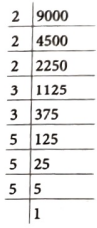
Answer(i) Prime factorisation of 9000
$\therefore 9000=2 \times 2 \times 2 \times 3 \times 3 \times 5 \times 5 \times 5=2^3 \times 3^2 \times 5^3$
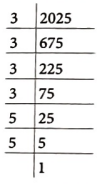
(ii) Prime factorisation of 2025
$\therefore \quad 2025=3 \times 3 \times 3 \times 3 \times 5 \times 5=3^4 \times 5^2$
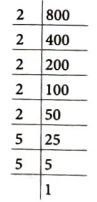
(iii) Prime factorisation of 800
$\therefore 800=2 \times 2 \times 2 \times 2 \times 2 \times 5 \times 5=2^5 \times 5^2$
View full question & answer→Question 123 Marks
Evaluate
(i) $(-1)^{19} \times(-1)^{26}$
(ii) $(-1)^{21}-(-1)^{22}$
Answer(i) We have, $(-1)^{19} \times(-1)^{26}$
$\because \quad(-1)^{19}=-1 \quad\left[\because(-1)^{\text {odd number }}=-1\right]$
and $\quad(-1)^{26}=1 \quad\left[\because(-1)^{\text {even number }}=1\right]$
So, $\quad(-1)^{19} \times(-1)^{26}=(-1) \times(1)=-1$
(ii) We have, $(-1)^{21}-(-1)^{22}$
$\because \quad(-1)^{21}=-1 \quad\left[\because(-1)^{\text {odd number }}=-1\right]$
and $\quad(-1)^{22}=1 \quad\left[\because(-1)^{\text {even number }}=1\right]$
So, $\quad(-1)^{21}-(-1)^{22}=(-1)-(1)=-2$
View full question & answer→Question 133 Marks
Evaluate
(i) $(-2)^2 \times(-3)^3$
(ii) $(-3)^2 \times 4^3$
Answer(i) We have, $(-2)^2 \times(-3)^3$
$\because \quad(-2)^2=(-2) \times(-2)=4$
and $\quad(-3)^3=(-3) \times(-3) \times(-3)=-27$
$\therefore(-2)^2 \times(-3)^3=4 \times(-27)=-108$
(ii) We have, $(-3)^2 \times 4^3$
$\because(-3)^2=(-3) \times(-3)=9$
and $4^3=4 \times 4 \times 4=64$
$\therefore(-3)^2 \times 4^3=9 \times 64=576$
View full question & answer→Question 143 Marks
Express in exponential notation.
(i) 25
(ii) 36
(iii) 81
Answer(i) We have, $25=5 \times 5=5^2$
(ii) We have, $36=6 \times 6=6^2$
(iii) We have, $81=3 \times 3 \times 3 \times 3=81=3^4$
View full question & answer→Question 153 Marks
Evaluate
(i) $2^5$
(ii) $3^5$
(iii) $(-3)^4$
Answer(i) $2^5=2 \times 2 \times 2 \times 2 \times 2=32$
(ii) $3^5=3 \times 3 \times 3 \times 3 \times 3=243$
(iii) $(-3)^4=(-3) \times(-3) \times(-3) \times(-3)=81$
View full question & answer→Question 163 Marks
Write the base and the exponent in each of the following.
(i) $2^6$
(ii) $3^2$
(iii) 9
Answer(i) Given, $2^6$
Here, base $=2$ and exponent $=6$
(ii) Given, $3^2$
Here, base $=3$ and exponent $=2$
(iii) Given, 9
$\because \quad 9=3 \times 3=3^2$
Here, base $=3$ and exponent $=2$
View full question & answer→Question 173 Marks
How many times of 30 must be added to get a sum equal to $30^7$ ?
AnswerLet 30 be added $x$ times, then
$30+30+30++x$ times $=30 \times x$
$\therefore \quad 30 \times x=30^7$
$x=\frac{30^7}{30}=\frac{30^7}{30^1}=30^{7-1}=30^6$ times
$\left[\because a^m÷a^n=a^{m-n}\right]$
View full question & answer→Question 183 Marks
Find the value of
(i) $2^5 \times 4^2 \times 2^2$
(ii) $\left(-3^5\right) \times 2^2 \times 3^2$
(iii) $-(-4)^3 \times 5^2 \times 6^3$
Answer(i) Given, $2^5 \times 4^2 \times 2^2$
$\because \quad 2^5=2 \times 2 \times 2 \times 2 \times 2=32$,
$4^2=4 \times 4=16$ and $2^2=2 \times 2=4$
So, $\quad 32 \times 16 \times 4=2048$
(ii) Given, $(-3)^5 \times 2^2 \times 3^2$
$\because \quad(-3)^5=(-3) \times(-3) \times(-3) \times(-3) \times(-3)$
$\begin{array}{c}=-243 \\ 2^2=2 \times 2=4\end{array}$
and $\quad 3^2=3 \times 3=9$
So, $(-243) \times 4 \times 9=-8748$
(iii) Given, $-(-4)^3 \times 5^2 \times 6^3$
$\because-(-4)^3=-\{(-4) \times(-4) \times(-4)\}=64$,
$5^2=5 \times 5=25$
and $\quad 6^3=6 \times 6 \times 6=216$
So, $64 \times 25 \times 216=345600$
View full question & answer→Question 193 Marks
Simplify :
$\frac{3^5 \times 10^5 \times 25}{5^7 \times 6^5}$
AnswerWe have, $\frac{3^5 \times 10^5 \times 25}{5^7 \times 6^5}=\frac{3^5 \times(2 \times 5)^5 \times 5^2}{5^7 \times(2 \times 3)^5}$ $\left[\begin{array}{l}\because 10=2 \times 5 \\ 25=5 \times 5=5^2 \\ 6=2 \times 3\end{array}\right]$
$=\frac{3^5 \times 2^5 \times 5^5 \times 5^2}{5^7 \times 2^5 \times 3^5}\left[\because(a \times b)^m=a^m \times b^m\right]$
$=\frac{3^{5-5} \times 2^{5-5} \times 5^{5+2}}{5^7}$ $\left[\begin{array}{c}\because a^m \div a^n=a^{m-n} \\ \text { and } a^m \times a^n=a^{m+n}\end{array}\right]$
$=3^0 \times 2^0 \times 5^{7-7}=3^0 \times 2^0 \times 5^0$
$=1 \times 1 \times 1=1 \quad\left[\because a^0=1\right]$
View full question & answer→Question 203 Marks
Simplify :
$\frac{25 \times 5^2 \times t^8}{10^3 \times t^4}$
AnswerWe have, $\frac{25 \times 5^2 \times t^8}{10^3 \times t^4}=\frac{5^2 \times 5^2 \times t^8}{(2 \times 5)^3 \times t^4}$ $\left[\because 25=5 \times 5=5^2\right.$ and $\left.10=2 \times 5\right]$
$=\frac{5^{2+2} \times t^8}{2^3 \times 5^3 \times t^4} \quad\left[\begin{array}{l}\because a^m \times a^n=a^{m+n} \\ \text { and }(a b)^m=a^m \times b^m\end{array}\right]$
$=\frac{5^{4-3} \times t^{8-4}}{2^3}=\frac{5 \times t^4}{2 \times 2 \times 2}=\frac{5 t^4}{8}$ $\left[\because a^m \div a^n=a^{m-n}\right]$
View full question & answer→Question 213 Marks
Express each of the following as a product of prime factors only in exponential form.
270
AnswerWe have, 270
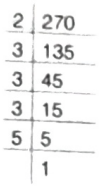
$\therefore \quad 270=2 \times 3 \times 3 \times 3 \times 5=2^1 \times 3^3 \times 5^1$
Hence, the required exponential form of the product of prime factors of 270 is $2 \times 3^3 \times 5$. View full question & answer→Question 223 Marks
Express each of the following as a product of prime factors only in exponential form.
$108 \times 192$
AnswerWe have, $108 \times 192$
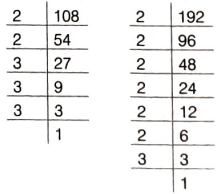
$\therefore \quad 108=2 \times 2 \times 3 \times 3 \times 3=2^2 \times 3^3$
and $\quad 192=2 \times 2 \times 2 \times 2 \times 2 \times 2 \times 3=2^6 \times 3^1$
Now, $108 \times 192=\left(2^2 \times 3^3\right) \times\left(2^6 \times 3^1\right)$
$\begin{array}{l}=\left(2^2 \times 2^6\right) \times\left(3^3 \times 3^1\right) \\ =\left(2^{2+6}\right) \times\left(3^{3+1}\right)\left[\because a^m \times a^n=a^{m+n}\right] \\ =2^8 \times 3^4\end{array}$
Hence, the required exponential form of the product of prime factors of $108 \times 192$ is $2^8 \times 3^4$. View full question & answer→Question 233 Marks
Simplify and express each of the following in exponential form.
$\left(2^3 \times 2\right)^2$
AnswerWe have,
$\left(2^3 \times 2\right)^2=\left(2^{3+1}\right)^2=\left(2^4\right)^2=2^{4 \times 2}$ $\left[\because a^m \times a^n=a^{m+n}\right]$
$=2^8 \quad\left[\because\left(a^m\right)^n=a^{m n}\right]$
View full question & answer→Question 243 Marks
Simplify and express each of the following in exponential form.
$\frac{4^5 \times a^8 b^3}{4^4 \times a^5 b^2}$
AnswerWe have,
$\frac{4^5 \times a^8 b^3}{4^5 \times a^5 b^2}=4^{5-5} \times a^{8-5} \times b^{3-2}$ $\left[\because a^m \div a^n=\frac{a^m}{a^n}=a^{m-n}\right]$
$=4^0 \times a^3 \times b=1 \times a^3 \times b$
$=a^3 b \quad\left[\because a^0=1\right]$
View full question & answer→Question 253 Marks
Simplify and express each of the following in exponential form.
$\left(\frac{a^5}{a^3}\right) \times a^8$
AnswerWe have,
$\left(\frac{a^5}{a^3}\right) \times a^8=\left(a^{5-3}\right) \times a^8=a^2 \times a^8$ $\left[\because a^m \div a^n=a^{m-n}\right]$
$=a^{2+8}=a^{10}\left[\because a^m \times a^n=a^{m+n}\right]$
View full question & answer→Question 263 Marks
Simplify and express each of the following in exponential form.
$\frac{2^8 \times a^5}{4^3 \times a^3}$
AnswerWe have,
$\frac{2^8 \times a^5}{4^3 \times a^3}=\frac{2^8 \times a^5}{\left(2^2\right)^3 \times a^3} \quad\left[\because 4=2 \times 2=2^2\right]$
$=\frac{2^8 \times a^5}{2^{2 \times 3} \times a^3}=\frac{2^8 \times a^5}{2^6 \times a^3}$
$=2^{8-6} \times a^{5-3}$
$=2^2 \times a^2 \quad\left[\because a^m \div a^n=a^{m-n}\right]$
$=(2 a)^2 \quad\left[\because a^m \times b^m=(a b)^m\right]$
View full question & answer→Question 273 Marks
Simplify and express each of the following in exponential form.
$\left(3^0+2^0\right) \times 5^0$
AnswerWe have,
$\left(3^0+2^0\right) \times 5^0=(1+1) \times 1=2 \times 1=2$
View full question & answer→Question 283 Marks
Simplify and express each of the following in exponential form.
$2^0 \times 3^0 \times 4^0$
AnswerWe have,
$2^0 \times 3^0 \times 4^0=1 \times 1 \times 1=1$
View full question & answer→Question 293 Marks
Simplify and express each of the following in exponential form.
$2^0+3^0+4^0$
AnswerWe have,
$2^0+3^0+4^0=1+1+1=3 \quad\left[\because a^0=1\right]$
View full question & answer→Question 303 Marks
Simplify and express each of the following in exponential form.
$\frac{3^7}{3^4 \times 3^3}$
AnswerWe have,
$\frac{3^7}{3^4 \times 3^3}=\frac{3^7}{3^{4+3}}$ $\left[\because a^m \times a^n=a^{m+n}\right]$
$=\frac{3^7}{3^7}=3^{7-7}$ $\left[\because a^m \div a^n=a^{m-n}\right]$
$=3^0=1$ $\left[\because a^0=1\right]$
View full question & answer→Question 313 Marks
Simplify and express each of the following in exponential form.
$\frac{3 \times 7^2 \times 11^8}{21 \times 11^3}$
AnswerWe have,
$\frac{3 \times 7^2 \times 11^8}{21 \times 11^3}=\frac{3^1 \times 7^2 \times 11^8}{3^1 \times 7 \times 11^3}$ $[\because 21=3 \times 7]$
$=3^{1-1} \times 7^{2-1} \times 11^{8-3}$$\left[\because a^m \div a^n=a^{m-n}\right]$
$=3^0 \times 7^1 \times 11^5$
$=1 \times 7 \times 11^5$ $\left[\because a^0=1\right]$
$=7 \times 11^5$
View full question & answer→Question 323 Marks
Simplify and express each of the following in exponential form.
$25^4÷5^3$
AnswerWe have,
$25^4 \div 5^3=\left(5^2\right)^4÷5^3$ $\left[\because 25=5 \times 5=5^2\right]$
$=5^{2 \times 4} \div 5^3=5^8 \div 5^3$ $\left[\because\left(a^m\right)^n=a^{m n}\right]$
$=5^{8-3}=5^5$ $\left[\because a^m \div a^n=a^{m-n}\right]$
View full question & answer→Question 333 Marks
Simplify and express each of the following in exponential form.
$\left[\left(5^2\right)^3 \times 5^4\right]+5^7$
AnswerWe have,
$\left[\left(5^2\right)^3 \times 5^4\right]÷5^7=\left(5^{2 \times 3} \times 5^4\right)÷5^7$ $\left[\because\left(a^m\right)^n=a^{m n}\right]$
$=\left(5^6 \times 5^4\right) \div 5^7=\left(5^{6+4}\right) \div 5^7$ $\left[\because a^m \times a^n=a^{m+n}\right]$
$=5^{10}÷5^7=5^{10-7}=5^3$ $\left[\because a^m÷a^n=a^{m-n}\right]$
View full question & answer→Question 343 Marks
Simplify and express each of the following in exponential form.
$\frac{2^3 \times 3^4 \times 4}{3 \times 32}$
AnswerWe have,
$\frac{2^3 \times 3^4 \times 4}{3 \times 32}$
$=\frac{2^3 \times 3^4 \times 2^2}{3 \times 2^5}$
$\left[\begin{array}{ll}\because 4=2 \times 2=2^2 \text { and } 32=2 \times 2 \times 2 \times 2 \times 2=2^5\end{array}\right]$
$=\frac{2^{3+2} \times 3^4}{3 \times 2^5}=\frac{2^5 \times 3^4}{3 \times 2^5}$ $\left[\because a^m \times a^n=a^{m+n}\right]$
$=2^{5-5} \times 3^{4-1}$ $\left[\because a^m+a^n=a^{m-n}\right]$
$=2^0 \times 3^3$
$=1 \times 3^3=3^3$ $\left[\because a^0=1\right]$
View full question & answer→