Question 12 Marks
Find:
$\frac{7.75}{0.25}$
AnswerWe have, $\frac{7.75}{0.25}=7.75 \div0.25=\frac{775}{100} \div \frac{25}{100}$
$
\begin{array}{l}
=\frac{775}{100} \times \frac{100}{25}=\frac{775}{25}=31 \\
\quad\left[\because \text { Reciprocal of } \frac{25}{100} \text { is } \frac{100}{25}\right]
\end{array}
$
Hence, $\frac{7.75}{0.25}=31$
View full question & answer→Question 22 Marks
Find
$56.3 \times 1000$
AnswerWe have, $56.3 \times 1000$
$
563 \times 1000=563000
$
$\because$ There is only one digit to the right of the decimal point in 56.3 and 1000.
$
\therefore \quad 56.3 \times 1000=56300.0=56300
$
View full question & answer→Question 32 Marks
Find
$1.2 \times 100$
AnswerWe have, $1.2 \times 100$
$
12 \times 10=1200
$
$\because$ There is only one digit to the right of the decimal point in 1.2 and 100.
$
\therefore \quad 1.2 \times 100=120.0=120
$
View full question & answer→Question 42 Marks
Find
$0.3 \times 10$
AnswerWe have, $0.3 \times 10$
$
3 \times 10=30
$
$\because$ There is only one digit to the right of the decimal point in 0.3 and 10.
$
\therefore \quad 0.3 \times 10=3.0=3
$
View full question & answer→Question 52 Marks
Find
$7 \div 2 \frac{4}{7}$
View full question & answer→Question 62 Marks
Find
$6 \div 5 \frac{1}{3}$
AnswerWe have,
$
\begin{aligned}
6 \div 5 \frac{1}{3} & =6 \div\left(\frac{5 \times 3+1}{3}\right) \\
& =\left(6 \div \frac{15+1}{3}\right)=6 \div \frac{16}{3} \\
& =6 \times \frac{3}{16} \quad\left[\because \text { reciprocal of } \frac{16}{3} \text { is } \frac{3}{16}\right] \\
& =\frac{6 \times 3}{16}=\frac{18}{16}=\frac{9}{8}=1 \frac{1}{8}
\end{aligned}
$
[dividing numerator and denominator by 2 ]
View full question & answer→Question 72 Marks
Fill in these boxes.
$\frac{1}{7} \times \frac{1}{5}=$ __________ $=$ __________
View full question & answer→Question 82 Marks
Fill in these boxes.
$\frac{1}{7} \times \frac{1}{2}=$ __________ $=$ __________
View full question & answer→Question 92 Marks
Fill in these boxes.
$\frac{1}{5} \times \frac{1}{7}=$ __________ $=$ __________
View full question & answer→Question 102 Marks
A vehicle covers a distance of $4 3 . 2 ~ k m$ in $2 . 4$ litres of petrol. How much distance will it cover in one litre of petrol?
AnswerDistance covered in 2.4 L petrol $=43.2 km$
$\therefore$ Distance covered in 1 L petrol $=(43.2 \div2.4) km$
$
=\frac{432}{10} \div\frac{24}{10}=\frac{432}{10} \times \frac{10}{24}=18 km
$
Hence, the distance covered by a vehicle in 1L petrol is 18 km.
View full question & answer→Question 112 Marks
Find:
$0.4 \div 2$
AnswerWe have,
$\begin{aligned}
0.4 \div2 & =\frac{4}{10} \times \frac{1}{2} \quad\left[\because \text { Reciprocal of } 2 \text { is } \frac{1}{2}\right] \\
& =\frac{4}{20}=\frac{2}{10}=0.2
\end{aligned}
$
[dividing numerator and denominator by 2]
View full question & answer→Question 122 Marks
Find:
$2.5 \times 0.3$
AnswerWe have, $2.5 \times 0.3$
On multiplying 25 and 3 , we get
$
25 \times 3=75
$
Number of digits after decimal point in given decimal number $=1+1=2$
So, count 2 digits from rightmost digit of 75 and move towards left, then put the decimal point, we get 0.75
Hence, $2.5 \times 0.3=0.75$
View full question & answer→Question 132 Marks
A two-wheeler covers a distance of 55.3 km in 1 litre of petrol. How much distance will it cover in 10 litre of petrol?
AnswerDistance covered by a two-wheeler in 1 L petrol $=55.3 km$
$\therefore$ Distance covered in 10 L petrol $=55.3 \times 10=553 km$
View full question & answer→Question 142 Marks
Find:
$1.3 \times 10$
AnswerWe have, $1.3 \times 10=13$
View full question & answer→Question 152 Marks
Find the area of rectangle whose length is 5.7 cm and breadth is 3 cm .
AnswerGiven, length of the rectangle $=5.7 cm$ and breadth of the rectangle $=3 cm$
$\therefore$ Area of the rectangle $=$ Length $\times$ Breadth
$
=5.7 \times 3=17.1 cm^2
$
Hence, the area of the rectangle is $17.1 cm^2$.
View full question & answer→Question 162 Marks
Find:
$0.2 \times 6$
AnswerWe have, $0.2 \times 6$
On multiplying 2 and 6 , we get $2 \times 6=12$
Number of digits after decimal point in given decimal number $=1+0=1$
So, count 1 digit from the rightmost digit in 12 and move towards left, then put the decimal point, we get 1.2 .
Hence, $
0.2 \times 6=1.2
$
View full question & answer→Question 172 Marks
Find the reciprocal of each of the following fractions. Classify the reciprocals as proper fractions, improper fractions and whole numbers.
$\frac{1}{11}$
AnswerWe have $\frac{1}{11}$, Reciprocal of $\frac{1}{11}=\frac{11}{1}=11$
Here, 11 comes into whole numbers.
Hence, it is a whole number.
View full question & answer→Question 182 Marks
Find the reciprocal of each of the following fractions. Classify the reciprocals as proper fractions, improper fractions and whole numbers.
$\frac{1}{8}$
AnswerWe have $\frac{1}{8}$, Reciprocal of $\frac{1}{8}=\frac{8}{1}=8$
Here, 8 comes into whole numbers. Hence, it is a whole number.
View full question & answer→Question 192 Marks
Find the reciprocal of each of the following fractions. Classify the reciprocals as proper fractions, improper fractions and whole numbers.
$\frac{12}{7}$
AnswerWe have $\frac{12}{7}$, Reciprocal of $\frac{12}{7}=\frac{7}{12}$
Here, numerator is less than denominator. Hence, it is a proper fraction.
View full question & answer→Question 202 Marks
Find the reciprocal of each of the following fractions. Classify the reciprocals as proper fractions, improper fractions and whole numbers.
$\frac{6}{5}$
AnswerWe have $\frac{6}{5}$, Reciprocal of $\frac{6}{5}=\frac{5}{6}$
Here, numerator is less than denominator. Hence, it is a proper fraction.
View full question & answer→Question 212 Marks
Find the reciprocal of each of the following fractions. Classify the reciprocals as proper fractions, improper fractions and whole numbers.
$\frac{9}{7}$
AnswerWe have $\frac{9}{7}$, Reciprocal of $\frac{9}{7}=\frac{7}{9}$
Here, numerator is less than denominator. Hence, it is a proper fraction.
View full question & answer→Question 222 Marks
Find the reciprocal of each of the following fractions. Classify the reciprocals as proper fractions, improper fractions and whole numbers.
$\frac{5}{8}$
AnswerWe have $\frac{5}{8}$, Reciprocal of $\frac{5}{8}=\frac{8}{5}$
Here, numerator is greater than denominator. Hence, it is an improper fraction.
View full question & answer→Question 232 Marks
Find the reciprocal of each of the following fractions. Classify the reciprocals as proper fractions, improper fractions and whole numbers.
$\frac{3}{7}$
AnswerWe have $\frac{3}{7}$, Reciprocal of $\frac{3}{7}=\frac{7}{3}$
Here, numerator is greater than denominator. Hence, it is an improper fraction.
View full question & answer→Question 242 Marks
A car runs $1 6 km$ using 1 litre of petrol. How much distance will it cover using $2 \frac{3}{4}$ litre of petrol?
AnswerDistance covered by a car using 1 L of petrol $=16 km$
Distance covered by a car using $2 \frac{3}{4} L$ of petrol
$
\begin{array}{l}
=16 \times 2 \frac{3}{4} km=16 \times\left(\frac{2 \times 4+3}{4}\right)=16 \times\left(\frac{8+3}{4}\right) \\
=16 \times \frac{11}{4}=\frac{16 \times 11}{4}=4 \times 11=44 km
\end{array}
$
[dividing numerator and denominator by 4]
View full question & answer→Question 252 Marks
Lipika reads a book for $1 \frac{3}{4}$ hours everyday. She reads the entire book in 6 days. How many hours in all were required by her to read the book?
AnswerGiven, number of days $=6$
Time taken by Lipika to read a book in 1 day
$
\begin{array}{l}
=1 \frac{3}{4} h \\
=\frac{1 \times 4+3}{4}=\frac{7}{4} h
\end{array}
$
$\therefore$ Required hours by her to read the book
$
\begin{array}{l}
=6 \times \frac{7}{4}=\frac{6 \times 7}{4} \\
=\frac{42}{4}=\frac{21}{2}=10 \frac{1}{2} h
\end{array}
$
[dividing numerator and denominator by 2]
View full question & answer→Question 262 Marks
Saili plants $4$ saplings in a row, In her garden.
The distance between two adjacent saplings is $\frac{3}{4} m$.
Find the distance between the first and the last saplings.
View full question & answer→Question 272 Marks
Multiply the following fractions.
$3 \frac{4}{7} \times \frac{3}{5}$
View full question & answer→Question 282 Marks
Multiply the following fractions.
$2 \frac{3}{5} \times 3$
View full question & answer→Question 292 Marks
Multiply the following fractions.
$3 \frac{2}{5} \times \frac{4}{7}$
View full question & answer→Question 302 Marks
Multiply the following fractions.
$\frac{5}{6} \times 2 \frac{3}{7}$
View full question & answer→Question 312 Marks
Multiply the following fractions.
$\frac{3}{2} \times 5 \frac{1}{3}$
View full question & answer→Question 322 Marks
Multiply the following fractions.
$6 \frac{2}{5} \times \frac{7}{9}$
View full question & answer→Question 332 Marks
Multiply the following fractions.
$\frac{2}{5} \times 5 \frac{1}{4}$
AnswerWe have, $\frac{2}{5} \times 5 \frac{1}{4}=\frac{2}{5} \times\left(\frac{5 \times 4+1}{4}\right)=\frac{2}{5} \times\left(\frac{20+1}{4}\right)$
$
=\frac{2}{5} \times \frac{21}{4}=\frac{2 \times 21}{5 \times 4}=\frac{42}{20}=\frac{21}{10}
$
View full question & answer→Question 342 Marks
Find
$\frac{1}{7}$ of$\quad$ (a) $\frac{2}{9}$ (b) $\frac{6}{5}$ (c) $\frac{3}{10}$
Answer(a) $\frac{2}{63}$ (b) $\frac{6}{35}$ (c) $\frac{3}{70}$
View full question & answer→Question 352 Marks
Find
$\frac{1}{4}$ of$\quad$(a) $\frac{1}{4}$ (b) $\frac{3}{5}$ (c) $\frac{4}{3}$
Answer(a) We have, $\frac{1}{4}$ of $\frac{1}{4}=\frac{1}{4} \times \frac{1}{4}=\frac{1 \times 1}{4 \times 4}=\frac{1}{16}$
[ $\because$ 'of' means multiplication]
(b) We have, $\frac{1}{4}$ of $\frac{3}{5}=\frac{1}{4} \times \frac{3}{5}=\frac{1 \times 3}{4 \times 5}=\frac{3}{20}$
(c) We have, $\frac{1}{4}$ of $\frac{4}{3}=\frac{1}{4} \times \frac{4}{3}=\frac{1 \times 4}{4 \times 3}=\frac{4}{12}=\frac{1}{3}$
[dividing numerator and denominator by 4]
View full question & answer→Question 362 Marks
Vidya and Pratap went for a picnic. Their mother gave them a water bottle that contained 5 L of water. Vidya consumed $\frac{2}{5}$ of the water. Pratap consumed the remaining water.
(i) How much water did Vidya drink?
(ii) What fraction of the total quantity of water did Pratap drink?
Answer(i) Given, total amount of water in a bottle $=5 L$
$
\begin{aligned}
\text { Water consumed by Vidya } & =\frac{2}{5} \text { of } 5 L=\frac{2}{5} \times 5 \\
=\frac{2 \times 5}{5}=2 L
\end{aligned}
$
[dividing numerator and denominator by 5]
So, Vidya drink 2 L of water.
(ii) Water consumed by Pratap = Total amount of water- Water consumed by Vidya
$
=5-2=3 L
$
$\therefore$ Fraction of total quantity of water consumed by Pratap
$
\begin{array}{l}
=\frac{\text { Water consumed by Pratap }}{\text { Total amount of water }} \\
=\frac{3}{5} L
\end{array}
$
View full question & answer→Question 372 Marks
Find
$\frac{5}{8}$ of$\quad$(a) $3 \frac{5}{6}$ (b) $9 \frac{2}{3}$
Answer(a) $2 \frac{19}{48}$ (b) $6 \frac{1}{24}$
View full question & answer→Question 382 Marks
Find
$\frac{1}{2}$ of$\quad$(a) $2 \frac{3}{4}$ (b) $4 \frac{2}{9}$
Answer(a) We have, $\frac{1}{2}$ of $2 \frac{3}{4}=\frac{1}{2} \times 2 \frac{3}{4}$
$
\begin{array}{l}
=\frac{1}{2} \times\left(\frac{2 \times 4+3}{4}\right) \\
=\frac{1}{2} \times\left(\frac{8+3}{4}\right) \\
=\frac{1}{2} \times \frac{11}{4}=\frac{11}{8}=1 \frac{3}{8}
\end{array}
$
(b) We have, $\frac{1}{2}$ of $4 \frac{2}{9}=\frac{1}{2} \times 4 \frac{2}{9}$
$
\begin{array}{l}
=\frac{1}{2} \times\left(\frac{4 \times 9+2}{9}\right) \\
=\frac{1}{2} \times\left(\frac{36+2}{9}\right) \\
=\frac{1}{2} \times \frac{38}{9}=\frac{1 \times 19}{1 \times 9}
\end{array}
$
[dividing numerator and denominator by 2 ]
$
=\frac{19}{9}=2 \frac{1}{9}
$
View full question & answer→Question 392 Marks
Multiply and express as a mixed fraction.
$3 \frac{2}{5} \times 8$
AnswerMixed fraction $=27 \frac{1}{5}$
View full question & answer→Question 402 Marks
Multiply and express as a mixed fraction.
$3 \frac{1}{4} \times 6$
AnswerMixed fraction $=19 \frac{1}{2}$
View full question & answer→Question 412 Marks
Multiply and express as a mixed fraction.
$4 \times 6 \frac{1}{3}$
AnswerMixed fraction $=25 \frac{1}{3}$
View full question & answer→Question 422 Marks
Multiply and express as a mixed fraction.
$7 \times 2 \frac{1}{4}$
AnswerMixed fraction $=15 \frac{3}{4}$
View full question & answer→Question 432 Marks
Multiply and express as a mixed fraction.
$5 \times 6 \frac{3}{4}$
View full question & answer→Question 442 Marks
Multiply and express as a mixed fraction.
$3 \times 5 \frac{1}{5}$
AnswerWe have, $3 \times 5 \frac{1}{5}=3 \times\left(\frac{5 \times 5+1}{5}\right)=3 \times\left(\frac{25+1}{5}\right)$
$
=3 \times \frac{26}{5}=\frac{3 \times 26}{5}=\frac{78}{5}
$
Now, dividing 78 (numerator) by 5 (denominator), we get
quotient $=15$ and remainder $=3$
$\therefore$ Mixed fraction $=$ Quotient $\frac{\text { Remainder }}{\text { Divisor }}=15 \frac{3}{5}$
View full question & answer→Question 452 Marks
Find
$\frac{4}{5}$ of$\quad$(a) 20 (b) 35
View full question & answer→Question 462 Marks
Find
$\frac{3}{4}$ of$\quad$(a) 16 (b) 36
View full question & answer→Question 472 Marks
Find
$\frac{2}{3}$ of$\quad$(a) 18 (b) 27
View full question & answer→Question 482 Marks
Find
$\frac{1}{2}$ of$\quad$(a) 24 (b) 46
Answer(a) We have, $\frac{1}{2}$ of $24=\frac{1}{2} \times 24=\frac{1 \times 24}{2}=\frac{24}{2}=12$
(b) We have, $\frac{1}{2}$ of $46=\frac{1}{2} \times 46=\frac{1 \times 46}{2}=\frac{46}{2}=23$
View full question & answer→Question 492 Marks
Multiply and reduce to lowest form and convert into a mixed fraction.
(i) $7 \times \frac{3}{5}$
AnswerWe have, $ 7 \times \frac{3}{5}=\frac{7 \times 3}{5}=\frac{21}{5} $
This is required lowest form.
Now, on dividing 21 (numerator) by 5 (denominator), we get
Quotient $=4$ and remainder $=1$
$\therefore$ Mixed fraction $=$ Quotient $\frac{\text { Remainder }}{\text { Divisor }}=4 \frac{1}{5}$
View full question & answer→Question 502 Marks
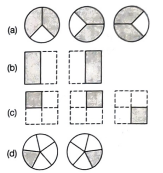
Answer(i) We have, $2 \times \frac{1}{5}=\frac{2}{5}$ or $\frac{1}{5}+\frac{1}{5}$
It shows that, out of 5 parts of two figures, one part is shaded, which is shown in Figure (d).
(ii) (b)
(iii) (a)
(iv) (c)
View full question & answer→