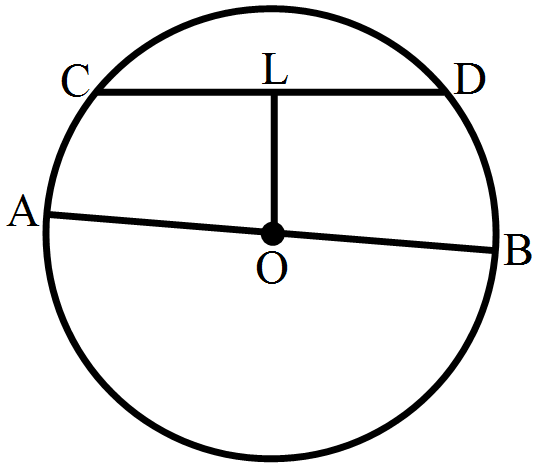
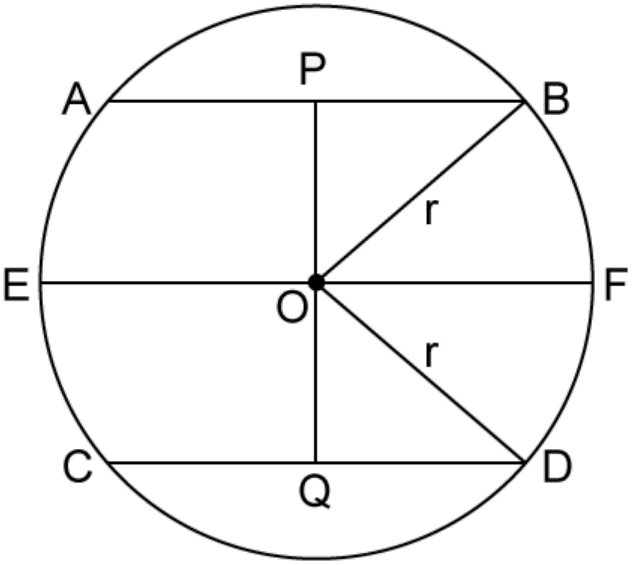
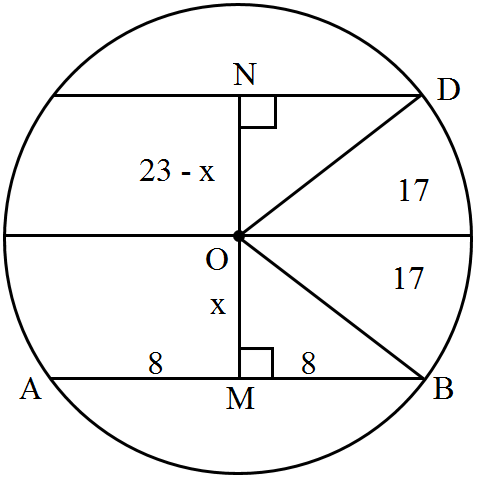
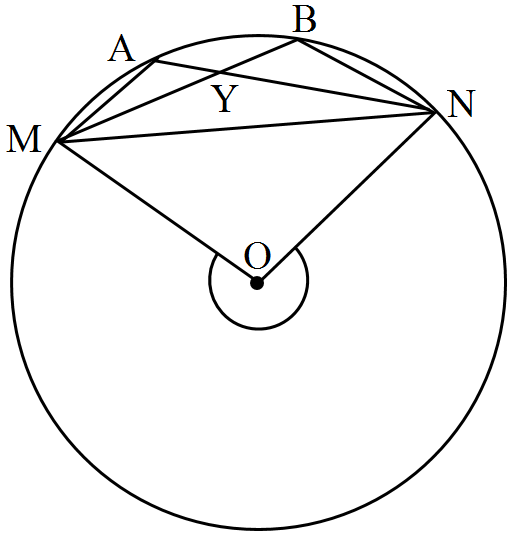
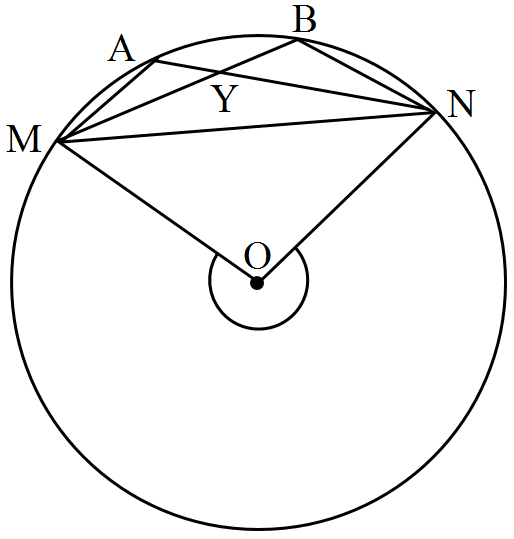
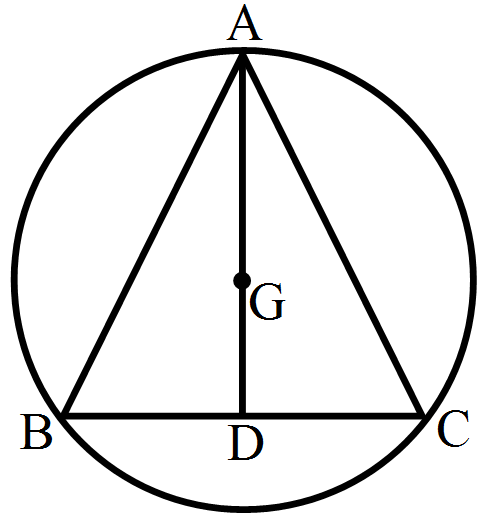
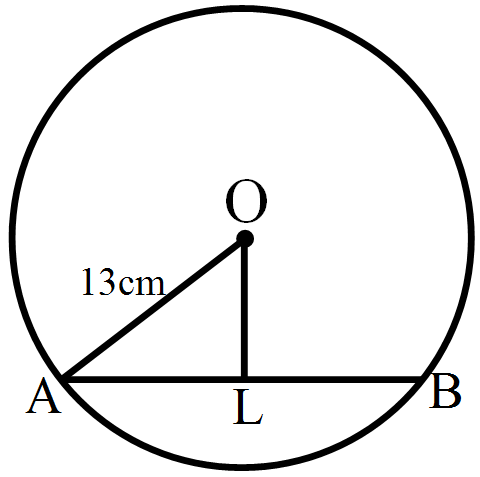
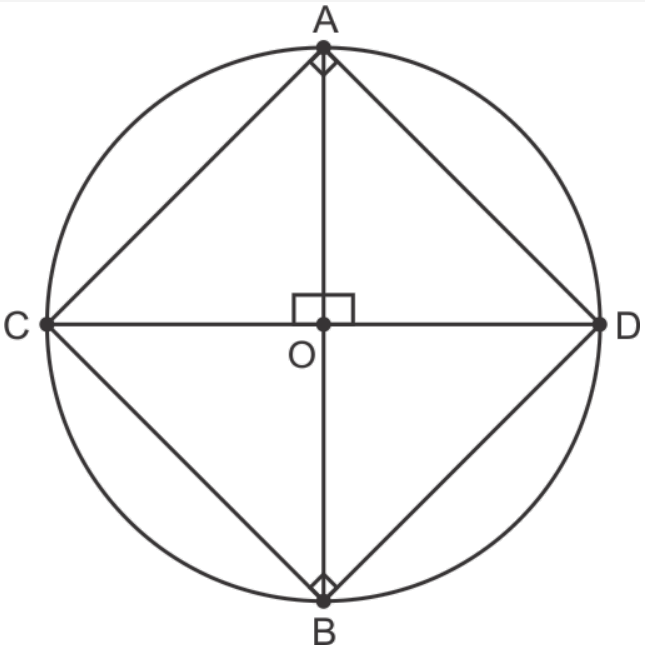
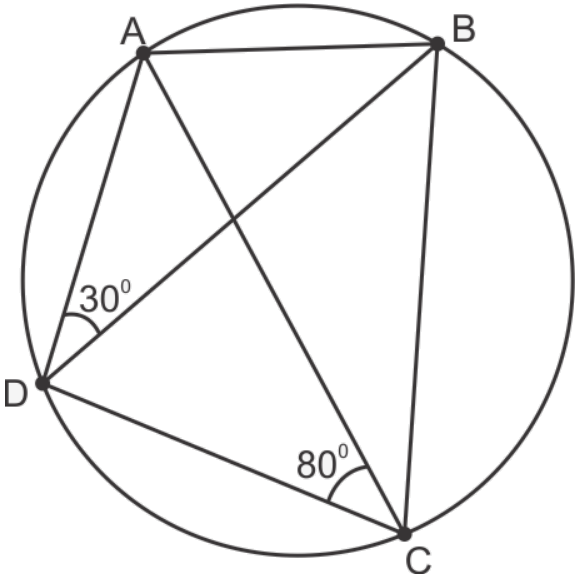
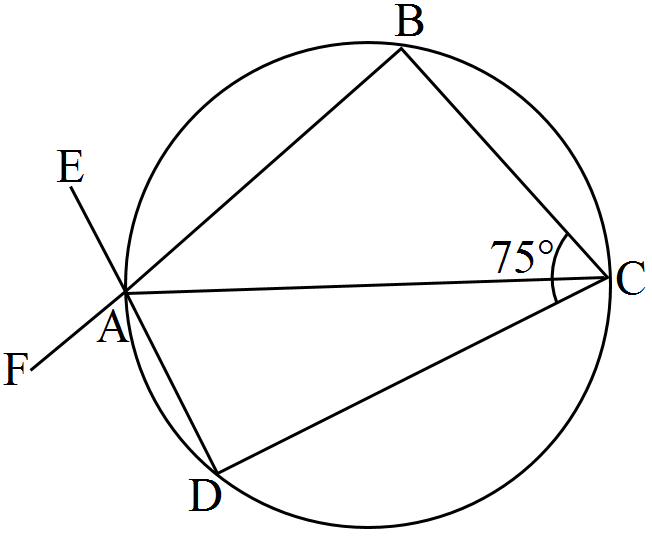
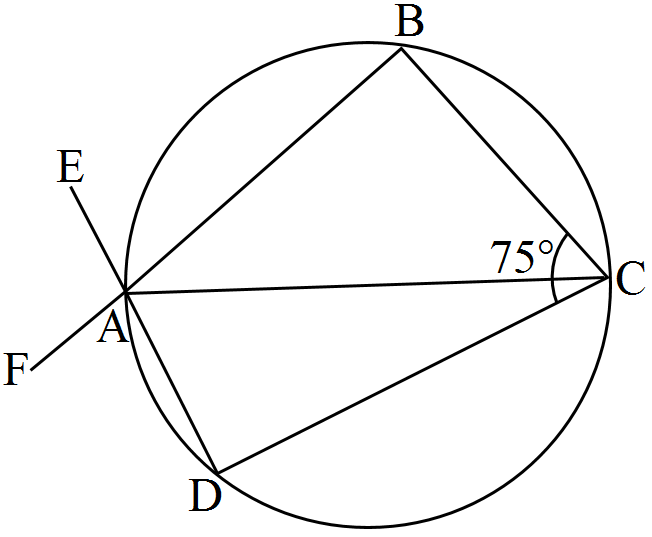
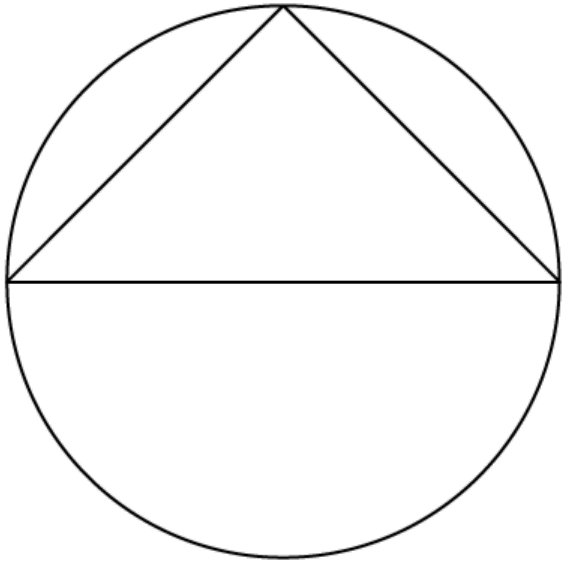
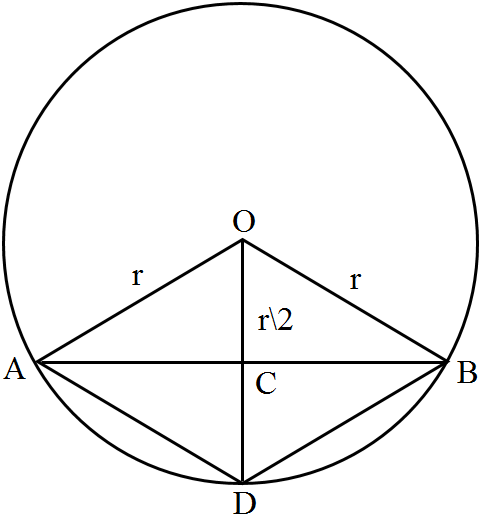
In a circle of radius 17cm, two parallel chords are drawn on opposite side of a diameter. The distance between the chords is 23cm. If the length of one chord is 16cm, then the length of the other is:
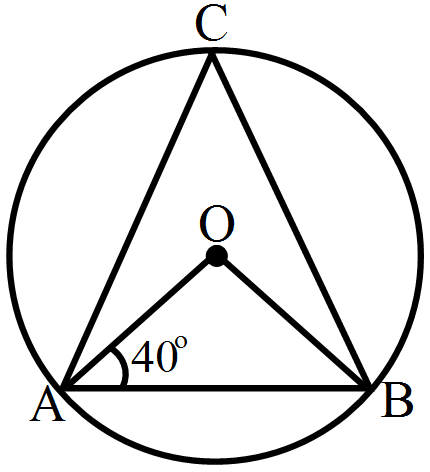
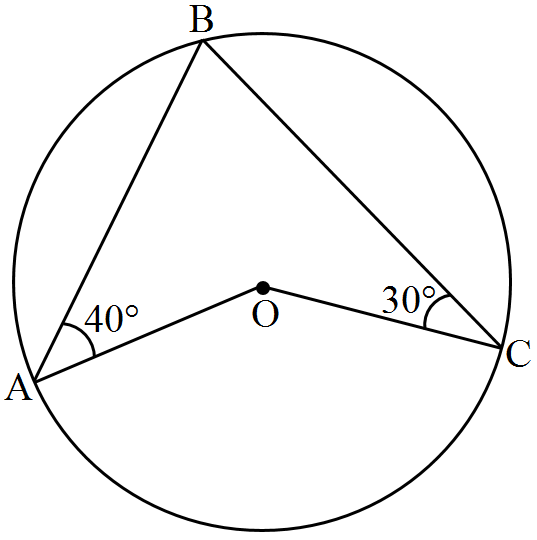
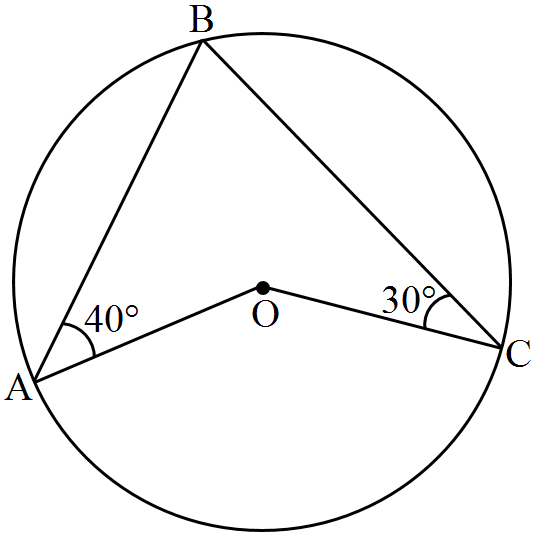
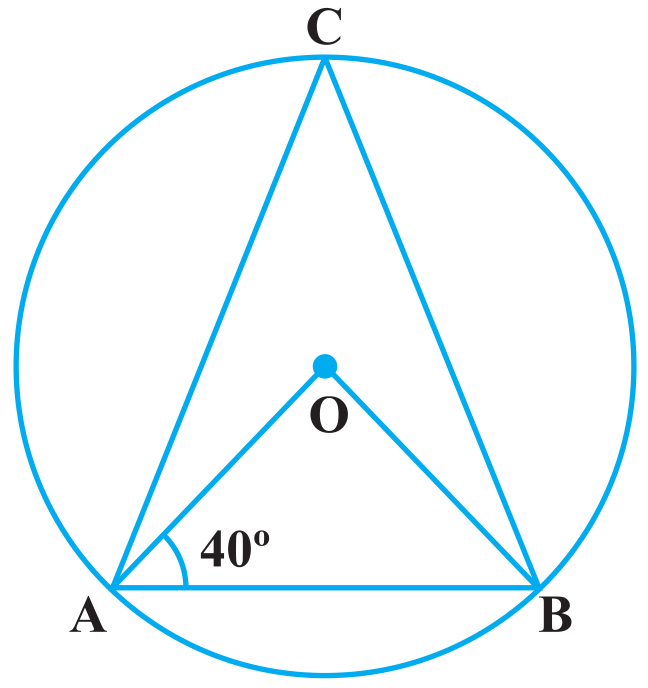
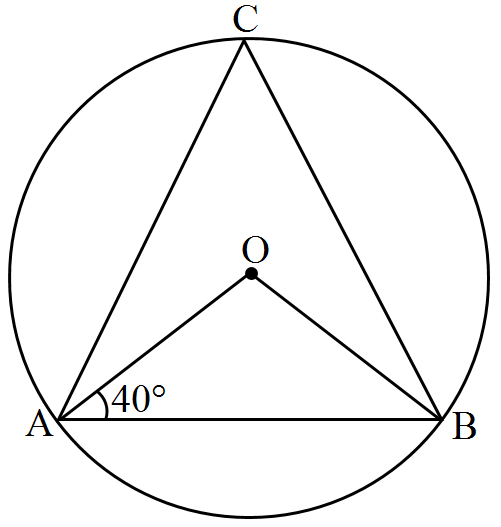
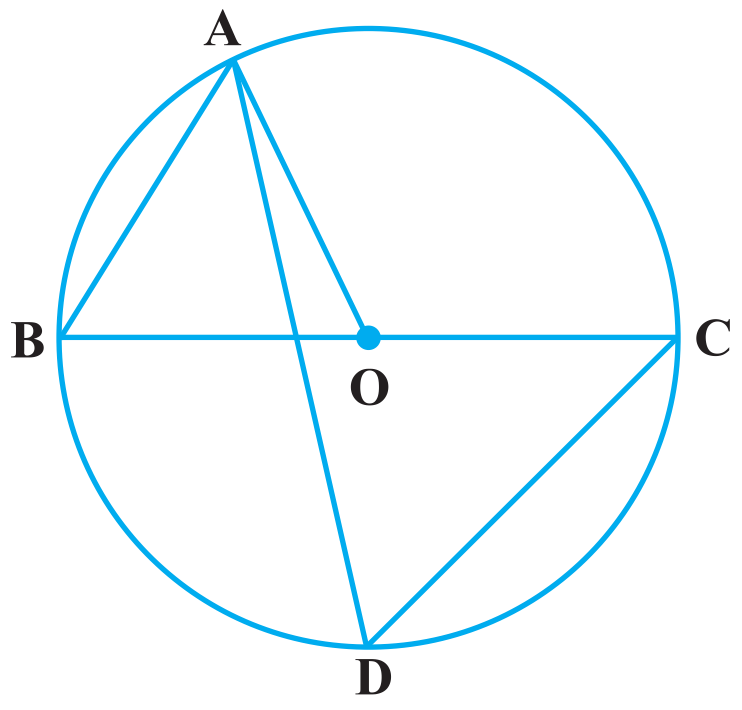
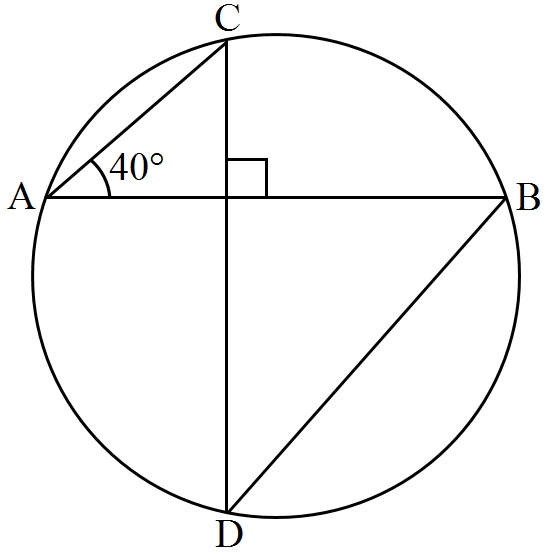
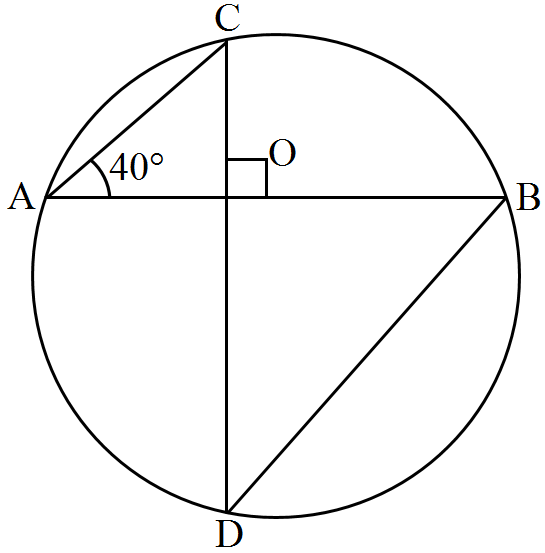
In the given figure, O is the centre of a circle. If $\angle\text{OAB}=40^\circ$ and C is a point on the circle, then $\angle\text{ACB}=?$
A
40°
B
50°
C
80°
D
100°
Answer
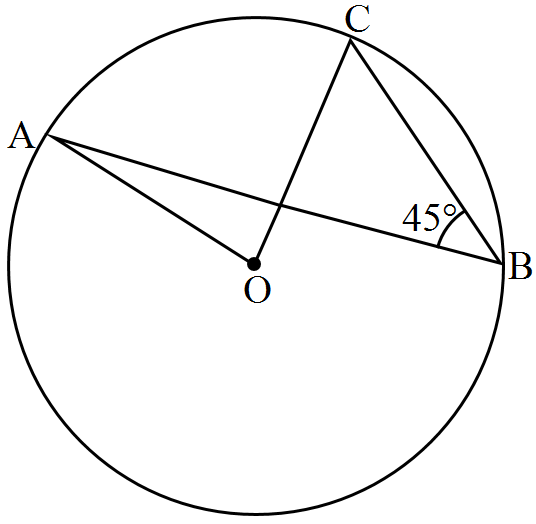
50° Solution: In $\triangle\text{OAB},$ $\text{OA}=\text{OB}$ [Radii of the same circle] $\Rightarrow\ \angle\text{OAB}=\angle\text{OBA}$ [Angle opposite equal sides are equal] $\angle\text{OAB}+\angle\text{OBA}+\angle\text{AOB}=180^\circ$ [Angle sum property] $\Rightarrow\ 40^\circ+40^\circ+\angle\text{AOB}=180^\circ$ $\Rightarrow\ \angle\text{AOB}=100^\circ$ We know that, the angle subtended by an arc of a circle at the centre is double the angle subtended by it at any point on the remaining part of the circle. So, $\angle\text{ACB}=\frac{1}{2}\angle\text{AOB}$ $=\frac{1}{2}(100^\circ)$ $=50^\circ$
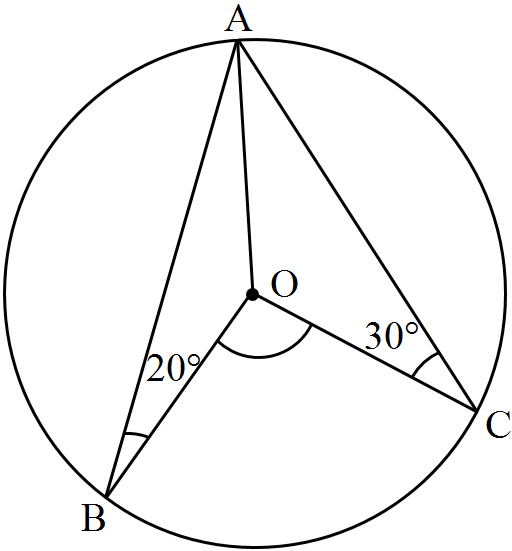
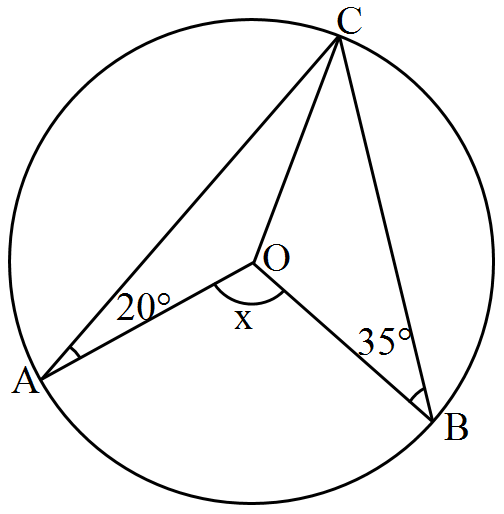
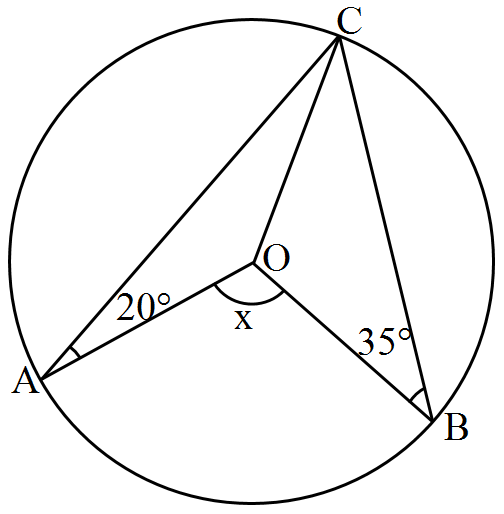
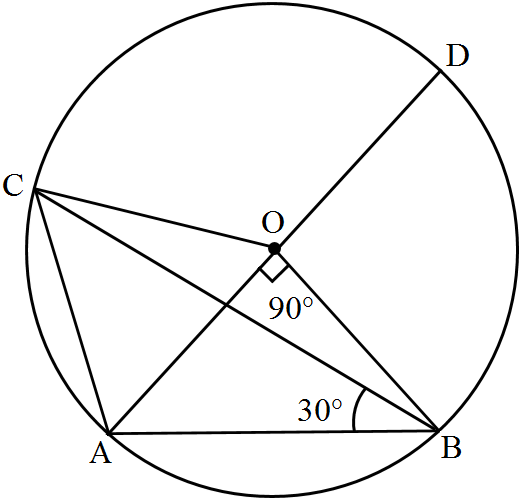
100º Solution: In $\triangle\text{OAB},$ we have: OA = OB (Radii of a circle) $\Rightarrow\angle\text{OAB}=\angle\text{OBA}=20^\circ$ In $\triangle\text{OAC},$ we have: OA = OC (Radii of a circle) $\Rightarrow\angle\text{OAC}=\angle\text{OCA}=30^\circ$ Now, $\angle\text{BAC}=(20^\circ+30^\circ)=50^\circ$ $\therefore\angle\text{BOC}=(2\times\angle\text{BAC})=(2\times50^\circ)=100^\circ$ $\Rightarrow\angle\text{BOC}=100^\circ$
In a circle of radius 17cm, two parallel chords are drawn on opposite side of a diameter. The distance between the chords is 23cm. If the length of one chord is 16cm, then the length of the other is:
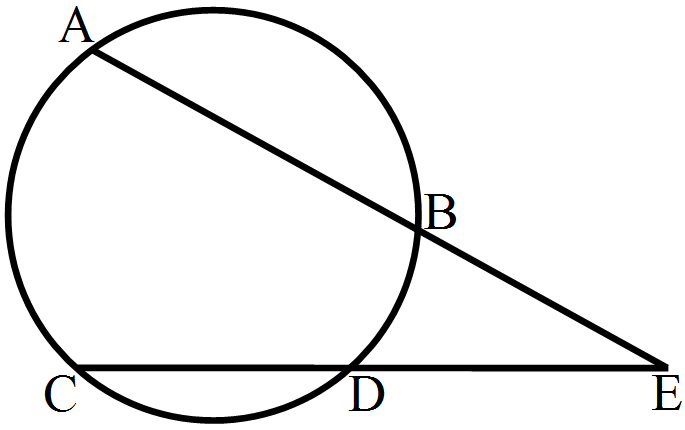
Two chords AB and CD of a circle intersect each other at a point E outside the circle. If AB = 11cm, BE = 3cm and DE = 3.5cm, then CD = ?
A
10.5cm
B
9.5cm
C
8.5cm
D
7.5cm
Answer
8.5cm Solution: Construction: Join AC. $\frac{\text{AE}}{\text{CE}}=\frac{\text{DE}}{\text{BE}}$ ⇒ AE × BE = DE × CE ...(i) Then, AE = AB + BE = 11 + 3 = 14cm, BE = 3cm, CE = (x + 3.5)cm and DE = 3.5cm So, from (i), we get 14 × 3 = 3.5 × (CD + 3.5) $\Rightarrow\ \frac{14\times3}{3.5}=\text{CD}+3.5$ ⇒ 12 = CD + 3.5 ⇒ CD = 8.5cm
50°. Solution: In $\triangle\text{QAB, OA} = \text{OB}$ [both are the radius of a circle] $\angle\text{OAB} = \angle\text{OBA}\Rightarrow \angle\text{OBA} = 40^\circ$ [angles opposite to equal sides are equal] Also, $\angle\text{AOB} = \angle\text{OBA}\Rightarrow \angle\text{BAO} = 180^\circ$ [by angle sum property of a triangle] $\angle\text{AOB} + 40^\circ + 40^\circ = 180^\circ$ $\Rightarrow\ \angle\text{AOB} = 180^\circ – 80^\circ = 100^\circ$ We know that, in a circle, the angle subtended by an arc at the centre is twice the angle subtended by it at the remaining part of the circle. $\angle\text{AOB} = 2 \angle\text{ACB} \Rightarrow 100^\circ =2 \angle\text{ACB}$ $\angle\text{ACB} = \frac{100}{2} = 50^\circ$
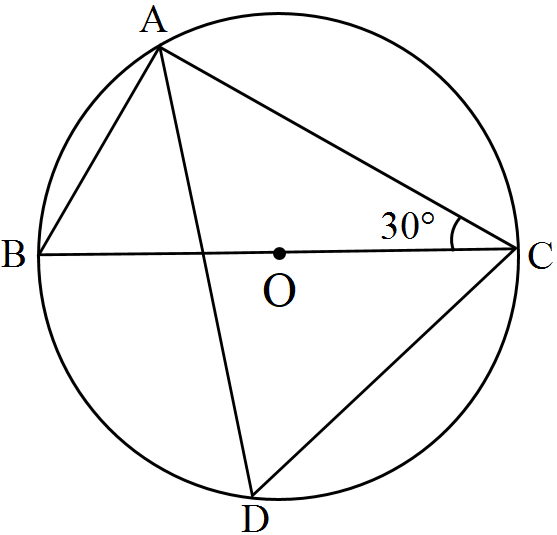
60º Solution: Angles in a semi-circle measure 90º. $\therefore\angle\text{BAC}=90^\circ$ In $\triangle\text{ABC},$ we have: $\angle\text{BAC}+\angle\text{ABC}+\angle\text{BCA}=180^\circ$ (Angle sum property of a triangle) $\therefore90^\circ+\angle\text{ABC}+30^\circ=180^\circ$ $\Rightarrow\angle\text{ABC}=(180^\circ-120^\circ)=60^\circ$ $\therefore\angle\text{CDA}=\angle\text{ABC}=60^\circ$ (Angles in the same segment of a circle) $\Rightarrow\angle\text{CDA}=60^\circ$
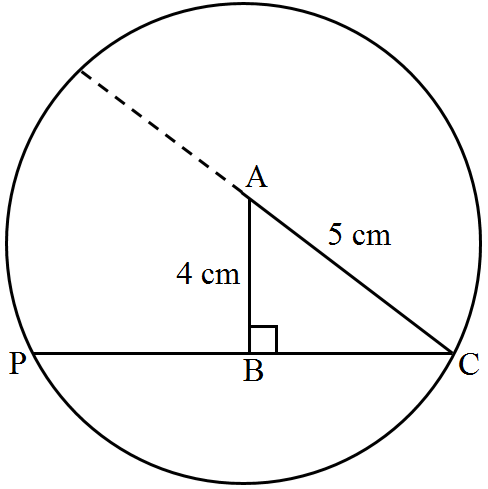
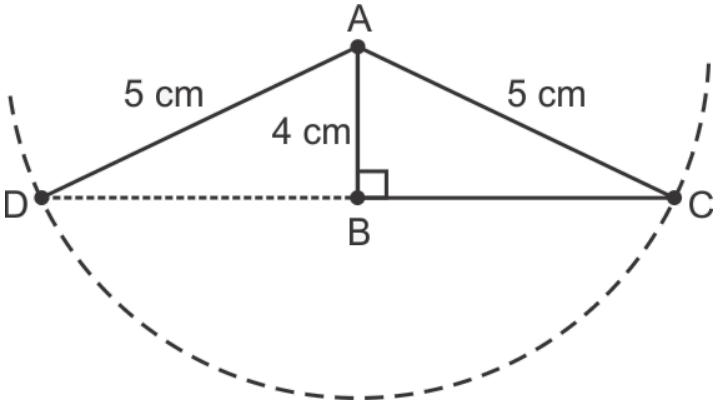
ABC is a triangle with B as right angle, AC = 5cm and AB = 4cm. A circle is drawn with A as centre and AC as radius. The length of the chord of this circle passing through C and B is:
How many circle can pass through three non-collinear points?
A
Three
B
One
C
Two
D
Four
Answer
One Solution: Only one circle can be drawn from three distinct points. Join any two sets of points. Make their respective perpendicular bisectors. The point where the two bisectors meet act as the centre of such a circle. Taking the distance between the centre and any of the given points as radius, we can draw the circle. Such a circle would definitely pass through the remaining two points as well.
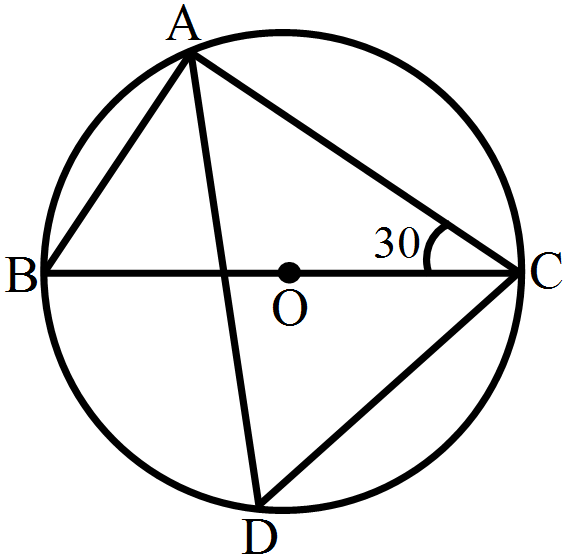
In the given figure, BOC is a diameter of a circle with centre O. If $\angle\text{BCA}=30^\circ$ then $\angle\text{CDA}=?$
A
30°
B
45°
C
60°
D
50°
Answer
60° Solution: Since BOC is a diameter, $\angle\text{BAC}=90^\circ.$ In $\triangle\text{BAC},$ $\angle\text{BAC}+\angle\text{ABC}+\angle\text{BCA}=180^\circ$ [Angle sum property] $\Rightarrow\ 90^\circ+\angle\text{ABC}+30^\circ=180^\circ$ $\Rightarrow\ \angle\text{ABC}=60^\circ$ Since angles in the same segment of a circle are equal. $\angle\text{CDA}=\angle\text{ABC}=60^\circ.$
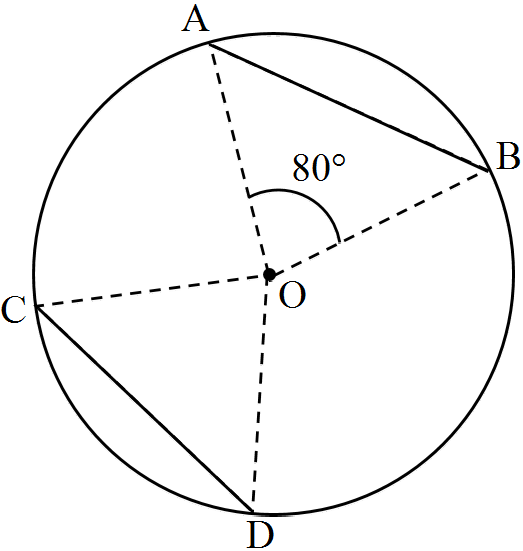
80º Solution: Given: AB = CD We know that equal chords of a circle subtend equal angles at the centre. $\therefore\angle\text{COD}=\angle\text{AOB}=80^\circ$ $\Rightarrow\angle\text{COD}=80^\circ$
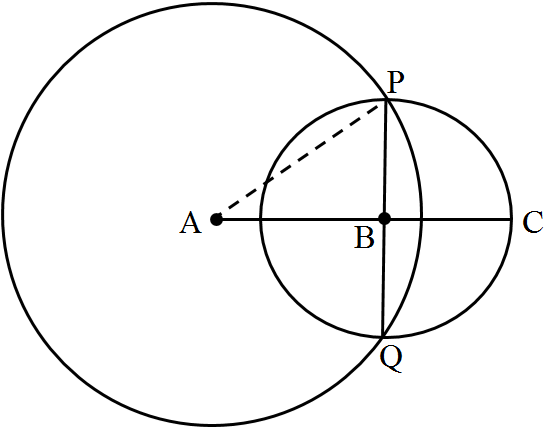
ABC is a triangle with B as right angle, AC = 5cm and AB = 4cm. A circle is drawn with A as centre and AC as radius. The length of the chord of this circle passing through C and B is:
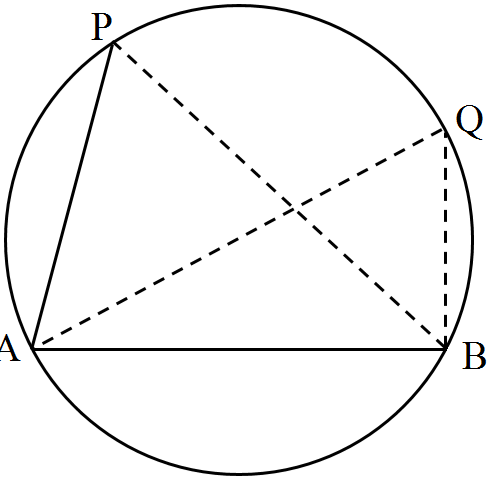
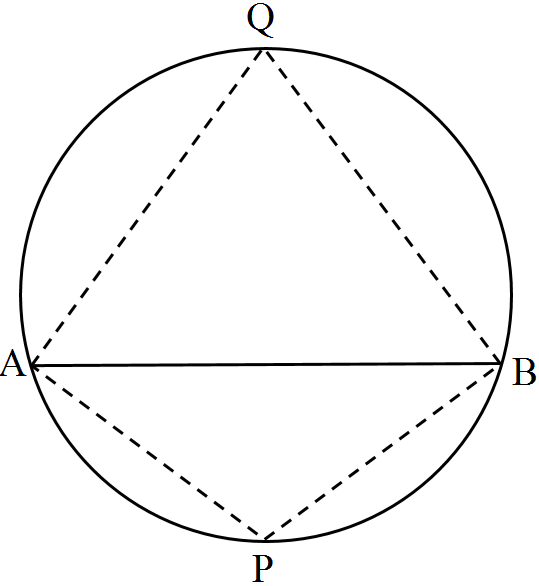
6cm Solution: We know that the line joining their centres is the perpendicular bisector of the common chord. Join AP. Then AP = 5cm; AB = 4cm Also, AP2 = BP2 + AB2 [using pythagoras theorem] ⇒ BP2 = AP2 - AB2 ⇒ BP2 = 52 - 42 ⇒ BP = 3cm $\therefore$ triangle ABP is a right angled and PQ = 2 × BP = (2 × 3)cm = 6cm
ABCD is a cyclic quadrilateral such that AB is a diameter of the circle circumscribing it and $\angle\text{ADC}=140^\circ,$ then $\angle\text{BAC}$ is equal to:
A
75º
B
40º
C
30º
D
50º
Answer
50º Solution: In the given quadrilateral, $\angle\text{ABC}+\angle\text{ADC}=180^\circ$ $140^\circ+\angle\text{ABC}=180^\circ$ $\angle\text{ABC}=40^\circ$ Since, AB is diameter so ABCD lies in semi-circle. Thus, $\angle\text{BCA}=90^\circ$ In triangle, ABC, $\angle\text{A}+\angle\text{B}+\angle\text{C}=180^\circ$ $\angle\text{BAC}=180^\circ-40^\circ-90^\circ=180^\circ-130^\circ=50^\circ$ $\angle\text{BAC}=50^\circ$
60°. Solution: In $\triangle\text{OAB},$ we have OA = OB [Radii of the same circle] $\therefore\angle\text{ABO}=\angle\text{BAO}$ [Angles opp. To equal sides are equal] $\therefore\angle\text{ABO}=\angle\text{BAO}=60^\circ$ [Given] Now, $\angle\text{ADC}=\angle\text{ABC}=60^\circ$ [$\because\angle\text{ABC}$ and $\angle\text{ADC}$ are angles in the same segment of circle, are equal] Hence, $\angle\text{ADC}=60^\circ$ So, (c) is the correct answer.
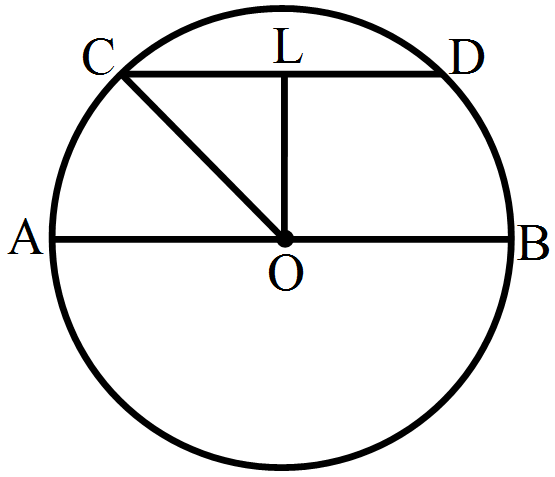
In the given figure, AOB is a diameter of a circle with centre O such that AB = 34cm and CD is a chord of length 30cm. Then the distance of CD from AB is:
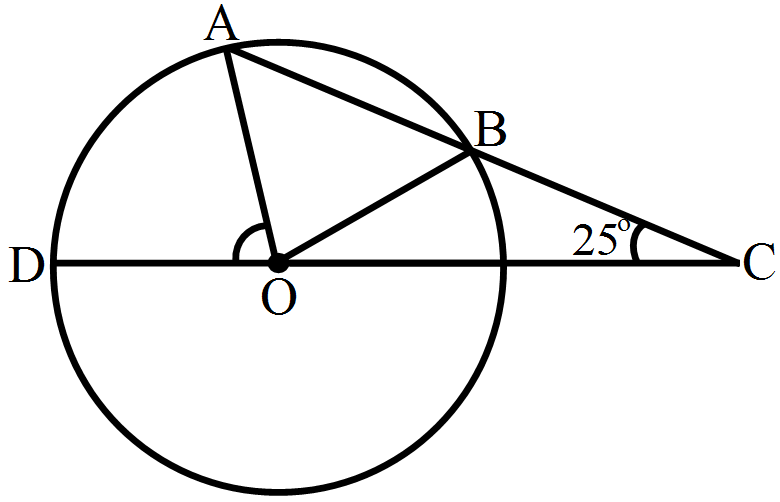
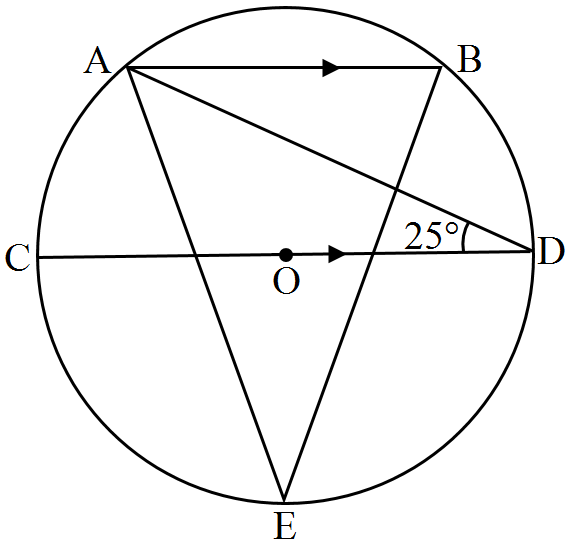
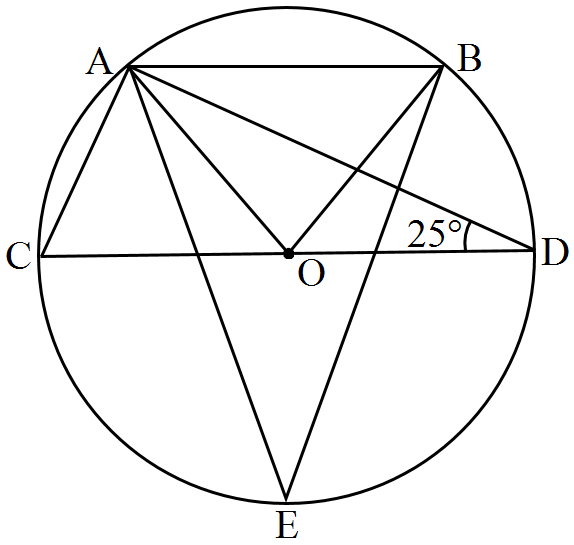
In the given figure, AB is a chord of a circle with centre O and AB is produced to C such that BC = OB. Also, CO is joined and produced to meet the circle in D. If $\angle\text{ACD}=25^\circ,$ then $\angle\text{AOD}=?$
A
50°
B
75°
C
90°
D
100°
Answer
75° Solution: OB = BC [Given] $\Rightarrow\ \angle\text{OBC}=\angle\text{BCO}=25^\circ$ [Angles opposite equal sides are equal] Now, $\angle\text{OBC}=\angle\text{BOC}+\angle\text{BCO}=25^\circ+25^\circ=50^\circ$ OA = OB [Radii of the same circle] $\Rightarrow\ \angle\text{OAB}=\angle\text{OBA}=50^\circ$ In $\triangle\text{AOC},$ $\angle\text{AOD}=\angle\text{OAC}+\angle\text{ACO}$ $=\angle\text{OAB}+\angle\text{BCO}$ $=50^\circ+25^\circ$ $=75^\circ$
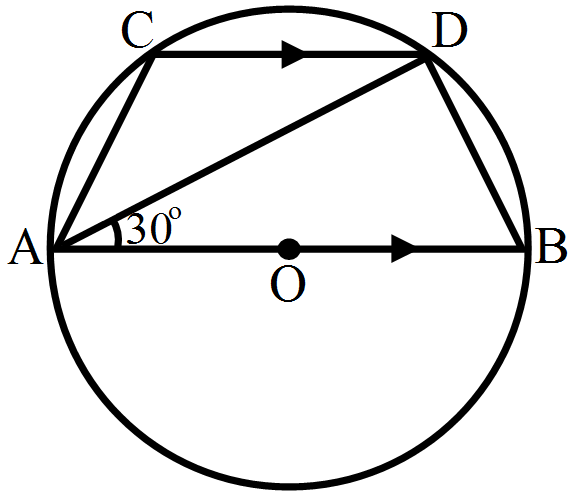
In the given figure, AOB is a diameter of a circle and CD || AB. If $\angle\text{BAD}=30^\circ$ then $\angle\text{CAD}=?$
A
30°
B
60°
C
45°
D
50°
Answer
30° Solution: Since AB || CD, $\angle\text{BAD}=\angle\text{CDA}=30^\circ$ [Alternate angles] Since AOB is a diameter, $\angle\text{ADB}=90^\circ$ $\angle\text{CDB}=\angle\text{CDA}+\angle\text{ADB}=30^\circ$ $\Rightarrow\ \angle\text{CDB}=30^\circ+90^\circ$ $\Rightarrow\ \angle\text{CDB}=120^\circ$ We know that the opposite angles of a quadrilateral are supplementary. $\angle\text{CAB}+\angle\text{CDB}=180^\circ$ $\Rightarrow\ \angle\text{CAD}+\angle\text{DAB}+\angle\text{CDB}=180^\circ$ $\Rightarrow\ \angle\text{CAD}+30^\circ+120^\circ=180^\circ$ $\Rightarrow\ \angle\text{CAD}=30^\circ$
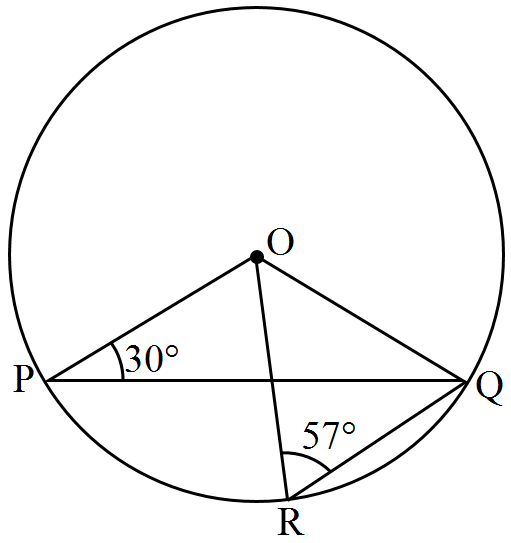
54º Solution: $\angle\text{OPQ}=\angle\text{OQP}=30^\circ$ (Angles of isosceles triangle OPQ) Also, in triangle OPQ, $\angle\text{O}+\angle\text{P}+\angle\text{Q}=180^\circ$ $\angle\text{O}=30^\circ+30^\circ=180^\circ$ $\angle\text{O}=180^\circ-60^\circ=120^\circ$ So, $\angle\text{POQ}=120^\circ\ ...(\text{i})$ Again, in triangle ORQ $\angle\text{R}=\angle\text{Q}=57^\circ$ And $\angle\text{O}+\angle\text{R}+\angle\text{Q}=180^\circ$ $\angle\text{O}+57^\circ+57^\circ=180^\circ$ $\angle\text{O}+180^\circ-114^\circ=66^\circ$ So, $\angle\text{ROQ}=66^\circ\ ...(\text{ii})$ From(1) and (2), we get :- $\angle\text{POR}=\angle\text{POQ}-\angle\text{ROQ}$ $\Rightarrow\angle\text{POR}=120^\circ-66^\circ=54^\circ$
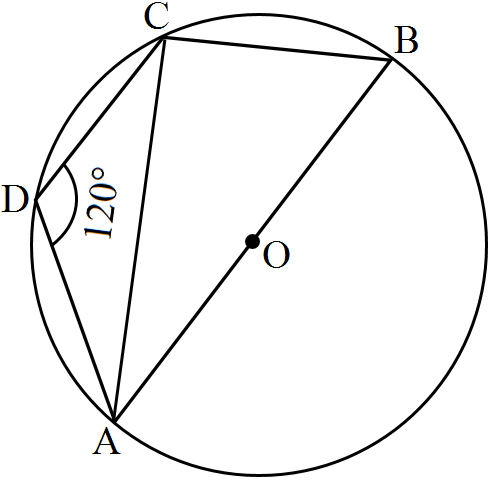
30º Solution: We have: $\angle\text{ABC}+\angle\text{ADC}=180^\circ$ (Opposite angles of a cyclic quadrilateral) $\Rightarrow\angle\text{ABC}+120^\circ=180^\circ$ $\Rightarrow\angle\text{ABC}=(180^\circ-120^\circ)=60^\circ$ $\Rightarrow\angle\text{ABC}=60^\circ$ Also, $\angle\text{ACB}=90^\circ$ (Angle in a semicircle) In $\triangle\text{ABC},$ we have: $\angle\text{BAC}+\angle\text{ACB}+\angle\text{ABC}=180^\circ$ (Angle sum property of a triangle) $\Rightarrow\angle\text{BAC}+90^\circ+60^\circ=180^\circ$ $\Rightarrow\angle\text{BAC}=(180^\circ-150^\circ)=30^\circ$ $\Rightarrow\angle\text{BAC}=30^\circ$
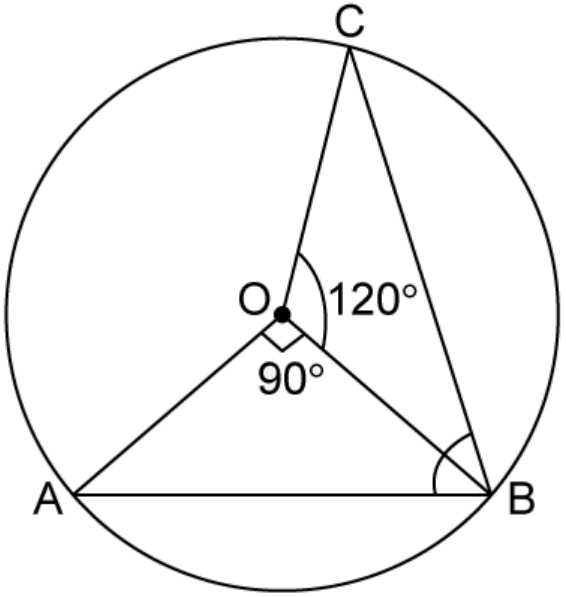
If A , B, C are three points on a circle with centre O such that $\angle\text{AOB} = 90^\circ$ and $\angle\text{BOC} = 120^\circ,$ then $\angle\text{ABC} =$
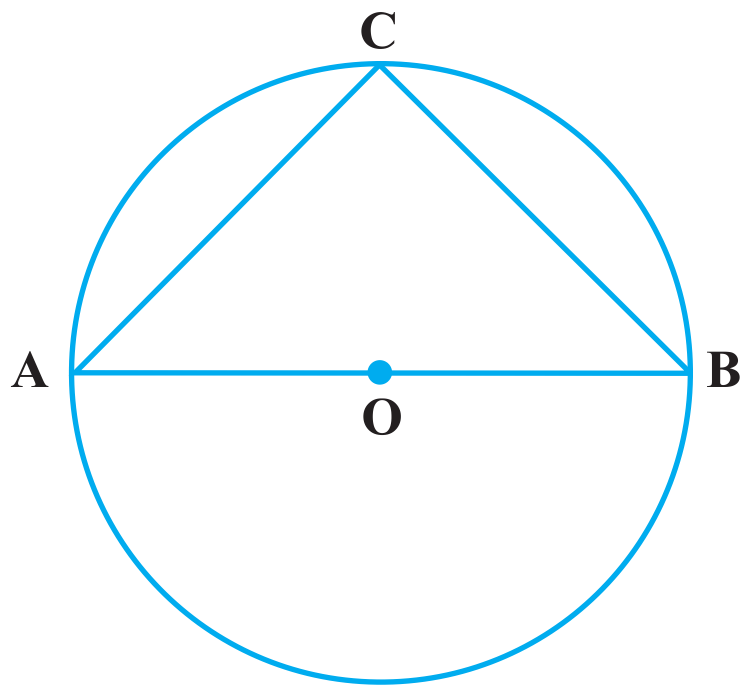
45°. Solution: As AOB is a diameter of the circle, $\angle\text{C}=90^\circ$ [$\because$ Angles in a semi-circle is 90°] Now, AC = BC $\angle\text{A}=\angle\text{B}$ [$\because$ Angles opposite to equal sides of triangle are equal] Using angle sum property of a triangle, we have $\angle\text{A}+\angle\text{B}+\angle\text{C}=180^\circ\Rightarrow2\angle\text{A}+90^\circ=180^\circ$ $\Rightarrow2\angle\text{A}=90^\circ\Rightarrow\angle\text{A}=90^\circ\div2=45^\circ$ Hence, (d) is the correct answer.
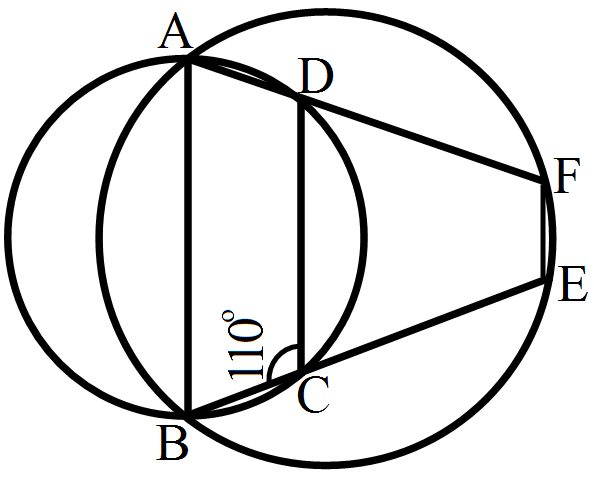
In the given figure, ABCD and ABEF are two cyclic quadrilaterals. If $\angle\text{BCD}=110^\circ$ then $\angle\text{BEF}=?$
A
55°
B
70°
C
90°
D
110°
Answer
110° Solution: Since ABCD is a cyclic qyadrilateral, we have: $\angle\text{BAD}+\angle\text{BCD}=180^\circ$ $\Rightarrow\ \angle\text{BAD}+110^\circ=180^\circ$ $\Rightarrow\ \angle\text{BAD}=70^\circ$ Since ABEF is a cyclic qyadrilateral, we have: $\angle\text{BAD}+\angle\text{BEF}=180^\circ$ $\Rightarrow\ 70^\circ+\angle\text{BEF}=180^\circ$ $\Rightarrow\ \angle\text{BEF}=110^\circ$