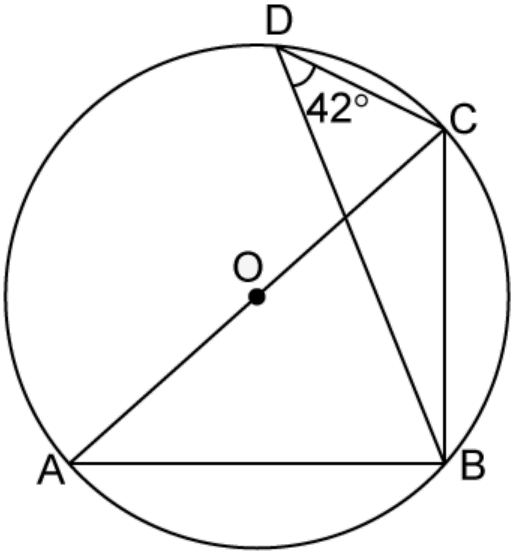
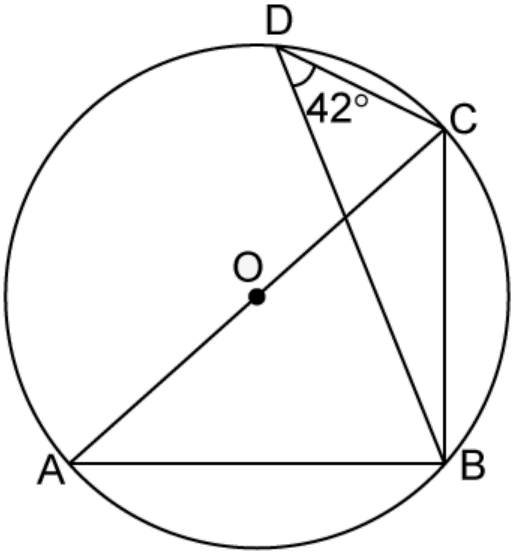
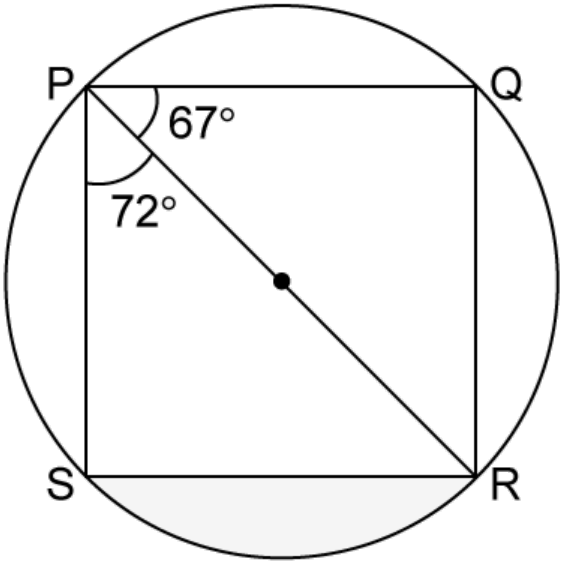
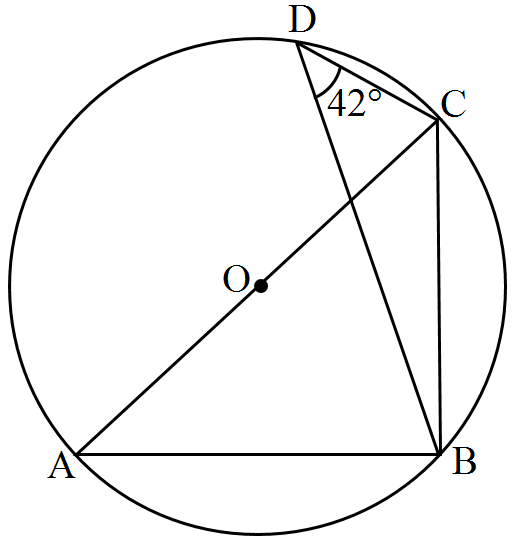
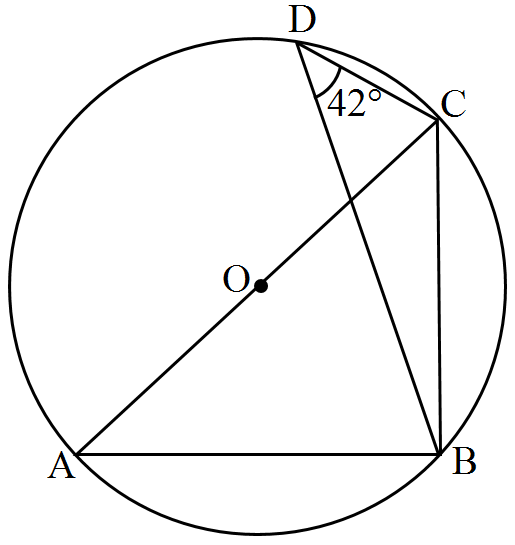
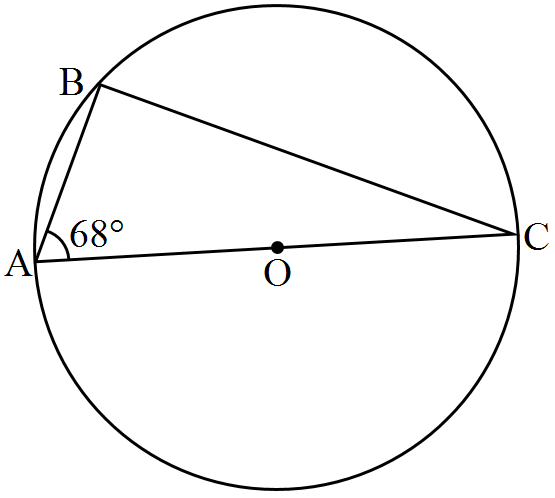
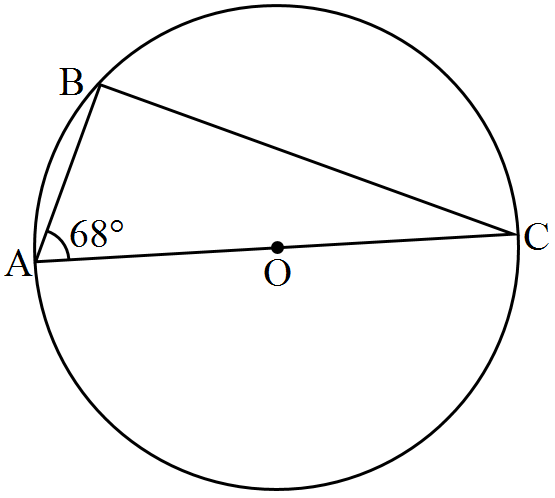
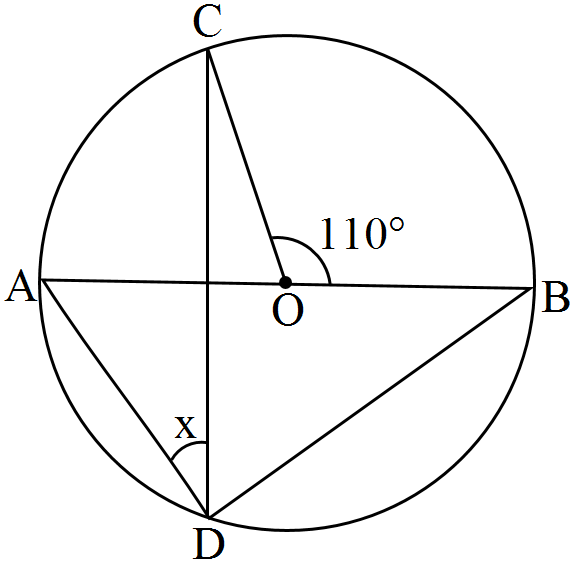
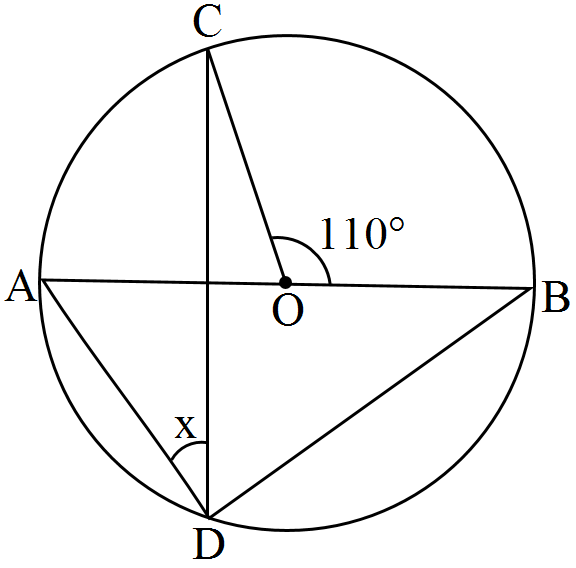
PQRS is a cyclic quadrilateral such that PR is a diameter of the circle. If $\angle\text{QPR} = 67^\circ$ and $ \angle\text{SPR} = 72^\circ,$ then $\angle\text{QRS} =$
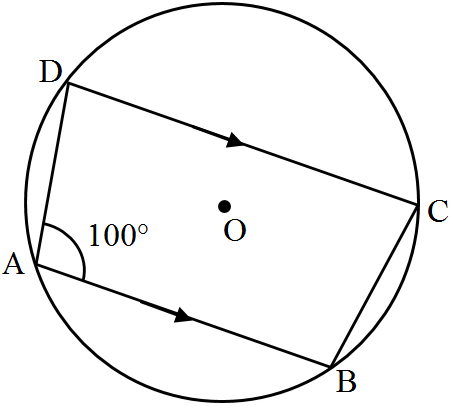
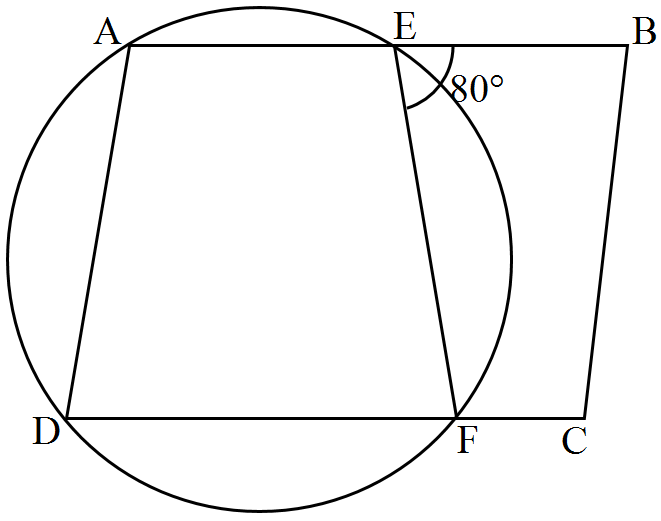
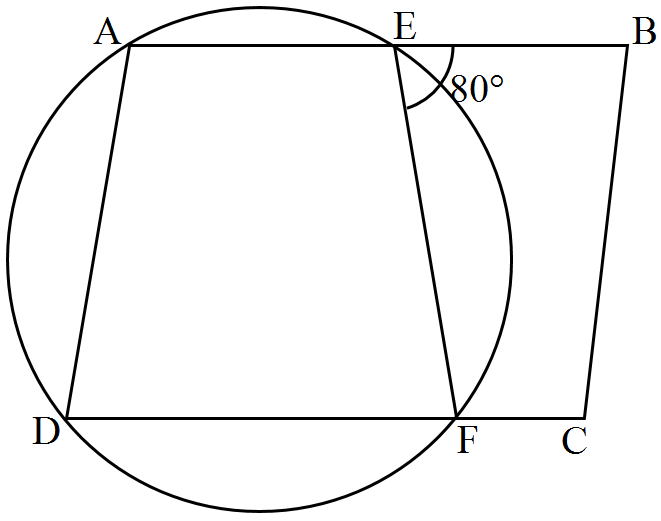
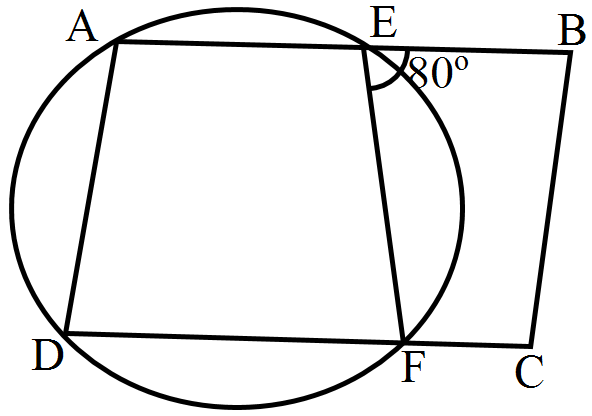
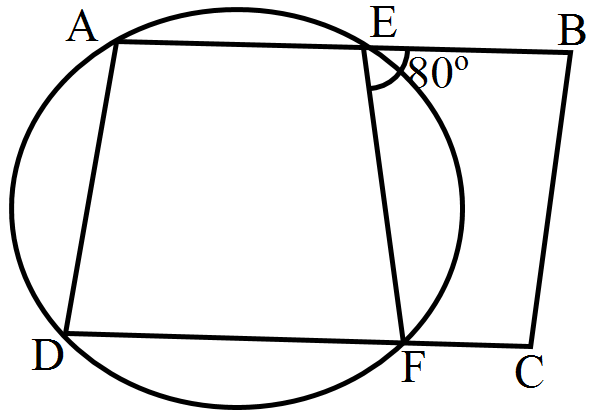
100º Solution: Since ABCD is a cyclic quadrilateral, we have: $\angle\text{BAD}+\angle\text{BCD}=180^\circ$ (Opposite angles of a cyclic quadrilateral) $\Rightarrow100^\circ+\angle\text{BCD}=180^\circ$ $\Rightarrow\angle\text{BCD}=(180^\circ-100^\circ)=80^\circ$ Now, AB || DC and CB is the transversal. $\therefore\angle\text{ABC}+\angle\text{BCD}=180^\circ$ $\Rightarrow\angle\text{ABC}+80^\circ=180^\circ$ $\Rightarrow\angle\text{ABC}=(180^\circ-80^\circ)=100^\circ$ $\Rightarrow\angle\text{ABC}=100^\circ$
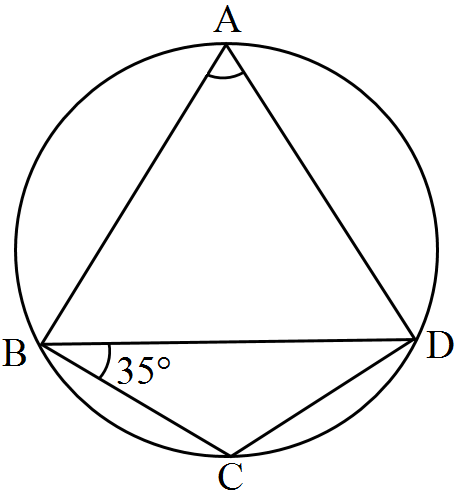
70º Solution: BC = CD (given) $\Rightarrow\angle\text{BDC}=\angle\text{CBD}=35^\circ$ In $\triangle\text{BCD},$ we have: $\angle\text{BCD}+\text{BDC}+\angle\text{CBD}=180^\circ$ (Angle sum property of a triangle) $\Rightarrow\angle\text{BCD}+35^\circ+35^\circ=180^\circ$ $\Rightarrow\angle\text{BCD}=(180^\circ-70^\circ)=110^\circ\Rightarrow\angle\text{BCD}=110^\circ$ In cyclic quadrilateral ABCD, we have: $\angle\text{BAD}+\angle\text{BCD}=180^\circ$ $\Rightarrow\angle\text{BAD}+110^\circ=180^\circ$ $\therefore\angle\text{BAD}=(180^\circ-110^\circ)=70^\circ$ $\Rightarrow\angle\text{BAD}=70^\circ$
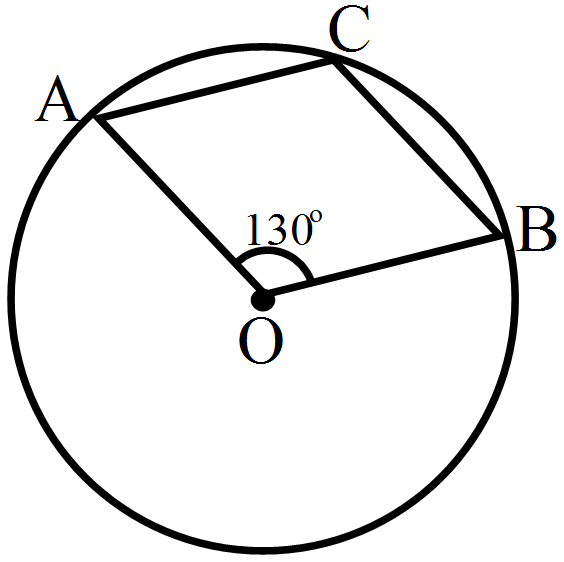
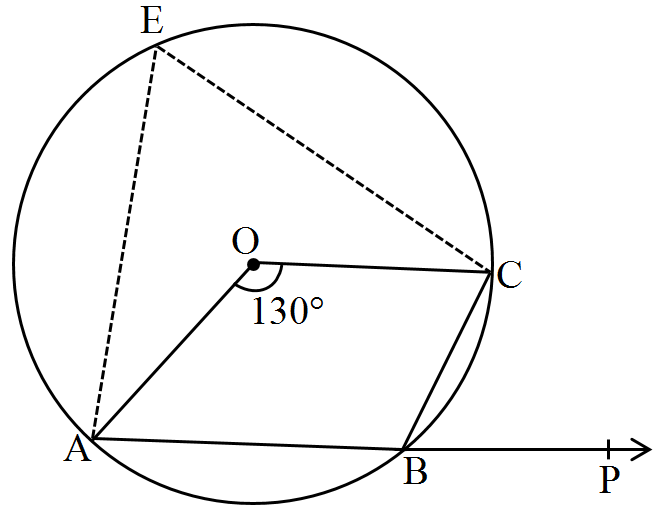
In the given figure, O is the centre of a circle and $\angle\text{AOB}=130^\circ.$ Then, $\angle\text{ACB}=?$
A
50°
B
65°
C
115°
D
155°
Answer
115° Solution: Minor $\angle\text{AOB}=130^\circ$ Major $\angle\text{AOB}=360^\circ-130^\circ$ ⇒ Major $\angle\text{AOB}=230^\circ$ Since $\angle\text{ACB}=\frac{1}{2}\text{major}\angle\text{AOB}$ $\Rightarrow\ \angle\text{ACB}=\frac{1}{2}(230^\circ)$ $\Rightarrow\ \angle\text{ACB}=115^\circ$
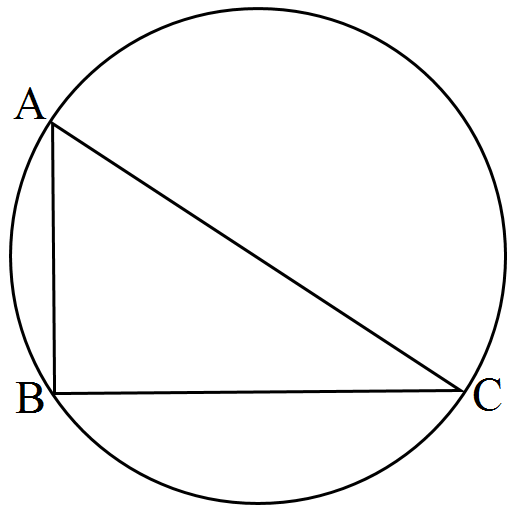
Write the correct answer in the following: If AB = 12cm, BC = 16cm and AB is perpendicular to BC, then the radius of the circle passing through the points A, B and C is:
A
6cm.
B
8cm.
C
10cm.
D
12cm.
Answer
10cm. Solution: AB is perpendicular to BC, therefore ABC is a right triangle. In right $\triangle\text{ABC},$ we have $\text{AC}=\sqrt{\text{AB}^2+\text{BC}^2}$ $=\sqrt{(12)^2+(16)^2}$ $\sqrt{144+256}$ $\text{AC}=20\text{cm}$ $\therefore\text{Radius}=\frac{1}{2}\times\text{diameter}=\frac{1}{2}\times20\text{cm}=10\text{cm}$ Hence, (c) is the correct answer.
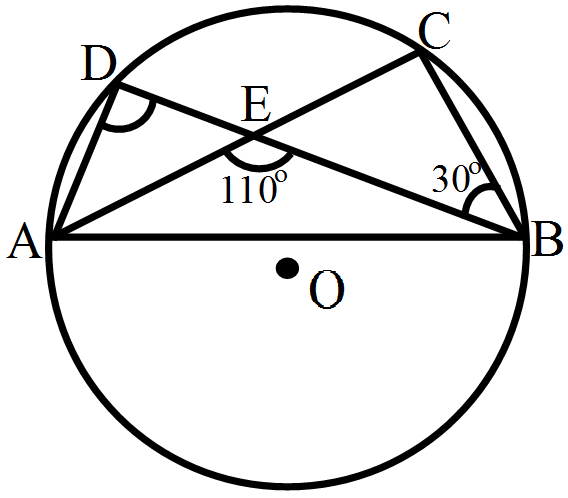
In the given figure, O is the centre of a circle and chords AC and BD intersect at E. If $\angle\text{AEB}=110^\circ$ and $\angle\text{CBE}=30^\circ,$ then $\angle\text{ADB}=?$
A
70°
B
60°
C
80°
D
90°
Answer
80° Solution: $\angle\text{AED}=\angle\text{ECB}+\angle\text{EBC}$ $\Rightarrow\ 110^\circ=\angle\text{ECB}+30^\circ$ $\Rightarrow\ \angle\text{ECB}=80^\circ$ Since angles in the same segment are equal, $\angle\text{ADB}=\angle\text{ECB}=80^\circ$
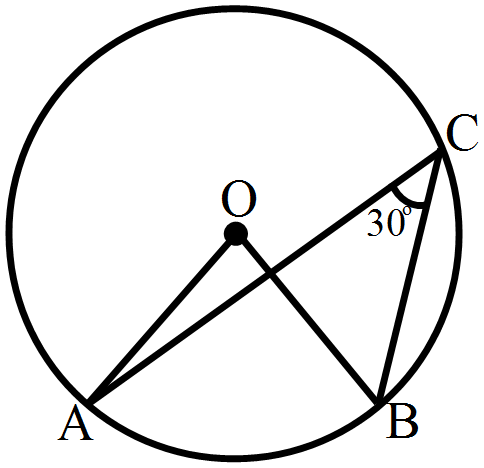
In the given figure, O is the centre of a circle and $\angle\text{ACB}=30^\circ.$ Then, $\angle\text{AOB}=?$
A
30°
B
15°
C
60°
D
90°
Answer
60° Solution: We know that, the angle subtended by an arc of a circle at the centre is double the angle subtended by it at any point on the remaining part of the circle. So, $\angle\text{AOB}=2\angle\text{ACB}$ $=2(30^\circ)$ $=60^\circ$
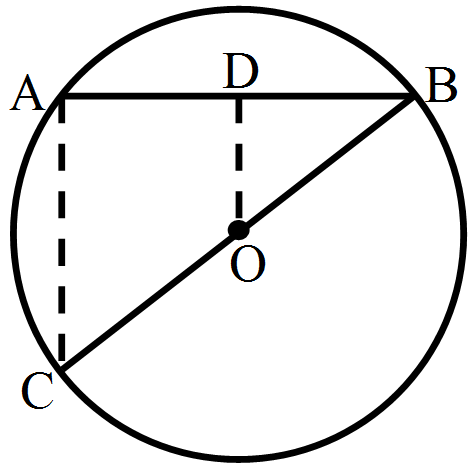
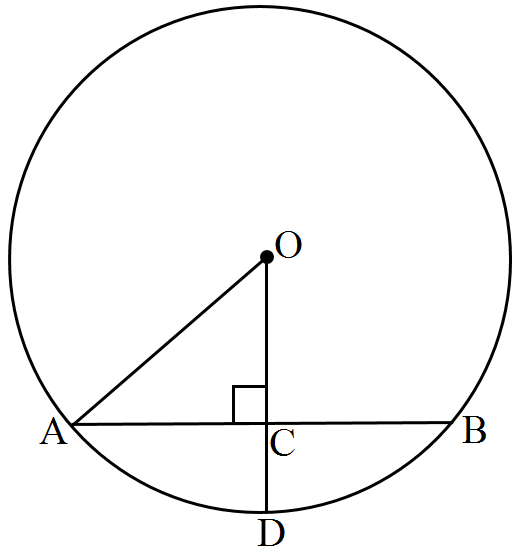
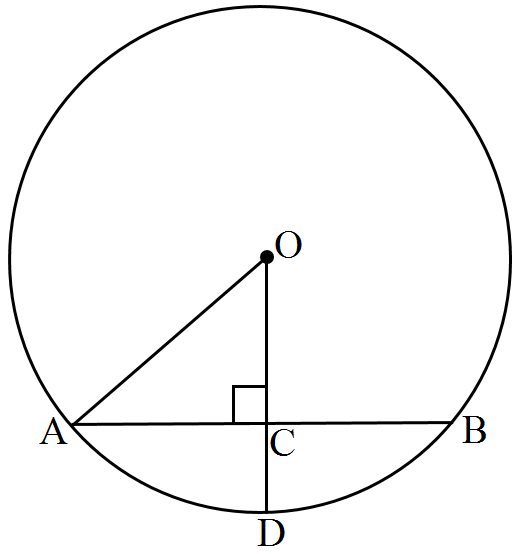
In the given figure, AB is a chord of a circle with centre O and BOC is a diameter. If $\text{OD}\perp\text{AB}$ such that OD = 6cm, then AC = ?
A
9cm
B
12cm
C
15cm
D
7.5cm
Answer
12cm Solution: In $\triangle\text{BOD}$ and $\triangle\text{CAB},$ Since BOC is the diameter, $\angle\text{CAB}=90^\circ.$ Also, $\angle\text{ODB}=90^\circ.$ So, $\angle\text{DBO}=\angle\text{ABC}$ [Common angles] $\Rightarrow\ \triangle\text{BOD}\sim\triangle\text{BCA}$ [AA congruence criterion] $\Rightarrow\ \frac{\text{OD}}{\text{CA}}=\frac{\text{BO}}{\text{BA}}$ $\Rightarrow\ \frac{\text{OD}}{\text{CA}}=\frac{1}{2}$ [Since radius = 2 diameter] $\Rightarrow\ \frac{6}{\text{CA}}=\frac{1}{2}$ ⇒ CA = 12cm that is, AC = 12cm.
The line which meet a circle in two points is called a:
A
Radius of circle.
B
Secant of circle.
C
Chord of circle.
D
Diameter of circle.
Answer
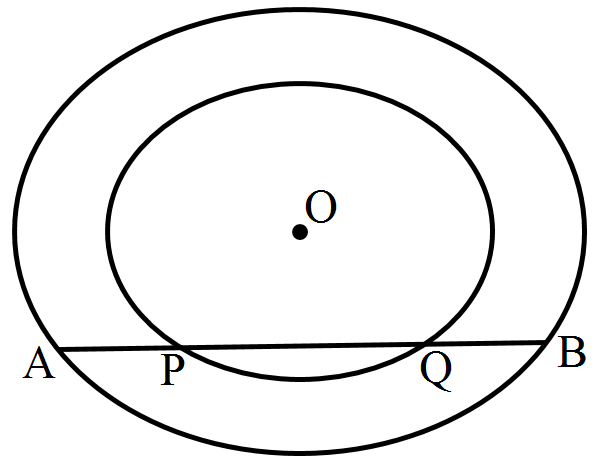
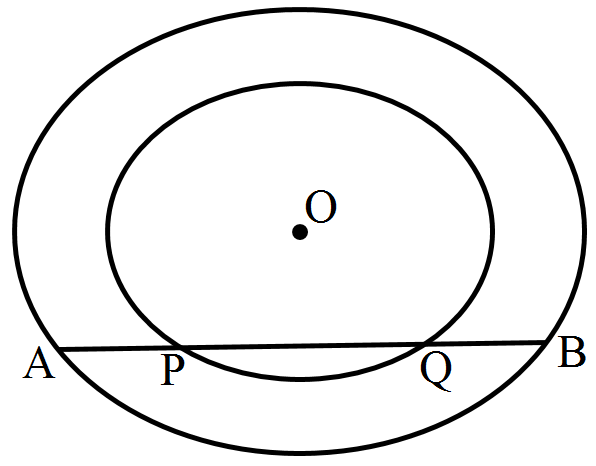
Secant of circle. Solution: A line that meets a circle at any two points is called secant of that circle and secant intercepted between these two points is chord of that circle.
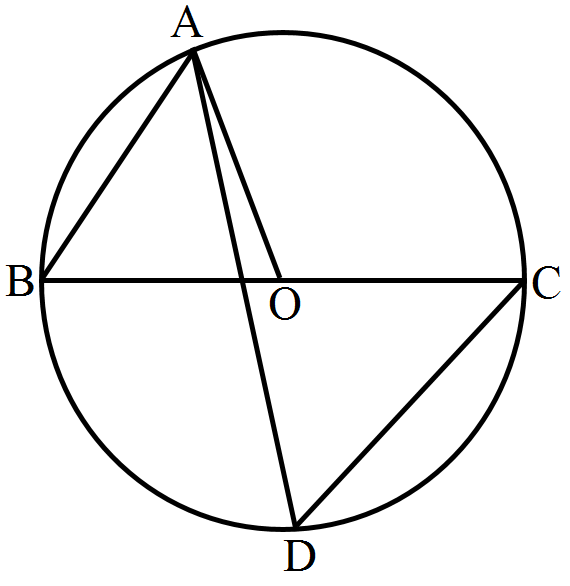
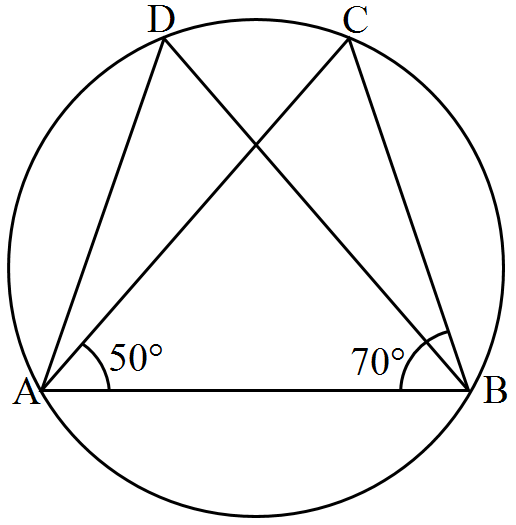
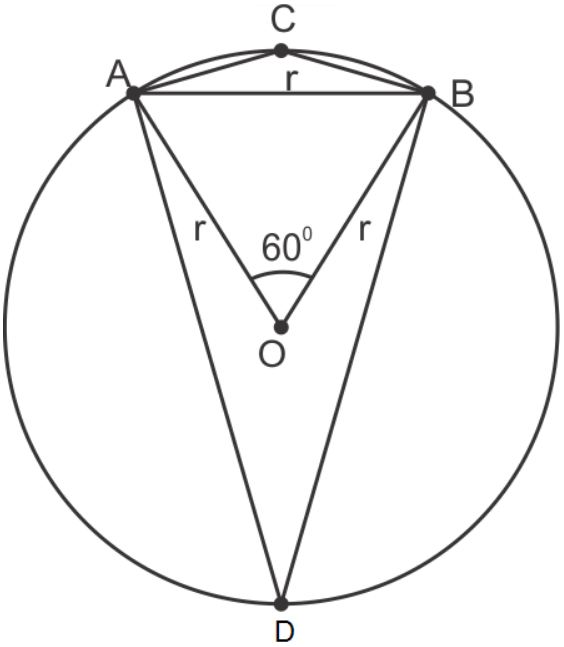
60º Solution: In triangle ABC, $\angle\text{A}+\angle\text{B}+\angle\text{C}=180^\circ$ $\Rightarrow\angle\text{C}=60^\circ$ $\angle\text{ACB}=\angle\text{ADB}=60^\circ$ (Angle made by the same chord are equal)
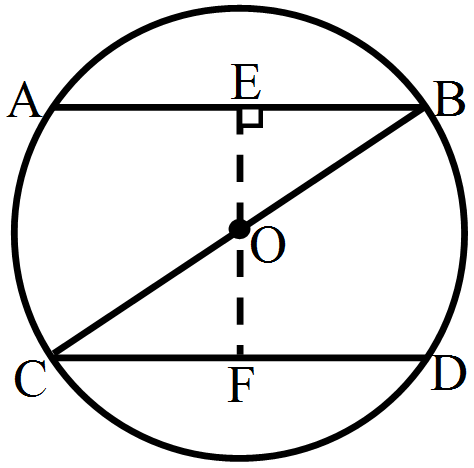
In the given figure, BOC is a diameter of a circle with centre O. If AB and CD are two chords such that AB || CD. If AB = 10cm, then CD = ?
A
5cm
B
12.5cm
C
15cm
D
10cm
Answer
10cm Solution: In $\triangle\text{BEO}$ and $\triangle\text{CFO},$ OB = OC [Radii of the same circle] $\angle\text{OBE}=\angle\text{OCF}$ [Alternate angles since AB || CD] $\angle\text{BOE}=\angle\text{COF}$ [Vertically angles] $\Rightarrow\ \triangle\text{BEO}\cong\triangle\text{CFO}$ [ASA congruence criterion] ⇒ OE = OF [C.P.C.T.] Since chord are equidistant from the centre are equal, AB = CD = 10 cm.
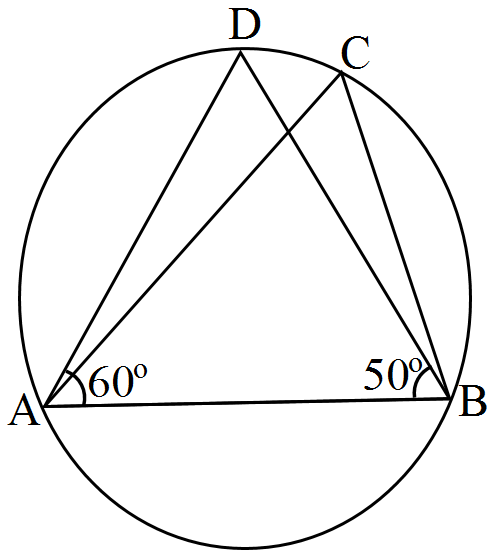
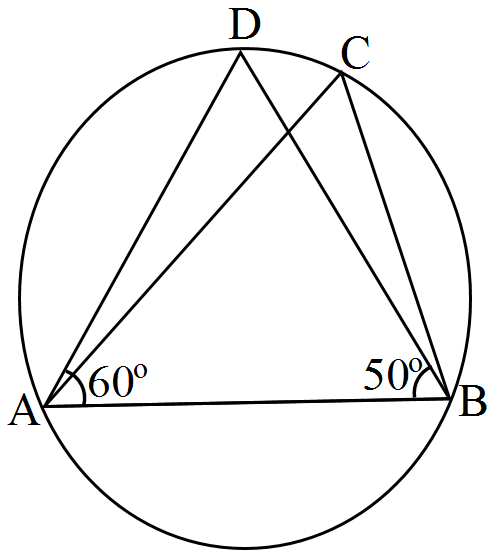
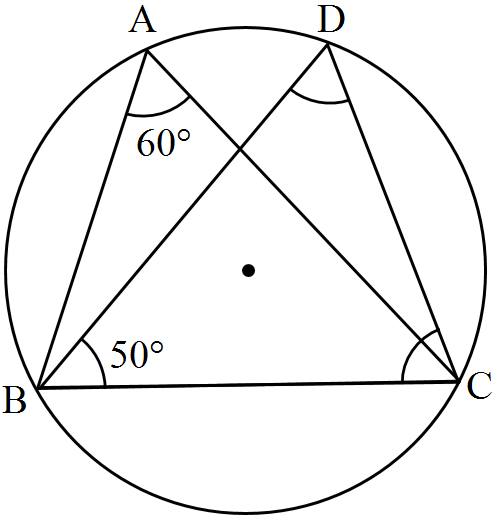
70º Solution: $\angle\text{BDC}=\angle\text{BAC}=60^\circ$ (Angles in the same segment of a circle) In $\triangle\text{BDC},$ we have $\angle\text{DBC}+\angle\text{BDC}+\angle\text{BCD}=180^\circ$ (Angle sum property of a triangle) $\therefore50^\circ+60^\circ+\angle\text{BCD}=180^\circ$ $\Rightarrow\angle\text{BCD}=180^\circ-(50^\circ+60^\circ)=(180^\circ-110^\circ)=70^\circ$ $\Rightarrow\angle\text{BCD}=70^\circ$
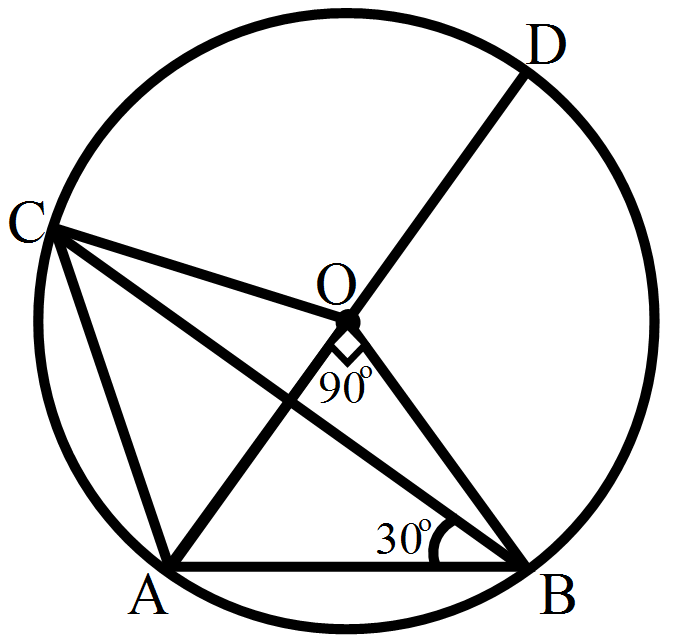
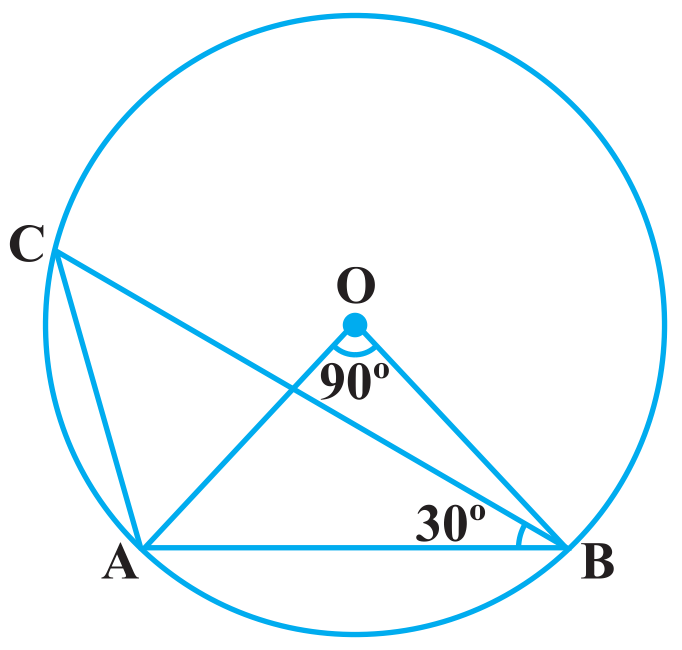
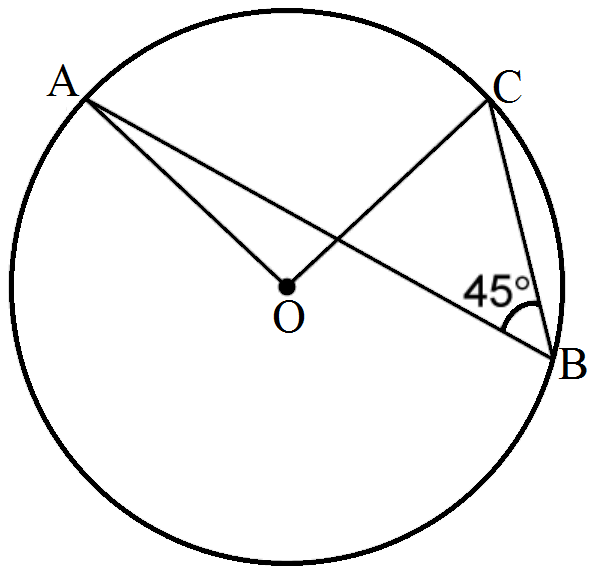
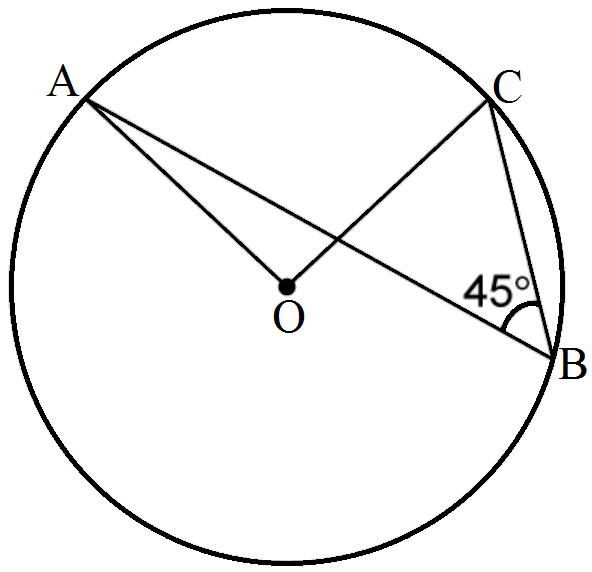
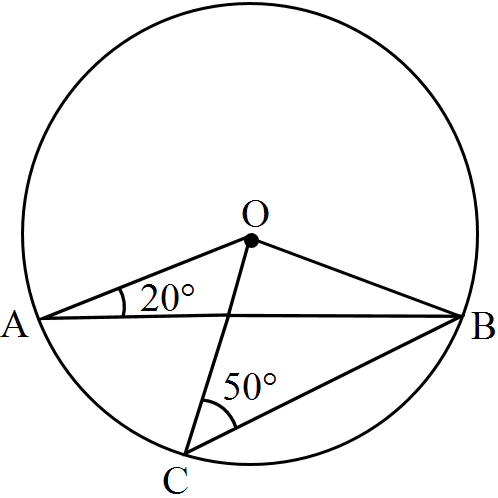
60°. Solution: In $\triangle\text{OAB},$ we have $\text{OA}=\text{OB}$ [Radii of the same circle] $\therefore\angle\text{OAB}=\angle\text{OBA}$ In triangle OAB, we have $\angle\text{OAB}+\angle\text{OBA}+\angle\text{AOB}=180^\circ$ $\therefore2\angle\text{OAB}=(180^\circ-\angle\text{AOB})$ $=(180^\circ-90^\circ)=90^\circ$ [$\because$ sum of angles of $\triangle$ is 180°] $\Rightarrow\angle\text{OAB}=\frac{1}{2}\times90^\circ=45^\circ$ Also, $\angle\text{ACB}=\frac{1}{2}\angle\text{AOB}=\frac{1}{2}\times90^\circ=45^\circ$ Now, in $\triangle\text{CAB},$ we have $\angle\text{CAB}=180^\circ-(\angle\text{ABC}+\angle\text{ACB})$ $=180^\circ-(30^\circ+45^\circ)=105^\circ$ Now, $\angle\text{CAO}=\angle\text{CAB}-\angle\text{OAB}$ $\Rightarrow\angle\text{CAO}=105^\circ-45^\circ=60^\circ$ Hence, (d) is the correct answer.
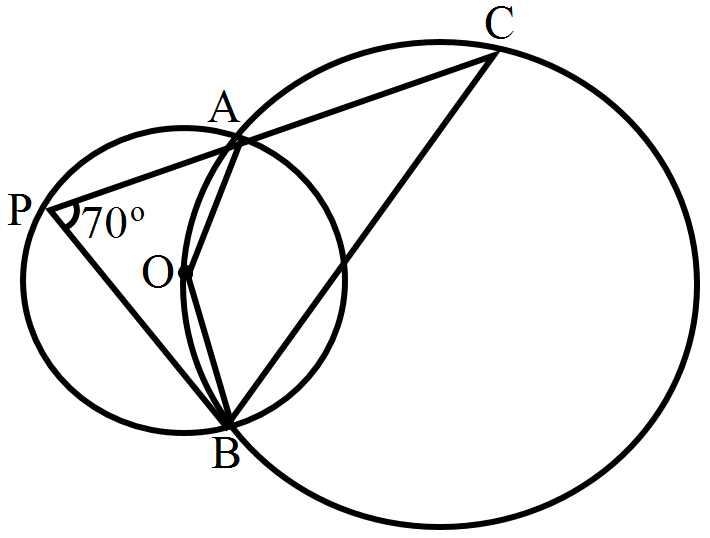
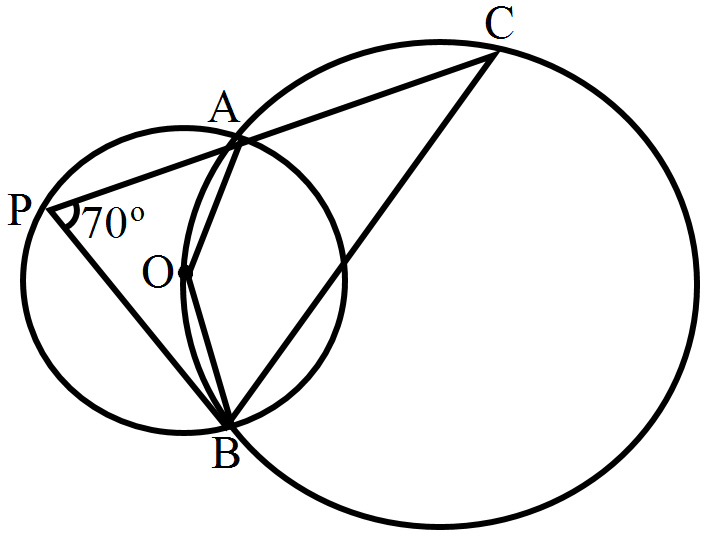
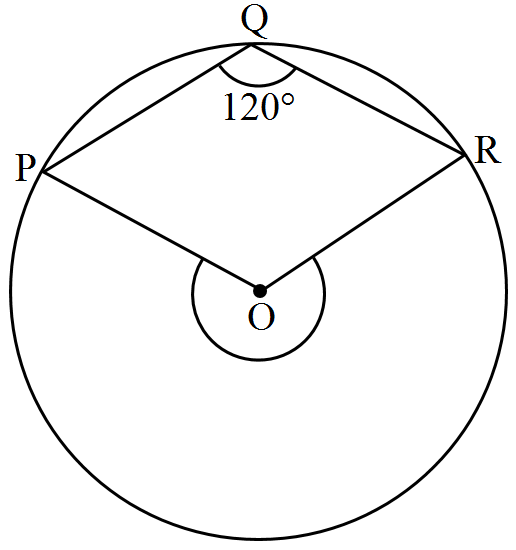
$\frac{1}{3}$ of the circle. Solution: Complete the cyclic quadrilateral PQRS, with S being a point on a point on the major arc. Then $\angle\text{S}=60^\circ$ (Opposite angles of a cyclic quadrilateral) Then Major $\angle\text{POR}=120^\circ$ Thus fraction the minor arc $=\frac{120^\circ}{130^\circ}=\frac{1}{3}$