Question 12 Marks
Bus $X$ travels a distance of $360\ km$ in $5$ hours whereas bus $Y$ travels a distance of $476\ km$ in $7$ hours. Which bus travels faster?
AnswerFor bus X,$\text{Speed}=\frac{\text{Distance}}{\text{Time}}$
Speed $=\frac{360}{5}=72\text{km}/\text{h}$
For bus Y,$\text{Speed}=\frac{\text{Distance}}{\text{Time}}$
Speed $=\frac{476}{7}=68\text{km}/\text{h}$
Speed of bus $X$ is more than that of bus $Y$. Hence, bus $X$ travels faster.
View full question & answer→Question 22 Marks
What type of motion, uniform or non-uniform, is exhibited by a freely falling body? Give reason for your answer.
AnswerA freely falling body has non-uniform motion because it covers smaller distances in the initial $'1$ second' intervals and larger distances in the later $'1$ second' intervals, i.e., it covers unequal distances in equal intervals of time.
View full question & answer→Question 32 Marks
Draw a velocity-time graph to show the following motion: A car accelerates uniformly from rest for $5s$ ; then it travels at a steady’ velocity for $5s.$
View full question & answer→Question 42 Marks
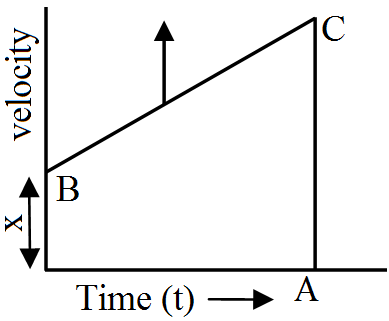
A body with an initial velocity x moves with a uniform acceleration y. Plot its velocity-time graph.
AnswerWe have to plot a graph between velocity and time. From the graph we can conclude that the curve is a straight line showing uniform acceleration.
View full question & answer→Question 52 Marks
State an important characteristic of uniform circular motion. Name the force which brings about uniform circular motion.
AnswerAn important characteristic of uniform circular motion is that the direction of motion in it changes continuously with time, so it is accelerated. Centripetal force brings about uniform circular motion.
View full question & answer→Question 62 Marks
If a bus travelling at $20\ m/s$ is subjected to a steady deceleration of $5\ m/s^2,$ how long will it take to come to rest$?$
AnswerDeceleration, $a = -5\ m/s^2$
Initial velocity, $u = 20\ m/s$
Final velocity, $v = 0\ m/s\ t = ?$
$\text{a}=\frac{\text{v}-\text{u}}{\text{t}}$
$-5=\frac{0-20}{\text{t}}$
$\text{t}=\frac{20}{5}=4\text{s}$
View full question & answer→Question 72 Marks
Define speed. What is the SI unit of speed?
AnswerIf an object changes the location relative to the time other than the other, then this state of the object is called motion/ motion. In general terms the meaning of speed - the change in the position of the object is called speed.
View full question & answer→Question 82 Marks
When is a body said to have uniform velocity?
AnswerWhen a body covers equal distances in equal intervals of time in a particular direction however small or big the time interval may be, the object is said to have uniform velocity.
View full question & answer→Question 92 Marks
Define velocity. What is the SI unit of velocity?
AnswerSpeed of a body is the distance travelled by it per unit time. The $S.I$. unit of speed is m/s.
View full question & answer→Question 102 Marks
A bus running at a speed of $18\ km/h$ is stopped in $2.5$ seconds by applying brakes. Calculate the retardation produced.
AnswerInitial velocity, $u = 18\ km/h$
$\text{u}=18\times\frac{1000}{3600}=\frac{18000}{3600}\text{m/s}=\text{m/s}$
Final velocity, $v = 0\ m/s$ Time, $t = 2.5$ sec
Acceleration, $a = ?$ Using,
$v = u +$ at $\text{a}=\frac{\text{v-u}}{\text{t}}=\frac{0-5}{2.5}2\text{m/s}^2$
So, retardation is $2\ m/s^2.$
View full question & answer→Question 112 Marks
Three speed-time graphs are given below:
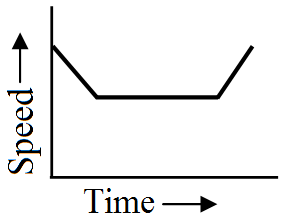
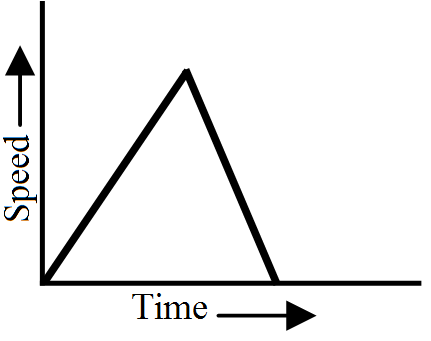
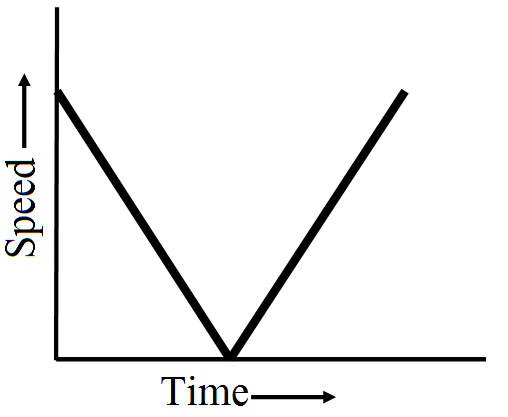
Which graph represents the case of:
- A cricket ball thrown vertically upwards and returning to the hands of the thrower?
- A trolley decelerating to a constant speed and then accelerating uniformly?
Answer
- Graph (c) represents a cricket ball thrown vertically upwards and returning to the hands of the thrower.
- Graph (a) represents a trolley decelerating to a constant speed and then accelerating uniformly.
View full question & answer→Question 122 Marks
A ball hits a wall horizontally at $6.0\ ms^{-1}$. It rebounds horizontally at $4.4\ ms^{-1}$. The ball is in contact with the wall for $0.040\ s$. What is the acceleration of the ball$?$
AnswerInitial velocity, $u = 6\ m/s$
Final velocity, $v = -4.4\ m/s($the ball rebounds in opposite direction$)$
Time, $t = 0.040\ s$
Acceleration velocity $=\frac{\text{u}-\text{v}}{\text{t}}=\frac{-4,4-6}{0.040}=-260\text{m/s}^2$
View full question & answer→Question 132 Marks
A train starting from stationary position and moving with uniform acceleration attains a speed of $36km$ per hour in $10$ minutes. Find its acceleration.
AnswerInitial velocity, $u = 0m/s$
Final velocity, $v = 36km/h = 10m/s$
Time, $t = 10min = 10 x 60 = 600 sec$
Acceleration, $a = ?$
Acceleration $=\frac{\text{Final velocity-Initial velocity}}{\text{time taken}}$
So, $\text{a}=\frac{\text{v-u}}{\text{t}}$
$=\frac{10-0}{600}=\frac{10}{600}\text{m/s}^2$
$=\frac{1}{60}\text{m/s}^2-0.16\text{m/s}^2$
View full question & answer→Question 142 Marks
Write the three equations of uniformly accelerated motion. Give the meaning of each symbol which occurs in them.
Question 152 Marks
What is the difference between uniform linear motion and uniform circular motion? Explain with examples.
AnswerUniform linear motion is uniform motion along a linear path or a straight line. The direction of motion is fixed. So, it is not accelerated.
For example: A car running with uniform speed of $10\ km/hr$ on a straight road.
Uniform circular motion is uniform motion along a circular path. The direction of motion changes continuously. So, it is accelerated.
For example: Motion of earth around the sun.
View full question & answer→Question 162 Marks
The velocity-time graph for part of a train journey is a horizontal straight line. What does this tell you about $(a)$ the train’s velocity, and $(b)$ about its acceleration?
Answer
- The train has a uniform velocity.
- There is no acceleration.
View full question & answer→Question 172 Marks
A body is moving along a circular path of radius $R$. What will be the distance travelled and displacement of the body when it completes half a revolution?
AnswerDistance travelled in half a rotation of a circular path is equal to the circumference of semi-circle, i.e. Distance travelled in half a rotation of a circular path is equal to the circumference of semi-circle, i.e $=\pi\text{R}.$ Displacement = diameter of circle $= 2R.$
View full question & answer→Question 182 Marks
Explain the meaning of the following equation of motion: $v = u + at$ where symbols have their usual meanings.
Answer$v = u + at$ is the first equation of motion. It gives the velocity acquired by a body in time t when the body has initial velocity u and uniform acceleration a.
View full question & answer→Question 192 Marks
A train starting from Railway Station attains a speed of $21\ m/s$ in one minute. Find its acceleration.
Answer$u = 0m/s v = 21m/s$ Time, $t = 1min = 60sec$
$\text{a}=\frac{\text{v}-\text{u}}{\text{t}}$
$\text{a}=\frac{\text{21}-\text{0}}{\text{60}}$
$\text{a}=\frac{21}{60}=0.35\text{m}/\text{s}^2$
View full question & answer→Question 202 Marks
An aircraft travelling at $60\ km/h$ accelerates steadily at $10\ km/h$ per second. Taking the speed of sound as $1100\ km/h$ at the aircraft’s altitude, how long will it take to reach the ‘sound barrier’$?$
AnswerInitial velocity, $u = 600\ km/h$
Final velocity, $v = 1100\ km/h$
Acceleration $= 10\ km/h/s = 600\ km/h^2$
From relation, $\text{a} = \frac{(\text{v-u})}{\text{t}}$
$\text{t} = \frac{(\text{v-u})}{\text{a}}$
$\text{t} = \frac{(1100-600)}{600} = \frac{500}{600}= \frac{5}{6}\text{hr} = 50 \text{sec}$
View full question & answer→Question 212 Marks
What is meant by uniform circular motion? Give two examples of uniform circular motion.
AnswerWhen a body moves in a circular path with uniform speed (constant speed), its motion is called uniform circular motion.
For example:
- Artificial satellites move in uniform circular motion around the earth.
- Motion of a cyclist on a circular track.
View full question & answer→Question 222 Marks
What is meant by:
- Average speed
- Uniform speed?
Answer
- Average Speed: The average speed of a body is the total distance travelled divided by the total time taken to cover this distance.
- Uniform Speed: A body has a uniform speed if it travels equal distances in equal intervals of time, no matter how small these intervals may be.
View full question & answer→Question 232 Marks
A motorcycle moving with a speed of $5\ m/s$ is subjected to an acceleration of $0.2\ m/s^2.$ Calculate the speed of the motorcycle after $10$ seconds, and the distance travelled in this time.
AnswerInitial velocity, $u = 5\ m/s$
Final velocity, $v = ?$
Acceleration, $a = 0.2\ m/s^2$
Time, $t = 10$ sec
Using, $v = u + at\ v = 5 + 0.2 \times 10 v = 5 + 2 = 7\ m/s$
Now distance travelled in time is calculated;
Using, $\text{s}=\text{ut}+\frac{1}{2}\text{at}^2$
$\text{s}=5\times10+\frac{1}{2}\times0.2\times10\times10$
$\text{s}=50+10=60\text{m}$
View full question & answer→Question 242 Marks
Arrange the following speeds in increasing order (keeping the least speed first):
- An athlete running with a speed of $10m/s.$
- A bicycle moving with a speed of $200m/min.$
- A scooter moving with a speed of $30km/h.$
AnswerSpeed of athelete $= 10m/s$
Speed of bicycle $= 200m/min = \frac{200}{60}\text{m/s} = 3.33\text{m/s}$
Speed of scooter $= 30km/h = \frac{30000}{3600}\text{m/s} = 8.33\text{m/s}$
$3.33m/s < 8.33m/s < 10m/s$
i.e. $200m/min < 30km/h < 10m/s$
View full question & answer→Question 252 Marks
A car is moving along a straight road at a steady speed. It travels $150\ m$ in $5$ seconds: What is its average speed?
AnswerAverage speed $\text{v}_\text{av}=\frac{\text{Total distance travelled}}{\text{Total time taken}}$ $=\frac{150}{5}=30\text{m/s}$
View full question & answer→Question 262 Marks
A tortoise moves a distance of $100$ metres in $15$ minutes. What is the average speed of tortoise in km/h?
AnswerTotal distance $= 100m = 0.1km$
Total time taken = 15 minutes $ = \frac{15}{60}=0.25\ \text{hour}$
Average speed $=\frac{\text{ Total distance travelled}}{\text{Total time taken}}$
$=\frac{0.1}{0.25}= 0.4\text{km/h}$
View full question & answer→Question 272 Marks
A motorcyclist starts from rest and reaches a speed of $6\ m/s$ after travelling with uniform acceleration for $3s$. What is his acceleration?
Answerintial velocity $= 6m/s Time = 3sec$
Acceleration $=\frac{\text{Final velocity - Intial velocity}}{\text{Time taken}}$
$=\frac{(6-0)}{3}=\frac{6}{3}=2\text{m/sec}^2$
View full question & answer→Question 282 Marks
Explain why, the motion of a body which is moving with constant speed in a circular path is said to be accelerated.
AnswerThe motion of a body which is moving with constant speed in a circular path is said to be accelerated because its velocity changes continuously due to the continuous change in the direction of motion.
View full question & answer→Question 292 Marks
Explain why, the motion of a body which is moving with constant speed in a circular path is said to be accelerated.
AnswerThe motion of a body which is moving with constant speed in a circular path is said to be accelerated because its velocity changes continuously due to the continuous change in the direction of motion.
View full question & answer→Question 302 Marks
The tip of seconds’ hand of a dock takes $60$ seconds to move once on the circular dial of the clock. If the radius of the dial of the clock be $10.5\ cm$, calculate the speed of the tip of the seconds’ hand of the clock. $\Big(\text{Given}\pi=\frac{22}{7}\Big).$
AnswerThe speed of a body moving along a circular path is given by the formula: $\text{v}=\frac{2\pi\text{r}}{\text{t}}$
Given, $t = 60 sec$
Radius, $r = 10.5cm = 0.105m$
$ \text{v}=\frac{2\pi\text{r}}{\text{t}}=\frac{2\times22\times0.105}{7\times60}=\frac{4.62}{420}=0.011\text{m/s}$
View full question & answer→Question 312 Marks
A train starting from rest moves with a uniform acceleration of $0.2\ m/s^2$ for $5$ minutes. Calculate the speed acquired and the distance travelled in this time.
AnswerInitial velocity, $u = 0\ m/s$
Final velocity, $v = ?$
Acceleration, $a = 0.2\ m/s^2$
Time, $t = 5$min $= 5 × 60 = 300$ sec
Using, $v = u + at\ v = 0 + 0.2 × 300 =60m/s$
And the distance travelled is,
$\text{s}=\text{ut}+\frac{1}{2}\text{at}^2$
$\text{s}=0\times300+\frac{1}{2}\times0.2\times300\times300$
$\text{s}=0+9000=9000\text{m}=9\text{km}$
View full question & answer→Question 322 Marks
Is the uniform circular motion accelerated? Give reasons for your answer.
AnswerYes, uniform circular motion is accelerated because the velocity changes due to continuous change in the direction of motion.
View full question & answer→Question 332 Marks
What is the difference between ‘distance travelled’ by a body and its ‘displacement’? Explain with the help of a diagram.
Answer | | Distance | Displacement |
| 1. | distance has only magnitude, with no specified direction. | Diplacement has magnitude as well as direction. |
| 2. | It is a scalar quantity. | It is vector quantity. |
| 3. | Two different distance can be added directly. | We have to follow the vector addition method to add displacements. |
One difference in digramatic form is as follows:
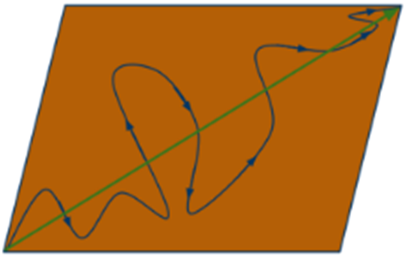
Here the curved line is the distance traveled and the straight line is the magnitude of the displacement.
View full question & answer→Question 342 Marks
A snail covers a distance of $100$ metres in $50$ hours. Calculate the average speed of snail in km/h. 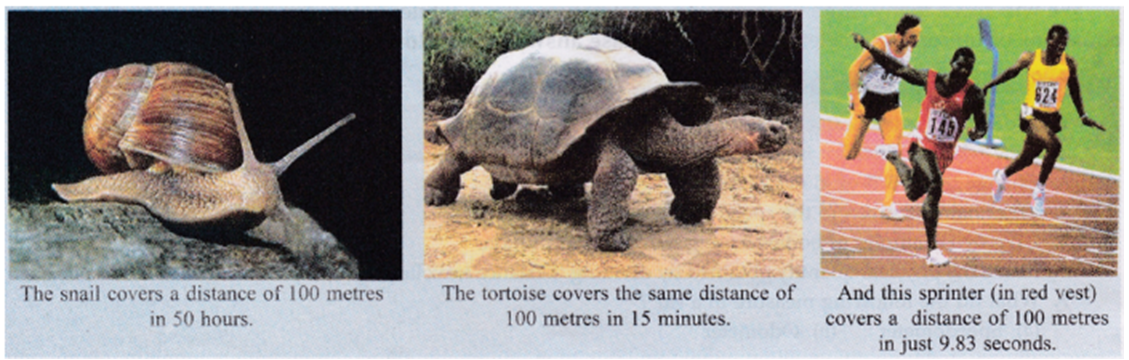
AnswerAverage speed $= \frac{\text{Total distance travelled}}{\text{Total time taken}}$
Total distance travelled $= 100m = 0.1km$
Total time taken $= 50 hr$
Average speed $= \frac{0.1}{50}=0.002\text{km/h}$
View full question & answer→Question 352 Marks
A car is moving along a straight road at a steady speed. It travels $150\ m$ in $5$ seconds: How far does it travel in $1$ second?
AnswerTime $=1 s$ Distance $= V _{ av } \times$ time $=30 \times 1=30 m / s$
View full question & answer→Question 362 Marks
If on a round trip you travel $6\ km$ and then arrive back home:
- What distance have you travelled?
- What is your final displacement?
Answer
- Distance travelled $= 6\ km.$
- Displacement = zero (since final position is same as initial position).
View full question & answer→Question 372 Marks
Give one example of a situation in which a body has a certain average speed but its average velocity is zero.
AnswerMotion of a boy from his home to shop (in one direction) and back to home (in its reverse direction) is an example of a situation in which a body has a certain average speed but its average velocity is zero.
View full question & answer→Question 382 Marks
A car is moving along a straight road at a steady speed. It travels $150\ m$ in $5$ seconds:
How far does it travel in $6$ seconds?
AnswerTime $= 6s$
Distance $= V_{av} \times time = 30 \times 6 = 180m/s$
View full question & answer→Question 392 Marks
What can you say about the motion of a body if:
- Its displacement-time graph is a straight line?
- Its velocity-time graph is a straight line?
Answer
- The body has uniform velocity if its displacement-time graph is a straight line. If the straight line is parallel to the time axis then the magnitude of uniform velocity is zero.
- The body has a uniform acceleration if its velocity-time graph is a straight line. If the straight line is parallel to the time axis then the magnitude of uniform acceleration is zero.
View full question & answer→