Question types

Gravitation question types

39 questions across 5 question groups — pick any mix to generate a Physics paper with step-by-step answer keys.

39
Questions
5
Question groups
5
Question types
Sample Questions

Gravitation questions

One sample from each question group in this chapter. Select any group above to see the full set with answer keys.

As observed from earth, the sun appears to move in an approximate circular orbit. For the motion of another planet like mercury as observed from earth, this would.
  • A
    Be similarly true.
  • B
    Not be true because the force between earth and mercury is not inverse square law.
  • Not be true because the major gravitational force on mercury is due to sun.
  • D
    Not be true because mercury is influenced by forces other than gravitational forces.

Answer: C.

View full solution
Choose the wrong option.
  • A
    Inertial mass is a measure of difficulty of accelerating a body by an external force whereas the gravitational mass is relevant in determining the gravitational force on it by an external mass.
  • B
    That the gravitational mass and inertial mass are equal is an experimental result.
  • C
    That the acceleration due to gravity on earth is the same for all bodies is due to the equality of gravitational mass and inertial mass.
  • Gravitational mass of a particle like proton can depend on the presence of neighouring heavy objects but the inertial mass cannot.

Answer: D.

View full solution
Both earth and moon are subject to the gravitational force of the sun. As observed from the sun, the orbit of the moon.
  • A
    Will be elliptical.
  • Will not be strictly elliptical because the total gravitational force on it is not central.
  • C
    Is not elliptical but will necessarily be a closed curve.
  • D
    Deviates considerably from being elliptical due to influence of planets other than earth.

Answer: B.

View full solution
If the law of gravitation, instead of being inversesquare law, becomes an inversecube law.
  1. Planets will not have elliptic orbits.
  2. Circular orbits of planets is not possible.
  3. Projectile motion of a stone thrown by hand on the surface of the earth will be approximately parabolic.
  4. There will be no gravitational force inside a spherical shell of uniform density.
  • $a, b$ and $c$
  • B
    $a, b$ and $d$
  • C
    $a, c$ and $d$
  • D
    $b, c$ and $d$

Answer: A.

View full solution
Which of the following options are correct?
  1. Acceleration due to gravity decreases with increasing altitude.
  2. Acceleration due to gravity increases with increasing depth $($assume the earth to be a sphere of uniform density$).$
  3. Acceleration due to gravity increases with increasing latitude.
  4. Acceleration due to gravity is independent of the mass of the earth.
  • A
    $a, c$
  • $a, b$
  • C
    $b, c$
  • D
    $b, d$

Answer: B.

View full solution
The gravitational force between a hollow spherical shell (of radius R and uniform density) and a point mass is F. Show the nature of F vs r graph where r is the distance of the point from the centre of the hollow spherical shell of uniform density.
View full solution
We can shield a charge from electric fields by putting it inside a hollow conductor. Can we shield a body from the gravitational influence of nearby matter by putting it inside a hollow sphere or by some other means?
View full solution
An astronaut inside a small spaceship orbiting around the earth cannot detect gravity. If the space station orbiting around the earth has a large size, can he hope to detect gravity?
View full solution
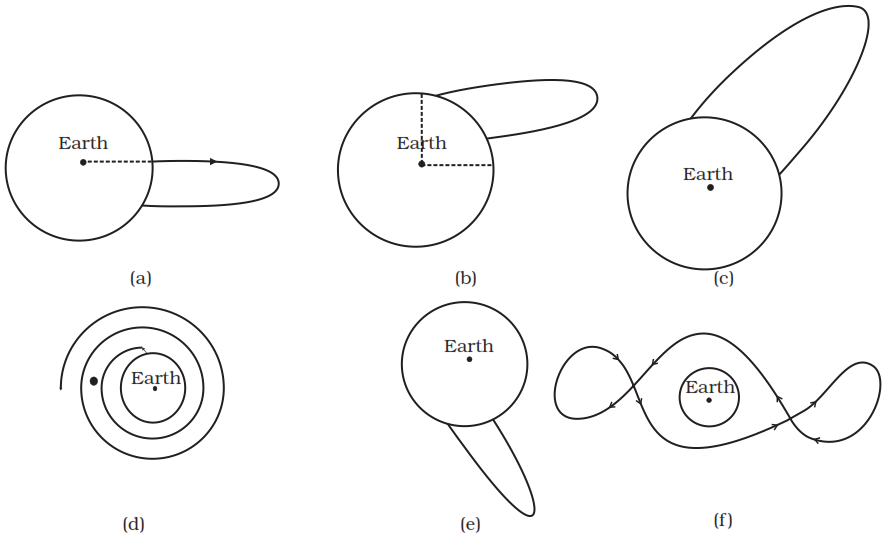
Shown are several curves. Explain with reason, which ones amongst them can be possible trajectories traced by a projectile (neglect air friction).
View full solution
Q 143 Marks Question3 Marks
Molecules in air in the atmosphere are attracted by gravitational force of the earth. Explain why all of them do not fall into the earth just like an apple falling from a tree.
View full solution
Mean solar day is the time interval between two successive noon when sun passes through zenith point (meridian). Sidereal day is the time interval between two successive transit of a distant star through the zenith point (meridian). By drawing appropriate diagram showing earth’s spin and orbital motion, show that mean solar day is four minutes longer than the sidereal day. In other words, distant stars would rise 4 minutes early every successive day.
View full solution
Show the nature of the following graph for a satellite orbiting the earth.
  1. KE vs orbital radius R
  2. PE vs orbital radius R
  3. TE vs orbital radius R.
View full solution
Two identical heavy spheres are separated by a distance $10$ times their radius. Will an object placed at the mid point of the line joining their centres be in stable equilibrium or unstable equilibrium? Give reason for your answer.
View full solution
An object of mass m is raised from the surface of the earth to a height equal to the radius of the earth, that is, taken from a distance R to 2R from the centre of the earth. What is the gain in its potential energy?
View full solution

Generate a Gravitation paper free

Pick question groups from the list above, set marks and difficulty, and export a branded PDF with step-by-step answer keys. First 3 chapters free — no signup.

Download App