Question types

Work, Energy, and Power question types

41 questions across 4 question groups — pick any mix to generate a Physics paper with step-by-step answer keys.

41
Questions
4
Question groups
5
Question types
Sample Questions

Work, Energy, and Power questions

One sample from each question group in this chapter. Select any group above to see the full set with answer keys.

An electron and a proton are moving under the influence of mutual forces. In calculating the change in the kinetic energy of the system during motion, one ignores the magnetic force of one on another. This is because:
  • A
    The two magnetic forces are equal and opposite, so they produce no net effect.
  • The magnetic forces do no work on each particle.
  • C
    The magnetic forces do equal and opposite (but non-zero) work on each particle.
  • D
    The magenetic forces are necessarily negligible.

Answer: B.

View full solution
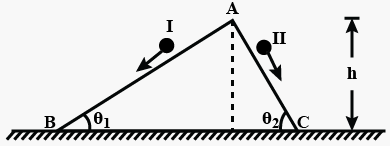
Two inclined frictionless tracks, one gradual and the other steep meet at a from where two stones are allowed to slide down from rest, one on each track as shown in which of the following statement is correct?
Image
  • A
    Both the stones reach the bottom at the same time but not with the same speed.
  • B
    Both the stones reach the bottom with the same speed and stone $I$ reaches the bottom earlier than stone $II.$
  • Both the stones reach the bottom with the same speed and stone $II$ reaches the bottom earlier than stone $I.$
  • D
    Both the stones reach the bottom at different times and with different speeds.

Answer: C.

View full solution
A proton is kept at rest. A positively charged particle is released from rest at a distance d in its field. Consider two experiments one in which the charged particle is also a proton and in another, a positron. In the same time t, the work done on the two moving charged particles is:
  • A
    Same as the same force law is involved in the two experiments.
  • B
    Less for the case of a positron, as the positron moves away more rapidly and the force on it weakens.
  • More for the case of a positron, as the positron moves away a larger distance.
  • D
    Same as the work done by charged particle on the stationary proton.

Answer: C.

View full solution
A body is falling freely under the action of gravity alone in vacuum. Which of the following quantities remain constant during the fall?
  • A
    Kinetic energy.
  • B
    Potential energy.
  • Total mechanical energy.
  • D
    Total linear momentum.

Answer: C.

View full solution
A mass of 5kg is moving along a circular path of radius 1m. If the mass moves with 300 revolutions per minute, its kinetic energy would be:
  • $250\pi^2$
  • B
    $100\pi^2$
  • C
    $5\pi^2$
  • D
    $0$

Answer: A.

View full solution
Calculate the work done by a car against gravity in moving along a straight horizontal road. The mass of the car is 400kg and the distance moved is 2m.
View full solution
Two bodies of unequal mass are moving in the same direction with equal kinetic energy. The two bodies are brought to rest by applying retarding force of same magnitude. How would the distance moved by them before coming to rest compare?
View full solution
Q 103 Marks Question3 Marks
A raindrop of mass $1.00g$ falling from a height of $1km$ hits the ground with a speed of $50m s^{-1}$. Calculate:
  1. The loss of $P.E.$ of the drop.
  2. The gain in $K.E.$ of the drop.
  3. Is the gain in $K.E.$ equal to loss of $P.E.$? If not why.
Take $g = 10m s^{-2}$
View full solution
Q 113 Marks Question3 Marks
In an elastic collision of two billiard balls, which of the following quantities remain conserved during the short time of collision of the balls $($i.e., when they are in contact$)$.
  1. Kinetic energy.
  2. Total linear momentum?
Give reason for your answer in each case.
View full solution
Q 123 Marks Question3 Marks
Why is electrical power required at all when the elevator is descending? Why should there be a limit on the number of passengers in this case?
View full solution
Q 133 Marks Question3 Marks
A body is moved along a closed loop. Is the work done in moving the body necessarily zero? If not, state the condition under which work done over a closed path is always zero.
View full solution
Q 143 Marks Question3 Marks
A ball of mass m, moving with a speed $2v_0,$ collides inelastically $(e > 0)$ with an identical ball at rest. Show that:
For head-on collision, both the balls move forward.
View full solution
Two identical steel cubes (masses $50g$, side $1cm$) collide head-on face to face with a speed of $10cm/ s$ each. Find the maximum compression of each. Young’s modulus for steel = $Y = 2 \times 1011 N/ m^2$.
View full solution
Consider a one-dimensional motion of a particle with total energy E. There are four regions A, B, C and D in which the relation between potential energy V, kinetic energy (K) and total energy E is as given below:
Region A : V > E
Region B : V < E
Region C : K > E
Region D : V > K
State with reason in each case whether a particle can be found in the given region or not.
View full solution
A ball of mass m, moving with a speed $2v_0$, collides inelastically $(e > 0)$ with an identical ball at rest. Show that:
For a general collision, the angle between the two velocities of scattered balls is less than $90°$
View full solution
The bob A of a pendulum released from horizontal to the vertical hits another bob B of the same mass at rest on a table as shown in.
If the length of the pendulum is 1m, calculate.
  1. The height to which bob A will rise after collision.
  2. The speed with which bob B starts moving. Neglect the size of the bobs and assume the collision to be elastic.
View full solution
A block of mass 1kg is pushed up a surface inclined to horizontal at an angle of 30º by a force of 10N parallel to the inclined surface. The coefficient of friction between block and the incline is 0.1. If the block is pushed up by 10m along the incline, calulate.
  1. Work done against gravity.
  2. Work done against force of friction.
  3. Increase in potential energy.
  4. Increase in kinetic energy.
  5. Work done by applied force.
View full solution

Generate a Work, Energy, and Power paper free

Pick question groups from the list above, set marks and difficulty, and export a branded PDF with step-by-step answer keys. First 3 chapters free — no signup.

Download App