MCQ 11 Mark
Two point on a circle makes the:
AnswerA chord is the line joining any two points on the circle.
View full question & answer→MCQ 21 Mark
Circle having same centre are said to be:
AnswerConcentric circles are those circle that is drawn with the same point as a centre but different radii.
View full question & answer→MCQ 31 Mark
In the given figure, $CD$ is the diameter of a circle with centre $O$ and $CD$ is perpendicular to chord $AB.$ If $AB = 12\ cm$ and $CE = 3\ cm,$ then radius of the circles is:
- A
$6\ cm$
- B
$9\ cm$
- ✓
$7.5\ cm$
- D
$8\ cm$
AnswerCorrect option: C. $7.5\ cm$
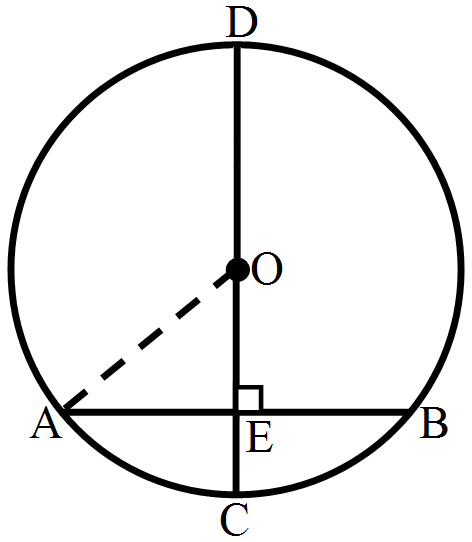
$\mathrm{OA}=\mathrm{OC}$
$\Rightarrow \mathrm{OA}=\mathrm{OE}+\mathrm{CE}$
$\Rightarrow \mathrm{OA}=\mathrm{OE}+3$
$\Rightarrow \mathrm{OE}=\mathrm{OA}-3 ...(i)$
$\mathrm{AE}=\frac{1}{2} \mathrm{AB}[\text { Perpendicular drawn from the centre of a circle to the chord bisect the chord }]$
$=\frac{1}{2}(12)=6 \mathrm{~cm}$
$\text { In right } \triangle \mathrm{OEA}$
$\mathrm{OA}^2=\mathrm{OE}^2+\mathrm{AE}^2$
$\Rightarrow \mathrm{OA}^2=(\mathrm{OA}-3)^2+\mathrm{AE}^2\left[\mathrm{From}(\text { i })\right]$
$\Rightarrow \mathrm{OA}^2=\mathrm{OA}^2-6 \mathrm{OA}+9+\mathrm{AE}^2$
$\Rightarrow 6 \mathrm{OA}=9+6^2$
$\Rightarrow 6 \mathrm{OA}=9+36$
$\Rightarrow \mathrm{OA}=\frac{45}{6}=7.5 \mathrm{~cm}$
So, the radius of the circle is $7.5 \ cm.$
View full question & answer→MCQ 41 Mark
In the given figure, $O$ is the centre of a circle. If $\angle\text{OAC}=50^\circ,$ then $\angle\text{ODB}=?$
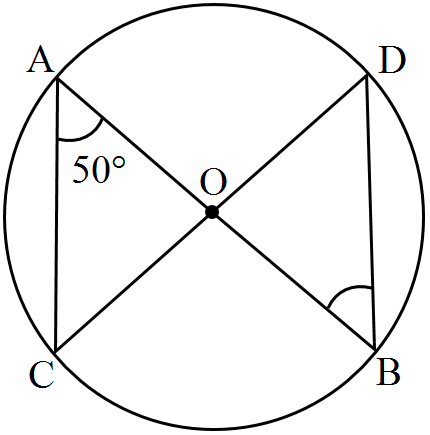
- A
$40^\circ $
- ✓
$50^\circ$
- C
$75^\circ$
- D
$60^\circ$
AnswerCorrect option: B. $50^\circ$
$\angle\text{ODB}=\angle\text{OAC}=50^\circ ($Angles in the same segment of a circle$)$
$\Rightarrow\angle\text{ODB}=50^\circ$
View full question & answer→MCQ 51 Mark
If the length of a chord of a circle is $16\ cm$ and is at a distance of $15\ cm$ from the centre of the circle, then the radius of the circle is:
- A
$15\ cm.$
- B
$16\ cm.$
- ✓
$17\ cm.$
- D
$34\ cm.$
AnswerCorrect option: C. $17\ cm.$
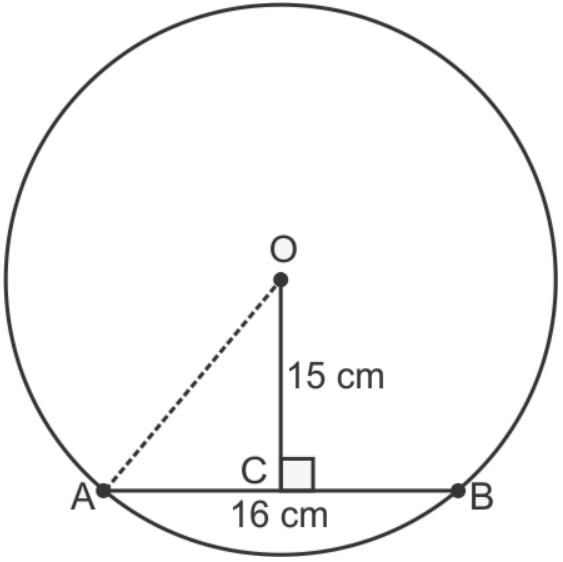
$AB = 16\ cm$
$OC = 15\ cm$
$C$ is the mid-point of $AB.$
$\text{AC}=\text{BC}=\frac{16}{2}=8\text{cm}$
Consider $\triangle\text{OCA},$
$\text{OC}=\text{15cm},\ \text{AC}=\text{8cm}$
$\Rightarrow\text{OA}=\sqrt{(15)^2+(8)^2}$
$=\sqrt{225-64}$
$=\sqrt{289}$
$\Rightarrow\text{OA}=17\text{cm}$
View full question & answer→MCQ 61 Mark
In the given figure, if $\angle\text{CAB}=50^\circ$ and $\angle\text{ABC}=70^\circ,$ then $\angle\text{ADB}$ is equal to: 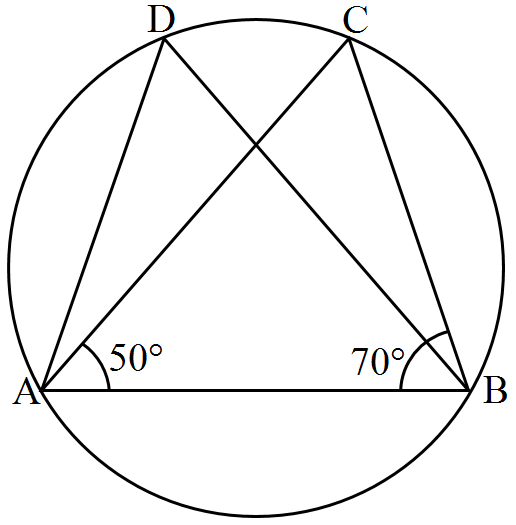
- ✓
$60^\circ$
- B
$80^\circ$
- C
$70^\circ$
- D
$50^\circ$
AnswerCorrect option: A. $60^\circ$
In triangle $ABC, \angle\text{A}+\angle\text{B}+\angle\text{C}=180^\circ$
$\Rightarrow\angle\text{C}=60^\circ$
$\angle\text{ACB}=\angle\text{ADB}=60^\circ ($Angle made by the same chord are equal$)$
View full question & answer→MCQ 71 Mark
A circle is drawn. It divides the plane into:
- A
- B
$4$ Parts
- C
$5$ Parts
- ✓
$3$ Parts
AnswerCorrect option: D. $3$ Parts
A circle divides the plane into $3$ parts namely, the points outside the circle, the points inside the circle and the points on the circle.
View full question & answer→MCQ 81 Mark
Two circle are congruent if they have equal.
AnswerEqual radius would generate two same circles that are exact copy of each other, hence making them congruent.
View full question & answer→MCQ 91 Mark
An angle in the semicircle is:
- A
$360^\circ$
- B
- C
$180^\circ$
- ✓
$90^\circ$
AnswerCorrect option: D. $90^\circ$
The angle in a semicircle is always $90^\circ .$
View full question & answer→MCQ 101 Mark
$ABC$ is a triangle with $B$ as right angle, $AC = 5\ cm$ and $AB = 4\ cm.$ A circle is drawn with $A$ as centre and $AC$ as radius. The length of the chord of this circle passing through $C$ and $B$ is:
- A
$4\ cm$
- B
$5\ cm$
- C
$3\ cm$
- ✓
$6\ cm$
AnswerCorrect option: D. $6\ cm$
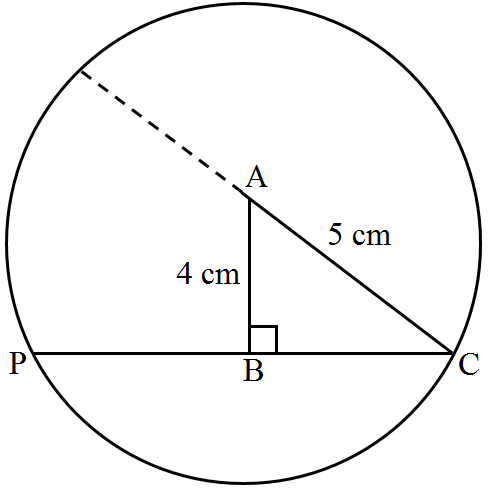
In the circle produce $CB$ to $P.$ Here $PC$ is the required chord.
We know that perpendicular drawn from the centre to the chord divide the chord into two equal parts.
So, $PC = 2BC$
Now in $\triangle\text{ABC}$ apply Pythagoras theorem
$A B^2+B C^2=A C^2$
$\Rightarrow B C^2=A C^2-A B^2$
$\Rightarrow B C^2=5^2-4^2$
$\Rightarrow B C^2=25-16$
$\Rightarrow B C^2=9$
$\Rightarrow B C=3 \mathrm{~cm}$
$\text { So, } P C=2 \times B C$
$=2 \times 3$
$P C=6 \mathrm{~cm}$
View full question & answer→MCQ 111 Mark
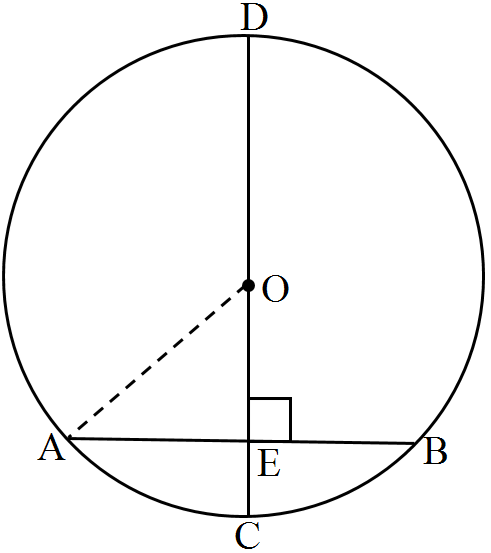
In the given figure, $CD$ is the diameter of a circle with centre $O$ and $CD$ is perpendicular to chord $AB.$ If $AB = 12\ cm$ and $CE = 3\ cm,$ then radius of the circles is:
- A
$9\ cm$
- B
$6\ cm$
- C
$8\ cm$
- ✓
$7.5\ cm$
AnswerCorrect option: D. $7.5\ cm$
Let $OA = OC = r \ cm.$
Then $OE = (r - 3)\ cm$ and $\text{AE}=\frac{1}{2}\text{AB}=6\text{cm}$
Now, in right $\triangle\text{OAE},$ we have:
$O A^2=\mathrm{OE}^2+\mathrm{AE}^2 \text { [Using paythagoras theorem] }$
$\Rightarrow(r)^2=(r-3)^2+6^2$
$\Rightarrow r^2=r^2+9-6 r+36$
$\Rightarrow 6 r=45$
$\Rightarrow\text{r}=\frac{45}{6}=7.5\text{cm}$
Hence, the required radius of the circle is $7.5\ cm.$
View full question & answer→MCQ 121 Mark
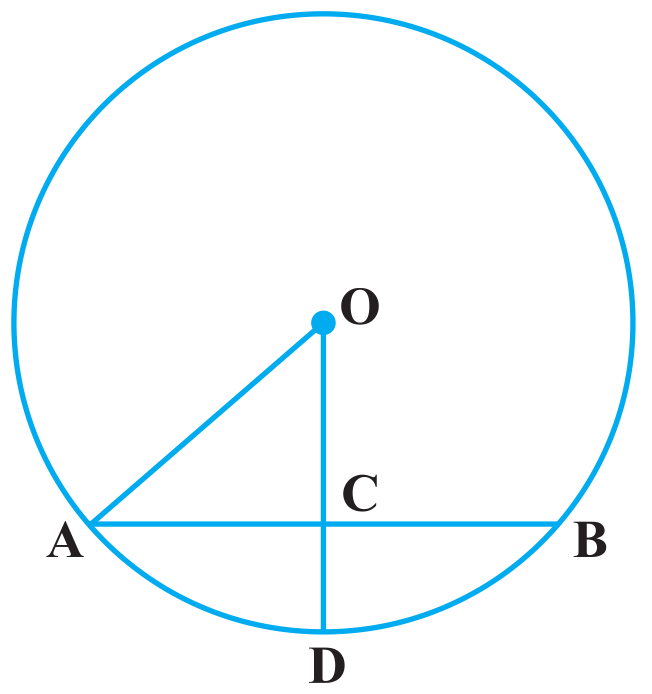
Write the correct answer in the following: In Fig. if $OA = 5\ cm, AB = 8\ cm$ and $OD$ is perpendicular to $AB,$ then $CD$ is equal to:
- A
$2\ cm$
- B
$3\ cm$
- ✓
$4\ cm.$
- D
$5\ cm$
AnswerCorrect option: C. $4\ cm.$
As perpendicular from the centre to a chord the chord,
$\text{AC}=\frac{1}{2}\times\text{AB}=\frac{1}{2}\times8=4\text{cm}$
$\text{OC}=\sqrt{(\text{OA})^2-(\text{AC})^2}=\sqrt{(5)^2-(4)^2}=\sqrt{25-16}=\sqrt{9}$
$OC = 3\ cm$
Now, $CD = OD - OC$
$= 5\ cm - 3\ cm = 2\ cm$
Hence, $(c)$ is the correct answer.
View full question & answer→MCQ 131 Mark
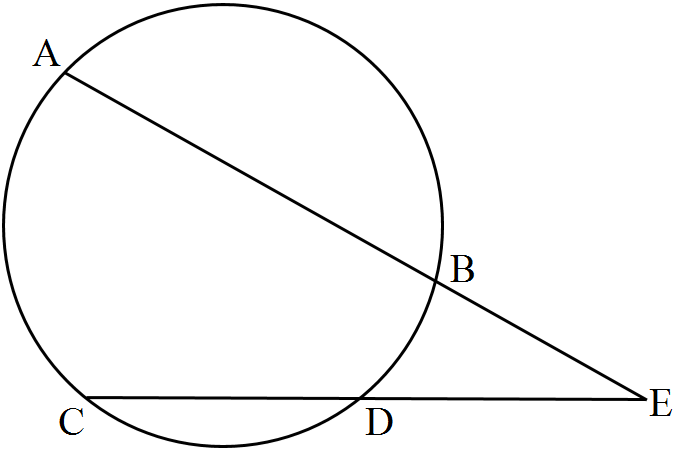
Two chords $AB$ and $CD$ of a circle intersect each other at a point $E$ outside the circle. If $AB = 11\ cm, BE = 3\ cm$ and $DE = 3.5\ cm, t$hen $CD = ?$
- A
$7.5\ cm$
- B
$9.5\ cm$
- C
$10.5\ cm$
- ✓
$8.5\ cm$
AnswerCorrect option: D. $8.5\ cm$
Join $AC.$
Then $AE : CE = DE : BE ($Intersecting secant theorem$)$
$\therefore AE × BE = DE × CE ....(i)$
Let $CD = x\ \ cm$
Then $AE = (AB + BE) = (11 + 3)\ cm = 14\ cm;$
$BE = 3\ cm; CE = (x + 3.5)\ cm; DE = 3.5\ cm$
$\therefore 14 × 3 = (x + 3.5) × 3.5 [$FROM $(1)]$
$\Rightarrow\text{x}+3.5=\frac{14\times3}{3.5}=\frac{42}{3.5}=12$
$⇒ x = (12 - 3.5)\ cm = 8.5\ cm$
Hence, $CD = 8.5\ cm$
View full question & answer→MCQ 141 Mark
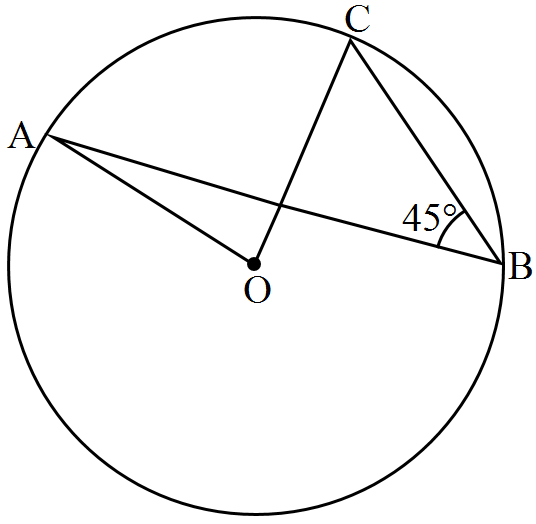
In the given figure, if $\angle\text{ABC}=45^\circ,$ then $\angle\text{AOC}=$
- A
$75^\circ $
- B
$45^\circ$
- ✓
$90^\circ$
- D
$60^\circ$
AnswerCorrect option: C. $90^\circ$
The angle made by an arc at the centre is double the angle made by it on any other point on the circumfrence.
View full question & answer→MCQ 151 Mark
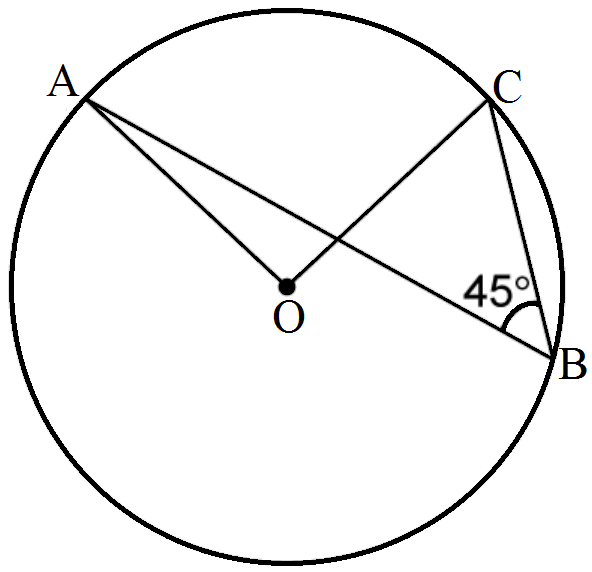
In the given figure, if $\angle\text{ABC} = 45^\circ,$ then $\angle\text{AOC} =$
- A
$45^\circ$
- B
$60^\circ$
- C
$75^\circ$
- ✓
$90^\circ$
AnswerCorrect option: D. $90^\circ$
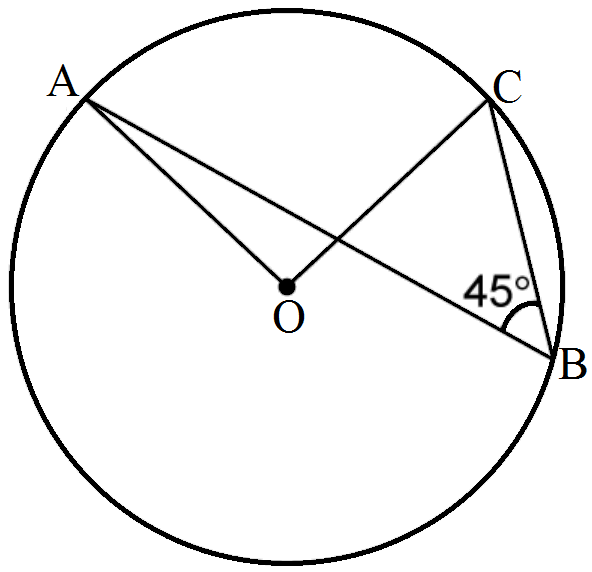
$\angle\text{AOC}$ is made by arc $\widehat{\text{AC}}$ at centre and $\angle\text{ABC}$ is made by $\widehat{\text{AC}}$ on circumference in major segment.
$\Rightarrow\angle\text{ABC}=\frac{1}{2}\angle\text{AOC}$
$\Rightarrow\angle\text{AOC}=2\times\angle\text{ABC}$
$=2\times45^\circ=90^\circ$
View full question & answer→MCQ 161 Mark
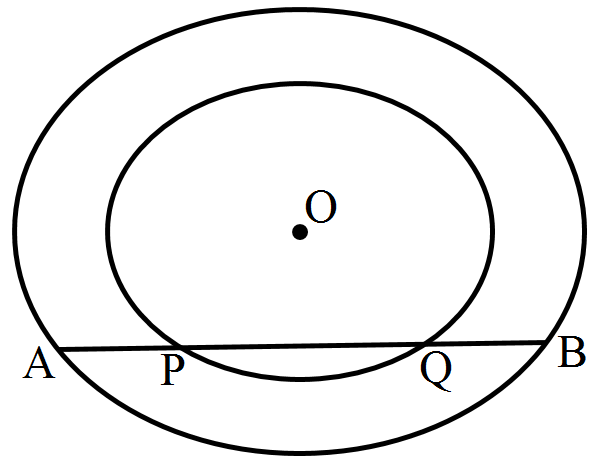
If a straight line $APQB$ is drawn to cut two concentric circles, then:
- A
$AP > BQ$
- B
$AP < BQ$
- C
$AQ > PB$
- ✓
$AP = BQ$
AnswerCorrect option: D. $AP = BQ$
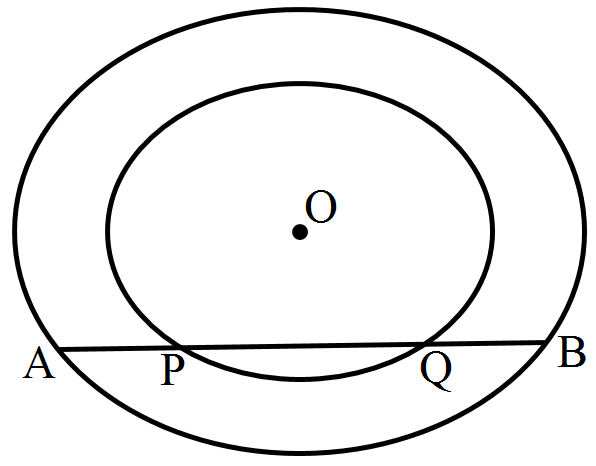
Let $OD$ is perpendicular to $AB.$ Then $AD = DB$.
Also $DP = DQ$
Therefore, $AP = AD - PD$
$= BD - DQ$
$= BQ$
Hence, $AP = BQ$
View full question & answer→MCQ 171 Mark
$ABC$ is a triangle with $B$ as right angle, $AC = 5\ cm$ and $AB = 4\ cm.$ A circle is drawn with $A$ as centre and $AC$ as radius. The length of the chord of this circle passing through $C$ and $B$ is:
- A
$3\ cm$
- B
$4\ cm$
- C
$5\ cm$
- ✓
$6\ cm$
AnswerCorrect option: D. $6\ cm$
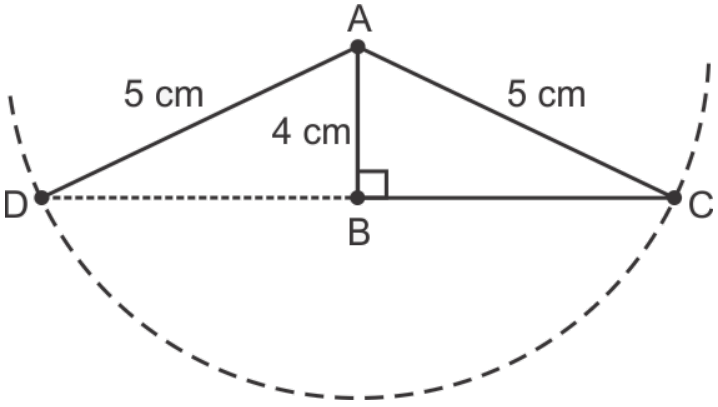
$AD$ and $AC$ are radii of same circle and $CD$ is a chord.
Consider $\triangle\text{ABC},$
$BC^2 = (AC)^2 - (AB)^2$
$=5^2 - 4^2 = 25 - 16 = 9$
$⇒ BC = 3\ cm$
Chord $CD = 2 × BC = 6\ cm$
View full question & answer→MCQ 181 Mark
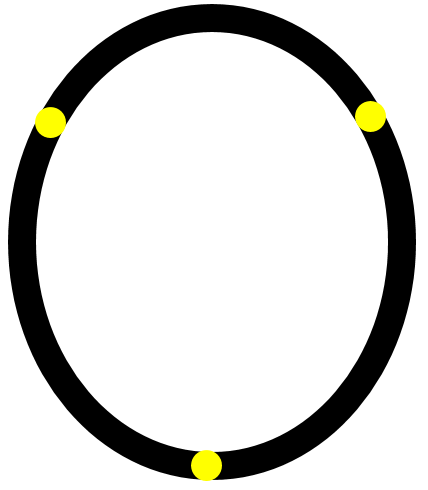
Number of circles that can be drawn through three non-collinear points is:
AnswerOnly $1$ circle can be drawn from three non-collinear points.
View full question & answer→MCQ 191 Mark
If $A , B, C$ are three points on a circle with centre $O$ such that $\angle\text{AOB} = 90^\circ$ and $\angle\text{BOC} = 120^\circ,$ then $\angle\text{ABC} =$
- A
$60^\circ $
- ✓
$75^\circ$
- C
$90^\circ$
- D
$135^\circ$
AnswerCorrect option: B. $75^\circ$
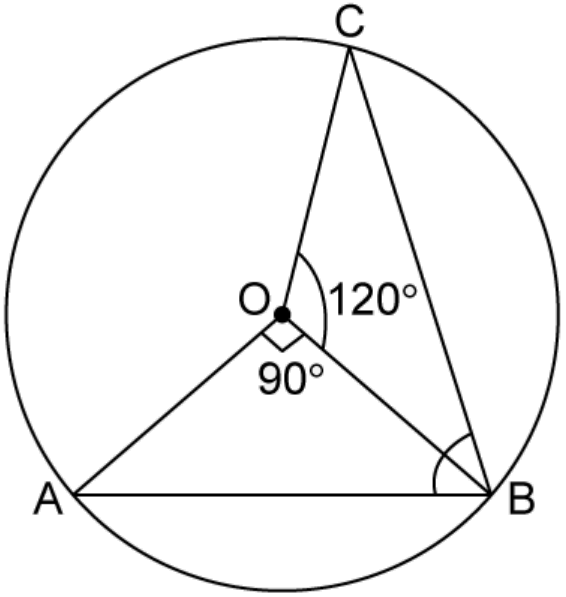
$\angle\text{AOC}=\angle\text{AOB}+\angle\text{BOC}$
$=90^\circ+120^\circ=210^\circ$
$\angle\text{COA}=360^\circ-210^\circ=150^\circ$
If arc $\widehat{\text{COA}}$ makes $150^\circ $ at centre, then it will make half angle of the centre at circumference.
$\Rightarrow\angle\text{CBA}$ or $\angle\text{ABC}=\frac{150^\circ}{2}=75^\circ$ View full question & answer→MCQ 201 Mark
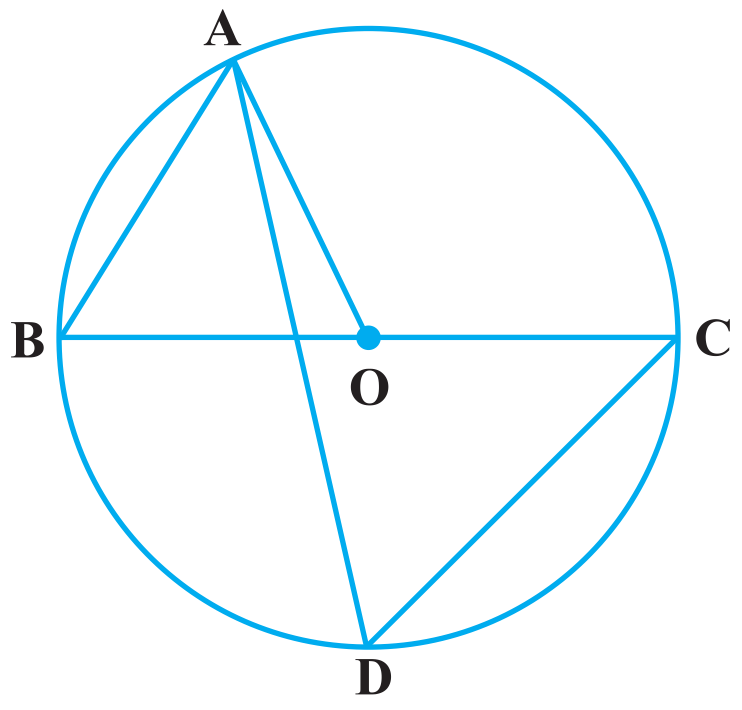
Write the correct answer in the following: In Fig. $BC$ is a diameter of the circle and $\angle\text{BAO}=60^\circ.$ Then $\angle\text{ADC}$ is equal to:
- A
$30^\circ .$
- B
$45^\circ .$
- ✓
$60^\circ .$
- D
$120^\circ .$
AnswerCorrect option: C. $60^\circ .$
In $\triangle\text{OAB},$ we have
$OA = OB [$Radii of the same circle$]$
$\therefore\angle\text{ABO}=\angle\text{BAO} [$Angles opp. To equal sides are equal$]$
$\therefore\angle\text{ABO}=\angle\text{BAO}=60^\circ [$Given$]$
Now, $\angle\text{ADC}=\angle\text{ABC}=60^\circ$
$[\because\angle\text{ABC}$ and $\angle\text{ADC}$ are angles in the same segment of circle, are equal$]$
Hence, $\angle\text{ADC}=60^\circ$
So, $(c)$ is the correct answer.
View full question & answer→MCQ 211 Mark
The radius of a circle is $13\ cm$ and the length of one of its chords is $10\ cm$. The distance of the chord from the centre is:
- A
$11.5\text{cm}$
- ✓
$12\text{cm}$
- C
$\sqrt{69}\text{cm}$
- D
$23\text{cm}$
AnswerCorrect option: B. $12\text{cm}$
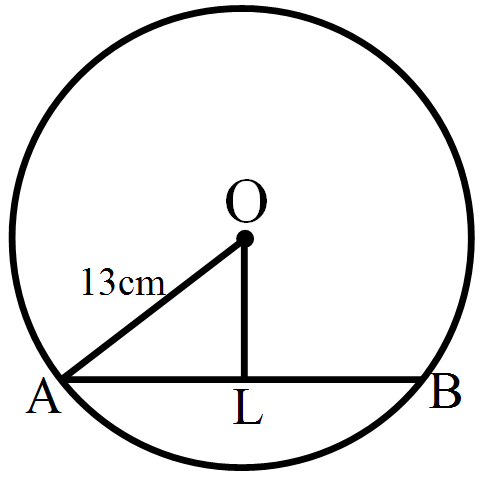
Let $O$ be the centre of the circle with radius $OA = 13\ cm.$
$AB$ is given to be $10\ cm.$
Distance of a point to a line is always perpendicular to the line.
So, $\text{OL}\perp\text{AB}.$
We know that, the perpendicular drawn from the centre to the chord bisects the chord.
$⇒ AL = LB = 5\ cm$
In right $\triangle\text{OLA},$
$\mathrm{OL}^2=\mathrm{AO}^2-\mathrm{AL}^2[\text { By pythagoras theorem }]$
$\Rightarrow O L^2=13^2-5^2$
$\Rightarrow O L^2=169-25$
$\Rightarrow O L^2=144$
$\Rightarrow \mathrm{OL}=12 \mathrm{~cm}$
View full question & answer→MCQ 221 Mark
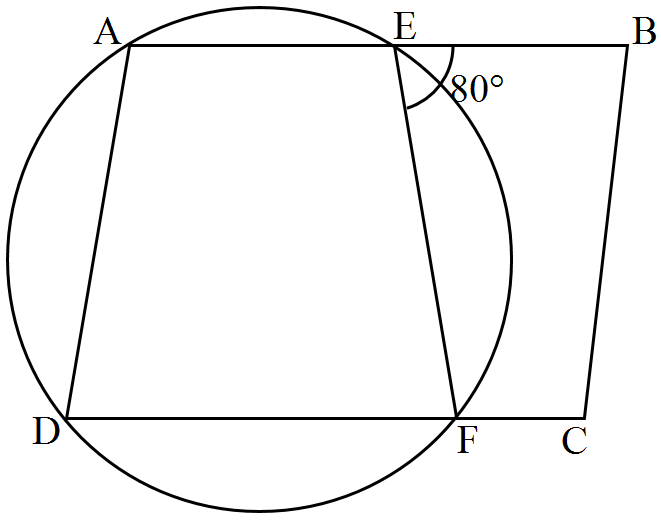
$ABCD$ is a parallelogram. A circle passes through $A$ and $D$ and cuts $AB$ at $E$ and $DC$ at $F$. If $\angle\text{BEF}=80^\circ,$ then $\angle\text{ABC}$ is equal to:
- A
$75^\circ$
- ✓
$80^\circ$
- C
$100^\circ$
- D
$120^\circ$
AnswerCorrect option: B. $80^\circ$
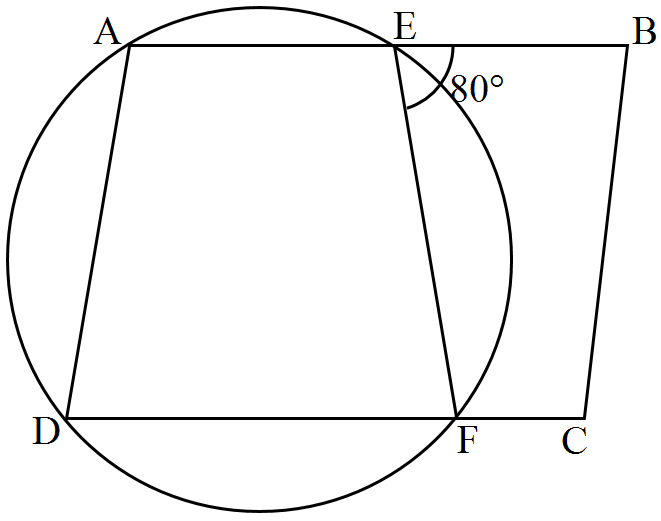
$\angle\text{AEF}+80^\circ=180^\circ$ (Linear Pair)
$\angle\text{AEF}=100^\circ$
$\angle\text{ADF}+\angle\text{AEF}=180^\circ$ (Opposite angles of a cyclic quadrilateral)
$\angle\text{ADF}=180^\circ-100^\circ=80^\circ$
$\angle\text{ADF}=\angle\text{ABC}=80^\circ$ (Opposite angles of a parallelogram)
View full question & answer→MCQ 231 Mark
One half of the whole arc of a circle.
AnswerCorrect option: A. Semi$-$circle
A semi$-$circle is half the circle. In other words, half of the total length of the circle makes the semicircle.
View full question & answer→MCQ 241 Mark
In the given figure, $AOB$ is a diameter of a circle with centre $O$ such that $AB = 34\ cm$ and $CD$ is a chord of length $30cm.$ Then the distance of $CD$ from $AB$ is:
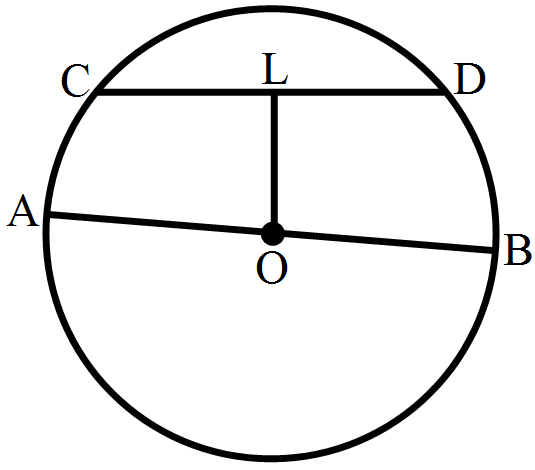
- ✓
$8\ cm$
- B
$15\ cm$
- C
$18\ cm$
- D
$6\ cm$
AnswerCorrect option: A. $8\ cm$
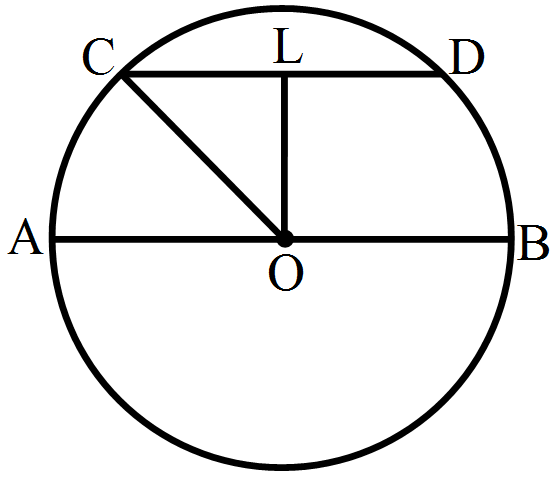
Construction: Join $OC.$
We know that, the perpendicular drawn from the centre to the chord bisects the chord.
So, $\text{CL}=\frac{1}{2}\text{CD}=\frac{1}{2}(30)=15\text{cm}$
AB is the diameter.
So, $\text{AO}=\frac{1}{2}\text{AB}=\frac{1}{2}(34)=17\text{cm}.$
In $\triangle\text{OLC},$
$\mathrm{OL}^2=\mathrm{OC}^2-\mathrm{CL}^2$
$\Rightarrow \mathrm{OL}^2=17^2-15^2$
$\Rightarrow \mathrm{OL}^2=289-225$
$\Rightarrow O L^2=64$
$\Rightarrow \mathrm{OL}=8 \mathrm{~cm}$
View full question & answer→MCQ 251 Mark
What is a diameter in terms of the radius$?$
- A
$\text{d}=2\pi\text{r}$
- B
$r = 2d$
- C
$d = r$
- ✓
$d = 2r$
AnswerCorrect option: D. $d = 2r$
Diameter is twice of radius.
thus, $d = 2r.$
View full question & answer→MCQ 261 Mark
In the given figure, $O$ is the centre of a circle and $\angle\text{AOB}=140^\circ.$ Then, $\angle\text{ACB}=?$ 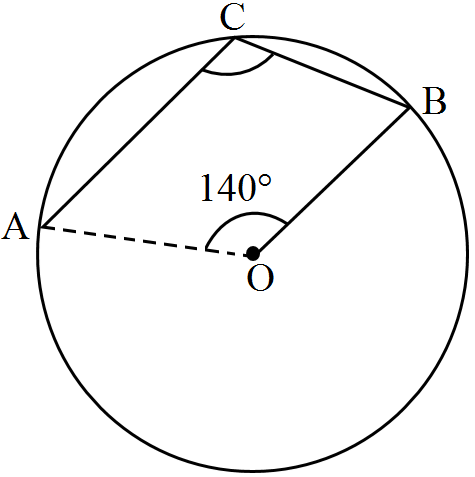
- ✓
$110^\circ$
- B
$70^\circ$
- C
$80^\circ$
- D
$40^\circ$
AnswerCorrect option: A. $110^\circ$
Let, $D$ on any point on circumference and join $AD$ and $BD,$
Now, $\angle\text{ADB}=\frac{\angle\text{AOB}}{2}$
$\angle\text{ADB}=\frac{140}{2}=70^\circ$
Now, in cyclic quadrilateral $ADBC$
$\Rightarrow\angle\text{ADB}+\angle\text{ACB}=180^\circ$
$\Rightarrow\angle\text{ACB}=180^\circ-\angle\text{ADB}$
$\Rightarrow\angle\text{ACB}=180^\circ-70^\circ$
$\Rightarrow\angle\text{ACB}=110^\circ$
View full question & answer→MCQ 271 Mark
Two equal circles of radius $r$ intersect such that each passes through the centre of the other. The length of the common chord of the circle is:
AnswerCorrect option: C. $\sqrt{3}\text{r}$
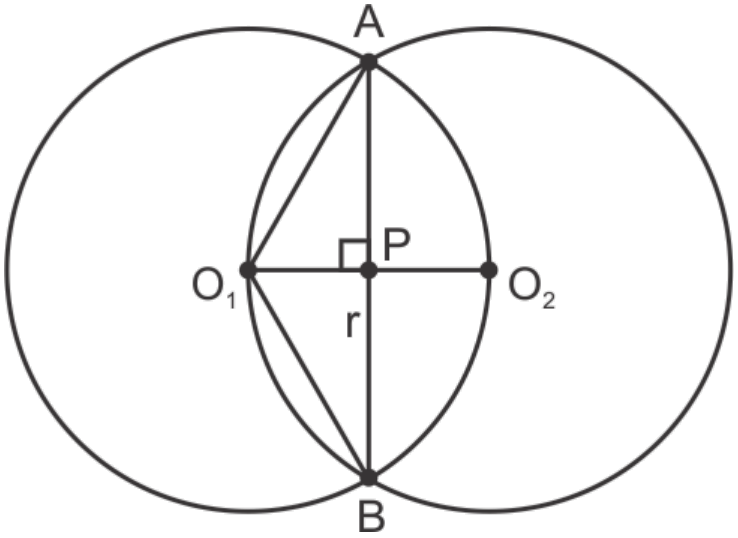
Both the circles pass through the centre of each other
$\Rightarrow \mathrm{O}_1 \mathrm{O}_2=\mathrm{r}$
Common chord is $AB$
We know that perpendicular drawn from centre of circle to any chord bisects it.
$⇒ P$ is the midpoint of $AB$
$⇒ PA = PB$
$\mathrm{O}_1 \mathrm{~A}=\mathrm{r} ($radius of circle$)$
Consider $\triangle\text{O}_1\text{PA}$
$\big(\text{O}_1\text{A}\big)^2=\text{AP}^2+\text{O}_1\text{P}^2$
$\Rightarrow\text{r}^2=\text{AP}^2+\Big(\frac{\text{r}}{2}\Big)^2 ...(P$ is also mid-point of $\mathrm{O}_1 \mathrm{O}_2)$
$\Rightarrow\text{AP}^2=\text{r}^2-\frac{\text{r}^2}{4}=\frac{\text{3r}^2}{4}$
$\Rightarrow\text{AP}=\frac{\sqrt3}{2}\text{r}$
Lenght of chord $\text{AP}=\text{2AP}=\sqrt{3}\text{r}$
View full question & answer→MCQ 281 Mark
If $O$ is the centre of a circle of radius $r$ and $AB$ is a chord of the circle at a distance $\frac{\text{r}}{2}$ from $O,$ then $\angle\text{BAO}=$
- A
$15^\circ $
- B
$60^\circ$
- C
$45^\circ$
- ✓
$30^\circ$
AnswerCorrect option: D. $30^\circ$
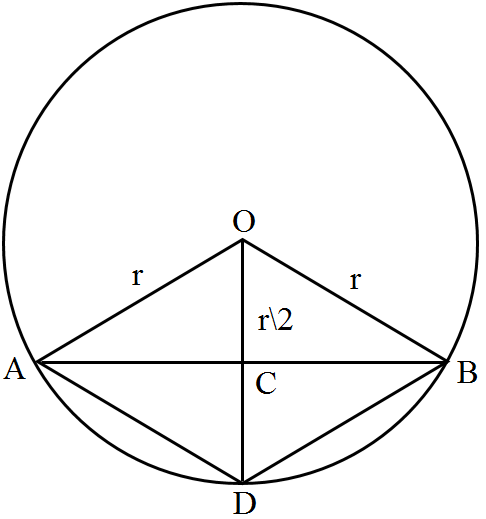
Let $OD = r$
$\text{OC}=\frac{\text{r}}{2}$
In $\angle\text{OAC}$ and $\angle\text{DAC}$
$\text{SAS}-\angle\text{OAC}\cong\angle\text{DAC}$
Now, in $\angle\text{OAD}$ equilateral
$\angle\text{AOD}=60^\circ$
$\angle\text{CAO}=\angle\text{BAO}=30^\circ$
$\Rightarrow\sin\theta=\frac{\text{r}}{\frac{2}{\text{r}}}=\frac{1}{2}$
$\Rightarrow\theta=30^\circ$ View full question & answer→MCQ 291 Mark
In the given figure, $BOC$ is a diameter of a circle with centre $O.$ If $\angle\text{BCA}=30^\circ$ then $\angle\text{CDA}=?$
- A
$30^\circ$
- B
$45^\circ$
- ✓
$60^\circ$
- D
$50^\circ $
AnswerCorrect option: C. $60^\circ$
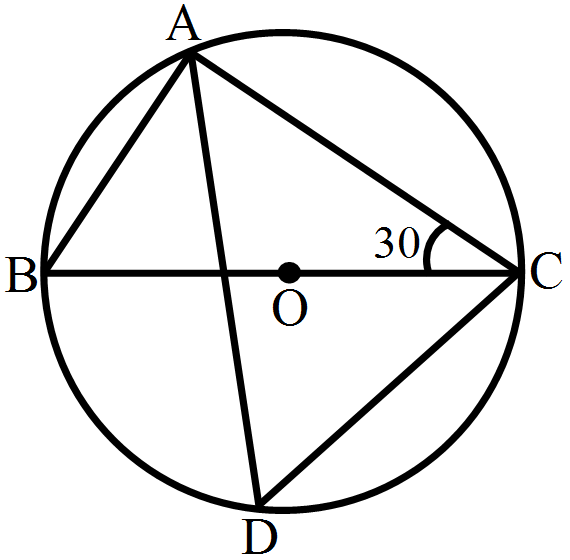
Since $BOC$ is a diameter, $\angle\text{BAC}=90^\circ.$
In $\triangle\text{BAC},$
$\angle\text{BAC}+\angle\text{ABC}+\angle\text{BCA}=180^\circ$ [Angle sum property]
$\Rightarrow\ 90^\circ+\angle\text{ABC}+30^\circ=180^\circ$
$\Rightarrow\ \angle\text{ABC}=60^\circ$
Since angles in the same segment of a circle are equal.
$\angle\text{CDA}=\angle\text{ABC}=60^\circ.$
View full question & answer→MCQ 301 Mark
The angle in a semicircle measures:
- A
$45^\circ$
- B
$60^\circ$
- ✓
$90^\circ$
- D
$36^\circ $
AnswerCorrect option: C. $90^\circ$
The angle in a semicircle measures $90^\circ .$
View full question & answer→MCQ 311 Mark
A chord is at a distance of $8\ cm$ from the centre of a circle of radius $17\ cm.$ The length of the chord is:
- A
$25\ cm$
- B
$12.5\ cm$
- ✓
$30\ cm$
- D
$9\ cm$
AnswerCorrect option: C. $30\ cm$
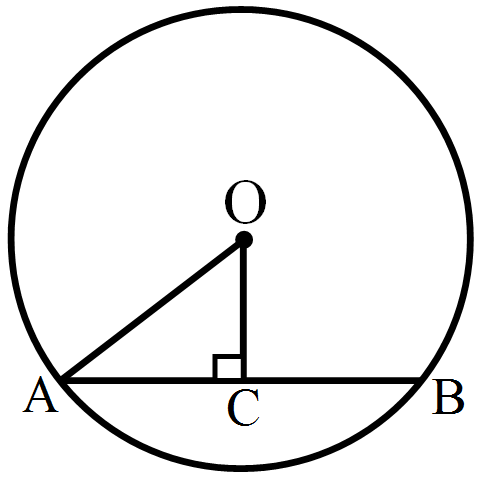
Let $O$ be the centre of the circle with radius $OA = 17\ cm.$
Since $\text{OC}\perp\text{AB}.$
In right $\triangle\text{OCA},$
$O A^2=O C^2+A C^2[B y \text { pythagoras theorem }]$
$A C^2=O A^2-O C^2$
$\Rightarrow A C^2=17^2-8^2$
$\Rightarrow A C^2=289-64$
$\Rightarrow A C^2=225$
$\Rightarrow A C=15 \mathrm{~cm}$
We know that, the perpendicular drawn from the centre to the chord bisects the chord.
$\Rightarrow A B=2 A C=2(15)=30 \mathrm{~cm}$ View full question & answer→MCQ 321 Mark
$AB$ and $CD$ are two parallel chords of a circle with centre $O$ such that $AB = 6\ cm$ and $CD = 12\ cm.$ The chords are on the same side of the centre and the distance between them is $3\ cm.$ The radius of the circle, is:
- A
$7\text{cm}$
- B
$6\text{cm}$
- ✓
$3\sqrt{5}\text{cm}$
- D
$5\sqrt{2}\text{cm}$
AnswerCorrect option: C. $3\sqrt{5}\text{cm}$
Let the distance between the center and the chord $CD $ be $x\ cm$ and the radius of the circle is $r\ cm.$
We have to find the radius of the following circle:
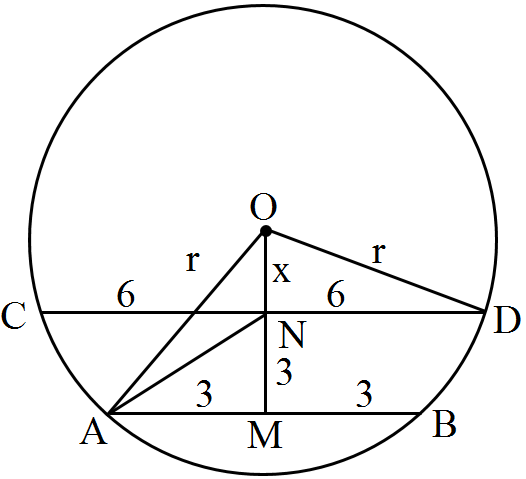
In right angled triangle, $OND,$
$x^2+36=r^2 \ldots$ $(i)$
Now, in right angled triangle $AOM,$
$r^2=9+(x+3)^2 \ldots (ii)$
From $(i)$ and $(ii),$ we have
$\text{r}^2=9+((\sqrt{\text{r}})^2-36+3)^2$
$\Rightarrow\text{r}^2=9+\text{r}^2-36+9+6\sqrt{\text{r}^2-36}$
$\Rightarrow3=\sqrt{\text{r}^2-36}$
$\Rightarrow9=\text{r}^2-36[ $squaring both the sides$]$
$\Rightarrow\text{r}^2=45\Rightarrow\text{r}=3\sqrt{5}\text{cm}$
View full question & answer→MCQ 331 Mark
In the given figure, $O$ is the centre of a circle in which $\angle\text{OAB}=20^\circ$ and $\angle\text{OCB}=50^\circ.$ Then, $\angle\text{AOC}=?$
- A
$50^\circ$
- B
$70^\circ$
- C
$20^\circ$
- ✓
$60^\circ $
AnswerCorrect option: D. $60^\circ $
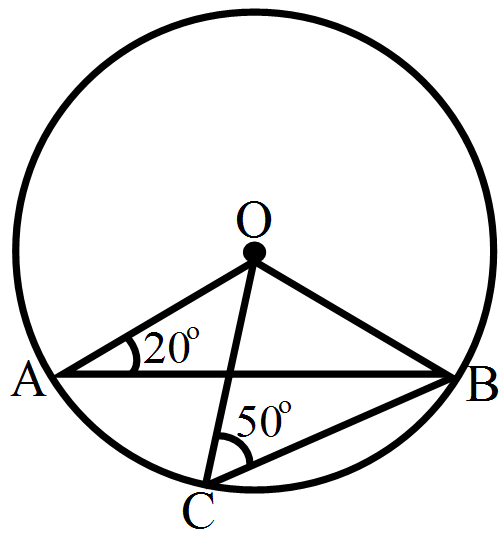
$OA = OC [$Radii of the same circle$]$
$\Rightarrow\ \angle\text{OBA}=\angle\text{OAB}=20^\circ$
In $\triangle\text{OAB,}$
$\angle\text{OBA}+\angle\text{OAB}+\angle\text{AOB}=180^\circ$ [Angle sum property]
$\Rightarrow\ 20^\circ+20^\circ+\angle\text{AOB}=180^\circ$
$\Rightarrow\ \angle\text{AOB}=140^\circ$
Now,
$OB = OC [$Radii of the same circle$]$
$\Rightarrow\ \angle\text{OBC}=\angle\text{OCB}=50^\circ$
In $\triangle\text{OCB},$
$\angle\text{OBC}+\angle\text{OCB}+\angle\text{COB}=180^\circ$ [Angle sum property]
$\Rightarrow\ 50^\circ+50^\circ+\angle\text{COB}=180^\circ$
$\Rightarrow\ \angle\text{COB}=80^\circ$
So,
$\angle\text{AOB}=\angle\text{AOC}+\angle\text{COB}$
$\Rightarrow\ \angle\text{AOC}=\angle\text{AOB}-\angle\text{COB}$
$\Rightarrow\ \angle\text{AOC}=140^\circ-80^\circ$
$\Rightarrow\ \angle\text{AOC}=60^\circ$ View full question & answer→MCQ 341 Mark
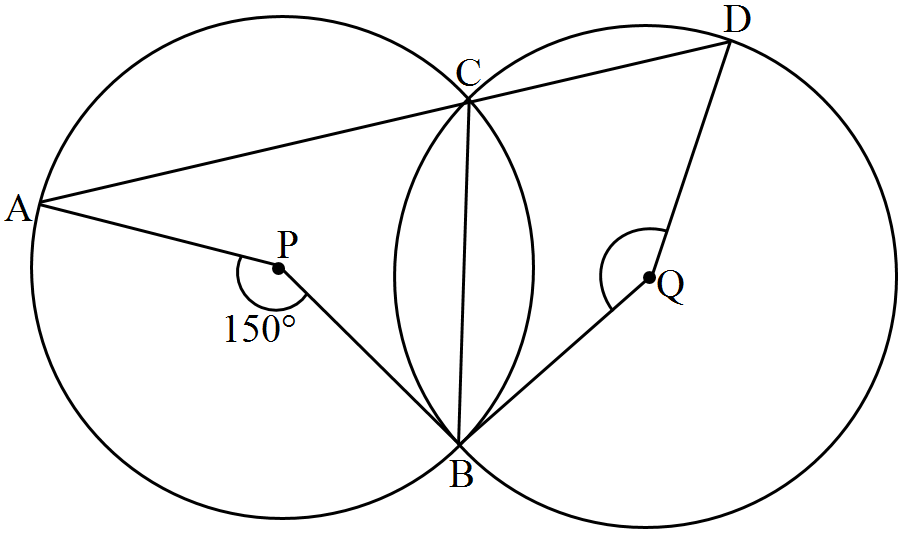
In the given figure, $P$ and $Q$ are centers of two circles intersecting at $B$ and $C.$ $ACD$ is a straight line. Then, the measure of $\angle\text{BQD}$ is:
- A
$115^\circ $
- ✓
$150^\circ$
- C
$105^\circ$
- D
$130^\circ$
AnswerCorrect option: B. $150^\circ$
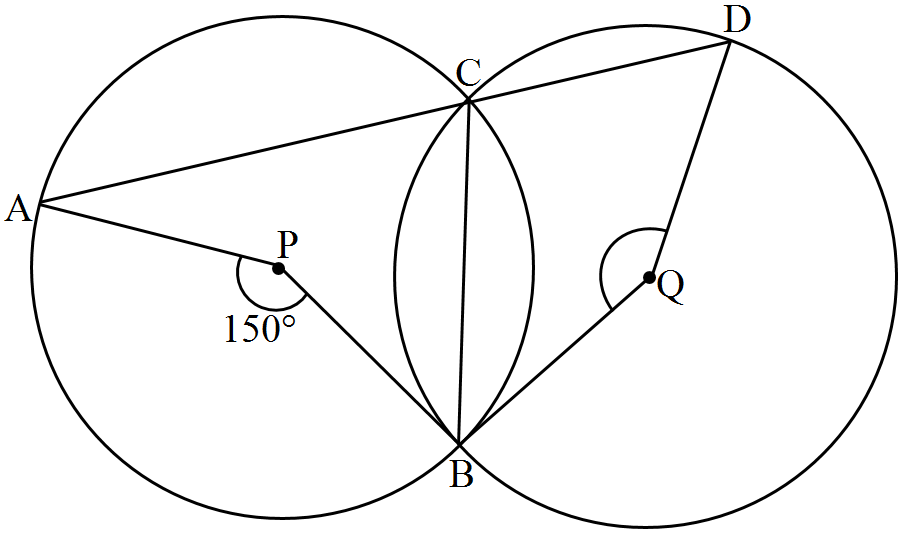
$\angle\text{APB}=150^\circ,$ so, $\angle\text{ACB}=75^\circ$ {Angle subtended by an arc at centre is twice the angle subtended at any point on circumference}
Now, ACD is straight line, so, $\angle\text{ACB}+\angle\text{DCB}=180^\circ$
$\angle\text{DCB}=180-75=105^\circ$
Now, angle subtended by arc BD on centre is twice of $\angle\text{DCB}=2\times105=210^\circ$
Now, $\angle\text{BQD}=360^\circ-210^\circ=150^\circ$
View full question & answer→MCQ 351 Mark
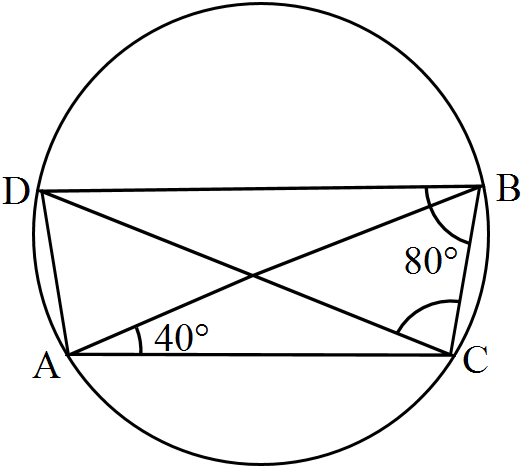
In the given figure, $AB$ and $CD$ are two intersecting chords of a circle. If $\angle\text{CAB}=40^\circ$ and $\angle\text{BCD}=80^\circ,$ then $\angle\text{CBD}=?$
- A
$80^\circ $
- B
$70^\circ$
- ✓
$60^\circ$
- D
$50^\circ$
AnswerCorrect option: C. $60^\circ$
We have:
$\angle\text{CDB}=\angle\text{CAB}=40^\circ$ (Angles in the same segment of a circle)
In $\triangle\text{CBD},$ we have:
$\angle\text{CDB}+\angle\text{BCD}+\angle\text{CBD}=180^\circ$ (Angle sum property of a triangle)
$\Rightarrow40^\circ+80^\circ+\angle\text{CBD}=180^\circ$
$\Rightarrow\angle\text{CBD}=(180^\circ-120^\circ)=60^\circ$
$\Rightarrow\angle\text{CBD}=60^\circ$
View full question & answer→MCQ 361 Mark
The radius of a circle is $6\ cm.$ The perpendicular distance from the centre of the circle to the chord which is $8\ cm$ in length, is:
- A
$\sqrt{5}\text{cm}.$
- ✓
$2\sqrt{5}\text{cm}.$
- C
$2\sqrt{7}\text{cm}.$
- D
$\sqrt{7}\text{cm}.$
AnswerCorrect option: B. $2\sqrt{5}\text{cm}.$
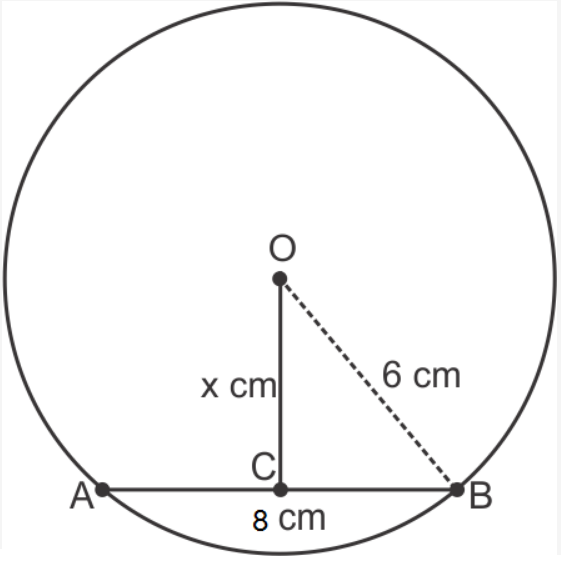
$AB = 8\ cm$
$⇒ AC = BC = 4\ cm$
Consider $\triangle\text{OCB},$ where $BC = 8\ cm,$
$OB = 6\ cm$
$\text { Now, }(\mathrm{OC})^2+(\mathrm{BC})^2=(\mathrm{OB})^2$
$\Rightarrow(\mathrm{OC})^2+4^2=6^2$
$\Rightarrow(\mathrm{OC})^2+16=36$
$\Rightarrow(\mathrm{OC})^2=20$
$\Rightarrow\text{OC}=\sqrt{20}=2\sqrt{5}$ View full question & answer→MCQ 371 Mark
If $O$ is the centre of a circle of radius $r$ and $AB$ is a chord of the circle at a distance $\frac{\text{r}}2{}$ from $O,$ then $\angle\text{BAO} =$
- A
$60^\circ$
- B
$45^\circ$
- ✓
$30^\circ$
- D
$15^\circ$
AnswerCorrect option: C. $30^\circ$
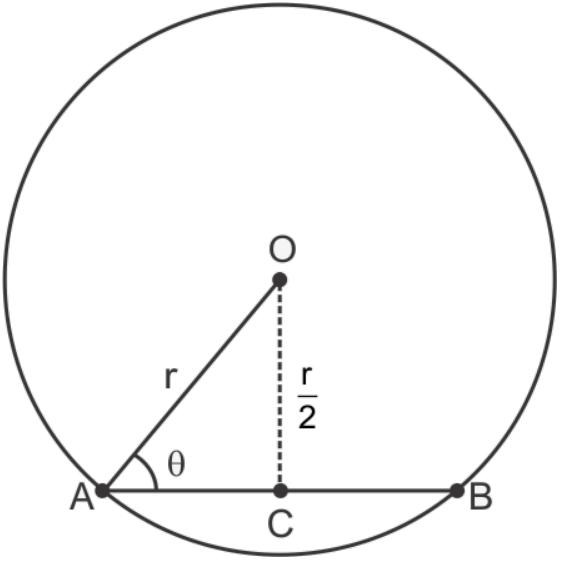
Let $\angle\text{BAO}=\theta$
Consider $\triangle\text{OAC},$
$\sin\theta=\frac{\text{OC}}{\text{OA}}=\frac{\frac{\text{r}}{2}}{\text{r}}$
$=\frac{1}{2}=\sin30^\circ$
$\Rightarrow\theta=30^\circ$
View full question & answer→MCQ 381 Mark
$ABCD$ is a cyclic quadrilateral such that $AB$ is a diameter of the circle circumscribing it and $\angle\text{ADC}=140^\circ,$ then $\angle\text{BAC}$ is equal to:
- A
$75^\circ$
- B
$40^\circ$
- C
$30^\circ$
- ✓
$50^\circ$
AnswerCorrect option: D. $50^\circ$
In the given quadrilateral,
$\angle\text{ABC}+\angle\text{ADC}=180^\circ$
$140^\circ+\angle\text{ABC}=180^\circ$
$\angle\text{ABC}=40^\circ$
Since, $AB$ is diameter so $ABCD$ lies in semi-circle.
Thus, $\angle\text{BCA}=90^\circ$
In triangle, $ABC,$
$\angle\text{A}+\angle\text{B}+\angle\text{C}=180^\circ$
$\angle\text{BAC}=180^\circ-40^\circ-90^\circ=180^\circ-130^\circ=50^\circ$
$\angle\text{BAC}=50^\circ$
View full question & answer→MCQ 391 Mark
Let $C$ be the mid-point of an arc $AB$ of a circle such that m $AB = 183^\circ .$ If the region bounded by the arc $ACB$ and line segment $AB$ is denoted by $S,$ then the centre $O$ of the circle lies.
- ✓
In the interior of $S.$
- B
On the segment $AB.$
- C
On $AB$ and bisect $AB.$
- D
In the exterior of $S.$
AnswerCorrect option: A. In the interior of $S.$
Given: m $AB= 183^\circ $ and $C$ is mid-point of arc $ABO$ is the centre.
With the given information the corresponding figure will look like the following,
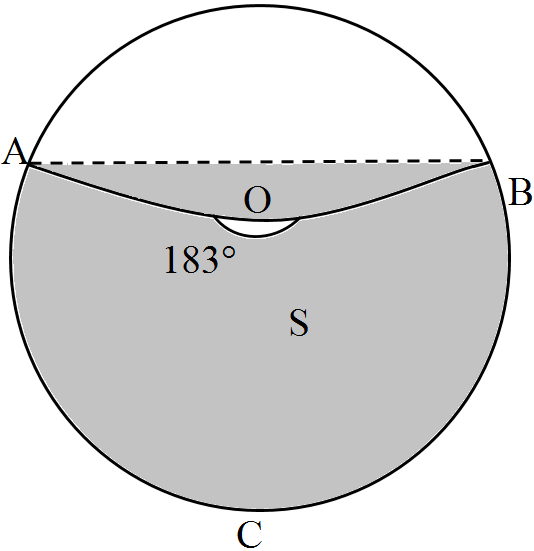
From the figure, so the centre of the circle $O$ lies inside the shaded region $S.$
View full question & answer→MCQ 401 Mark
In the given figure $PQ = QR = RS$ and $\angle\text{PTS}=75^\circ$ then the measure of $\angle\text{QOR}$ is: 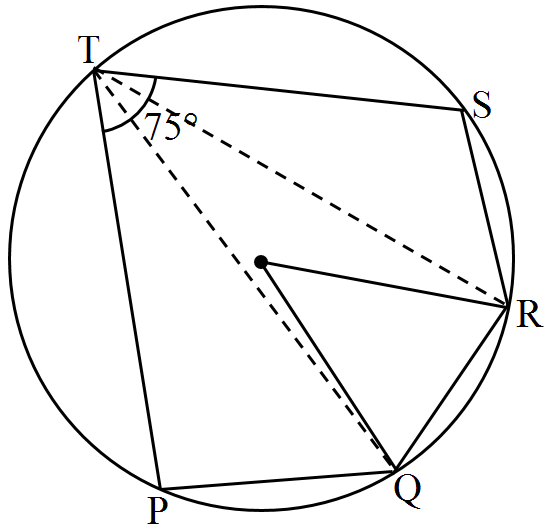
- A
$75^\circ$
- B
$25^\circ$
- ✓
$50^\circ$
- D
$20^\circ$
AnswerCorrect option: C. $50^\circ$
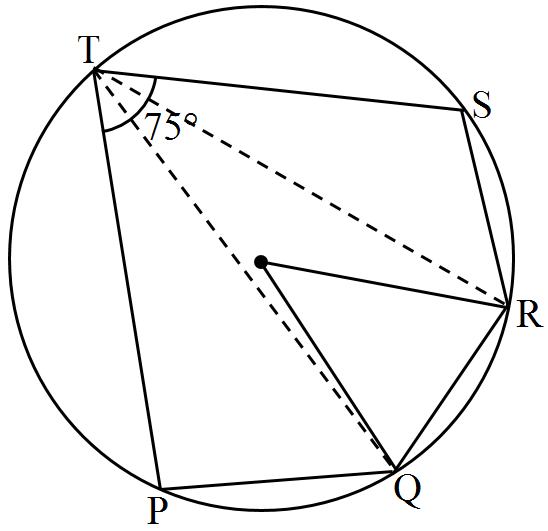
$\angle\text{PTS}=75^\circ$
Now $\angle\text{PTQ}=\angle\text{QTR}=\angle\text{RTS}$ (Equal chords would make equal angles at centre and thus equal angles at the circumference)
$\angle\text{QTR}=\frac{75^\circ}{3}=25^\circ$
So, $\angle\text{QOR}=25^\circ\times2=50^\circ$ View full question & answer→MCQ 411 Mark
In the give figure, $ABCD$ is a cyclic quadrilateral in which $BC = CD$ and $\angle\text{CBD}=35^\circ,$ Then, $\angle\text{BAD}=?$
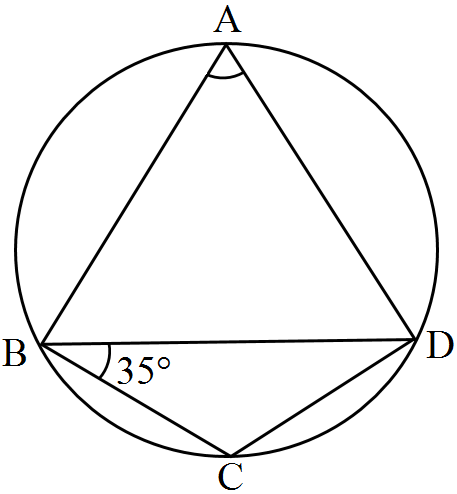
- ✓
$70^\circ$
- B
$90^\circ$
- C
$65^\circ$
- D
$110^\circ$
AnswerCorrect option: A. $70^\circ$
$BC = CD ($given$)$
$\Rightarrow\angle\text{BDC}=\angle\text{CBD}=35^\circ$
In $\triangle\text{BCD},$ we have:
$\angle\text{BCD}+\text{BDC}+\angle\text{CBD}=180^\circ ($Angle sum property of a triangle$)$
$\Rightarrow\angle\text{BCD}+35^\circ+35^\circ=180^\circ$
$\Rightarrow\angle\text{BCD}=(180^\circ-70^\circ)=110^\circ\Rightarrow\angle\text{BCD}=110^\circ$
In cyclic quadrilateral $ABCD,$ we have:
$\angle\text{BAD}+\angle\text{BCD}=180^\circ$
$\Rightarrow\angle\text{BAD}+110^\circ=180^\circ$
$\therefore\angle\text{BAD}=(180^\circ-110^\circ)=70^\circ$
$\Rightarrow\angle\text{BAD}=70^\circ$
View full question & answer→MCQ 421 Mark
In a circle with centre $O, AB$ and $CD$ are two diameters perpendicular to each other. The length of chord $AC$ is:
AnswerCorrect option: D. $\frac{1}{\sqrt{2}}\text{AB}$
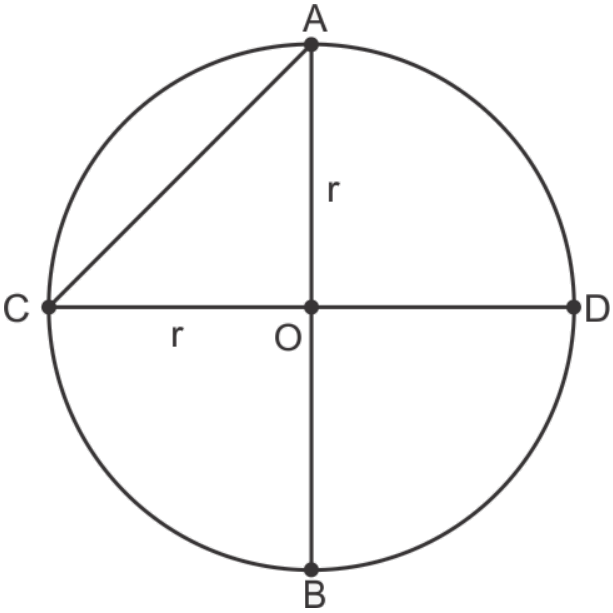
$OC = OA = r ($radius$)$
$AB =$ Diameter $= 2r$
$\text{AC}=\sqrt{(\text{OA})^2+(\text{OC})^2}$
$=\sqrt{\text{r}^2+\text{r}^2}$
$=\sqrt{2}\text{r}$
$=\sqrt{2}\Big(\frac{\text{AB}}2{}\Big)$
$\Rightarrow\text{AC}=\frac{1}{\sqrt2}\text{AB}$
View full question & answer→MCQ 431 Mark
The greatest chord of a circle is called its:
AnswerThe greatest chord of the circle is diameter of the circle.
View full question & answer→MCQ 441 Mark
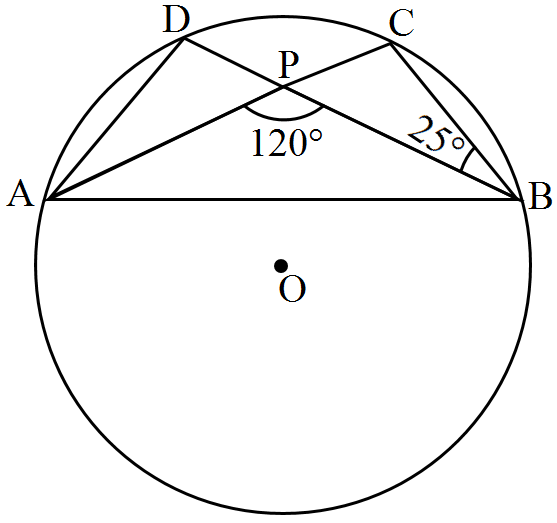
$O$ is the centre of the given circle. If $\angle\text{APB}=120^\circ$ and $\angle\text{DBC}=25^\circ,$ then the measure of $\angle\text{ADB}$ is equal to:
- A
$60^\circ$
- B
$120^\circ$
- ✓
$95^\circ$
- D
$100^\circ$
AnswerCorrect option: C. $95^\circ$
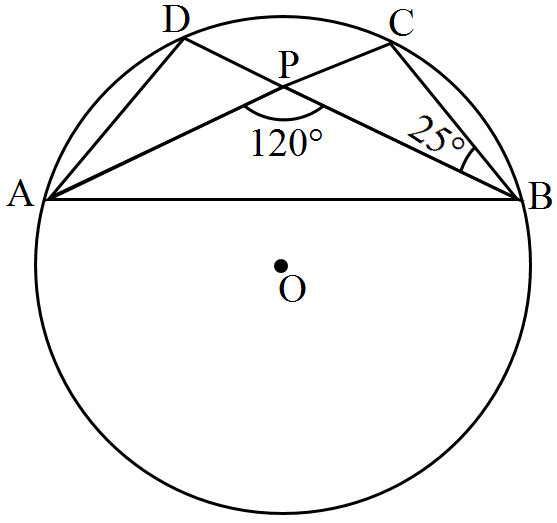
Now, $\angle\text{APB}+\angle\text{CPB}=180^\circ$ (Linear Pair)
$120^\circ+\angle\text{CPB}=180^\circ$
$\angle\text{CPB}=60^\circ$
Now from angle sum property, we can calculate the values of $\angle\text{CPB}$ and we find that $\angle\text{CPB}=95^\circ$
Since, $\angle\text{PCB}=\angle\text{ADB}=95^\circ$
View full question & answer→MCQ 451 Mark
In the given figure, $O$ is the centre of a circle and $\angle\text{ACB}=30^\circ.$ Then, $\angle\text{AOB}=?$
- A
$30^\circ$
- B
$15^\circ$
- ✓
$60^\circ$
- D
$90^\circ$
AnswerCorrect option: C. $60^\circ$
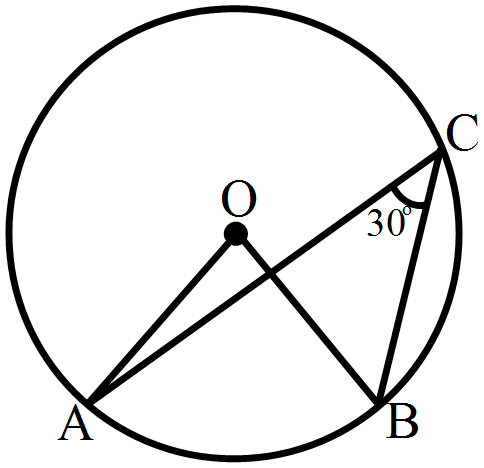
We know that, the angle subtended by an arc of a circle at the centre is double the angle subtended by it at any point on the remaining part of the circle.
So,
$\angle\text{AOB}=2\angle\text{ACB}$
$=2(30^\circ)$
$=60^\circ$
View full question & answer→MCQ 461 Mark
If two diameters of a circle intersect each other at right angles, then quadrilateral formed by joining their end points is a:
Answer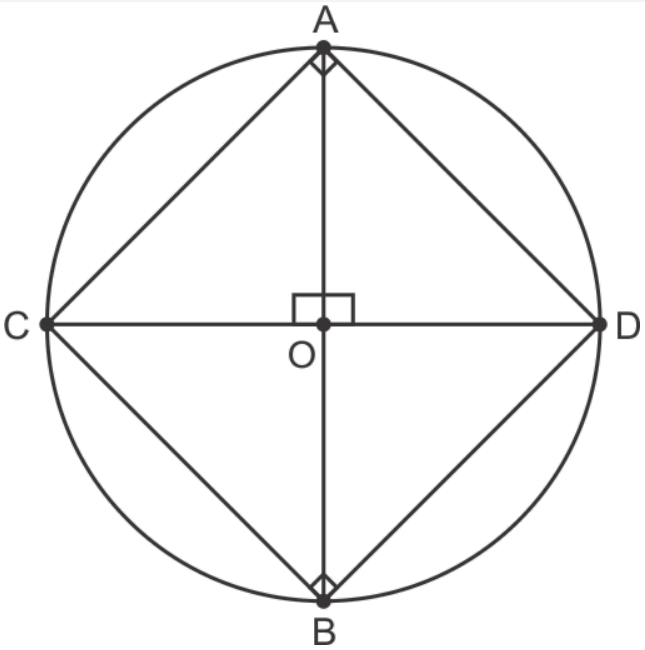
$AB$ and $CD$ are diameters of a circle and diameter makes $90^\circ$ at any point on circle.
$\Rightarrow\angle\text{CAD}=\angle\text{CBD}=\angle\text{BCA}=\angle\text{ADB}=90^\circ$
Also, diagonals $AB$ and $CD$ are perpendicular to each other.
Thus, $ABCD$ is a square.
View full question & answer→MCQ 471 Mark
$AOB$ is the diameter of the circle. If $\angle\text{AOE}=150^\circ,$ then the measure of $\angle\text{CBE}$ is: 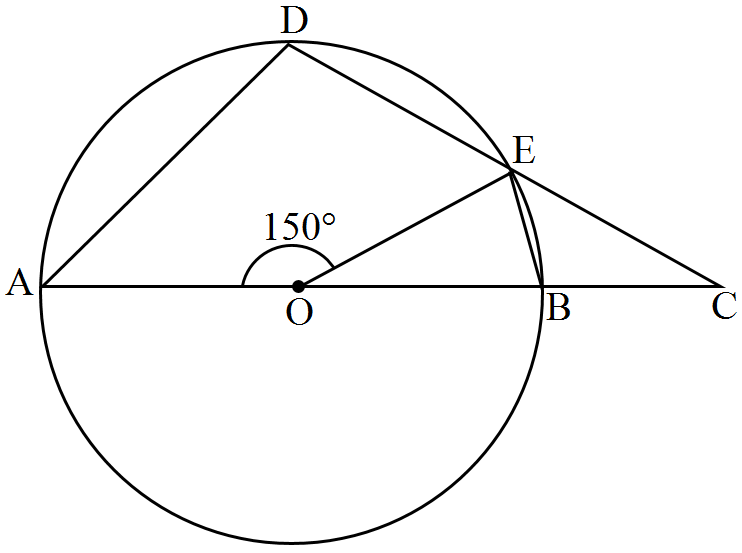
- A
$125^\circ$
- B
$120^\circ$
- ✓
$105^\circ$
- D
$115^\circ$
AnswerCorrect option: C. $105^\circ$
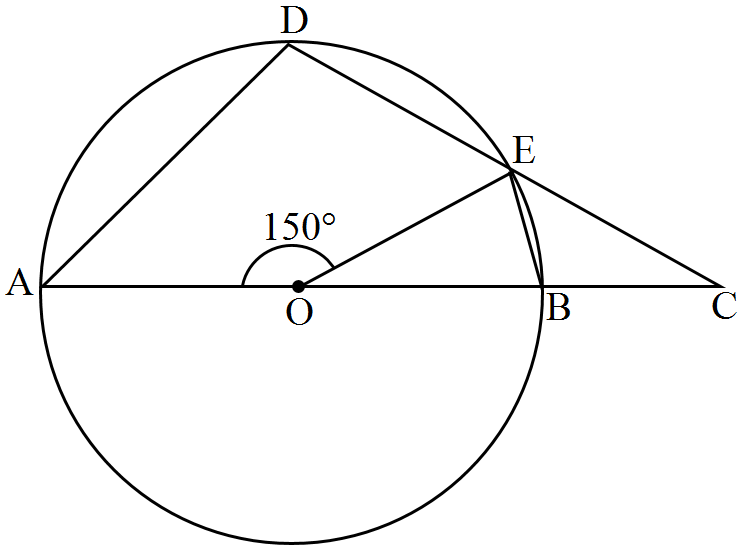
Here, $AOB$ is diameter,
So, $\angle\text{BOE}=180-150=30^\circ$ {Angles lie in straight line}
Now, $OE\ \&\ OB$ are radius so, $OE = OB$ .i.e $\angle\text{OEB}=\angle\text{OBE}$
In $\triangle\text{BOE},\angle\text{BOE}+\angle\text{OBE}+\angle\text{BEO}=180^\circ$
$=30+2\angle\text{OBE}=180^\circ$
$=2\angle\text{OBE}=180-30=150^\circ$
$=\angle\text{OBE}=75^\circ$
Now, $\angle\text{OBE}$ and $\angle\text{CBE}$ lie on staright line
so, $\angle\text{OBE}+\angle\text{CBE}=180^\circ$
$\angle\text{CBE}=180-75=105^\circ$ View full question & answer→MCQ 481 Mark
In the given figure, $O$ is the centre of a circle and $\angle\text{OAB}=50^\circ.$ Then, $\angle\text{CDA}=?$ 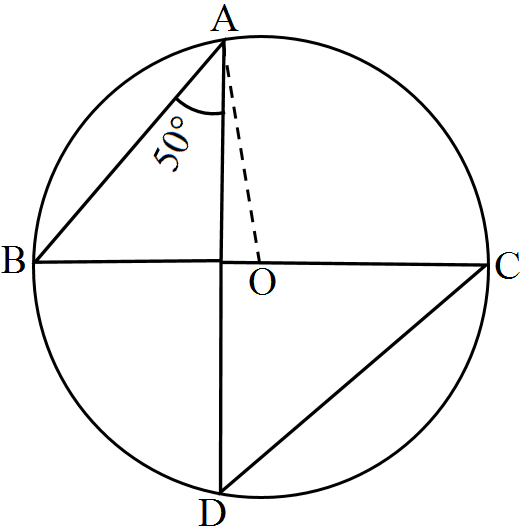
- ✓
$50^\circ$
- B
$40^\circ $
- C
$25^\circ$
- D
$75^\circ$
AnswerCorrect option: A. $50^\circ$
We have:
$OA = OB ($Radii of a circle$)$
$\Rightarrow\angle\text{OBA}=\angle\text{OAB}=50^\circ$
$\therefore\angle\text{CDA}=\angle\text{OBA}=50^\circ$ (Angles in the same segment of a circle)
$\Rightarrow\angle\text{CDA}=50^\circ$
View full question & answer→MCQ 491 Mark
If $AB, BC$ and $CD$ are equal chords of a circle with $O$ as centre and $AD$ diameter, than $\angle\text{AOB} =$
- ✓
$60^\circ$
- B
$90^\circ$
- C
$120^\circ$
- D
AnswerCorrect option: A. $60^\circ$
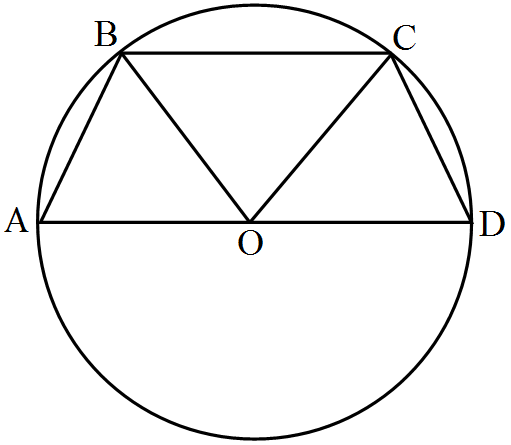
Chord $AB =$ Chord $BC = $ Chord $CD$
$\Rightarrow\angle\text{AOB}=\angle\text{BOC}=\angle\text{COD}$ (equal chords subtend equal angles at the center)
Now, $\angle\text{AOB}+\angle\text{BOC}+\angle\text{COD}=180^\circ$
$\Rightarrow\angle\text{AOB}+\angle\text{AOB}+\angle\text{AOB}=180^\circ$
$\Rightarrow3\angle\text{AOB}=180^\circ$
$\Rightarrow\angle\text{AOB}=60^\circ$
View full question & answer→MCQ 501 Mark
In the given figure, $O$ is the centre of a circle. If $\angle\text{AOB}=100^\circ$ and $\angle\text{AOC}=90^\circ$ then $\angle\text{BAC}=?$
- ✓
$85^\circ$
- B
$80^\circ$
- C
$95^\circ$
- D
$75^\circ$
AnswerCorrect option: A. $85^\circ$
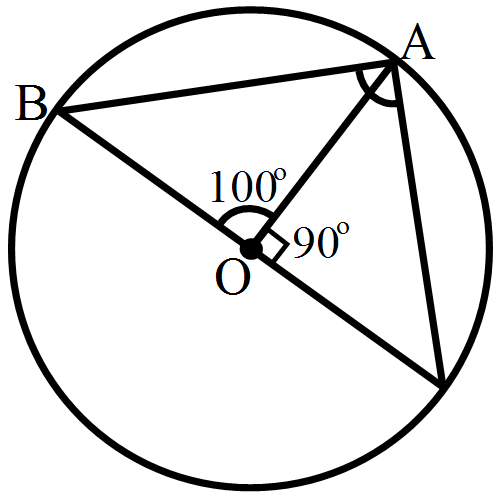
$\angle\text{BOA}+\angle\text{AOC}+\angle\text{BOC}=360^\circ [$Angles around a point are $360^\circ ]$
$\Rightarrow\ 100^\circ+90^\circ+\angle\text{BOC}=360^\circ$
$\Rightarrow\ \angle\text{BOC}=170^\circ$
Now,
$\angle\text{BAC}=\frac{1}{2}(\angle\text{BOC})=\frac{1}{2}(170^\circ)=85^\circ$ View full question & answer→