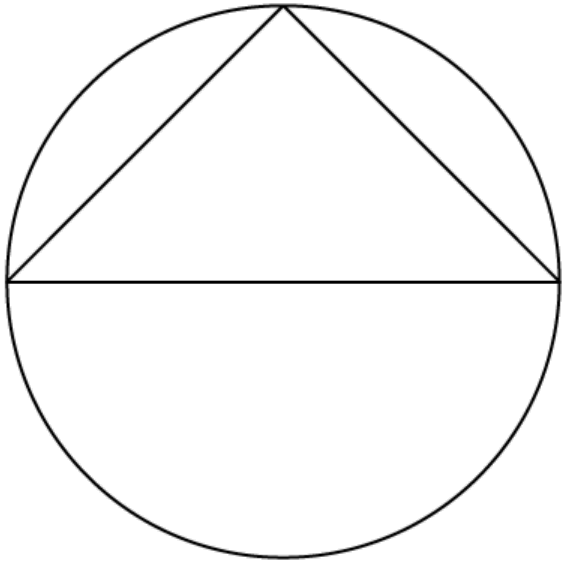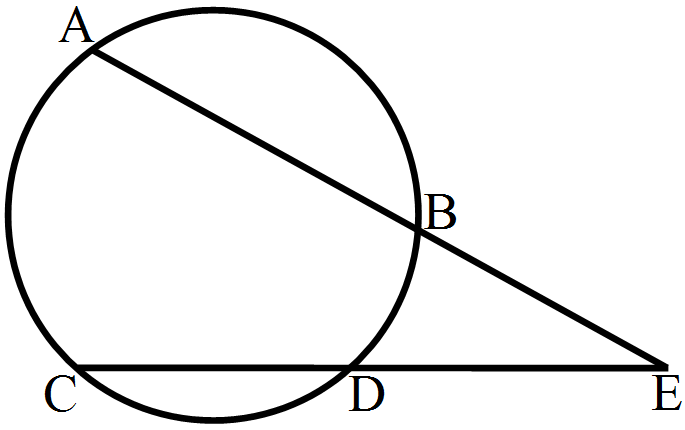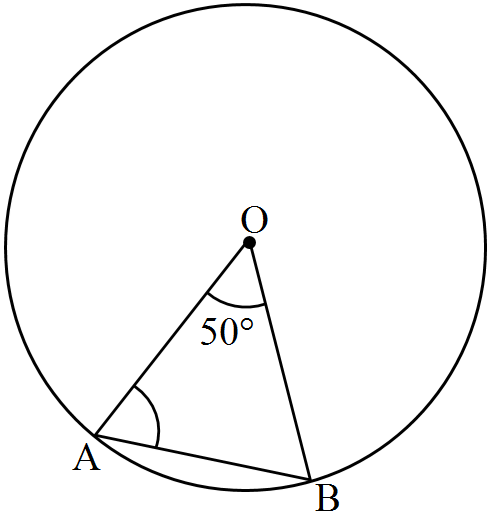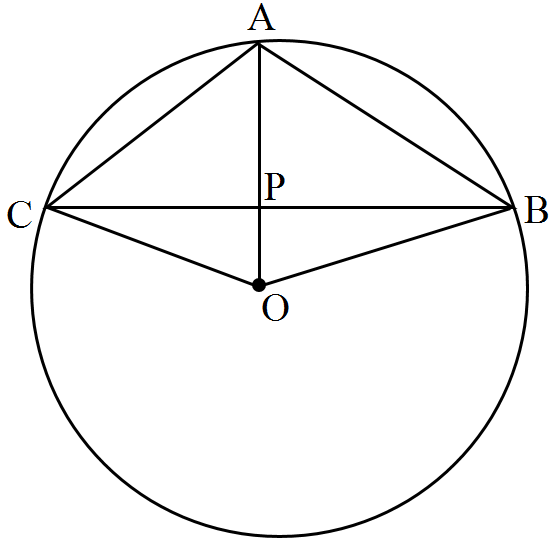
- A$r^2$
- B$3r$
- C$r$
- ✓$2r$
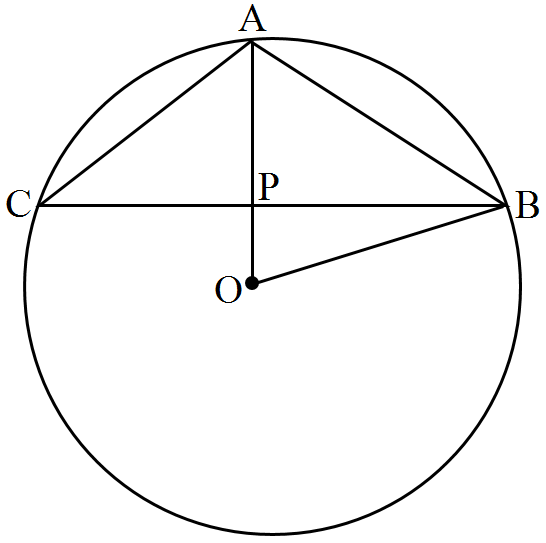
Since the angle subtended by the diameter or the semicircle is a right angle, therefore the $AB$ is nothing but the diameter. Hence, it is equal to $2r, r$ being the radius.


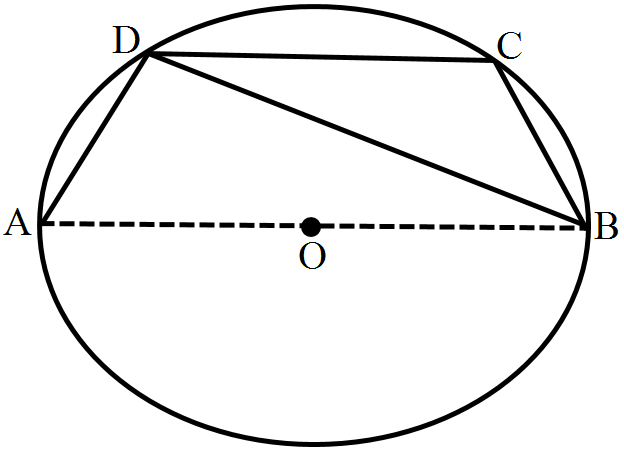
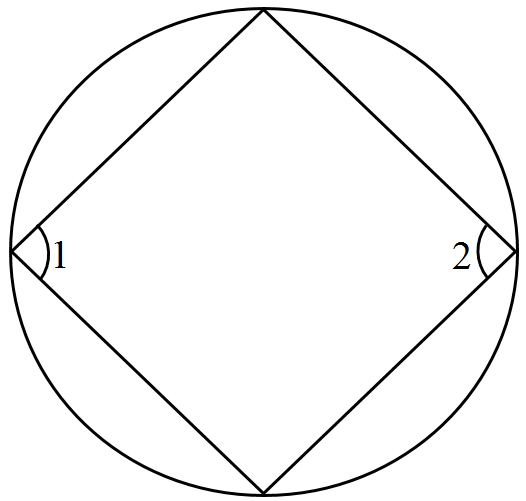
As per theorem,
he sum of either pair of opposite angles of a cyclic quadrilateral is $180^\circ .$
Here, $\angle1+\angle2=180^\circ$


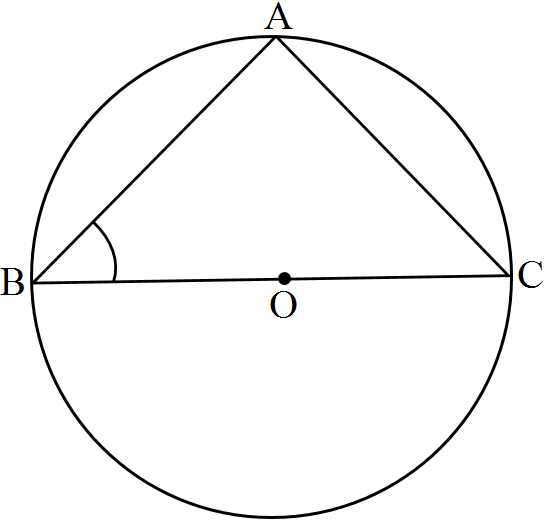
Since an angle in a semicircle is a right angle, $\angle\text{BAC}=90^\circ$
$\therefore\angle\text{ABC}+\angle\text{ACB}=90^\circ ....(\text{i})$
Now, $AB = AC ($Given$)$
$\Rightarrow\angle\text{ABC}=\angle\text{ACB}=45^\circ\ ....(\text{ii})$
$\Rightarrow\angle\text{ABC}+\angle\text{ABC}=90^\circ [$From $(i)$ and $(ii)]$
$\Rightarrow2\angle\text{ABC}=90$
$\Rightarrow\angle\text{ABC}=45^\circ$
Angle inscribed in a semicircle is a right angle. Its a given theorem.


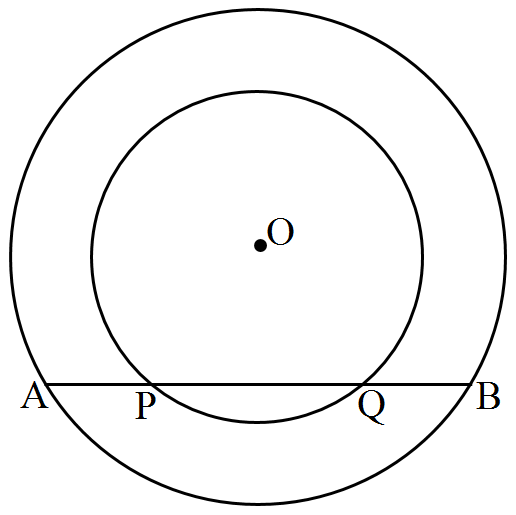
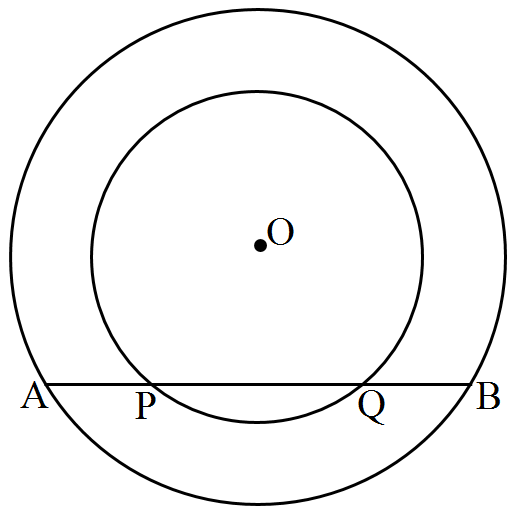
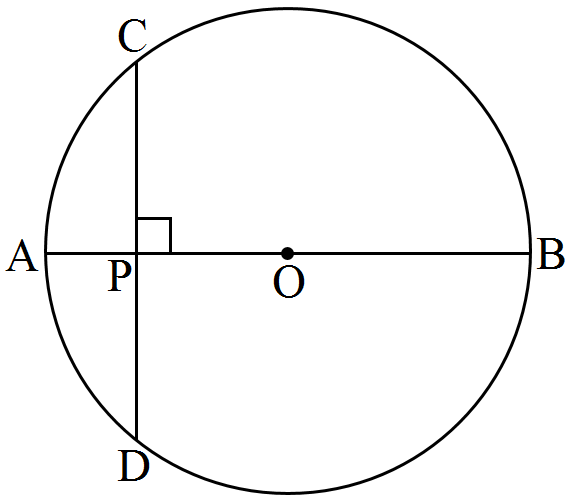
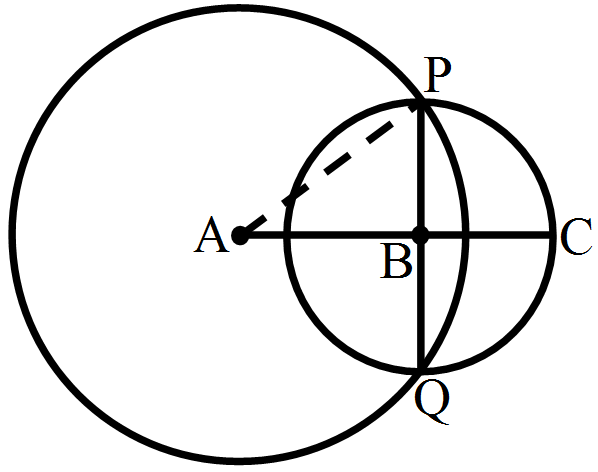
Let $OD$ is perpendicular to $AB.$ Then $AD = DB.$
Also $DP = DQ$
Therefore, $AP = AD - PD$
$= BD - DQ$
$= BQ$
Hence, $AP = BQ$

Angles in a semi-circle measure $90^\circ .$
$\therefore\angle\text{BAC}=90^\circ$
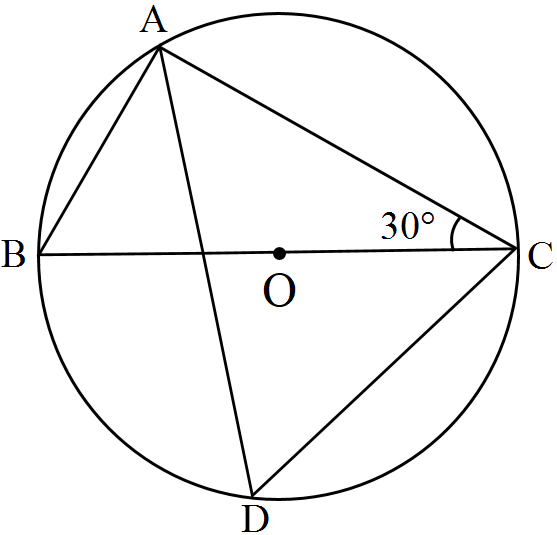
In $\triangle\text{ABC},$ we have:
$\angle\text{BAC}+\angle\text{ABC}+\angle\text{BCA}=180^\circ$ (Angle sum property of a triangle)
$\therefore90^\circ+\angle\text{ABC}+30^\circ=180^\circ$
$\Rightarrow\angle\text{ABC}=(180^\circ-120^\circ)=60^\circ$
$\therefore\angle\text{CDA}=\angle\text{ABC}=60^\circ$ (Angles in the same segment of a circle)
$\Rightarrow\angle\text{CDA}=60^\circ$


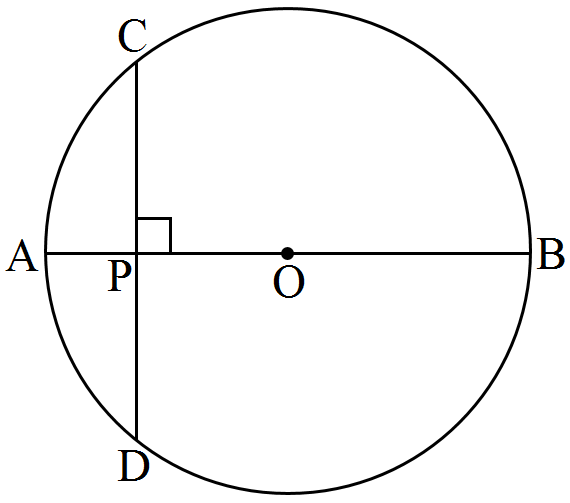
Join $A C, B C$. Let $C D=2 x$. Then $C P=x$
Now, in triangle $A C P$,
$\Rightarrow A C^2=A P^2+P C^2$
$\Rightarrow A C^2=4^2+x^2 ....(1)$
And $B C 2=C P^2+B P^2$
$\Rightarrow B C^2=x^2+16^2...(2)$
Again, in triangle $A B C$,
$\Rightarrow A B^2=B C^2+A C^2$
$\Rightarrow 20^2=x^2+4^2+x^2+16^2$
$\Rightarrow 400=2 x^2+16+256$
$\Rightarrow 128=2 x^2$
$\Rightarrow x^2=64$
$\Rightarrow x=8 \mathrm{~cm}$
$\Rightarrow 2 x=16 \mathrm{~cm}$
$C D=16 \mathrm{~cm}$


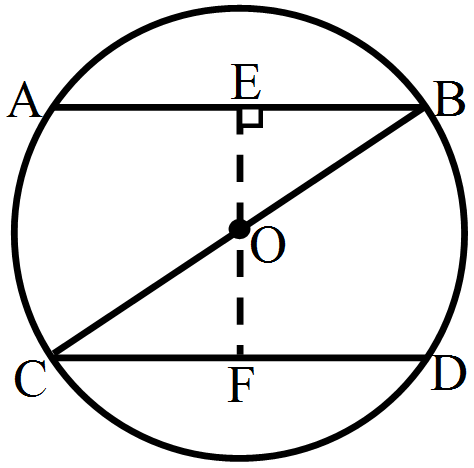
In $\triangle\text{BEO}$ and $\triangle\text{CFO},$
$OB = OC [$Radii of the same circle$]$
$\angle\text{OBE}=\angle\text{OCF} [$Alternate angles since $AB || CD]$
$\angle\text{BOE}=\angle\text{COF} [$Vertically angles$]$
$\Rightarrow\ \triangle\text{BEO}\cong\triangle\text{CFO} [ASA$ congruence criterion$]$
$⇒ OE = OF [C.P.C.T.]$
Since chord are equidistant from the centre are equal, $AB = CD = 10\ cm.$

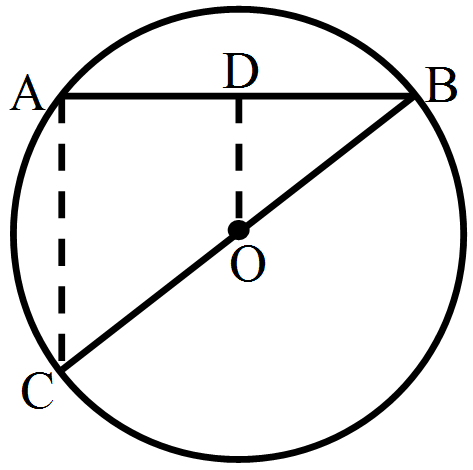
In $\triangle\text{BOD}$ and $\triangle\text{CAB},$
Since BOC is the diameter, $\angle\text{CAB}=90^\circ.$
Also, $\angle\text{ODB}=90^\circ.$
So, $\angle\text{DBO}=\angle\text{ABC} [$Common angles$]$
$\Rightarrow\ \triangle\text{BOD}\sim\triangle\text{BCA} [AA $ congruence criterion$]$
$\Rightarrow\ \frac{\text{OD}}{\text{CA}}=\frac{\text{BO}}{\text{BA}}$
$\Rightarrow\ \frac{\text{OD}}{\text{CA}}=\frac{1}{2} [$Since radius $= 2$ diameter$]$
$\Rightarrow\ \frac{6}{\text{CA}}=\frac{1}{2}$
$⇒ CA = 12\ cm$ that is, $AC = 12\ cm.$


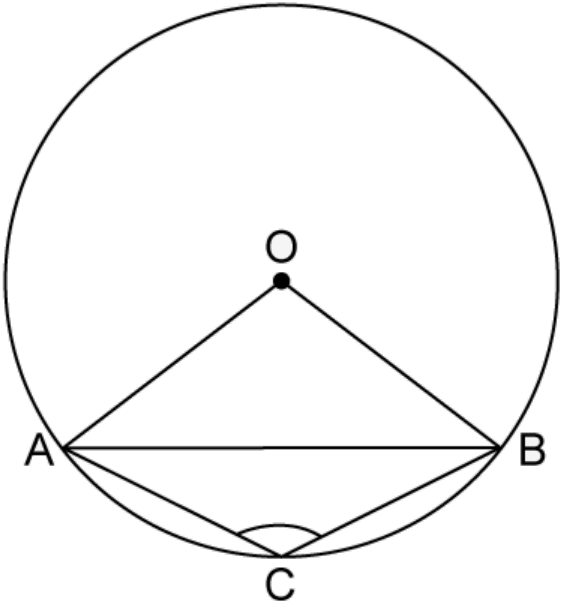
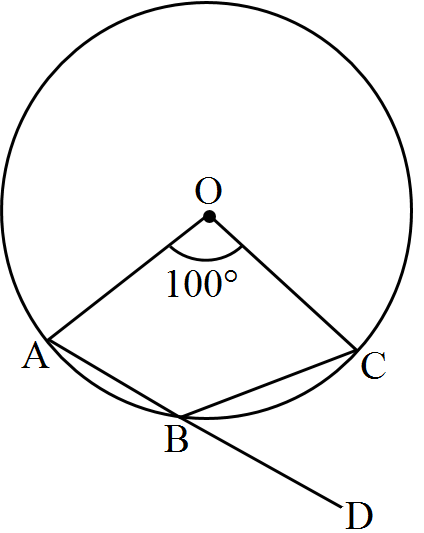
Take a point $E$ on the remaining part of the circumference.
Join $AE$ and $CE.$
Then, $\angle\text{AEC}=\frac{1}{2}\angle\text{AOC}=(\frac{1}{2}\times100^\circ)=50^\circ$
Now, side $AB$ of the cyclic quadrilateral $ABCE$ has been produced to $D.$
$\therefore$ Exterior $\angle\text{CBD}=\angle\text{AEC}=50^\circ$
$\Rightarrow\angle\text{CBD}=50^\circ$

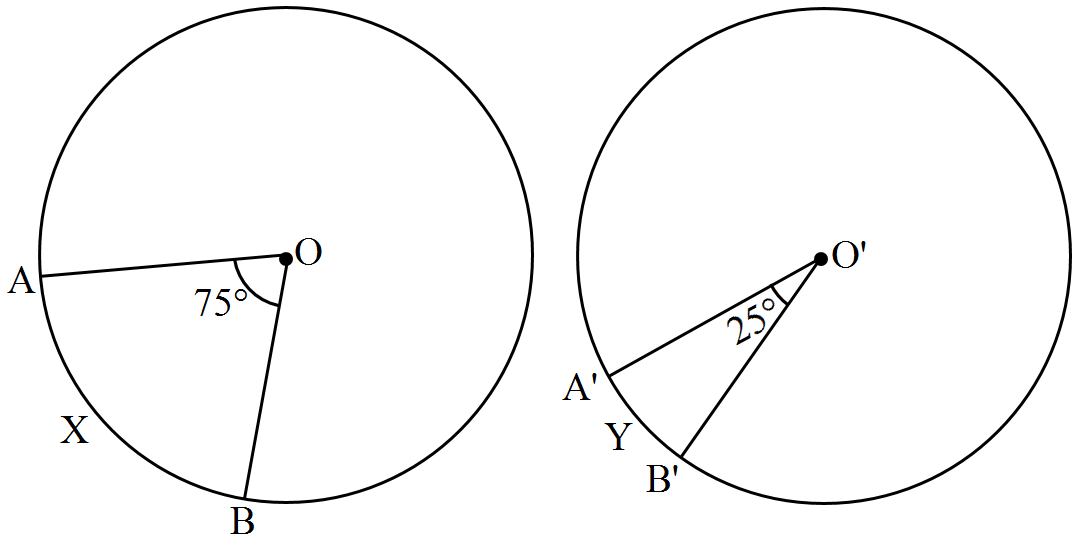
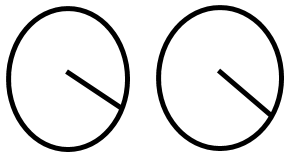
Since, circles are congruent thus we can consider the two arcs as in the same circle. Now the length of the arcs is directly proportional the angle subtended by the arcs. Therefore the lengths of the given arcs would be same in ratio as the ratio of the given angles.
Hence the required ratio is $\frac{75}{25}=\frac{3}{1}.$

Three non-collinear points make a triangle and there is only one circle that can pass through all three points,
i.e. circumcircle of that triangle.

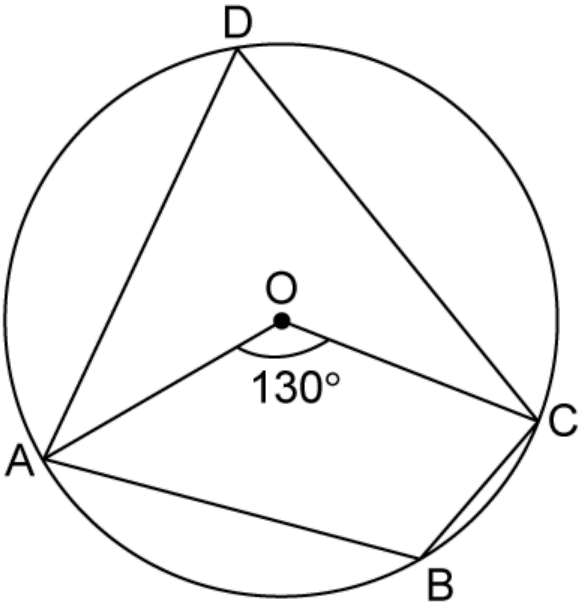
$\angle\text{ADC}=\frac{1}{2}\angle\text{AOC}$
$\big\{\angle\text{ADC}$ and $\angle\text{AOC}$ are made by same $\widehat{\text{AC}}$ on centre and cricumference$\big\}$
$\Rightarrow\angle\text{ADC}=\frac{1}{2}\times130^\circ=65^\circ$
$ADCB$ is a cyclic Quadrilateral.
$\Rightarrow\angle\text{D}+\angle\text{B}=180^\circ$
$\Rightarrow\angle\text{ABC}=180^\circ-65^\circ=115^\circ$


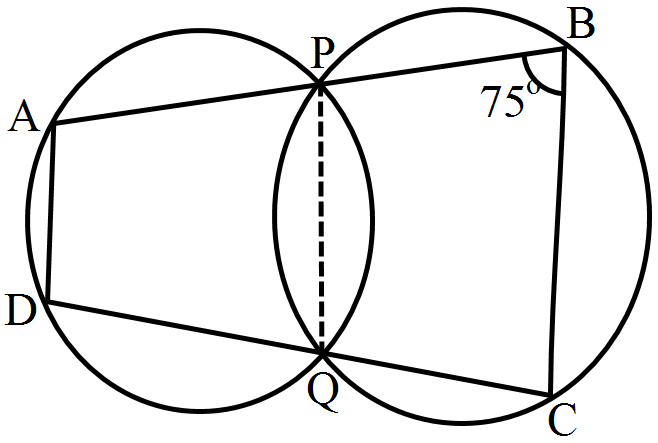
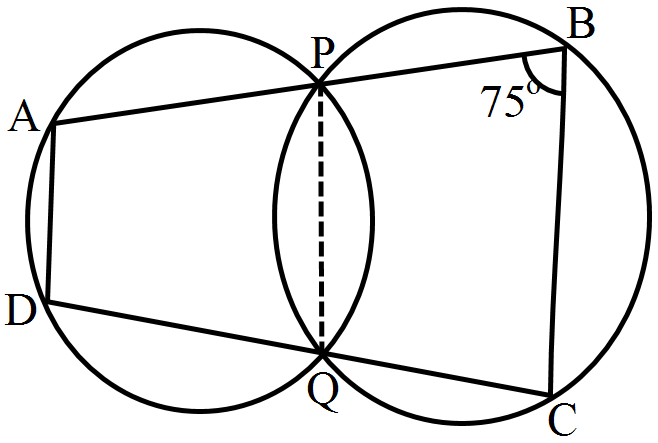
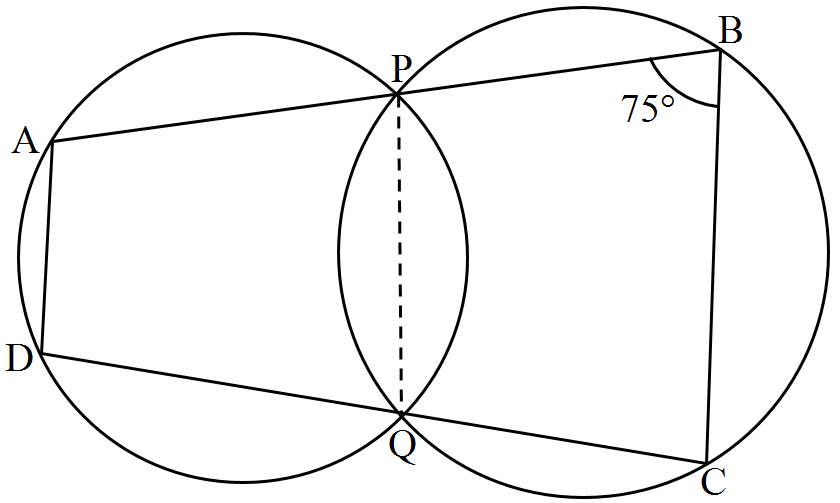
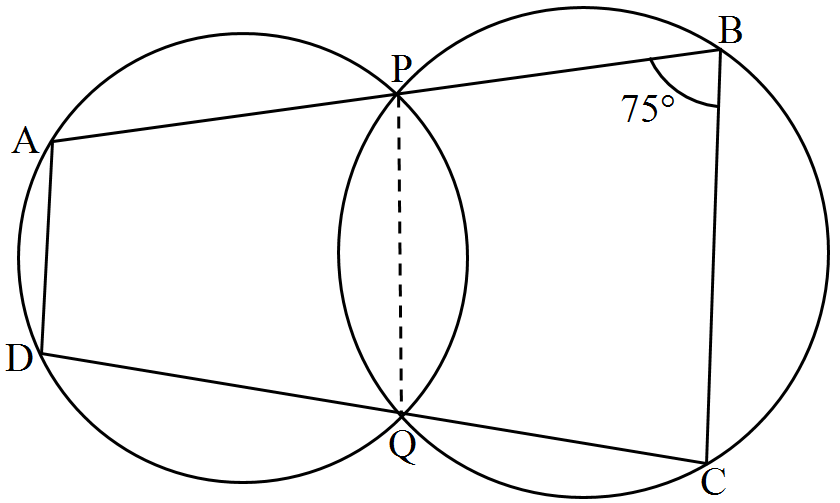
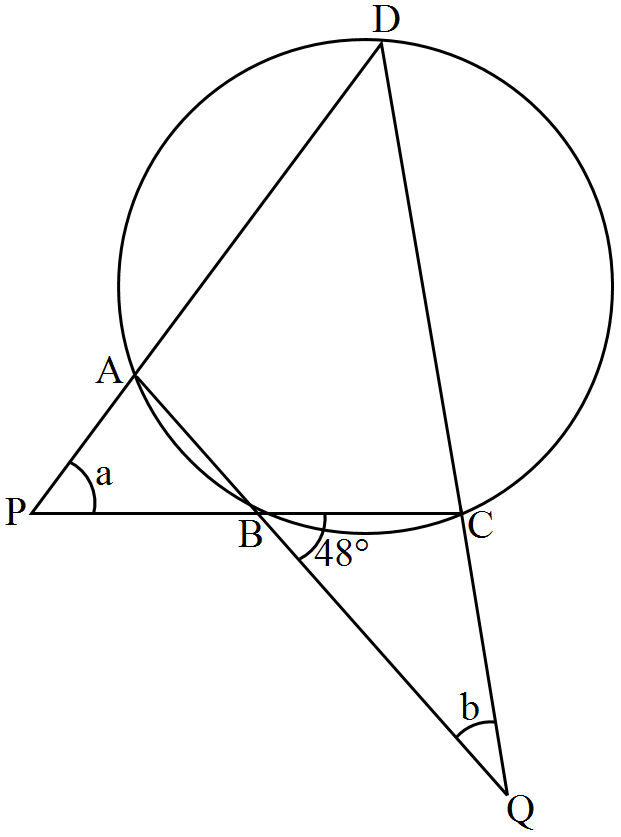
Since $\angle\text{PQC}+\angle\text{PBC}=180^\circ$ (Opposite angles of a cyclic quadrilateral)
$\angle\text{PQC}=180^\circ-75^\circ=105^\circ$
Again, $\angle\text{DQP}+\angle\text{PQC}=180^\circ$ (Linear Pair)
So, $\angle\text{DQP}=75^\circ$
Also, $\angle\text{PAD}+\angle\text{DQP}=180^\circ$ (Opposite angles of a cyclic quadrilateral)
$\angle\text{PAD}=105^\circ$

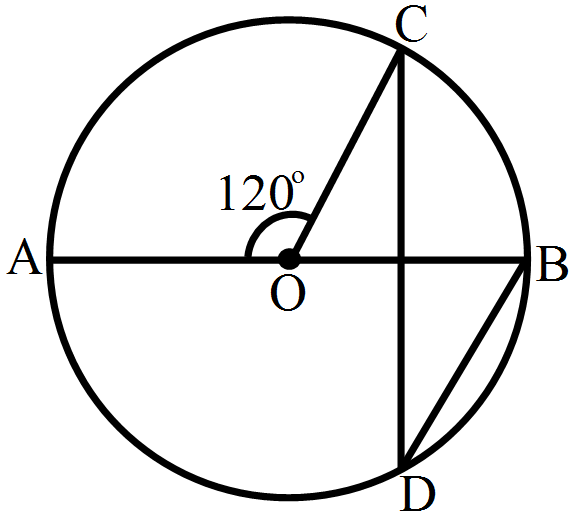
Since $BOA$ is a diameter.
$\angle\text{AOC}+\angle\text{BOC}=180^\circ$
$\Rightarrow\ 120^\circ+\angle\text{BOC}=180^\circ$
$\Rightarrow\ \angle\text{BOC}=60^\circ$
So, $\angle\text{BDC}=\frac{1}{2}\angle\text{BOC}=\frac{1}{2}(60^\circ)=30^\circ$


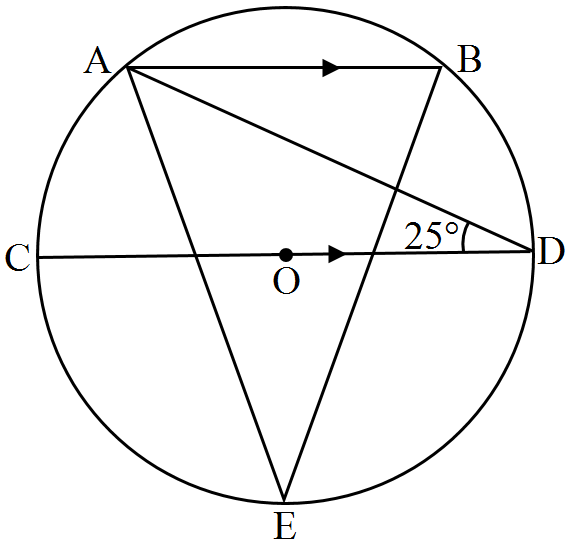
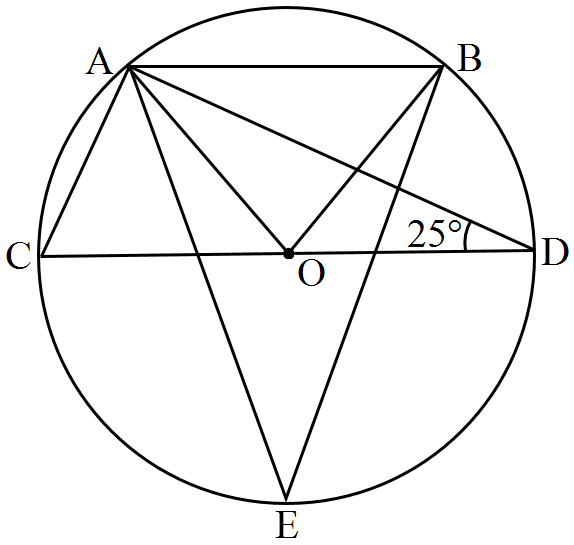
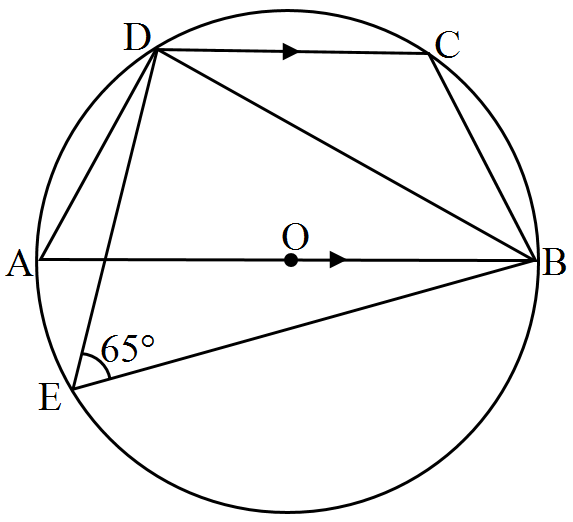
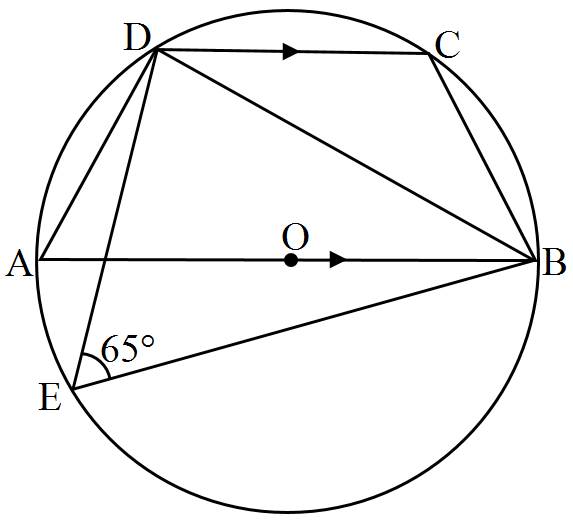
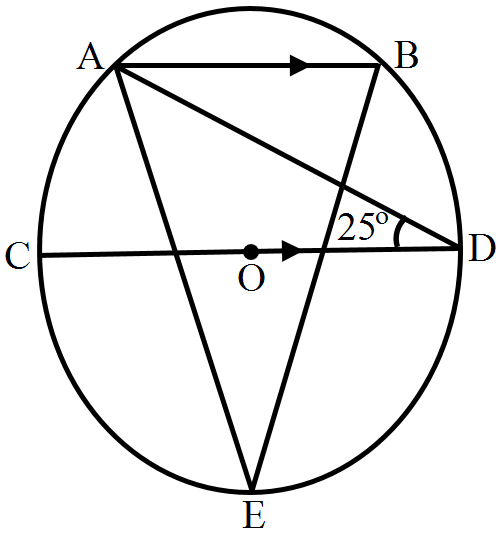
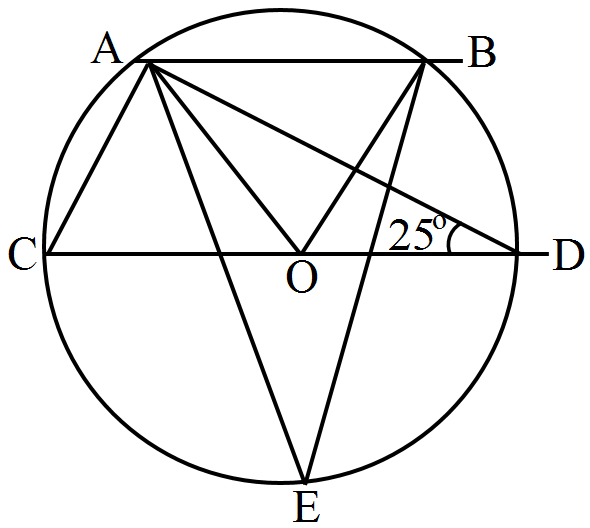
Here, $AB ||\ || CD$ and $\angle\text{ADC}=25^\circ$
So, $\angle\text{DAB}=25^\circ$ (opposite interior angles are equal)
Now, $\angle\text{ADC}=25^\circ,$ so, $\angle\text{AOC}=50^\circ$ (Angle subtended by arc $AC$ at centre is twice the angle subtended at circumference)
Similarly, $\angle\text{DAB}=25^\circ,$ So, $\angle\text{DOB}=50^\circ$(Angle subtended by arc $BD$ at centre is twice the angle subtended at circumference)
$\angle\text{AOB}+\angle\text{DOB}+\angle\text{AOC}=180^\circ$ (All lie in straight line)
$\angle\text{AOB}=180-50=80^\circ$
Now, $\angle\text{AEB}=40^\circ$ (Angle subtended by arc $AB$ at centre is twice the angle subtended at circumference)


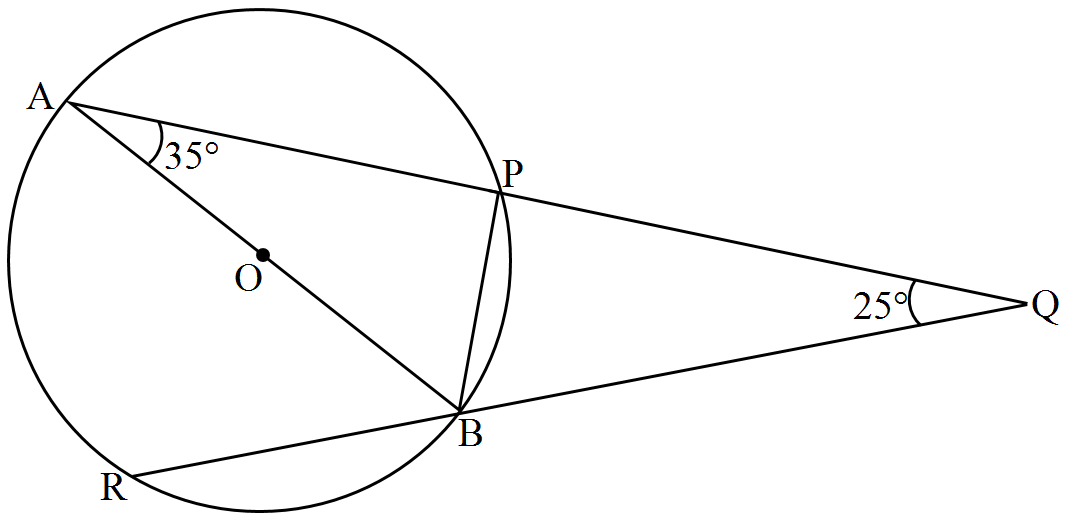
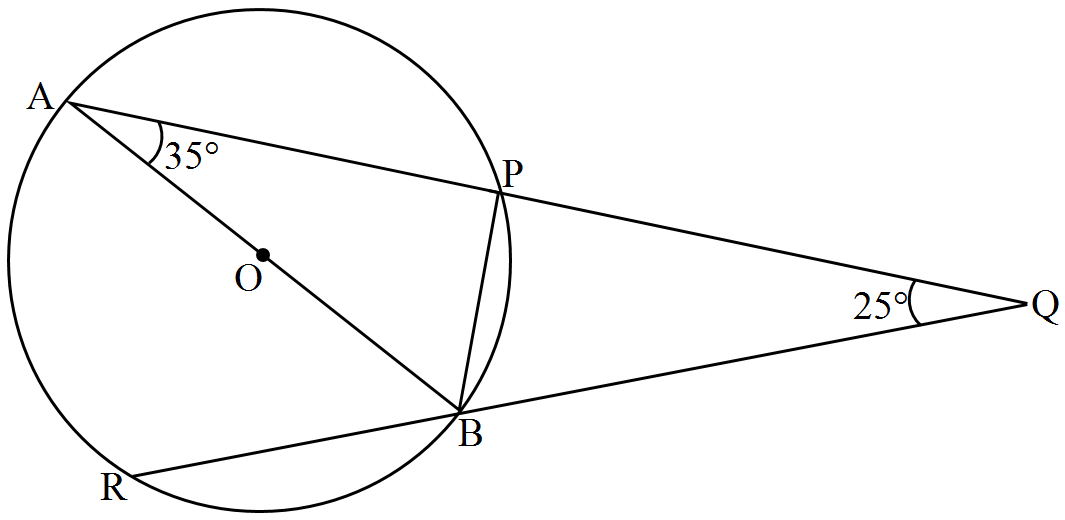
$\angle\text{APB}=\angle\text{BPQ}=90^\circ$
Now,
In $\triangle\text{APB},$
$\angle\text{BAP}+\angle\text{APB}+\angle\text{ABP}=180^\circ$
$35^\circ+90^\circ+\angle\text{ABP}=180^\circ$
$\angle\text{ABP}=55^\circ$
Again,
In $\triangle\text{BPQ}$
$\Rightarrow\angle\text{BPQ}+\angle\text{PQB}+\angle\text{PBQ}=180^\circ$
$\Rightarrow90^\circ+25^\circ+\angle\text{PBQ}=180^\circ$
$\Rightarrow\angle\text{PBQ}=65^\circ$
Since, RBQ is a straight line,
$\angle\text{RBA}+\angle\text{ABP}+\angle\text{PBQ}=180^\circ$
$\angle\text{RBA}+55^\circ+65^\circ=180^\circ$
$\angle\text{RBA}=60^\circ$
Finally,
$\angle\text{PBR}=\angle\text{ABP}+\angle\text{RBA}$
$=55^\circ+60^\circ=115^\circ$


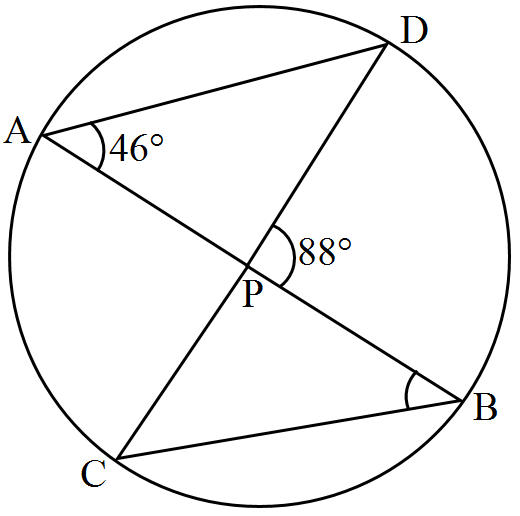
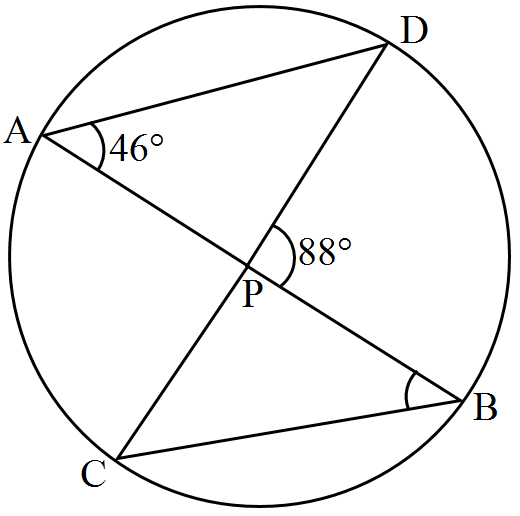
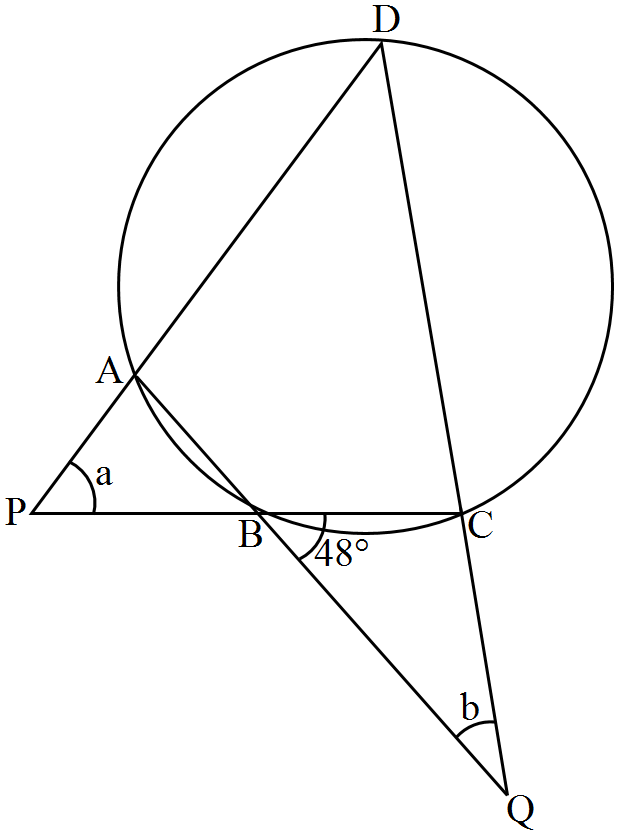
$\angle\text{PCB}=46^\circ ($Angles of same arc$)$
$\angle\text{CPB}=180^\circ-88^\circ=92^\circ ($Linear Pair$)$
So, $\angle\text{PBC}=180^\circ-46^\circ-92^\circ=42^\circ ($Using angle sum property in triangle $PCB)$
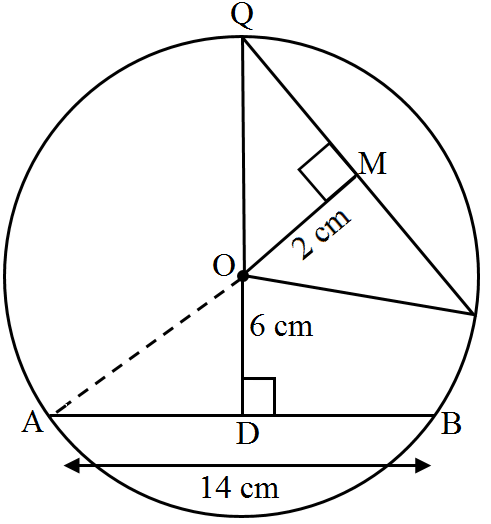
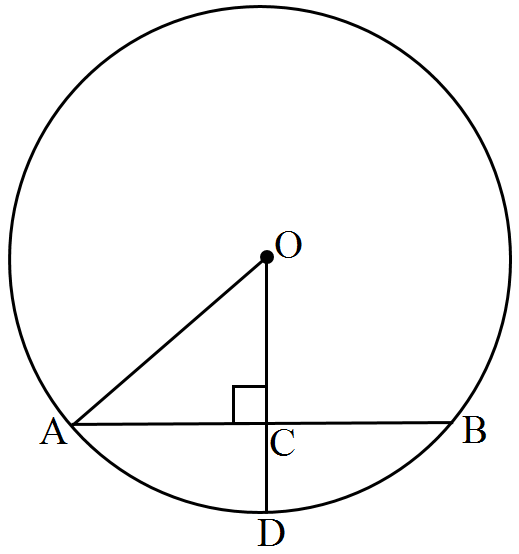
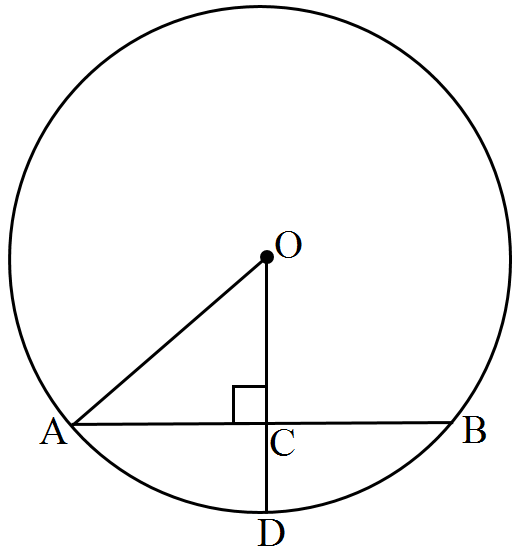
We are given the chord of length $14\ cm$ and perpendicular distance from the centre to the chord is $6\ cm.$ We are asked to find the length of another chord at a distance of $2\ cm$ from the centre.
We have the following figure

We are given $AB = 14\ cm, OD = 6\ cm, MO = 2\ cm, PQ = ?$
Since, perpendicular from centre to the chord divide the chord into two equal parts
Therefore
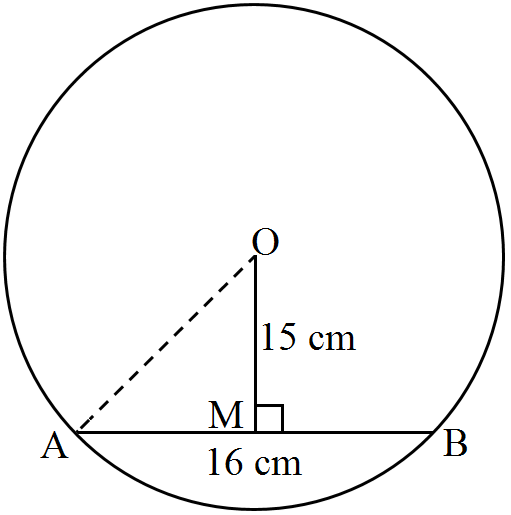
$A O^2=A D^2+O D^2 \text { [using paythagoras theorem] }$
$=7^2+6^2$
$=49+36$
$\mathrm{AO}=\sqrt{85}$
Now consider the $\triangle O P Q$ in which $O M=2 \mathrm{~cm}$
So using Pythagoras theorem in $\triangle \mathrm{OPM}$
$P M^2=O P^2-O M^2$
$=(\sqrt{85})^2-2^2(\because O P=A O=\text { radius })$
$P M^2=81$
$P M=9 \mathrm{~cm}$
Hence $P Q=2 P M$
$=2 \times 9$
$P Q=18 \mathrm{~cm}$


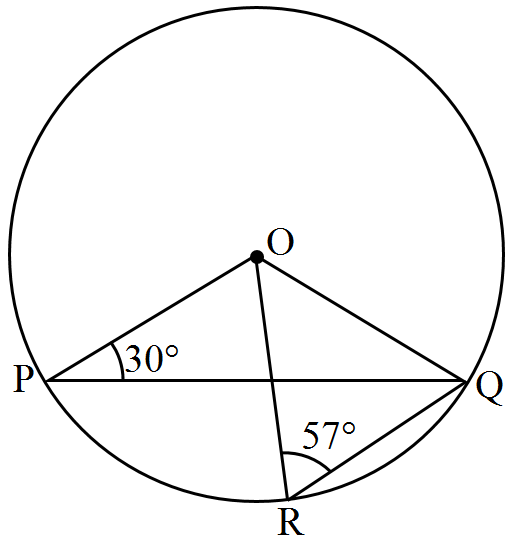
$\angle\text{OPQ}=\angle\text{OQP}=30^\circ ($Angles of isosceles triangle $OPQ)$
Also, in triangle $OPQ,$
$\angle\text{O}+\angle\text{P}+\angle\text{Q}=180^\circ$
$\angle\text{O}=30^\circ+30^\circ=180^\circ$
$\angle\text{O}=180^\circ-60^\circ=120^\circ$
So, $\angle\text{POQ}=120^\circ\ ...(\text{i})$
Again, in triangle $ORQ$
$\angle\text{R}=\angle\text{Q}=57^\circ$
And $\angle\text{O}+\angle\text{R}+\angle\text{Q}=180^\circ$
$\angle\text{O}+57^\circ+57^\circ=180^\circ$
$\angle\text{O}+180^\circ-114^\circ=66^\circ$
So, $\angle\text{ROQ}=66^\circ\ ...(\text{ii})$
From$(1)$ and $(2)$, we get :-
$\angle\text{POR}=\angle\text{POQ}-\angle\text{ROQ}$
$\Rightarrow\angle\text{POR}=120^\circ-66^\circ=54^\circ$

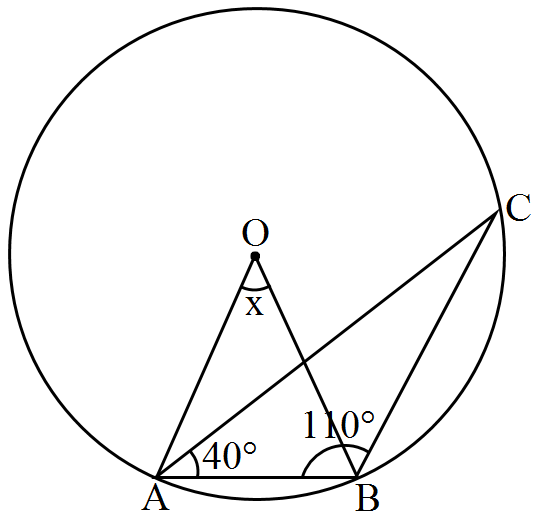
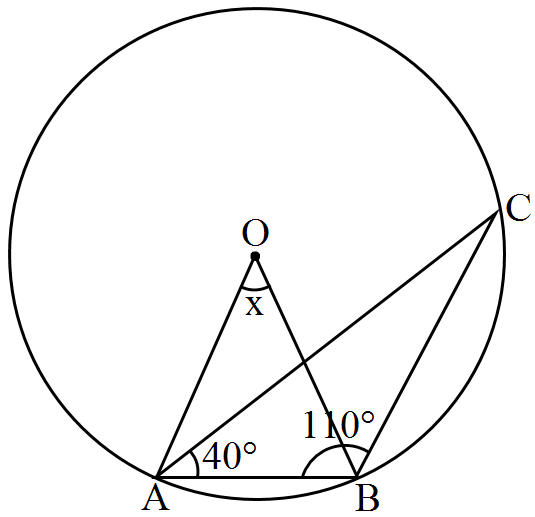
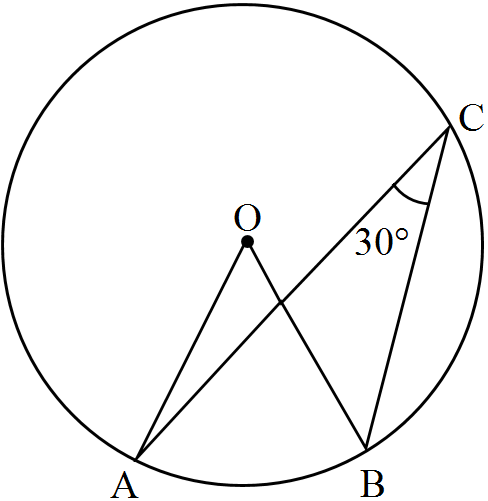
We know that the angle at the centre of a circle is twice the angle at any point on the remaining part of the circumference. Angles $\angle\text{AOB}$ and $\angle\text{ACB}$ are on the same arc $AB.$
Thus, $\angle\text{AOB}=(2\times\angle\text{ACB})=(2\times30^\circ)=60^\circ$

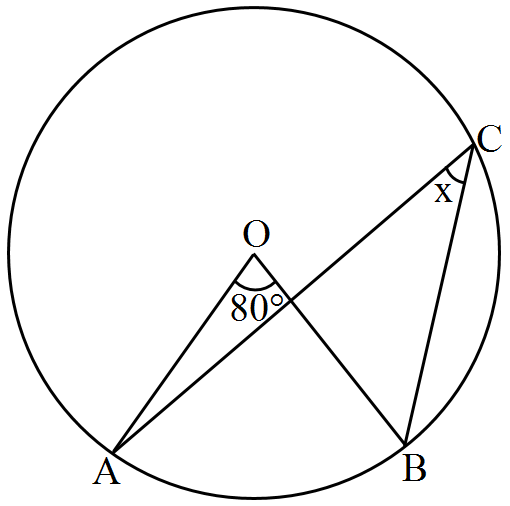
Angle made by a chord at the centre is twice the angle made by it on any point on the circumference.
$\text{x}=\frac{\angle\text{AOB}}{2}=\frac{80^\circ}{2}=40^\circ$


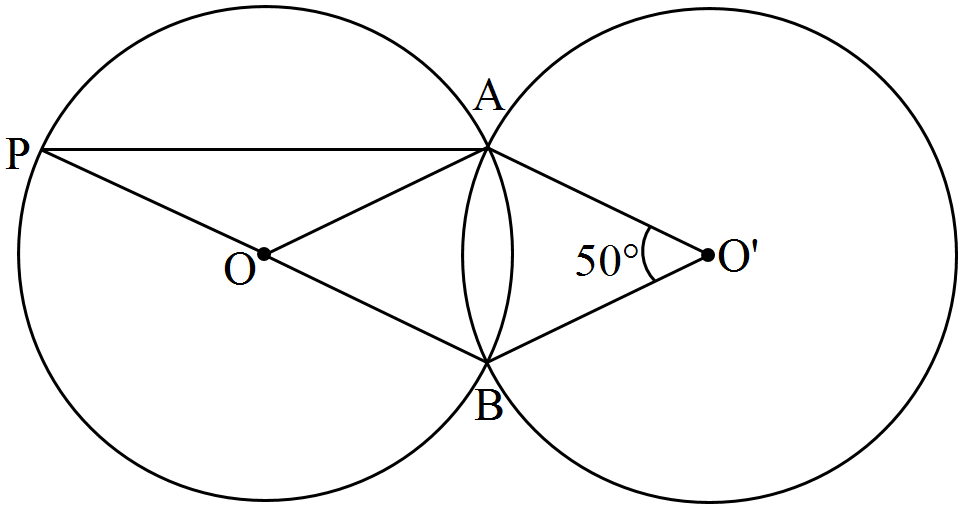
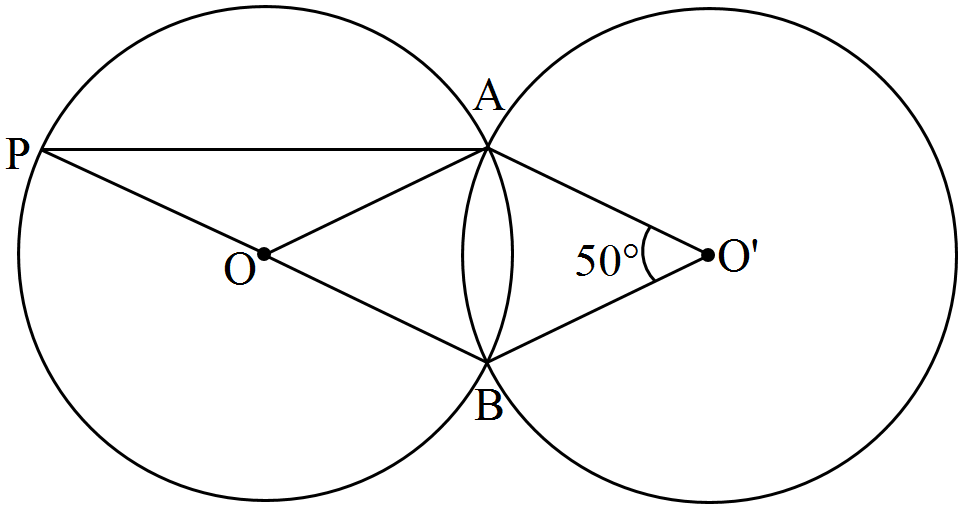
Since both the triangles are congruent,
So, $OA = O'A,$
$OB = O'B$
$AB = AB ($Common$)$
Hence, $\triangle\text{AOB}\cong\triangle\text{AO}'\text{B}$
Thus, $\angle\text{AOB}=\angle\text{AO}'\text{B}=50^\circ$
Since, PB is a straight line, therefore:-
$\angle\text{AOP}+\angle\text{AOB}=180^\circ$
$\Rightarrow\angle\text{AOP}=180^\circ-50^\circ=130^\circ$
Again, In triangle $OPA,$
$\Rightarrow\angle\text{P}=\angle\text{A}$
$\Rightarrow\angle\text{A}+\angle\text{P}+\angle\text{O}=180^\circ$
$\Rightarrow2\angle\text{P}+130^\circ=180^\circ$
$\Rightarrow\angle\text{P}=\frac{50^\circ}{2}=25^\circ$
Thus, $\angle\text{OPA}=25^\circ$
A chord is a line formed by any two points on a circle.


Here $AC$ is side of hexagon, so it will subtend $60^\circ $ angle at centre and also sides & radius are equal.
Thus, $AC = OC = OA$ and $\angle\text{COA}=\angle\text{OAC}=\angle\text{ACO}=60^\circ$
AB is side of pentagon, so it would subtend angle of $\frac{360}{5}=72^\circ$ angle at centre.
So, $\angle\text{BOP}=72^\circ$
So, $\angle\text{COB}=72+60=132^\circ$
Also since, $\text{OC},\text{OB},\angle\text{OCP}=\text{OBP}$
$\triangle\text{COB}\angle\text{COB}+\angle\text{OBC}+\angle\text{OCB}=180^\circ$
$2\angle\text{OBC}=180-(132)=48^\circ$
$\angle\text{OBC}=24^\circ$
Now, $\triangle\text{BOP}\angle\text{BOP}+\angle\text{OPB}+\angle\text{PBO}=180^\circ$
$\angle\text{OPB}=180-(24+72)=180-96=84^\circ$
Now,
$\angle\text{APB}$ and $\angle\text{OPB}$ lie on straight line, so they are supplementry angles.
$\angle\text{APB}=180-\angle\text{OPB}=180-84=96^\circ$
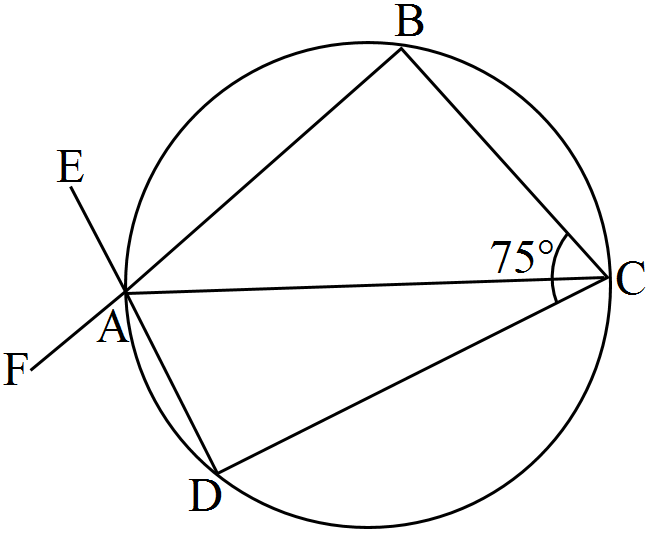
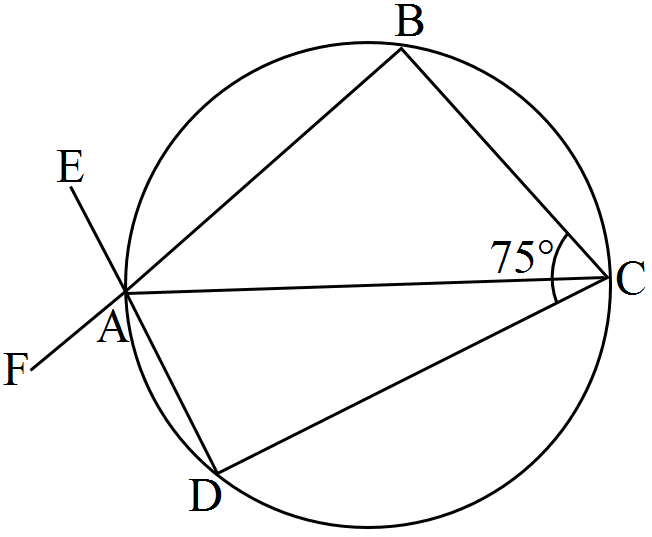
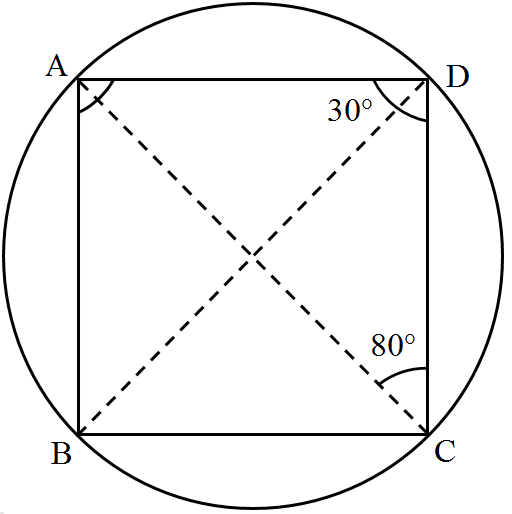
$\angle\text{B}=90^\circ$ (Angle in semicircle)
$\angle\text{BAD}=180^\circ-75^\circ=105^\circ$
$\angle\text{EAF}=\angle\text{BAD}=105^\circ$
$\angle\text{EAF}-\angle\text{ABC}=105^\circ-90^\circ=15^\circ$
The longest chord of a circle is its diameter.
$⇒$ Diameter $>\ 10\ cm$
$⇒ 2\ × \ $Radius $>\ 10\ cm$
$⇒$ Radius $>\ 5\ cm$


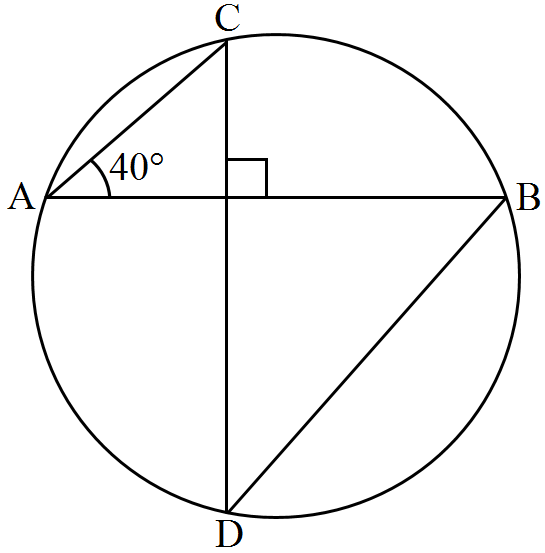
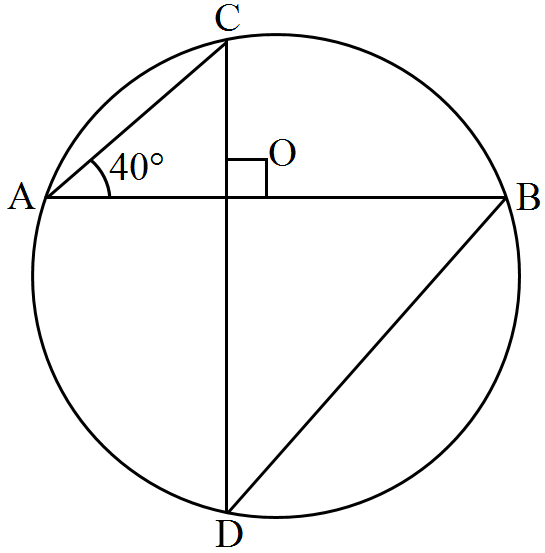
Let $AB$ and $CD$ intersect at $O.$ Then In the triangle $ACO,$
$\angle\text{A}+\angle\text{C}+\angle\text{D}=180^\circ$
$40^\circ+\angle\text{C}+90^\circ=180^\circ$
$130^\circ+\angle\text{C}=180^\circ$
$\angle\text{C}=50^\circ$
As per the theorem, Angles in the same segment of a circle are equal.
Hence, $\angle\text{ABD}=\angle\text{C}=50^\circ$

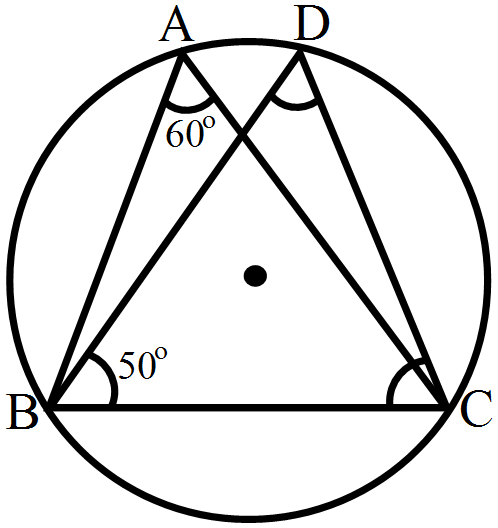
Since angles in the same segment of a circle are equal.
$\angle\text{BAC}=\angle\text{BDC}=60^\circ.$
In $\triangle\text{BDC},$
$\angle\text{BDC}+\angle\text{DBC}+\angle\text{BCD}=180^\circ.$
$\Rightarrow\ 60^\circ+50^\circ+\angle\text{BCD}=180^\circ$
$\Rightarrow\ \angle\text{BCD}=70^\circ$


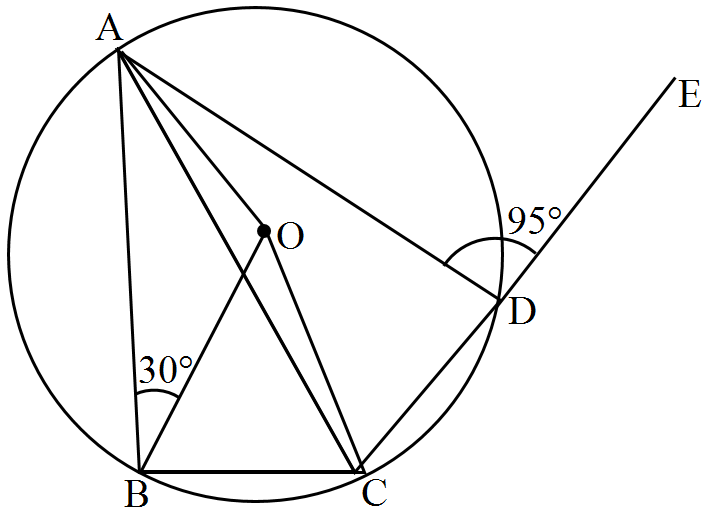
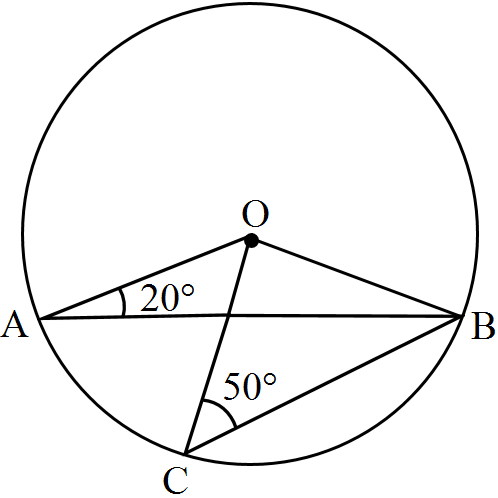
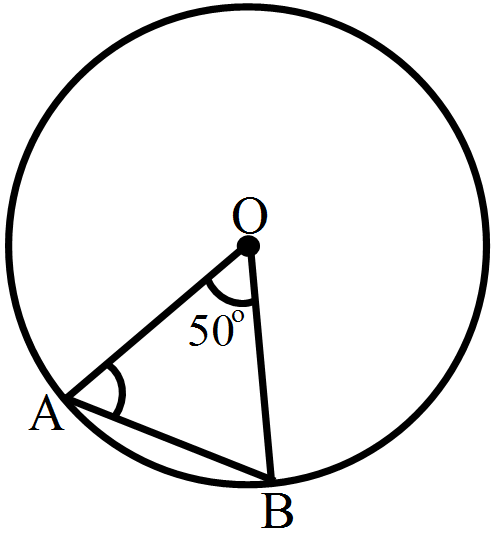
$\text{OA}=\text{OB}\Rightarrow\angle\text{OBA}=\angle\text{OAB}=20^\circ.$
In $\triangle\text{OAB},$
$\angle\text{OAB}+\angle\text{OBA}+\angle\text{AOB}=180^\circ$
$\Rightarrow20^\circ+20^\circ+\angle\text{AOB}=180^\circ$
$\Rightarrow\angle\text{AOB}=140^\circ.$
$\text{OB}=\text{OC}\Rightarrow\angle\text{OBC}=\angle\text{OCB}=50^\circ.$
In $\triangle\text{OCB},$
$\angle\text{OCB}+\angle\text{OBC}+\angle\text{COB}=180^\circ$
$\Rightarrow50^\circ+50^\circ+\angle\text{COB}=180^\circ$
$\Rightarrow\angle\text{COB}=80^\circ.$
$\angle\text{AOB}=140^\circ\Rightarrow\angle\text{AOC}+\angle\text{COB}=140^\circ$
$\Rightarrow\angle\text{AOC}+80^\circ=140^\circ$
$\Rightarrow\angle\text{AOC}=140^\circ-80^\circ$
$\Rightarrow\angle\text{AOC}=60^\circ.$


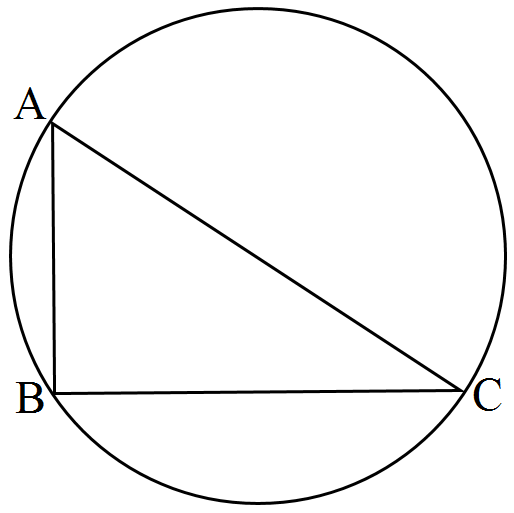
Since $AB$ is perpendicular to $BC,$ therefore $ABC$ is a right-angled triangle right angled at $B$. As clear from the figure, $AC$ would act as the diameter
$\mathrm{AB}^2+\mathrm{BC}^2=\mathrm{AC}^2$
$12^2+16^2=A C^2$
$A C=20$
Since $AC$ is diameter so radius $= 10\ cm.$