Questions · Page 5 of 5

M.C.Q

MCQ 2011 Mark
if $A$ and $B$ are two points on a circle such that m $(AB) = 260^\circ .$ A possible value for the angle subtended by arc $BA$ at a point on the circle is:
  • $50^\circ$
  • B
    $100^\circ$
  • C
    $75^\circ$
  • D
    $25^\circ$
Answer
Correct option: A.
$50^\circ$
We are given $m(AB) = 260^\circ $
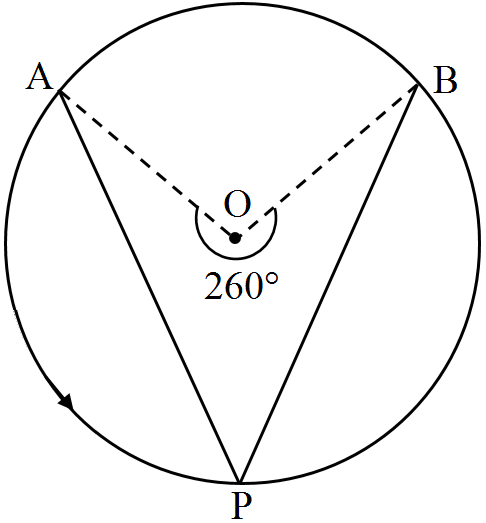
Suppose point $P$ is on the circle.
Since $m(AB) = 260^\circ $
So, angle $AOB = 360^\circ - 260^\circ = 100^\circ $
We know that angle subtended by chord $AB$ at the centre is twice that of subtended at the point $P$
So, $\angle\text{APB}=\frac{\angle\text{AOB}}{2}=\frac{100}{2}=50^\circ$
$\Rightarrow\angle\text{APB}=50^\circ$
View full question & answer
MCQ 2021 Mark
$ABCD$ is a cyclic quadrilateral such that $AB$ is a diameter of the circle circumscribing it and $\angle\text{ADC}=140^\circ,$ then $\angle\text{BAC}$ is equal to:
  • A
    $40^\circ $
  • B
    $30^\circ $
  • C
    $75^\circ $
  • $50^\circ $
Answer
Correct option: D.
$50^\circ $

ln the given quadrilateral,
$\angle\text{ABC}+\angle\text{ADC}=180^\circ$
$140^\circ+\angle\text{ABC}=180^\circ$
$\angle\text{ABC}=40^\circ$
Since, $AB$ is diameter so $ABCD$ lies in semi-circle.
thus, $\angle\text{BCA}=90^\circ$
In triangle, $ABC,$
$\angle\text{A}+\angle\text{B}+\angle\text{C}=180^\circ$
$\angle\text{BAC}=180^\circ-40^\circ-90^\circ=180^\circ-130^\circ=50^\circ$
$\angle\text{BAC}=50^\circ$

View full question & answer
MCQ 2031 Mark
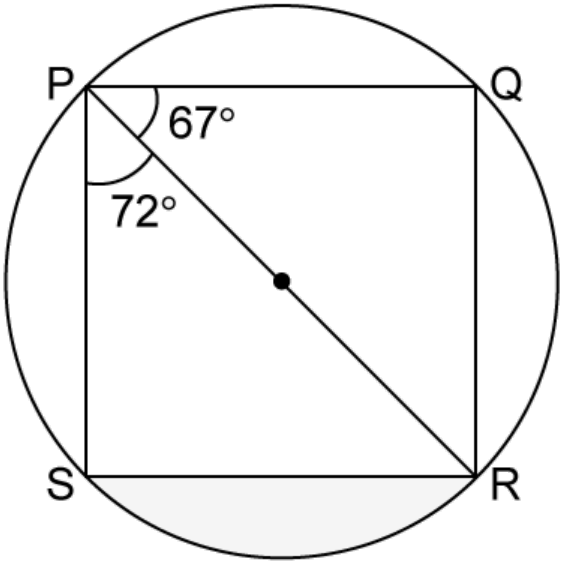
$PQRS$ is a cyclic quadrilateral such that $PR$ is a diameter of the circle. If $\angle\text{QPR} = 67^\circ$ and $ \angle\text{SPR} = 72^\circ,$ then $\angle\text{QRS} =$
  • $41^\circ$
  • B
    $23^\circ $
  • C
    $67^\circ $
  • D
    $18^\circ$
Answer
Correct option: A.
$41^\circ$


In a cyclic quadrilateral, Opposite angles are supplementary.
$\Rightarrow\angle\text{P}+\angle\text{R}=180^\circ$
Now, $\angle\text{P}=67^\circ+72^\circ=139^\circ$
Thus, $\angle\text{R}=180^\circ-139^\circ=41^\circ$
i.e. $\angle\text{R}=\angle\text{QRS}=41^\circ$

View full question & answer
MCQ 2041 Mark
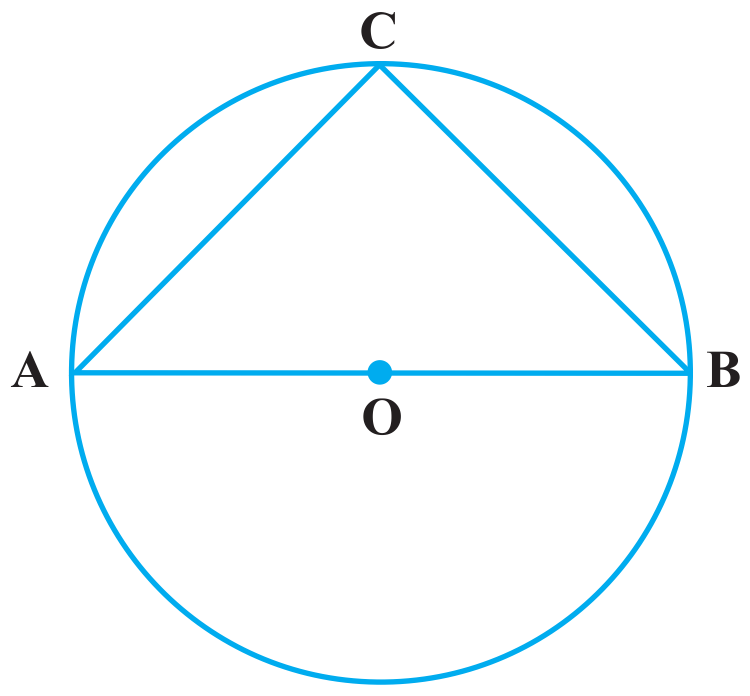
Write the correct answer in the following: In Fig. if $AOB$ is a diameter of the circle and $AC = BC,$ then $\angle\text{CAB}$ is equal to:
  • A
    $30^\circ $.
  • B
    $60^\circ .$
  • C
    $90^\circ .$
  • $45^\circ .$
Answer
Correct option: D.
$45^\circ .$

As $AOB$ is a diameter of the circle,
$\angle\text{C}=90^\circ$
$[\because$ Angles in a semi-circle is $90^\circ ]$
Now, $AC = BC$
$\angle\text{A}=\angle\text{B}$
$[\because$ Angles opposite to equal sides of triangle are equal$]$
Using angle sum property of a triangle, we have
$\angle\text{A}+\angle\text{B}+\angle\text{C}=180^\circ\Rightarrow2\angle\text{A}+90^\circ=180^\circ$
$\Rightarrow2\angle\text{A}=90^\circ\Rightarrow\angle\text{A}=90^\circ\div2=45^\circ$
Hence, $(d)$ is the correct answer.

View full question & answer
MCQ 2051 Mark
Greatest chord of a circle is called its:
  • A
    Secant
  • B
    Radius
  • C
    Chord
  • Diameter
Answer
Correct option: D.
Diameter
Since diameter is the longest segment that can be drawn in a circle$($touching the circle at both ends$),$ therefore it is the longest possible chord also.
View full question & answer
MCQ 2061 Mark
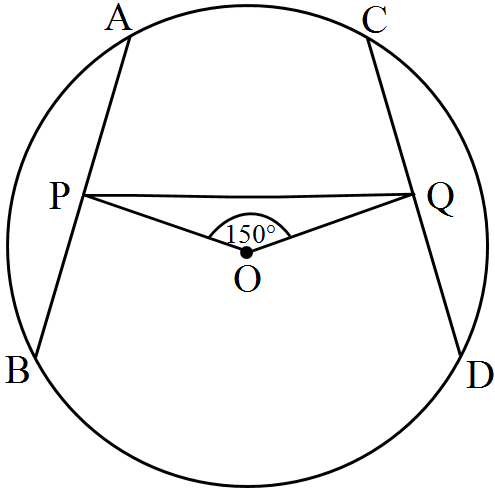
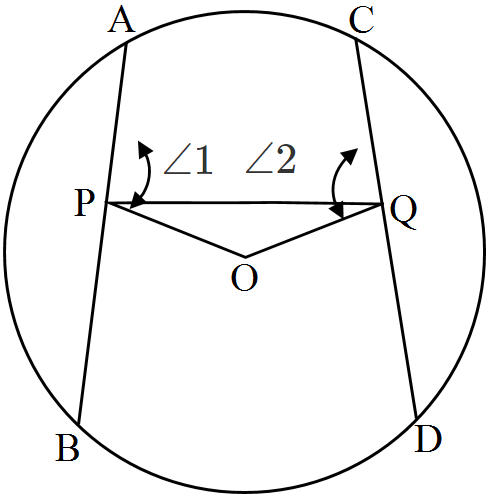
In Fig., $AB$ and $CD$ are two equal chords of a circle with centre $O.\ OP$ and $OQ$ are perpendiculars on chords $AB$ and $CD,$ respectively. If $\angle\text{POQ}=150^\circ,$ then $\angle\text{APQ}$ is equal to:
  • A
    $60^\circ $
  • B
    $30^\circ$
  • C
    $15^\circ $
  • $75^\circ $
Answer
Correct option: D.
$75^\circ $


As $AB = CD$
So, $OP = OQ ($equal chords are equidistant from the centre$)$
$\angle1=\angle2 ($angles opposite to equal sides are equal$)$
$\angle1+\angle2+\angle\text{POQ}=180^\circ$
$\angle1+\angle1+150^\circ=180^\circ$
$\therefore\angle1=15^\circ$
Since $APB$ is a line segement
$\therefore\angle\text{BPO}+\angle1+\angle\text{APQ}=180^\circ$
$90^\circ+15^\circ+\angle\text{APQ}=180^\circ$
$\therefore\angle\text{APQ}=75^\circ$

View full question & answer
MCQ 2071 Mark
$AD$ is diameter of a circle, $O$ being the centre and $AB$ is a chord. Let the centre of $AB$ be denoted by $M,$ then find $OM.$
  • $7\ cm$
  • B
    $8\ cm$
  • C
    $6\ cm$
  • D
    $5\ cm$
Answer
Correct option: A.
$7\ cm$

Join $OM. OM$ will be perpendicular to $AB$. Since the line joining the midpoint of a chord to the centre is always perpendicular to the chord.
$AB = 48\ cm,$ so, $\text{AM}=\frac{48}{2}=24\text{cm} (O$ is the midpoint of $AD)$
Now, applying pythagoras theorem, we get:-
$O A^2=\mathrm{AM}^2+O M^2$
$25^2=24^2+O M^2$
$O M^2=25^2-24^2$
$O M^2=625-576=49$
$O M=7 \mathrm{~cm}$

View full question & answer
MCQ 2081 Mark
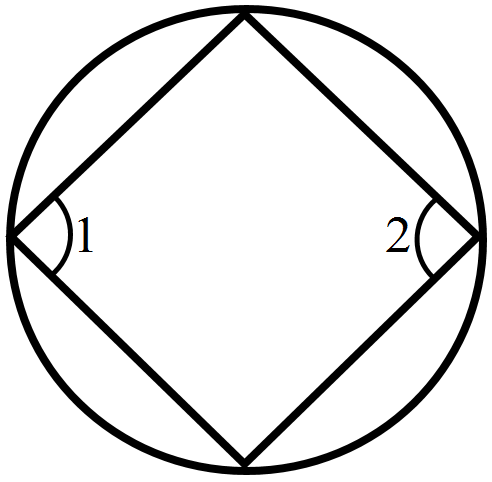
The sum of either pair of opposite angle of cyclic quadrilateral is:
  • A
    $270^\circ$
  • B
    $360^\circ$
  • C
    $90^\circ$
  • $180^\circ$
Answer
Correct option: D.
$180^\circ$


As per theorem,
The sum of either pair of opposite angles of a cyclic quadrilateral is $180^\circ .$
Here, $\angle1+\angle2=180^\circ$

View full question & answer
MCQ 2091 Mark
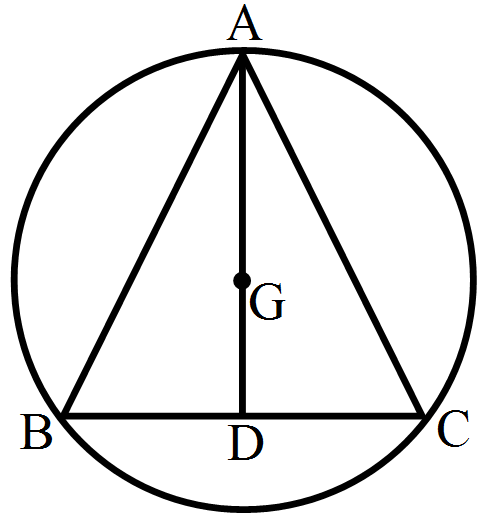
An equilateral triangle of side 9cm is inscribed in a circle. The radius of the circle is:
  • A
    $3\text{cm}$
  • B
    $3\sqrt{2}\text{cm}$
  • $3\sqrt{3}\text{cm}$
  • D
    $6\text{cm}$
Answer
Correct option: C.
$3\sqrt{3}\text{cm}$


Let $\triangle\text{ABC}$ be an equilateral triangle.
Let $AD$ be one of its medians.
Then, $\text{AD}\perp\text{BC}$ and $BD = 4.5cm$
In right $\triangle\text{ADB},$
$\therefore\ \text{AD}=\sqrt{\text{AB}^2-\text{BD}^2}$ [By pythagoras theorem]
$=\sqrt{9^2-\frac{9^2}{2}}$
$=\sqrt{81-\frac{81}{2}}$
$=\sqrt{\frac{243}{2}}$
$=\frac{9\sqrt{3}}{2}\text{cm}$
Let $G$ be the centroid of $\triangle\text{ABC}.$
Then, $AG : GD = 2 : 1$
$\therefore$ radius $=\text{AG}=\frac{2}{3}\text{AD}=\Big(\frac{2}{3}\times\frac{9\sqrt{3}}{2}\Big)=3\sqrt{3}\text{cm}$

View full question & answer
MCQ 2101 Mark
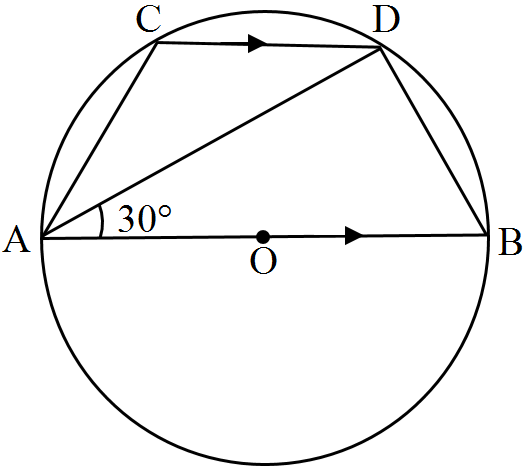
In the given figure, $AOB$ is a diameter of a circle and $CD || AB.$ If $\angle\text{BAD}=30^\circ,$ then $\angle\text{CAD}=?$
  • A
    $45^\circ$
  • $30^\circ$
  • C
    $50^\circ$
  • D
    $60^\circ$
Answer
Correct option: B.
$30^\circ$
$\angle\text{ADC}=\angle\text{BAD}=30^\circ$ (Alternate angles)
$\angle\text{ADB}=90^\circ$ (Angle in semicircle)
$\therefore\angle\text{CDB}=(90^\circ+30^\circ)=120^\circ$
But $ABCD$ being a cyclic quadrilateral, we have:
$\angle\text{BAC}+\angle\text{CDB}=180^\circ$
$\Rightarrow\angle\text{BAD}+\angle\text{CAD}+\angle\text{CDB}=180^\circ$
$\Rightarrow30^\circ+\Rightarrow\angle\text{CAD}+120^\circ=180^\circ$
$\Rightarrow\angle\text{CAD}=(180^\circ-150^\circ)=30^\circ$
$\Rightarrow\angle\text{CAD}=30^\circ$
View full question & answer
MCQ 2111 Mark
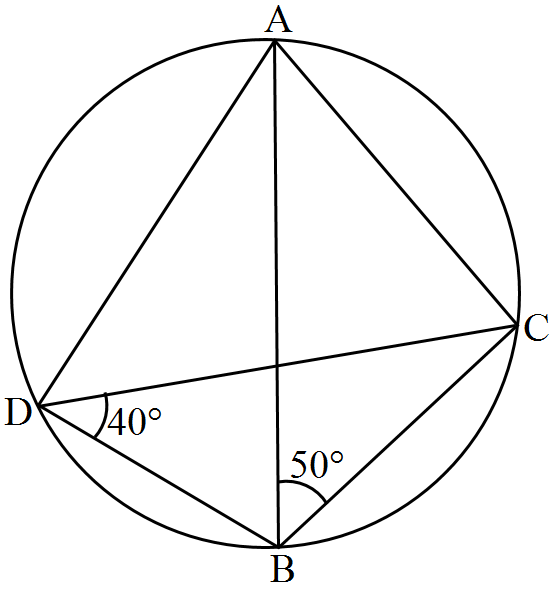
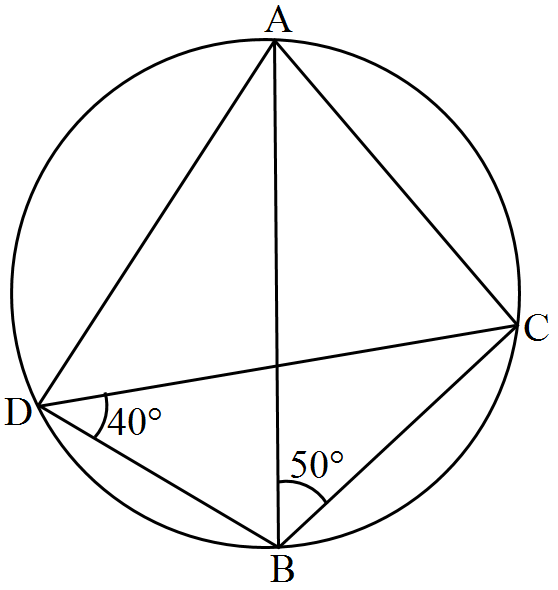
In the given figure, if $\angle\text{ABC}=50^\circ$ and $\angle\text{BDC}=40^\circ,$ then $\angle\text{BCA}$ is equal to:
  • A
    $40^\circ$
  • B
    $100^\circ$
  • C
    $50^\circ$
  • $90^\circ$
Answer
Correct option: D.
$90^\circ$


$\angle\text{BDC}=\angle\text{BAC}=40^\circ$
In triangle $ABC,$
$\angle\text{A}+\angle\text{B}+\angle\text{C}=180^\circ$ (angles of a triangle)
$50^\circ+40^\circ+\angle\text{C}=180^\circ$
$\angle\text{C}=90^\circ$

View full question & answer
MCQ 2121 Mark
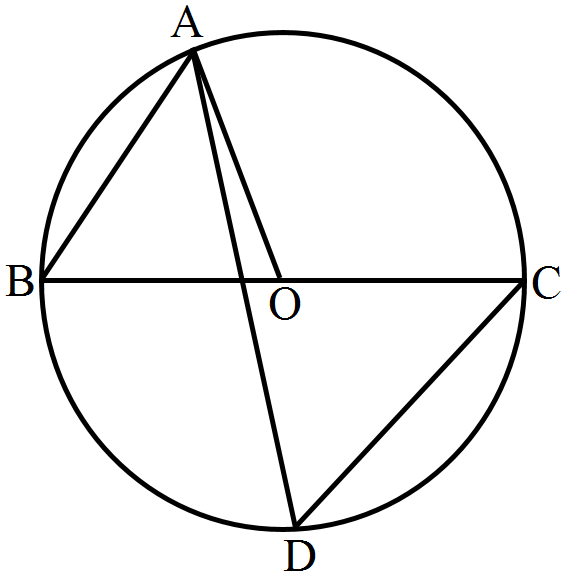
$BC$ is a diameter of the circle and $\angle\text{BAO}=60^\circ.$ Then $\angle\text{ADC}$ is equal to:
  • A
    $90^\circ $
  • B
    $45^\circ$
  • $60^\circ$
  • D
    $30^\circ$
Answer
Correct option: C.
$60^\circ$

In triangle $ABO,$
$OA = OB,\angle\text{A}=\angle\text{B}=60^\circ$
Now, $\angle\text{ABO}=\angle\text{ADC}=60^\circ$

View full question & answer
MCQ 2131 Mark
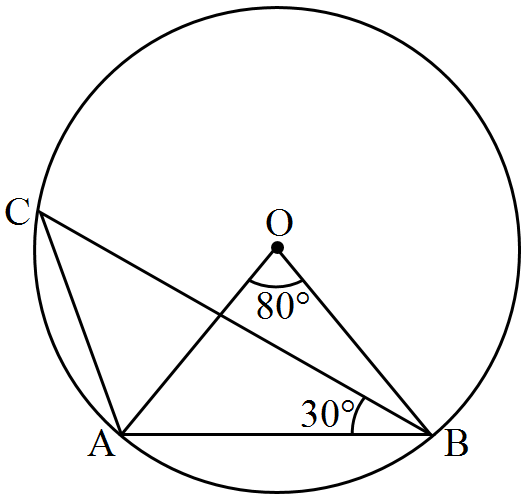
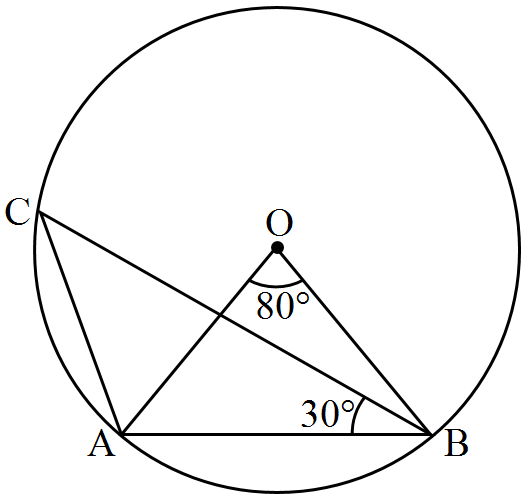
In the given figure, if $\angle\text{AOB}=80^\circ$ and $\angle\text{ABC}=30^\circ,$ then $\angle\text{CAO}$ is equal to:
  • $60^\circ$
  • B
    $40^\circ$
  • C
    $80^\circ$
  • D
    $30^\circ$
Answer
Correct option: A.
$60^\circ$


In triangle $AOB, OA = OB ($Radii$)$
$\Rightarrow\angle\text{OAB}=\angle\text{OBA}$
Now,
$\Rightarrow\angle\text{OAB}+\angle\text{ABO}+\angle\text{AOB}=180^\circ$
$\Rightarrow2\angle\text{OAB}=80^\circ=180^\circ$
$\Rightarrow\angle\text{OAB}=50^\circ$
Now, $\angle\text{CAB}=\frac{1}{2}\angle\text{AOB}=\frac{80^\circ}{2}=40^\circ$
Again, in triangle ABC,
$\angle\text{CAB}+\angle\text{ABC}+\angle\text{BCA}=180^\circ$
$\angle\text{CAB}+30^\circ+40^\circ=180^\circ$
$\angle\text{CAB}=110^\circ$
Thus,
$\angle\text{CAO}=\angle\text{CAB}-\angle\text{OAB }$
$=110^\circ-50^\circ=60^\circ$
Hence, proved.

View full question & answer
MCQ 2141 Mark
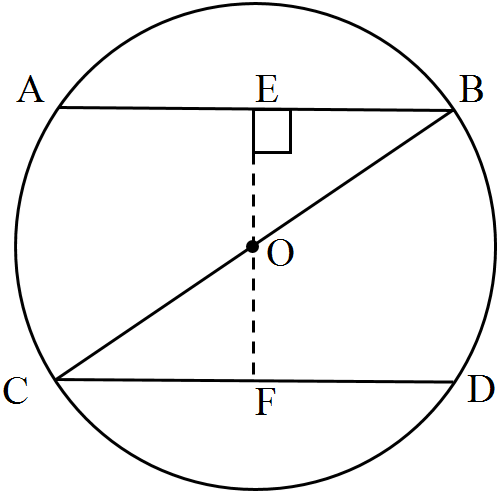
In the given figure, $BOC$ is a diameter of a circle with centre $O.$ If $AB$ and $CD$ are two chords such that $AB || CD.$ If $AB = 10\ cm,$ then $CD = ?$
  • A
    $15\ cm$
  • B
    $12.5\ cm$
  • $10\ cm$
  • D
    $5\ cm$
Answer
Correct option: C.
$10\ cm$

Draw $\text{OE}\perp\text{AB}$ and $\text{OF}\perp\text{CD}.$
In $\triangle\text{OEB}$ and $\triangle\text{OFC},$ we have:
$OB = OC ($Radius of a circle$)$
$\angle\text{BOE}=\angle\text{COF}$ (Vertically opposite angles)
$\angle\text{OEB}=\angle\text{OFC} (90^\circ $ each$)$
$\therefore\triangle\text{OEB}\cong\triangle\text{OFC}$ (By ASA congruency rule)
$\therefore\text{OE}=\text{OF}$ {by cpct}
Chords equidistance from the centre is equal.
$\therefore CD = AB = 10\ cm$

View full question & answer
MCQ 2151 Mark
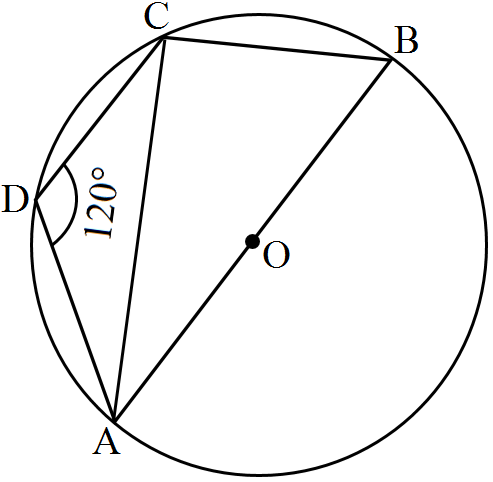
In the given figure, $AOB$ is a diameter and $ABCD$ is a cyclic quadrilateral. If $\angle\text{ADC}=120^\circ,$ then $\angle\text{BAC}=?$
  • A
    $20^\circ $
  • B
    $45^\circ$
  • C
    $60^\circ$
  • $30^\circ$
Answer
Correct option: D.
$30^\circ$
We have:
$\angle\text{ABC}+\angle\text{ADC}=180^\circ$ (Opposite angles of a cyclic quadrilateral)
$\Rightarrow\angle\text{ABC}+120^\circ=180^\circ$
$\Rightarrow\angle\text{ABC}=(180^\circ-120^\circ)=60^\circ$
$\Rightarrow\angle\text{ABC}=60^\circ$
Also, $\angle\text{ACB}=90^\circ$ (Angle in a semicircle)
In $\triangle\text{ABC},$ we have:
$\angle\text{BAC}+\angle\text{ACB}+\angle\text{ABC}=180^\circ$ (Angle sum property of a triangle)
$\Rightarrow\angle\text{BAC}+90^\circ+60^\circ=180^\circ$
$\Rightarrow\angle\text{BAC}=(180^\circ-150^\circ)=30^\circ$
$\Rightarrow\angle\text{BAC}=30^\circ$
View full question & answer
MCQ 2161 Mark
The relation between diameter and radius of a circle is:
  • A
    $\text{d}=2\pi\text{r}$
  • $d = 2r$
  • C
    $r = 2d$
  • D
    $d = r$
Answer
Correct option: B.
$d = 2r$
Radius is half the length of the diameter, thus diameter is twice the length of the radius.
View full question & answer
MCQ 2171 Mark
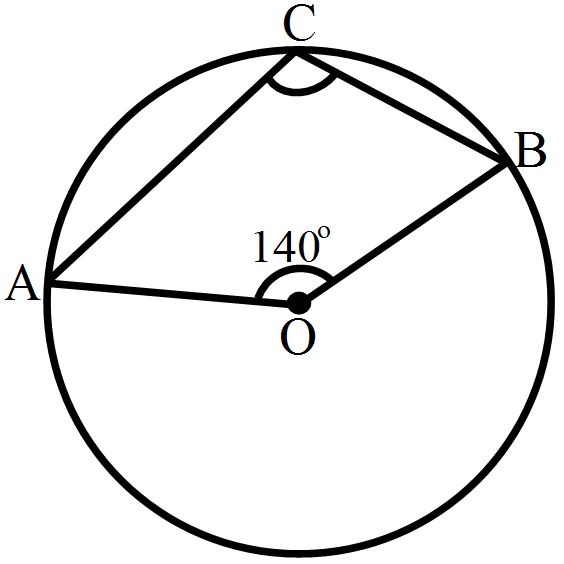
In the given figure, $O$ is the centre of a circle and $\angle\text{AOB}=140^\circ.$ Then, $\angle\text{ACB}=?$
  • A
    $70^\circ$
  • B
    $80^\circ$
  • $110^\circ$
  • D
    $40^\circ $
Answer
Correct option: C.
$110^\circ$

Minor $\angle\text{AOB}=140^\circ$
Major $\angle\text{AOB}=360^\circ-140^\circ$
$⇒$ Major $\angle\text{AOB}=220^\circ$
Since $\angle\text{ACB}=\frac{1}{2}\text{major}\angle\text{AOB}$
$\Rightarrow\ \angle\text{ACB}=\frac{1}{2}(220^\circ)$
$\Rightarrow\ \angle\text{ACB}=110^\circ$

View full question & answer
MCQ 2181 Mark
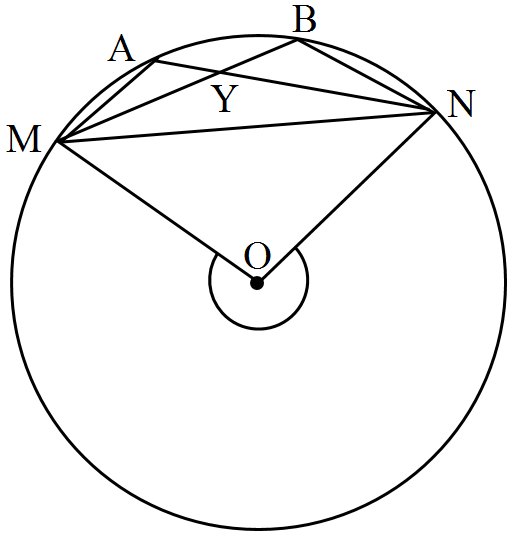
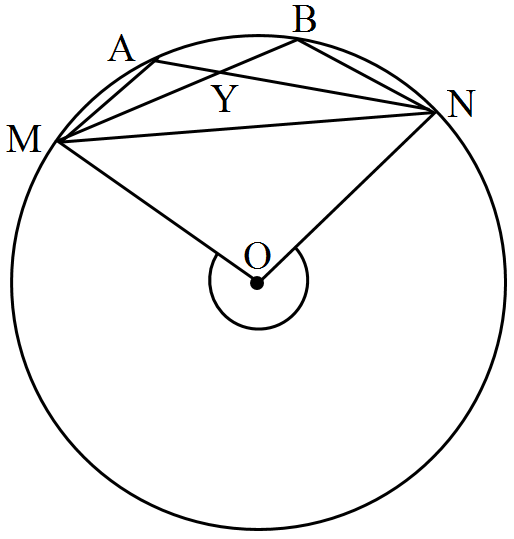
In the given figure, $M, A, B$ and $N$ are points on a circle having centre $O. \ AN$ and $MB$ cut at $Y.$ If $\angle\text{NYB}=50^\circ$ and $\angle\text{YNB}=20^\circ,$ then reflex $\angle\text{MON}$ is equal to:
  • A
    $260^\circ $
  • B
    $200^\circ$
  • $220^\circ$
  • D
    $240^\circ$
Answer
Correct option: C.
$220^\circ$


In triangle $NYB,$
$\angle\text{N}+\angle\text{Y}+\angle\text{B}=180^\circ$
$\Rightarrow\angle\text{B}=180^\circ-50^\circ-20^\circ=110^\circ$
Complete the cyclic quadrilateral, $MBNX,$ where $X$ being any point on the circumference in the major segment, we have:-
$\angle\text{MXN}=80^\circ-110^\circ=70^\circ$
So, minor $\angle\text{MON}=70^\circ\times2=140^\circ$
Hence, reflex $\angle\text{MON}=360^\circ-140^\circ=220^\circ$

View full question & answer
MCQ 2191 Mark
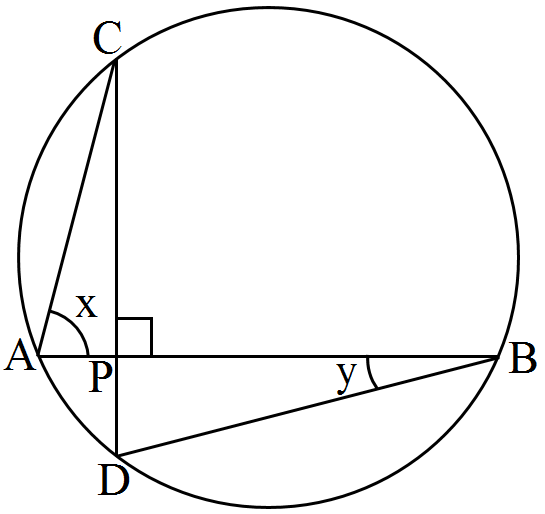
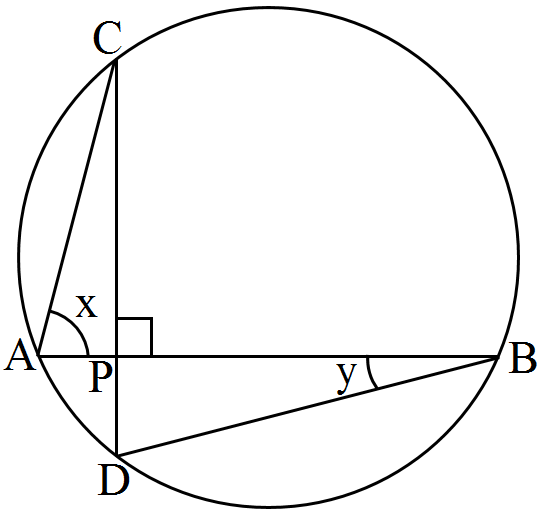
In the given figure, if chords $AB$ and $CD$ of the circle intersect each other at right angles, then, $x + y =$
  • $90^\circ$
  • B
    $60^\circ$
  • C
    $75^\circ$
  • D
    $45^\circ$
Answer
Correct option: A.
$90^\circ$


$\text{y}=\angle\text{ACP}$ (Angles of same arc)
$\angle\text{APC}=180^\circ-90^\circ=90^\circ$ ($\angle\text{APC},\angle\text{CPB}$ are linear pair)
Thus from triangle $APC$
$\text{x}+\text{y}+\angle\text{APC}=180^\circ$
Hence, $x + y = 90^\circ $

View full question & answer
MCQ 2201 Mark
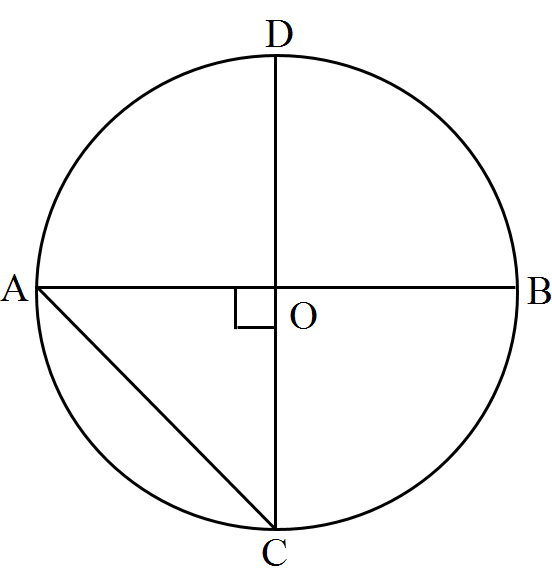
In a circle with centre $O, AB$ and $CD$ are two diameters perpendicular to each other. The length of chord $AC$, is:
  • $\frac{1}{\sqrt{2}\text{ AB}}$
  • B
    $\sqrt{2}$
  • C
    $\frac{1}{2\text{AB}}$
  • D
    $\text{2AB}$
Answer
Correct option: A.
$\frac{1}{\sqrt{2}\text{ AB}}$

We are given a circle with centre at $O$ and two perpendicular diameters $AB$ and $CD.$
We need to find the length of $AC$
We have the following corresponding figure:

Since, $AB = CD ($Diameter of the same circle$)$
Also, $\angle\text{AOC}=90^\circ$
And, $\text{AO}=\frac{\text{AB}}{2}$
Here, $AO = OC ($radius$)$
In $\triangle\text{AOC}$ is right angled triangle,
$\text{AC}^2=\text{AO}^2+\text{OC}^2=\text{AO}^2+\text{AO}^2$
$=\Big(\frac{\text{AB}}{2}\Big)^2+\Big(\frac{\text{AB}}{2}\Big)^2$
$\text{AC}2=\frac{\text{AB}^2}{2}$
$\text{AC}=\frac{\text{AB}}{\sqrt{2}}$

View full question & answer
MCQ 2211 Mark
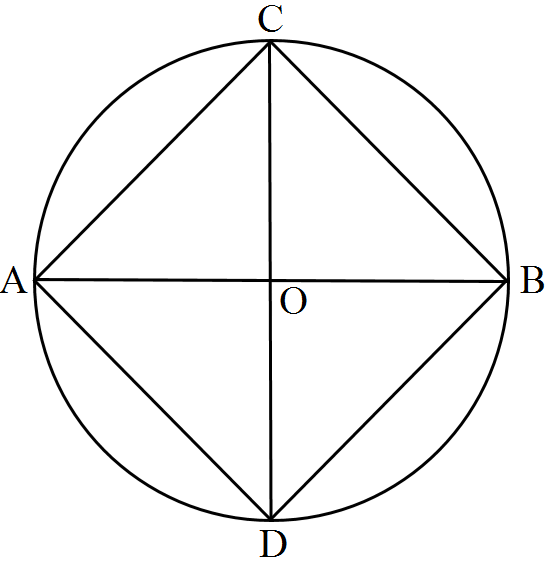
If two diameters of a circle intersect each other at right angles, then quadrilateral formed by joining their end points is a:
  • A
    Parallelogram
  • B
    Rhombus
  • C
    Rectangle
  • Square
Answer
Correct option: D.
Square


Let $AB$ and $CD$ be the diagonals of a circle such that $\text{AB}\perp\text{CD}.$
Joining points $A, B, C, D$ in the order we see that $AB$ and $CD$ are the equal diagonals of quad. $ACBD$ which intersect at a right angle. every angle is equal to $90^\circ $
$\therefore ACBD$ is a square.

View full question & answer
MCQ 2221 Mark
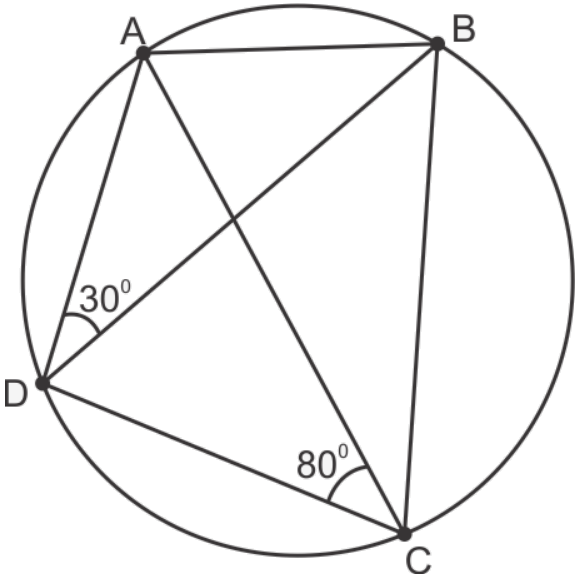
$ABCD$ is a cyclic quadrilateral such that $\angle\text{ADB} = 30^\circ$ and $\angle\text{DCA} = 80^\circ,$ then $\angle\text{DAB} =$
  • $70^\circ$
  • B
    $100^\circ$
  • C
    $125^\circ$
  • D
    $150^\circ$
Answer
Correct option: A.
$70^\circ$


$ABCD$ is a cyclic Quadrilateral.
Consider $\triangle\text{ABD}$ and $\triangle\text{ABC}.$
Both are on the same base $AB$ and $\angle\text{ADB}$ and $\angle\text{ACB}$ are the angles in the same segment $AB.$
$\Rightarrow\angle\text{ADB}=\angle\text{ACB}=30^\circ$
$\Rightarrow\angle\text{BCD}=80^\circ+30^\circ=110^\circ$
In a cyclic Quadrilateral, sum of opposite angles is $180^\circ $
$\Rightarrow\angle\text{A}+\angle\text{C}=180^\circ$
$\Rightarrow\angle\text{DAB}+\angle\text{BCD}=180^\circ$
$\Rightarrow\angle\text{DAB}=180^\circ-110^\circ=70^\circ$

View full question & answer
MCQ 2231 Mark
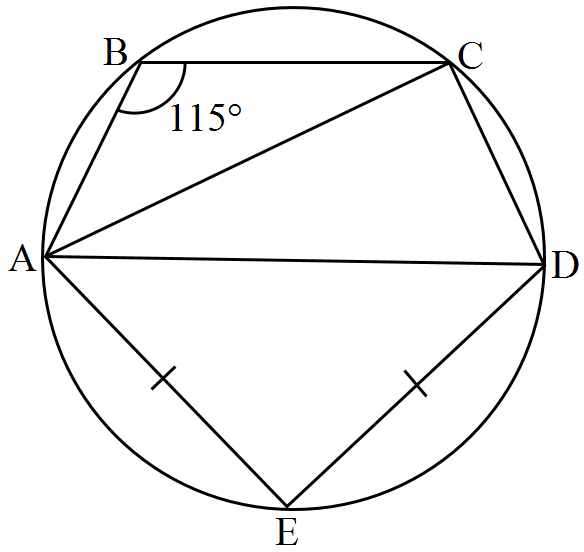
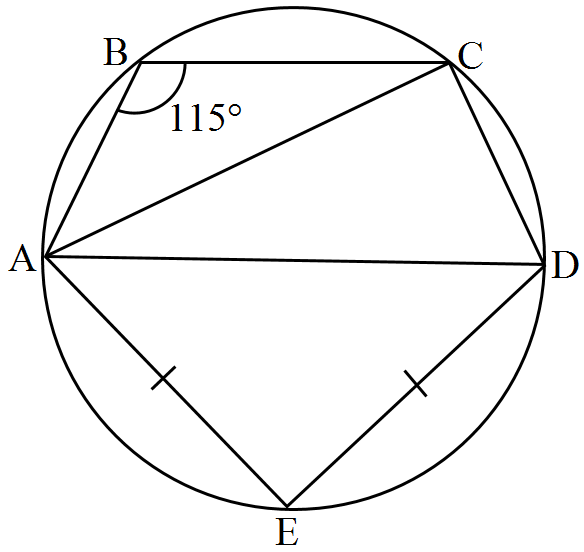
In the given figure, $AD$ is the diameter of the circle and $AE = DE.$ If, $\angle\text{ABC}=115^\circ,$ then the measure of $\angle\text{CAE}$ is:
  • $70^\circ$
  • B
    $60^\circ$
  • C
    $80^\circ$
  • D
    $90^\circ$
Answer
Correct option: A.
$70^\circ$


Since, $AE = DE,$
therefore, $\angle\text{DAE}=\angle\text{ADE}=45^\circ$ (In $\triangle\text{AED},\angle\text{E}$ And other two angles are equal.)
Now, $BADC$ is a cyclic quadrilateral,
$\Rightarrow\angle\text{B}+\angle\text{D}=180^\circ$
$\Rightarrow115^\circ+\angle\text{D}=180^\circ$
$\Rightarrow\angle\text{CDA}=\angle\text{D}=65^\circ$
Also, $\angle\text{ACD}=90^\circ$ (Angle in a semicircle)
So, we have:-
In $\triangle\text{ACD},$
$\Rightarrow\angle\text{CAD}+\angle\text{ACD}+\angle\text{CDA}=180^\circ$
$\Rightarrow\angle\text{CAD}+90^\circ+65^\circ=180^\circ$
$\Rightarrow\angle\text{CAD}=25^\circ$
Finally,
$\angle\text{CAE}=\angle\text{CAD}+\angle\text{DAE}=25^\circ+45^\circ=70^\circ$

View full question & answer
MCQ 2241 Mark
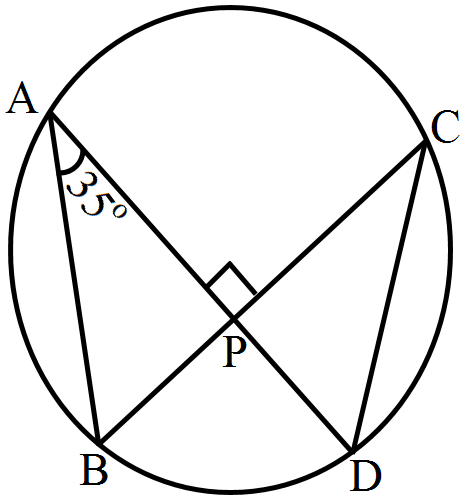
Chords $AD$ and $BC$ intersect each other at right angles at point $P. \angle\text{DAB}=35^\circ,$ then $\angle\text{ADC}$ is equal to:
  • A
    $35^\circ$
  • B
    $45^\circ $
  • C
    $65^\circ $
  • $55^\circ$
Answer
Correct option: D.
$55^\circ$
From triangle $APB, \angle\text{ABP}=180^\circ-90^\circ-35^\circ=55^\circ$
Thus, $\angle\text{ADC}=55^\circ\ (\angle\text{ABC}=\angle\text{ADC})$
View full question & answer
MCQ 2251 Mark
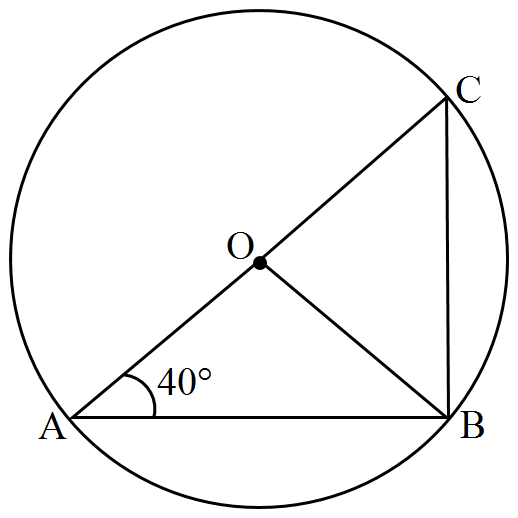
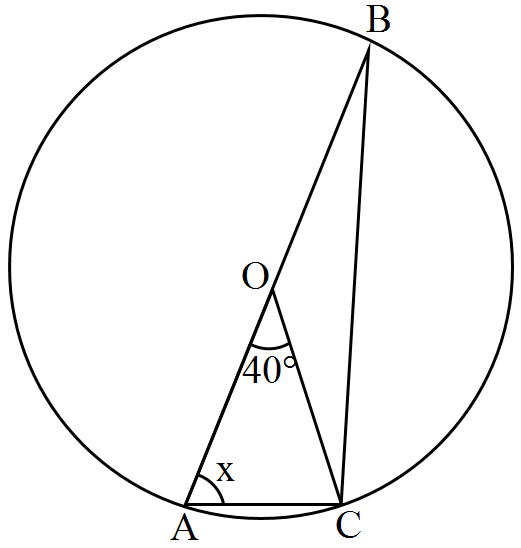
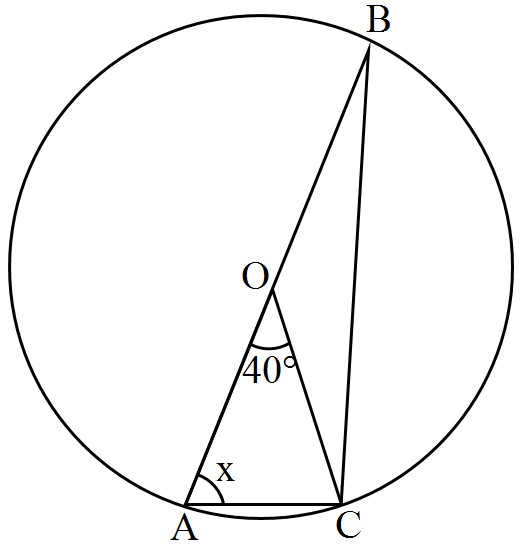
If $\angle\text{AOB}=40^\circ,$ then the measure of $\angle\text{ACB}$ is:
  • A
    $20^\circ$
  • B
    $80^\circ$
  • $50^\circ$
  • D
    $40^\circ$
Answer
Correct option: C.
$50^\circ$

In triangle $ABC,$
$\angle\text{A}+\angle\text{B}+\angle\text{C}=180^\circ$
$40^\circ+90^\circ+\angle\text{C}=180^\circ$
$\angle\text{C}=50^\circ$
View full question & answer
MCQ 2261 Mark
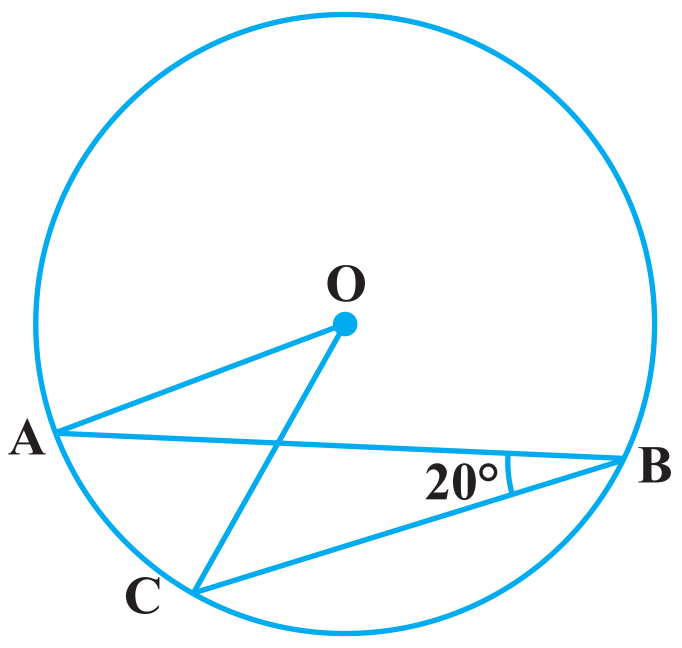
Write the correct answer in the following:In Fig. if $\angle\text{ABC}=20^\circ,$ then $\angle\text{AOC}$ is equal to:
  • A
    $20^\circ$
  • $40^\circ$
  • C
    $60^\circ$
  • D
    $10^\circ$
Answer
Correct option: B.
$40^\circ$

Given, $\angle\text{ABC} = 20^\circ$
We know that, angle subtended at the centre by an arc is twice the angle subtended by it at the remaining part of circle.
$\angle\text{AOC} = 2\angle\text{ABC} = 2 \times 20^\circ = 40^\circ$

View full question & answer
MCQ 2271 Mark
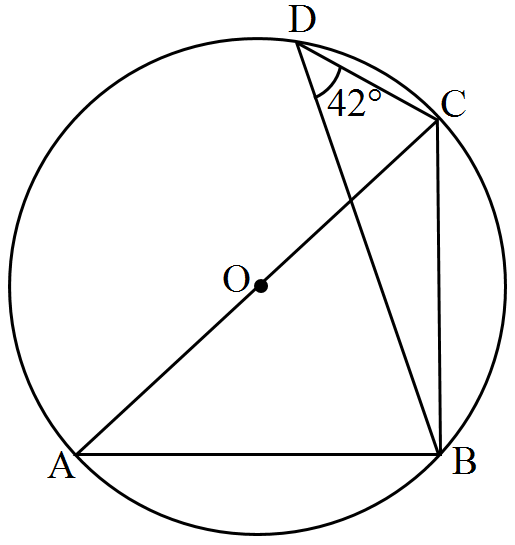
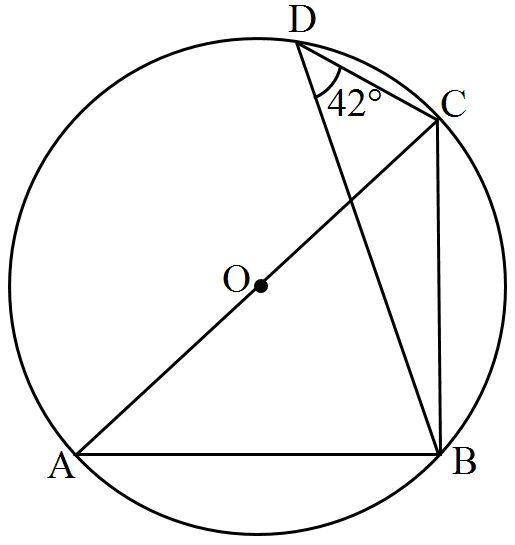
In the given circle, $O$ is the centre and $\angle\text{BDC}=42^\circ.$ Then, $\angle\text{ACB}$ is equal to:
  • A
    $58^\circ$
  • B
    $42^\circ$
  • C
    $52^\circ$
  • $48^\circ$
Answer
Correct option: D.
$48^\circ$

Here, $\angle\text{BDC}=\text{BAC}=42^\circ$ {Angles in same segment are equal}
now, since $AC$ is diameter so, $ABC$ forms a semi-circle, thus $\angle\text{ABC}=90^\circ$
So, in triangle ABC $\angle\text{BAC}+\angle\text{ABC}+\angle\text{ACB}=180^\circ$
$\angle\text{ACB}=180-(90+42)$
$=180^\circ-132^\circ$
$=48^\circ$
View full question & answer
MCQ 2281 Mark
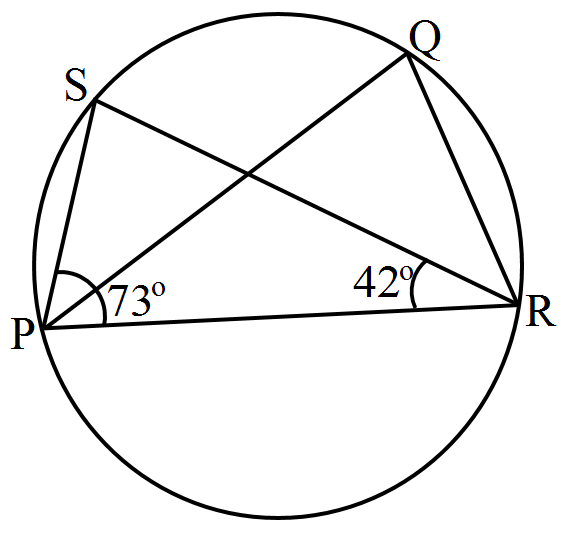
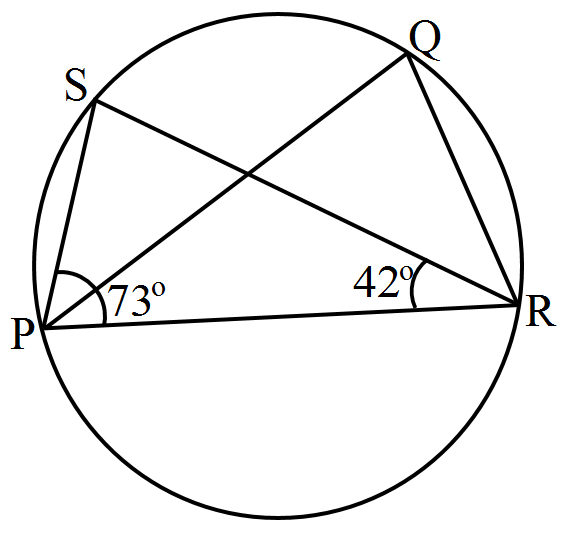
In the figure, if $\angle\text{SPR}=73^\circ,\angle\text{SRP}=42^\circ$ then $\angle\text{PQR}$ is equal to:
  • A
    $74^\circ $
  • B
    $76^\circ$
  • C
    $70^\circ$
  • $65^\circ$
Answer
Correct option: D.
$65^\circ$


$\angle\text{PQR}=\angle\text{PSR}=180^\circ-73^\circ-42^\circ=65^\circ$

View full question & answer
MCQ 2291 Mark
Write the correct answer in the following: AD$$ is a diameter of a circle and $AB$ is a chord. If $AD = 34\ cm, AB = 30\ cm,$ the distance of $AB$ from the centre of the circle is:
  • A
    $17cm.$
  • B
    $15cm.$
  • C
    $4cm.$
  • $8cm.$
Answer
Correct option: D.
$8cm.$

Draw $\text{OP}\bot\text{AB}.$
As perpendicular from the centre to a chord bisect the chord,
So, $\text{AP}=\frac{1}{2}\times\text{AB}=\frac{1}{2}\times30=15\text{cm}$
Radius $=\text{OA}=\frac{1}{2}\times34=17\text{cm}$
In right $\triangle\text{OPA},$ we have
$\text{OP}=\sqrt{\text{OA}^2-\text{AP}^2}=\sqrt{(17)^2-(15)^2}$
$=\sqrt{289-225}=\sqrt{64}=8\text{cm}$
Hence, $(d)$ is the correct answer.

View full question & answer
MCQ 2301 Mark
In the given figure $ABCD$ is a cyclic quadrilateral in which $AB || DC$ and $\angle\text{BAD}=100^\circ.$ Then, $\angle\text{ABC}=?$
  • A
    $80^\circ$
  • $100^\circ$
  • C
    $50^\circ$
  • D
    $40^\circ$
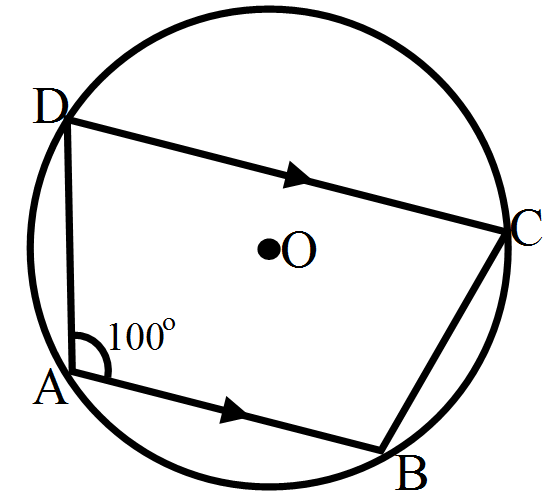
     
Answer
Correct option: B.
$100^\circ$
Since $AB || DC,$
$\angle\text{ADC}+\angle\text{BAD}=180^\circ$
$\Rightarrow\ 100^\circ+\angle\text{BAD}=180^\circ$
$\Rightarrow\ \angle\text{BAD}=80^\circ$
We know that the opposite angles of a quadrilateral are supplementary.
$\angle\text{BAD}+\angle\text{ABC}=180^\circ$
$\Rightarrow\ 80^\circ+\angle\text{ABC}=180^\circ$
$\Rightarrow\ \angle\text{ABC}=100^\circ$
View full question & answer
MCQ 2311 Mark
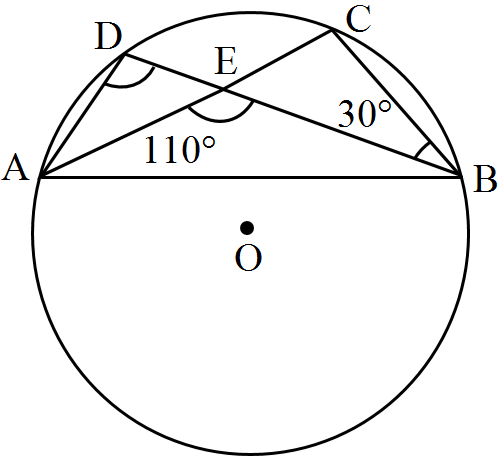
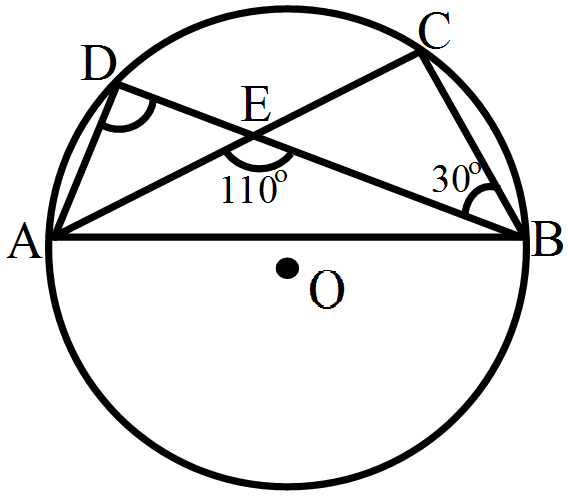
In the given figure, $O$ is the centre of a circle and chords $AC$ and $BD$ intersect at $E.$ If $\angle\text{AEB}=110^\circ$ and $\angle\text{CBE}=30^\circ,$ then $\angle\text{ADB}=?$
  • A
    $70^\circ$
  • B
    $60^\circ$
  • $80^\circ$
  • D
    $90^\circ$
     
Answer
Correct option: C.
$80^\circ$

$\angle\text{AED}=\angle\text{ECB}+\angle\text{EBC}$
$\Rightarrow\ 110^\circ=\angle\text{ECB}+30^\circ$
$\Rightarrow\ \angle\text{ECB}=80^\circ$
Since angles in the same segment are equal,
$\angle\text{ADB}=\angle\text{ECB}=80^\circ$

View full question & answer
MCQ 2321 Mark
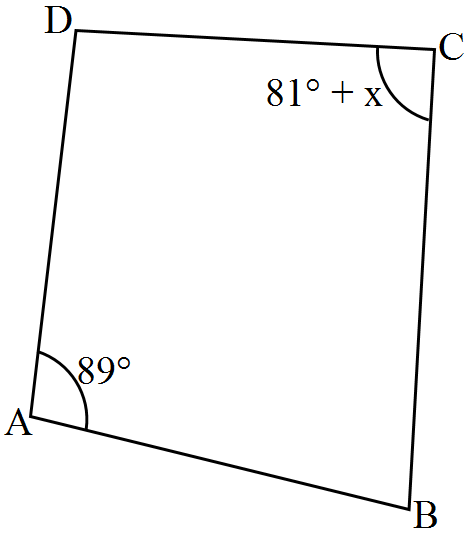
For what value of $x$ in the figure, points $A, B, C$ and $D$ are concyclic$?$
  • A
    $9^\circ$
  • $10^\circ$
  • C
    $11^\circ$
  • D
    $12^\circ$
Answer
Correct option: B.
$10^\circ$

If the quadrilateral $ABCD$ is concyclic, then,
$\angle\text{A}+\angle\text{C}=180^\circ$
$80^\circ + 81^\circ + x = 180^\circ $
$x = 10^\circ $
View full question & answer
MCQ 2331 Mark
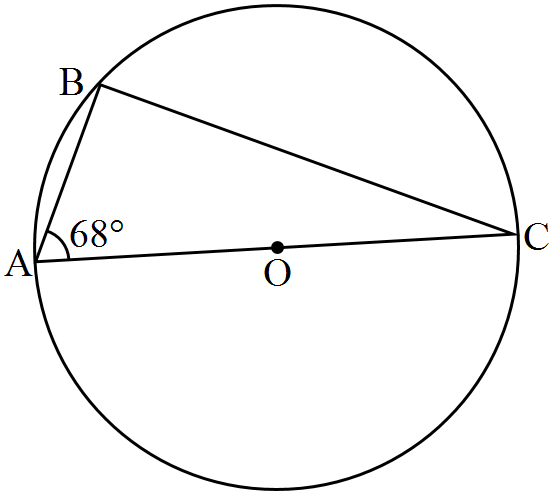
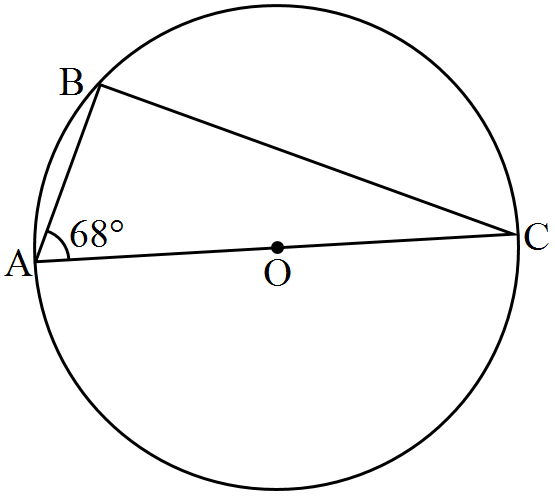
In the given figure, $O$ s the centre of circle, $\angle\text{BAO}=68^\circ$ $AC$ is diameter of circle, then measure of $\angle\text{BCO}$ is:
  • A
    $44^\circ $
  • B
    $68^\circ $
  • C
    $33^\circ$
  • $22^\circ$
Answer
Correct option: D.
$22^\circ$


$\angle\text{B}=90^\circ$ (Angle in a semicircle)
Now, in $\triangle\text{ABC}$
$\angle\text{A}+\angle\text{B}+\angle\text{C}=180^\circ$
$68^\circ+90^\circ+\angle\text{C}=180^\circ$

View full question & answer
MCQ 2341 Mark
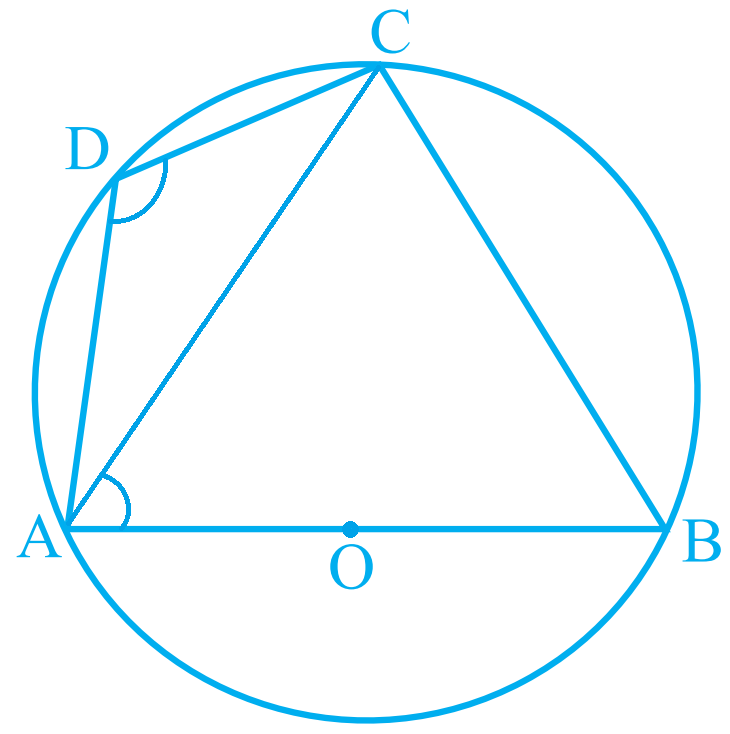
Write the correct answer in the following: $ABCD$ is a cyclic quadrilateral such that $AB$ is a diameter of the circle circumscribing it and $\angle\text{ADC}=140^\circ,$ then $\angle\text{BAC}$ is equal to:
  • A
    $80^\circ .$
  • $50^\circ .$
  • C
    $40^\circ .$
  • D
    $30^\circ .$
Answer
Correct option: B.
$50^\circ .$

Given, $ABCD$ is a cyclic quadrilateral and $\angle\text{ADC}=140^\circ.$

We know that, sum of the opposite angles in a cyclic quadrilateral is $180^\circ .$
$\angle\text{ADC}+\angle\text{ABC}=180^\circ$
$\Rightarrow\ 140^\circ+\angle\text{ABC}=180^\circ$
$\Rightarrow\ \angle\text{ABC}=180^\circ-140^\circ$
$\therefore\angle\text{ABC}=40^\circ$
Since, $\angle\text{ACB}$ is an angle in a semi-circle.
$\therefore\angle\text{ACB}=90^\circ$
In $\triangle\text{ABC},\ \ \angle\text{BAC}+\angle\text{ACB}+\angle\text{ABC}=180^\circ$ [by angle sum property of a triangle]
$\Rightarrow\angle\text{BAC}+90^\circ+40^\circ=180^\circ$
$\Rightarrow\angle\text{BAC}=180^\circ-130^\circ=50^\circ$

View full question & answer
MCQ 2351 Mark
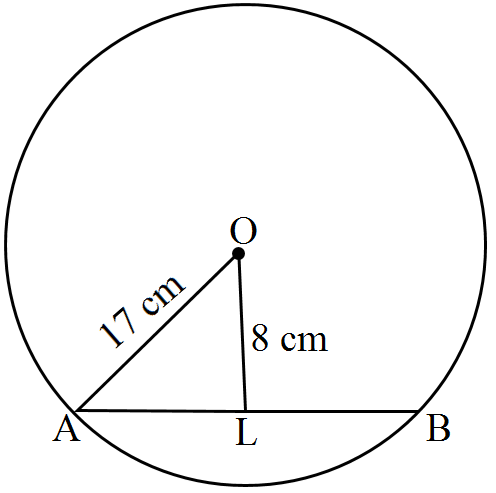
A chord is at a distance of $8\ cm$ from the centre of a circle of radius $17\ cm.$ The length of the chord is:
  • A
    $12.5cm$
  • $30cm$
  • C
    $25cm$
  • D
    $9cm$
Answer
Correct option: B.
$30cm$

Here $OA = 17\ cm$ and $OL = 8\ cm$
$\mathrm{AL}^2=\mathrm{OA}^2-\mathrm{OL}^2=(17)^2-(8)^2=289-64=225$. [using paythagoras theorem]
$\Rightarrow\text{AL}=\sqrt{225}=15$
$⇒ AB = (2 × AL) = (2 × 15)\ cm = 30\ cm.$
View full question & answer
MCQ 2361 Mark
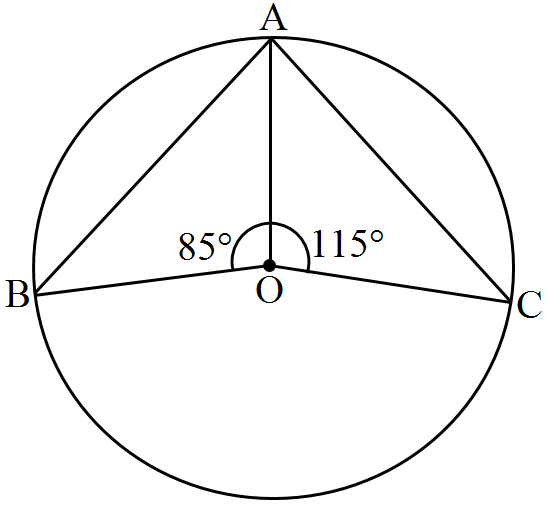
In the figure, $O$ is the centre of the circle with $\angle\text{AOB}=85^\circ$ and $\angle\text{AOC}=115^\circ,$ Then $\angle\text{BAC}$ is:
  • A
    $85^\circ$
  • $80^\circ$
  • C
    $115^\circ$
  • D
    $100^\circ$
Answer
Correct option: B.
$80^\circ$

$\angle\text{BOC}=360^\circ-(85^\circ+115^\circ)=160^\circ$
So, $\angle\text{BAC}=\frac{160^\circ}{2}=80^\circ$

View full question & answer
MCQ 2371 Mark
Circle having same centre are said to be:
  • A
    Secant
  • B
    Chord
  • Concentric
  • D
    Circle
Answer
Correct option: C.
Concentric
a circle that are drawn with same point as centre but different radii.
View full question & answer
MCQ 2381 Mark
Write the correct answer in the following: If $AB = 12\ cm, BC = 16\ cm$ and $AB$ is perpendicular to $BC,$ then the radius of the circle passing through the points $A, B$ and $C$ is:
  • A
    $6\ cm$
  • B
    $8\ cm$
  • $10\ cm$
  • D
    $12\ cm$
Answer
Correct option: C.
$10\ cm$

$AB$ is perpendicular to $BC,$ therefore $ABC$ is a right triangle.
In right $\triangle\text{ABC},$ we have
$\text{AC}=\sqrt{\text{AB}^2+\text{BC}^2}$
$=\sqrt{(12)^2+(16)^2}$
$\sqrt{144+256}$
$\text{AC}=20\text{cm}$
$\therefore\text{Radius}=\frac{1}{2}\times\text{diameter}=\frac{1}{2}\times20\text{cm}=10\text{cm}$
Hence, $(c)$ is the correct answer.

View full question & answer
MCQ 2391 Mark
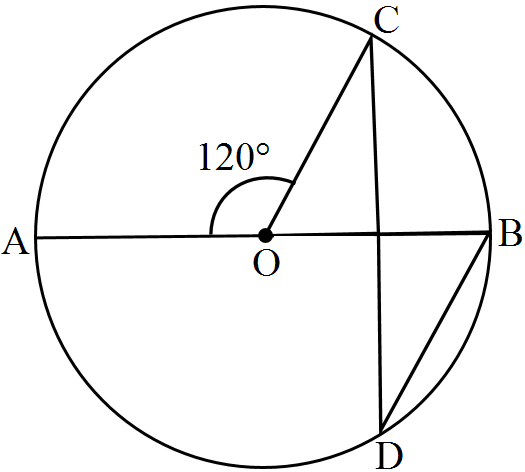
In the given figure, $O$ is the centre of a circle and $\angle\text{AOC}=120^\circ.$ Then, $\angle\text{BDC}=?$
  • A
    $45^\circ$
  • $30^\circ$
  • C
    $15^\circ$
  • D
    $60^\circ$
Answer
Correct option: B.
$30^\circ$

$\angle\text{COB}=180^\circ-120^\circ=60^\circ$ (Linear pair)
Now, arc $BC$ subtends $\angle\text{COB}$ at the centre and $\angle\text{BDC}$ at the point $D$ of the remaining part of the circle.
$\therefore\angle\text{COB}=2\angle\text{BDC}$
$\Rightarrow\angle\text{BDC}=\frac{1}{2}\angle\text{COB}=(\frac{1}{2}\times60^\circ)=30^\circ$
$\Rightarrow\angle\text{BDC}=30^\circ$

View full question & answer
MCQ 2401 Mark
In a figure, $O$ is the centre of the circle with $AB$ as diameter. If $\angle\text{AOC}=40^\circ,$ the value of $x$ is equal to:
  • A
    $60^\circ$
  • $70^\circ$
  • C
    $50^\circ$
  • D
    $80^\circ$
Answer
Correct option: B.
$70^\circ$


$OA = OC ($radii$)$
So, $\angle\text{OAC}=\angle\text{OCA}=\text{x}$
Again, in $\triangle\text{OAC}$
$\angle\text{OAC}+\angle\text{OCA}+\angle\text{AOC}=180^\circ$
$\text{x}+\text{x}+\angle\text{AOC}=180^\circ$
$\text{x}+\text{x}+40^\circ=180^\circ$
$2\text{x}=140^\circ$
$\text{x}=70^\circ$

View full question & answer
MCQ 2411 Mark
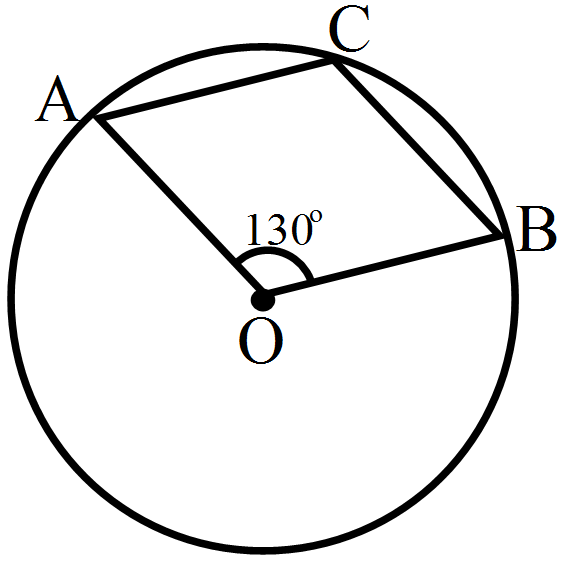
In the given figure, $O$ is the centre of a circle and $\angle\text{AOB}=130^\circ.$ Then, $\angle\text{ACB}=?$
  • A
    $50^\circ$
  • B
    $65^\circ$
  • $115^\circ$
  • D
    $155^\circ$
Answer
Correct option: C.
$115^\circ$

Minor $\angle\text{AOB}=130^\circ$
Major $\angle\text{AOB}=360^\circ-130^\circ$
$⇒$ Major $\angle\text{AOB}=230^\circ$
Since $\angle\text{ACB}=\frac{1}{2}\text{major}\angle\text{AOB}$
$\Rightarrow\ \angle\text{ACB}=\frac{1}{2}(230^\circ)$
$\Rightarrow\ \angle\text{ACB}=115^\circ$

View full question & answer
MCQ 2421 Mark
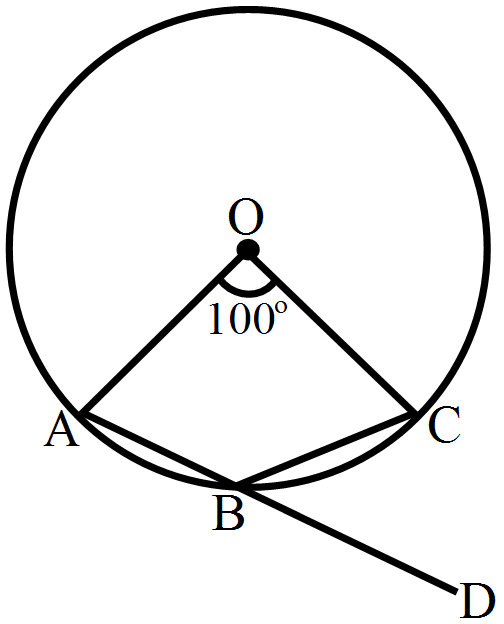
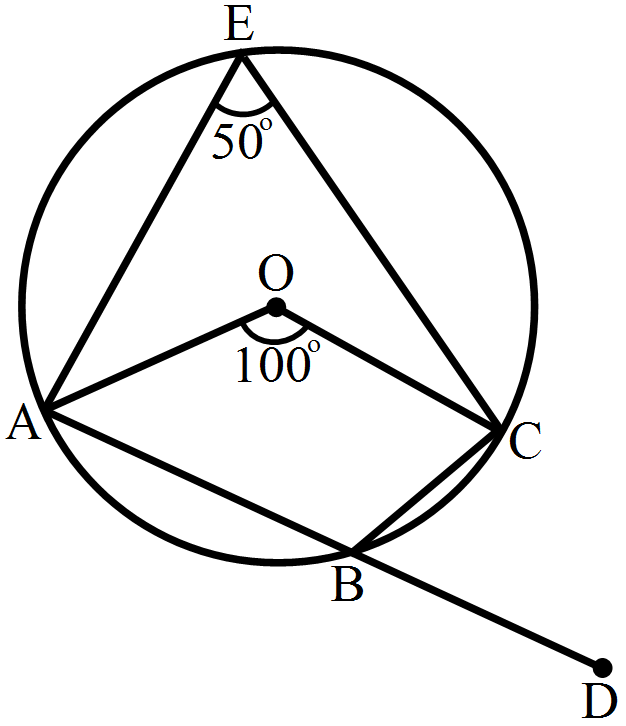
In the given figure, $O$ is the centre of a circle in which $\angle\text{AOC}=100^\circ.$ Side $AB$ of quadrilateral $OABC$ has been produced to $D$. Then, $\angle\text{CBD}=?$
  • $50^\circ$
  • B
    $40^\circ$
  • C
    $25^\circ$
  • D
    $80^\circ $
Answer
Correct option: A.
$50^\circ$


Construction: Let $E$ be a point on the reamaining part of the circumference of the circle.
Join $AE$ and $CE.$
$\angle\text{AEC}=\frac{1}{2}\angle\text{AOC}$
$\Rightarrow\ \angle\text{AEC}=\frac{1}{2}(100^\circ)=50^\circ$
Since $AECB$ forms a cyclic quadrilateral.
$\Rightarrow\ \angle\text{CBD}=\angle\text{AEC}=50^\circ$

View full question & answer
MCQ 2431 Mark
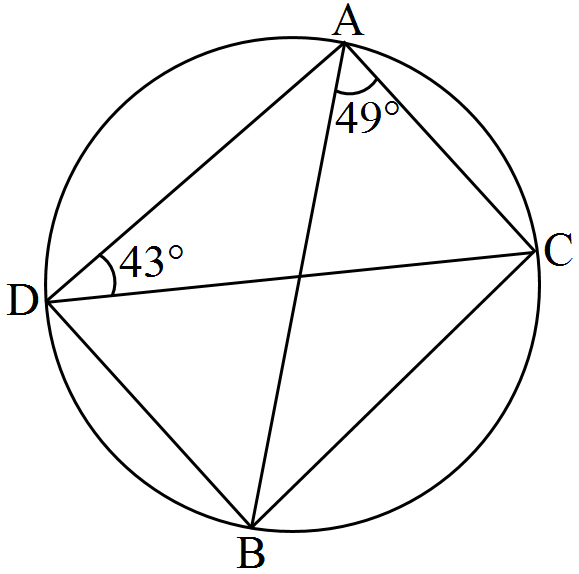
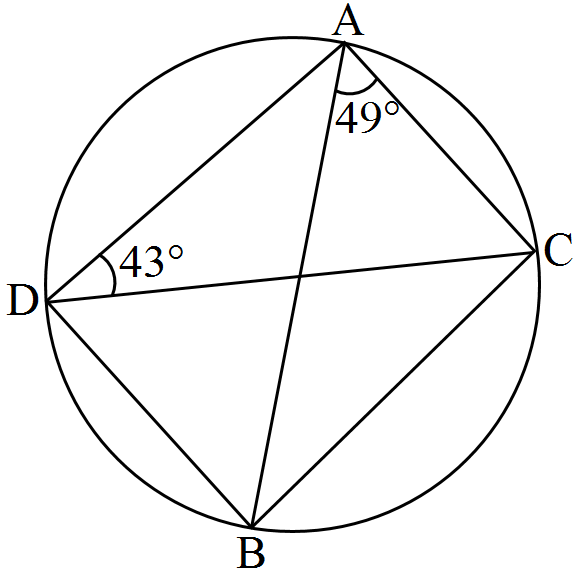
In the given figure if $\angle\text{CAB}=49^\circ$ and $\angle\text{ADC}=43^\circ,$ then the measure of $\angle\text{ACB}$ is:
  • A
    $74^\circ$
  • B
    $92^\circ$
  • $88^\circ$
  • D
    $96^\circ$
Answer
Correct option: C.
$88^\circ$


Here,
$\angle\text{CAB}=49^\circ=\angle\text{BDC}$ {Angles in same segment are equal}
So, $\angle\text{BDA}=43^\circ+49^\circ=92^\circ$
Now, $ACBD$ is a cyclic quadrilateral, so, sum of opposite angles is $180^\circ $
$\angle\text{BDA}+\angle\text{ACB}=180^\circ$
$\angle\text{ACB}=180-92=88^\circ$

View full question & answer
MCQ 2441 Mark
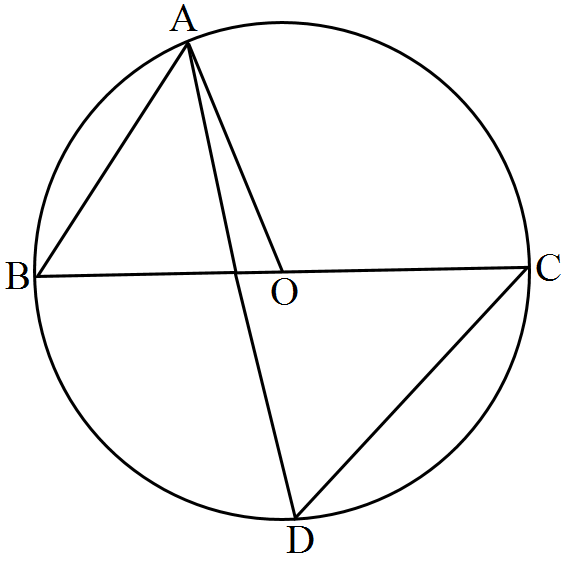
$BC$ is a diameter of the circle and $\angle\text{BAO}=60^\circ.$ Then $\angle\text{ADC}$ is equal to:
  • A
    $30^\circ$
  • B
    $90^\circ$
  • C
    $45^\circ$
  • $60^\circ$
Answer
Correct option: D.
$60^\circ$

In triangle $ABO,$
$\text{OA}=\text{OB},\angle\text{A}=\angle\text{B}=60^\circ$
Now, $\angle\text{ABO}=\angle\text{ADC}=60^\circ$

View full question & answer
MCQ 2451 Mark
In the given figure, $O$ is the centre of a circle and chords $AC$ and $BD$ intersect at $E.$ If $\angle\text{AEB}=110^\circ$ and $\angle\text{CBE}=30^\circ,$ then $\angle\text{ADB}=?$
  • A
    $90^\circ $
  • B
    $70^\circ$
  • C
    $60^\circ$
  • $80^\circ$
Answer
Correct option: D.
$80^\circ$

We have:
$\angle\text{AEB}+\angle\text{CEB}=180^\circ$ (Linear pair angles)
$\Rightarrow110^\circ+\angle\text{CEB}=180^\circ$
$\Rightarrow\angle\text{CEB}=(180^\circ-110^\circ)=70^\circ$
$\Rightarrow\angle\text{CEB}=70^\circ$
In $\triangle\text{CEB},$ we have:
$\angle\text{CEB}+\angle\text{EBC}+\angle\text{ECB}=180^\circ$ (Angle sum property of a triangle)
$\Rightarrow70^\circ+30^\circ+\angle\text{ECB}=180^\circ$
$\Rightarrow\angle\text{ECB}=(180^\circ-100^\circ)=80^\circ$
The angles in the same segment are equal.
Thus, $\angle\text{ADB}=\angle\text{ECB}=80^\circ$
$\Rightarrow\angle\text{ADB}=80^\circ$

View full question & answer
MCQ 2461 Mark
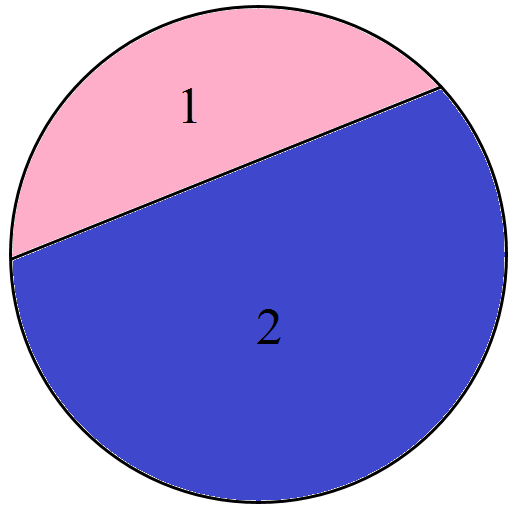
The region between chord and either of the arc is called.
  • A
    A semicircle.
  • B
    A sector.
  • A segment.
  • D
    Da quarter circle.
Answer
Correct option: C.
A segment.
The area in pink and blue are called segment .
i.e. area between chord and either of the arc.
View full question & answer
MCQ 2471 Mark
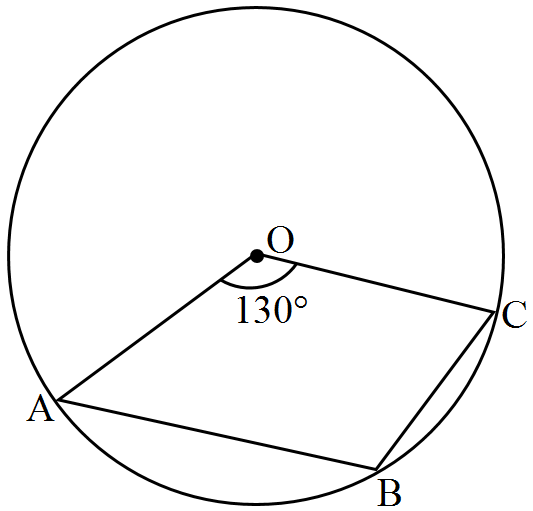
In the given figure, $O$ is the centre of the circle and $\angle\text{AOC}=130^\circ.$ Then $\angle\text{ABC}$ is equal to:
  • A
    $165^\circ$
  • B
    $130^\circ$
  • $115^\circ$
  • D
    $65^\circ$
Answer
Correct option: C.
$115^\circ$

In major segment, $\angle\text{AOC}=360^\circ-130^\circ=230^\circ$
So, $\angle\text{ABC}=\frac{230^\circ}{2}=115^\circ$ (Angle made by an arc at the centre is double the angle made by it on any other point on the circumference of the same segment)

View full question & answer
MCQ 2481 Mark
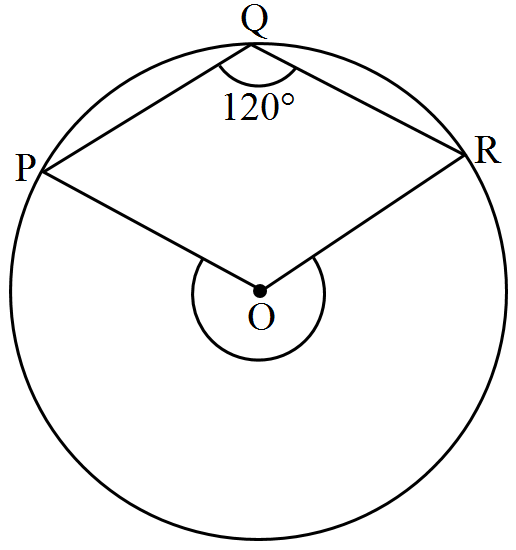
What fraction of the whole circle is minor arc $RP$ in the given figure$?$
  • $\frac{1}{3}$ of the circle.
  • B
    $\frac{1}{2}$ of the circle.
  • C
    $\frac{1}{4}$ of the circle.
  • D
    $\frac{1}{5}$ of the circle.
Answer
Correct option: A.
$\frac{1}{3}$ of the circle.

Complete the cyclic quadrilateral $PQRS,$ with $S$ being a point on a point on the major arc. Then $\angle\text{S}=60^\circ$ (Opposite angles of a cyclic quadrilateral)
Then Major $\angle\text{POR}=120^\circ$
Thus fraction the minor arc $=\frac{120^\circ}{130^\circ}=\frac{1}{3}$

View full question & answer
MCQ 2491 Mark
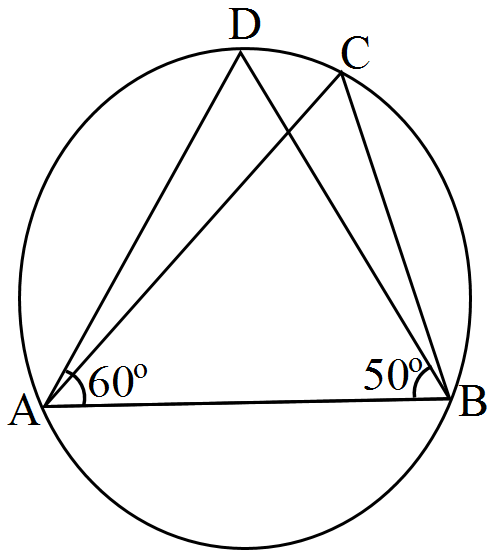
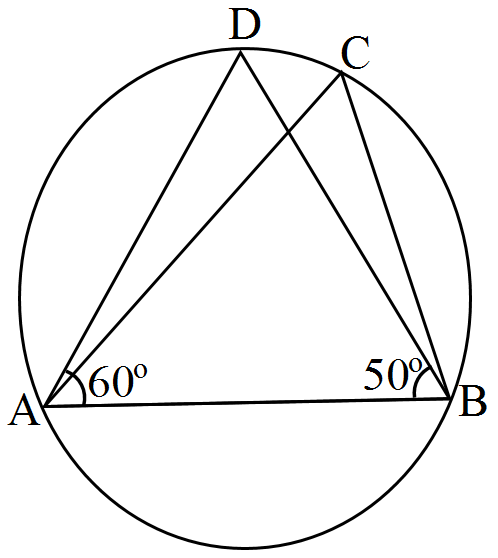
In the figure, if $\angle\text{DAB}=60^\circ,\angle\text{ABD}=50^\circ$ then $\angle\text{ACB}$ is equal to:
  • A
    $80^\circ$
  • B
    $60^\circ$
  • C
    $50^\circ$
  • $70^\circ$
Answer
Correct option: D.
$70^\circ$


In, $\triangle\text{ABD}$
$\angle\text{D}=180^\circ-\angle\text{A}-\angle\text{B}$
$=180^\circ-110^\circ=70^\circ$
Since angles made by same chord at any point of circumference are equal so,
$\angle\text{ACB}=\angle\text{ADB}=70^\circ$

View full question & answer
M.C.Q - Page 5 - Maths STD 9 Questions - Vidyadip