Question 14 Marks
Draw a line segment of length $8.6\ cm$. Bisect it and measure the length of each part.
Answer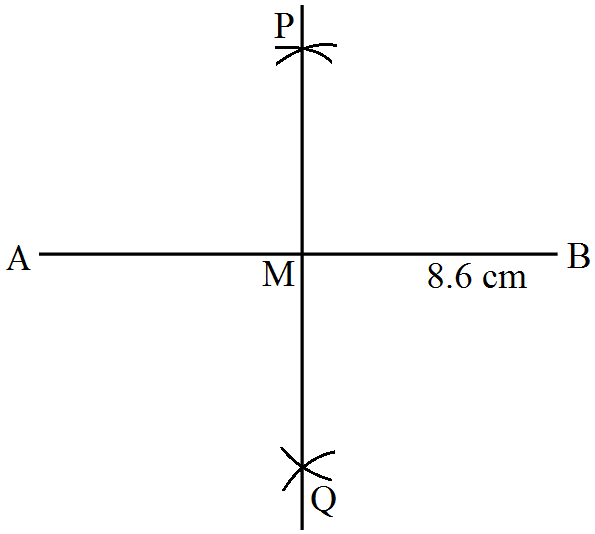
Steps of construction:
$1.$ Draw a line segment $AB$ of $8.6\ cm$.
$2.$ Keeping $A$ as centre and radius more than half of $AB$ draw arcs on each side of $AB$.
$3.$ Keeping $B$ as centre and the same radius draw arcs on each side of $AB$ cutting the previous arcs at $P$ and $Q$ respectively.
$4. $ Join the points $P$ and $Q$ which intersects $AB$ at $C$.
Therefore $AC = BC = 4.3\ cm$. View full question & answer→Question 24 Marks
Using a protractor, draw an angle of measure $72^\circ$. With this angle as given, draw angles of measure $36^\circ$ and $54^\circ$.
Answer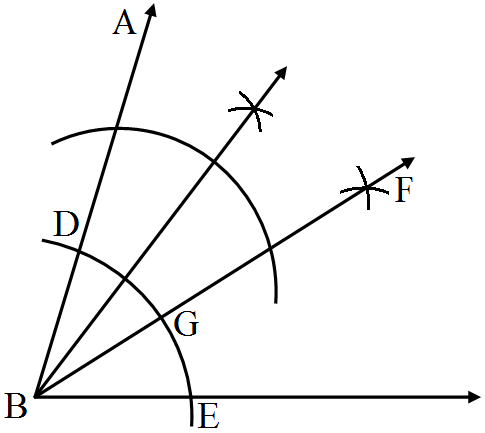
Steps of construction:
$1.$ Draw an $\angle\text{ABC}$ of $720$ with the help of a protractor.
$2.$ Keeping $B$ as center and any radius draw an arc which intersects $AB$ at $D$ and $BC$ at $E$.
$3.$ Keeping $D$ and $E$ as center and radius more than half of $DE$ draw two arcs which intersect each other at $F$.
$4.$ Join $FB$ which intersects the arc in $(2)$ at $G$.
$5.$ Keeping $D$ and $G$ as center and radius more than half of $DG$ draw two arcs which intersect each other at $H$.
$6.$ Join $HB$.
Therefore $\angle\text{HBC}=54^\circ,\angle\text{FBC}=36^\circ$ View full question & answer→Question 34 Marks
Using rulers and compasses only, draw an angle of measure $135^\circ$.
Answer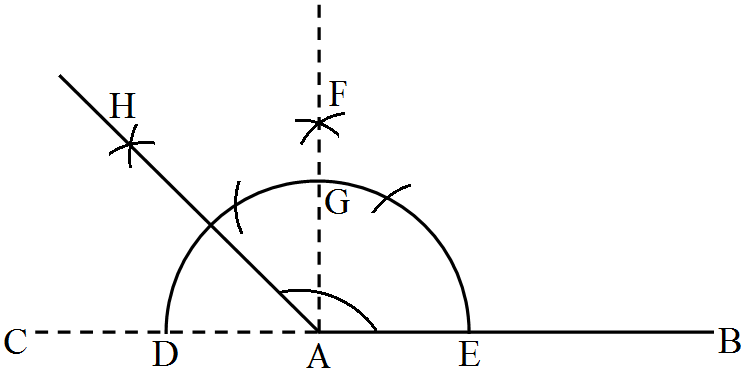
Steps of construction:
$1.$ Draw a line segment $AB$ and produce $BA$ to $C$.
$2.$ Keeping $A$ as the center and any radius draw an arc which intersects $AC$ at $D$ and $AB$ at $E$.
$3.$ Keeping $D$ and $E$ as center and radius more than half of $DE$ draw arcs which intersect each other at $F$.
$4.$ Join $FA$ which intersects the arc in $(2)$ at $G$.
$5.$ Keeping $G$ and $D$ as center and radius more than half of $GD$ draw arcs which intersect each other at $H$.
$6.$ Join $HA$.
Therefore $\angle\text{HAB}=135^\circ$ View full question & answer→Question 44 Marks
Construct a right$-$angled triangle $ABC$ whose base $BC$ is $6\ cm$ and the sum of the hypotenuse $AC$ and other side $AB$ is $10\ cm$.
Answer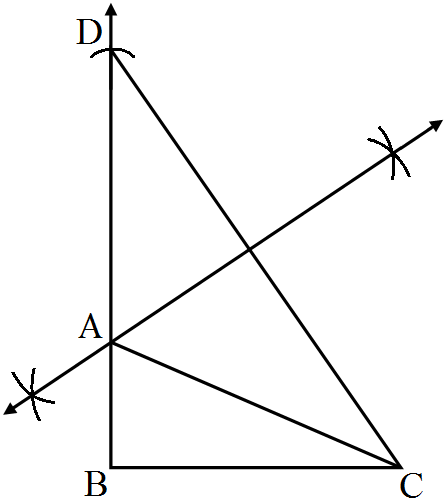
Steps of construction:
$1.$ Construct a line segment $BC$ of $6\ cm$.
$2.$ At the point $B$, draw $\angle\text{XBC}=90^\circ.$
$3.$ Keeping $B$ as center and radius $10\ cm$ draw an arc which intersects $XB$ at $D$.
$4.$ Join $DC$.
$5.$ Draw the perpendicular bisector of $DC$ which intersects $DB$ at $A$.
$6.$ Join $AC$.
Hence
$\triangle\text{ABC}$ is the required triangle. View full question & answer→Question 54 Marks
Construct a $\triangle\text{ABC}$ in which $BC = 3.4\ cm, AB - AC = 1.5\ cm$ and $\angle\text{B}=45^\circ.$
Answer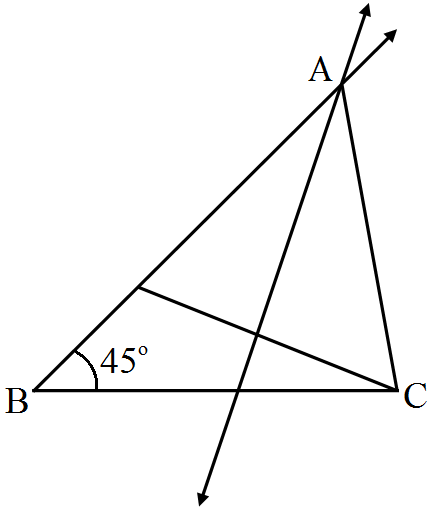
Steps of Construction:
$1.$ Construct a line segment $BC$ of $3.4\ cm$.
$2.$ At the point $B$, draw $\angle\text{XBC}=45^\circ$
$3.$ Keeping $B$ as centre and radius $1.5\ cm$ draw an arc which intersects $XB$ at $D$.
$4.$ Join $DC$.
$5.$ Draw the perpendicular bisector of $DC$ which intersects $DB$ at $A$.
$6.$ Join $AC$.
Hence $\triangle\text{ABC}$ is the required triangle. View full question & answer→Question 64 Marks
Construct a $\triangle\text{ABC}$ in which $AB + AC = 5.6\ cm, BC = 4.5\ cm$ and$\triangle\text{ABC}$
Answer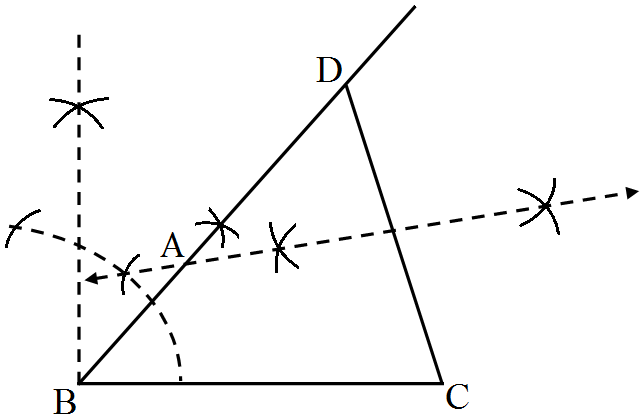
Steps of Construction:
$1.$ Construct a line segment $BC$ of $4.5\ cm$.
$2.$ At the point $B$, draw $\angle\text{XBC}=45^\circ.$
$3.$ Keeping $B$ as centre and radius $5.6\ cm$ draw an arc which intersects $XB$ at $D$.
$4.$ Join $DC$.
$5.$ Draw the perpendicular bisector of $DC$ which intersects $DB$ at $A$.
$6.$ Join $AC$.
Hence $\triangle\text{ABC}$ is the required triangle. View full question & answer→Question 74 Marks
Draw a line segment $AB$ bisect it. Bisect one of the equal parts to obtain a line segment of length $\frac{1}{2}(\text{AB})$
Answer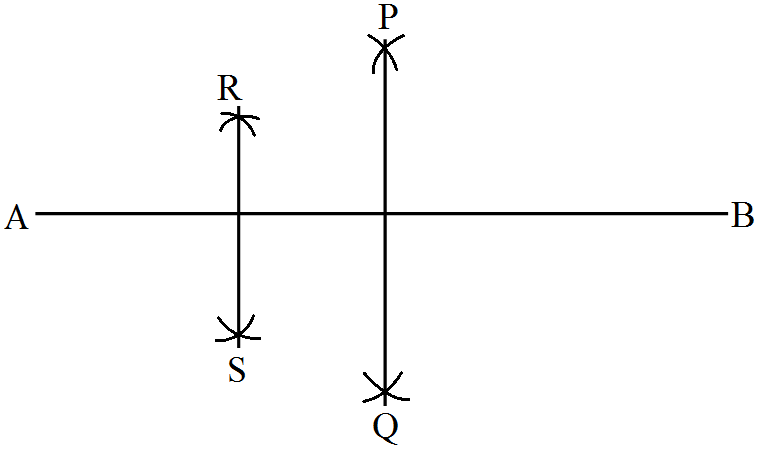
Steps of construction:
$1.$ Draw a line segment $AB$.
$2.$ With $A$ as centre and radius more than half of $AB$ draw arcs, one on each side of $AB$.
$3.$ With $B$ as the centre and same radius draw arcs cutting the previous arcs at points $P$ and $Q$ respectively.
$4.$ Join $P$ and $Q$ which intersects $AB$ at $C$.
$5.$ With $A$ as centre and radius more than half of $AC$ draw arcs, one on each side of $AC$.
$6.$ With $C$ as the centre and same radius draw arcs cutting the previous arcs at $R$ and $S$ respectively.
$7.$ Join points $R$ and $S$ which intersects $AC$ at $D$.
Therefore $\text{AD}=\big(\frac{1}{2}\big)\text{(AB)} $ View full question & answer→Question 84 Marks
Draw a line segment of length $10\ cm$ and bisect it. Further, bisect one of the equal parts and measure its length.
Answer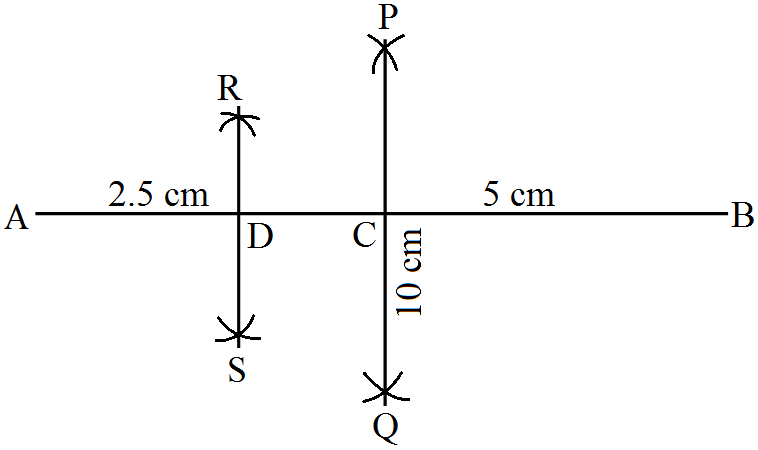
Steps of construction:
$1.$ Draw a line segment $AB$ of length $10\ cm$.
$2.$ Keeping $A$ as centre and radius more than half of $AB$ draw arcs one on each side of $AB$.
$3.$ Keeping $B$ as centre and same radius draw arcs cutting the previous arc at point $P$ and $Q$ respectively.
$4.$ Join $P$ and $Q$ which intersects $AB$ at $C$.
$5.$ Keeping $A$ as centre and radius more than half of $AC$ draw arcs on each side of $AC$.
$6.$ Keeping $C$ as centre and the same radius draw arcs cutting the previous arcs at points $R$ and $S$ respectively.
$7.$ Join points $R$ and $S$ which intersects $AC$ at $D$.
Therefore $AD = 2.5\ cm$ View full question & answer→Question 94 Marks
Draw a line segment $AB$ and by ruler and compasses, obtain a line segment of length $\frac{3}{4}\text{(AB)}.$
Answer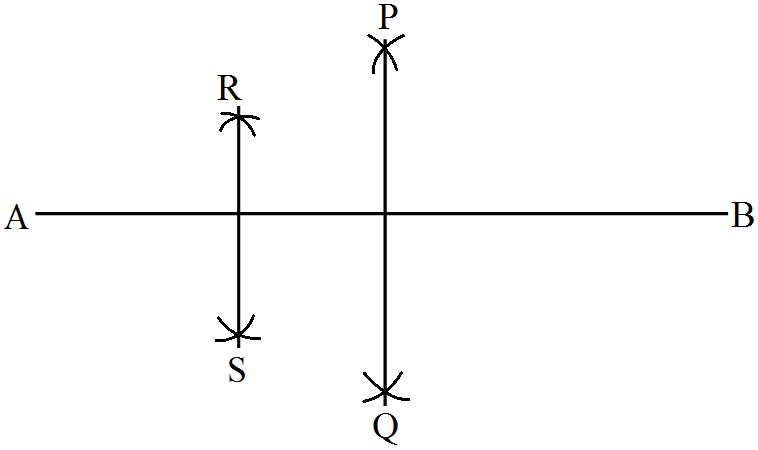
Steps of construction:
$1.$ Draw a line segment $AB$.
$2.$ With $A$ as centre and radius more than half of $AB$ draw arcs, one on each side of $AB$.
$3.$ With $B$ as the centre and same radius draw arcs cutting the previous arcs at points $P$ and $Q$ respectively.
$4.$ Join $P$ and $Q$ which intersects $AB$ at $C$.
$5.$ With $A$ as centre and radius more than half of $AC$ draw arcs, one on each side of $AC$.
$6.$ With $C$ as the centre and same radius draw arcs cutting the previous arcs at $R$ and $S$ respectively.
$7.$ Join points $R$ and $S$ which intersects $AC$ at $D$.
Therefore $\text{AD}=\frac{3}{4}\text{(AB)}$ View full question & answer→Question 104 Marks
Construct a right-angled triangle whose perimeter is equal to $10\ cm$ and one acute angle equal to $60^\circ$.
Answer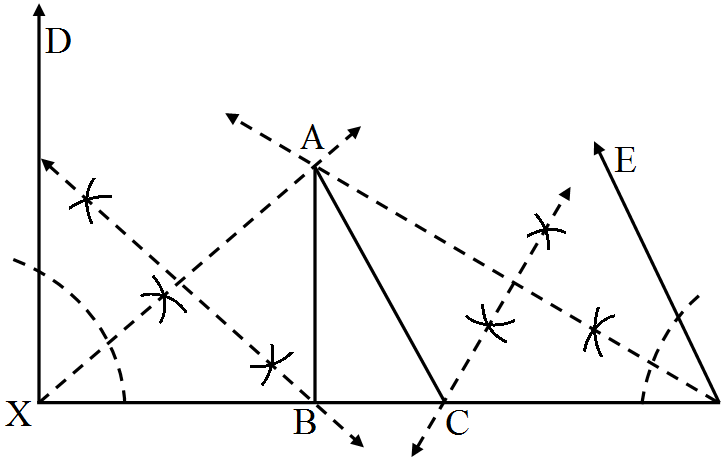
Steps of Construction:
$1.$ Draw a line segment $XY$ of $10\ cm$.
$2.$ Draw $\angle\text{DXY}=90^\circ$ and $\angle\text{EYX}=60^\circ.$
$3.$ Draw the angle bisectors of $\angle\text{DXY}$ and $\angle\text{EYX}$ which intersect each other at $A$.
$4.$ Draw the perpendicular bisector of $AX$ and $AY$ which intersect $XY$ at $B$ and $C$ respectively.
$5.$ Join $AB$ and $AC$.
Hence $\triangle\text{ABC}$ is the required triangle. View full question & answer→Question 114 Marks
Using rulers and compasses only, draw a right angle.
Answer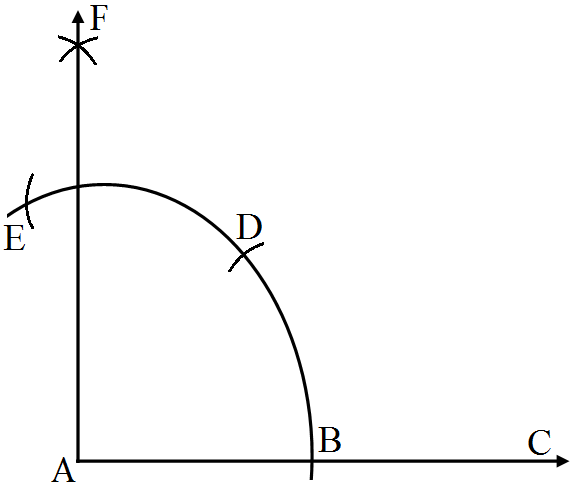
Steps of construction:
$1.$ Draw a line segment $AB$.
$2.$ Keeping $A$ as the center and any radius draw an arc which intersects $AB$ at $C$.
$3.$ Keeping $C$ as center and the same radius draw an arc which intersects the previous arc at $D$.
$4.$ Keeping $D$ as the center and same radius draw an arc which intersects arc in $(2)$ at $E$.
$5.$ Keeping $E$ and $D$ as center and radius more than half of $ED$ draw arcs which intersect each other at $F$.
$6.$ Join $FA$.
Therefore $\angle\text{FAB}=90^\circ$ View full question & answer→Question 124 Marks
Using rulers and compasses only, construct a $\triangle\text{ABC},$ given base $BC = 7\ cm$, $\angle\text{ABC}=60^\circ,$ and $AB + AC = 12\ cm$.
Answer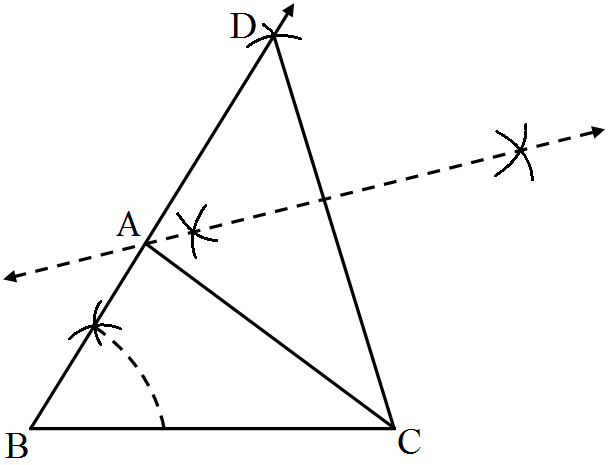
Steps of Construction:
$1.$ Construct a line segment $BC$ of $7\ cm$.
$2.$ At the point $B$, draw $\angle\text{XBC}=60^\circ$
$3.$ Keeping $B$ as centre and radius $12\ cm$ draw an arc which intersects $XB$ at $D$.
$4.$ Join $DC$.
$5.$ Draw the perpendicular bisector of $DC$ which intersects $DB$ at $A$.
$6.$ Join $AC$.
Hence $\triangle\text{ABC}$ is the required triangle. View full question & answer→Question 134 Marks
Construct a $\triangle \text{XYZ}$ in which $\angle\text{Y}=30^\circ,$ $\angle\text{Z}=90^\circ$ and $XY + YZ + ZX = 11\ cm$.
Answer
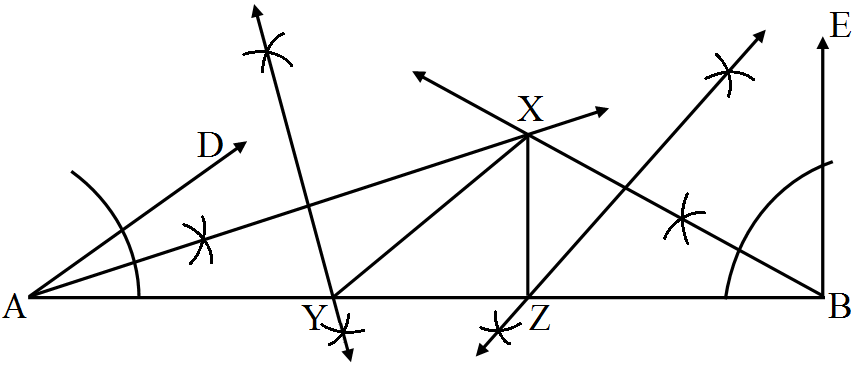
Steps of construction:
$1.$ Draw a line segment $AB$ of $11\ cm$.
$2.$ Draw $\angle\text{DAB}=30^\circ$ and $\angle\text{FBA}=90^\circ.$
$3.$ Draw the angle bisectors of $\angle\text{DAB}$ and $\angle\text{EBA}$ which intersect each other at $A$.
$4.$ Draw the perpendicular bisector of $XA$ and $XB$ which intersect $AB$ at $Y$ and $Z$ respectively
$5.$ Join $XY$ and $XZ$.
Hence $\triangle\text{XYZ}$ is the required triangle. View full question & answer→Question 144 Marks
Draw a line segment $AB$ of length $5.8\ cm$. Draw the perpendicular bisector of this line segment.
Answer
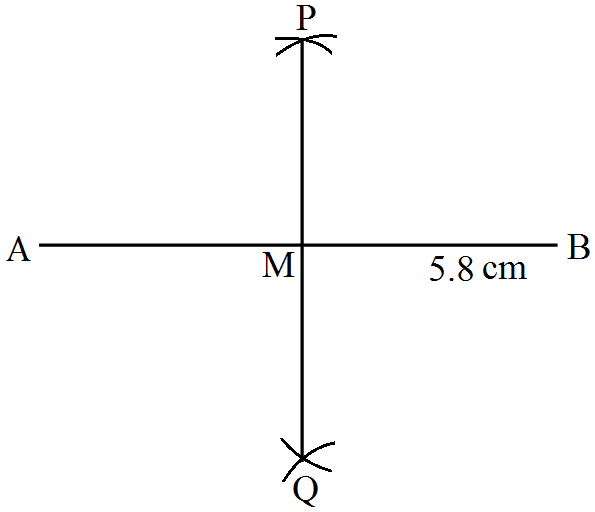
Steps of construction:
$1.$ Draw a line segment $AB$ of $5.8\ cm$.
$2.$ Keeping $A$ as centre and radius more than half of $AB$ draw arcs on each side of $AB$.
$3.$ Keeping $B$ as centre and the same radius draw arcs on each side of $AB$ cutting the previous arcs at $P$ and $Q$ respectively.
$4.$ Join the points $P$ and $Q$.
Hence $PQ$ is the perpendicular bisector of $AB$. View full question & answer→Question 154 Marks
Construct the angles of the following measurements$: \ 135^\circ$
Answer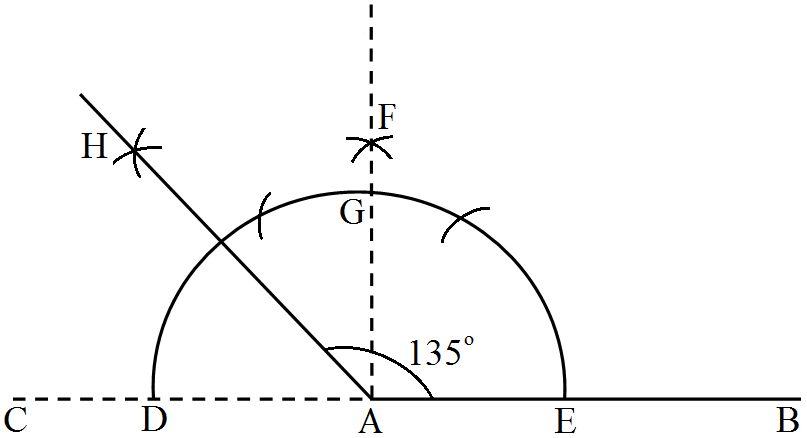
Steps of construction:
$1.$ Draw a line segment $AB$ and produce $BA$ to $C$.
$2.$ Keeping $A$ as the centre and any radius draw an arc which intersects $AC$ at $D$ and $AB$ at $E$.
$3.$ Keeping $D$ and $E$ as centre and radius more than half of $DE$ draw arcs which intersect each other at $F$.
$4.$ Join $FA$ which intersects the arc in $(2)$ at $G$.
$5.$ Keeping $G$ and $D$ as centre and radius more than half of $GD$ draw arcs which intersect each other at $H$
$6.$ Join $HA$.
Therefore $\angle\text{HAB}=135^\circ $ View full question & answer→Question 164 Marks
Construct a triangle whose perimeter is $6.4\ cm$, and angles at the base are $60^\circ$ $45^\circ$.
Answer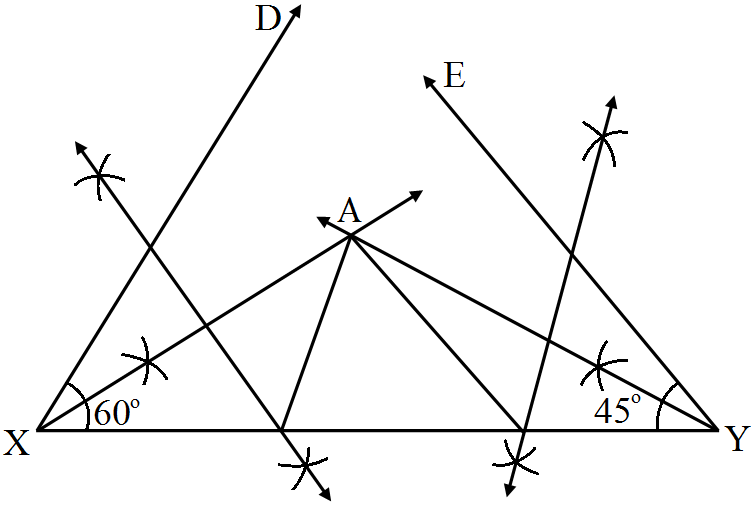
Steps of construction:
$1.$ Draw a line segment $XY$ of $6.4\ cm$.
$2.$ Draw $\angle\text{DXY}=60^\circ$ and $\angle\text{EYX}=45^\circ.$
$3.$ Draw the angle bisectors of $\angle\text{DXY}$ and $\angle\text{EYX}$ which intersect each other at $A$.
$4.$ Draw the perpendicular bisector of $AX$ and $AY$ which intersect $XY$ at $B$ and $C$ respectively.
$5.$ Join $AB$ and $AC$.
Hence $\triangle\text{ABC}$ is the required triangle. View full question & answer→Question 174 Marks
Construct a $\triangle ABC$ such that $BC = 6\ cm, AB = 6\ cm$ and median $AD = 4\ cm$.
Answer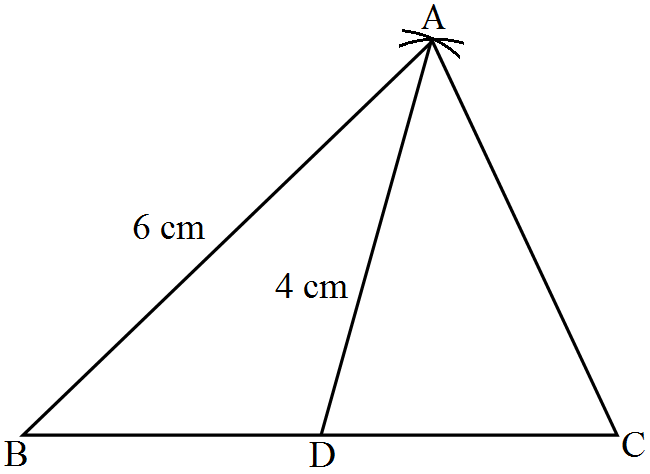
Steps of construction:
$1.$ Draw a line segment $BC$ of $6\ cm$.
$2.$ Take mid$-$point $O$ of side $BC$.
$3.$ With center $B$ and $D$ and radii $6\ cm$ and $4\ cm$, draw two arcs which intersect each other at $A$.
$4.$ Join $AB, AD$ and $AC$.
Hence $\triangle\text{ABC}$ is the required triangle. View full question & answer→Question 184 Marks
Construct a $\triangle\text{ABC}$ in which $BC = 3.6\ cm, AB + AC = 4.8\ cm$ and $\angle\text{B}=60^\circ. $
Answer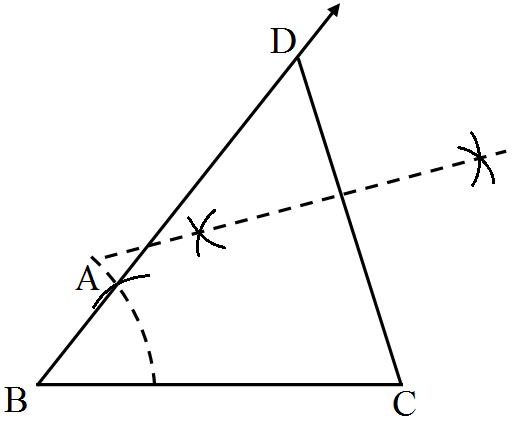
Steps of Construction:
$1.$ Construct a line segment $BC$ of $3.6\ cm$.
$2.$ At the point $B$, draw $\angle\text{XBC}=60^\circ.$
$3.$ Keeping $B$ as center and radius $4.8\ cm$ draw an arc which intersects $XB$ at $D$.
$4.$ Join $DC$.
$5.$ Draw the perpendicular bisector of $DC$ which intersects $DB$ at $A$.
$6.$ Join $AC$.
Hence $\triangle\text{ABC}$ is the required triangle. View full question & answer→Question 194 Marks
Draw a circle with centere at point $O$. Draw its two chords $AB$ and $CD$ such that $AB$ is not parallel to $CD$. Draw the perpendicular bisectors of $AB$ and $CD$. At what point do they intersect?
Answer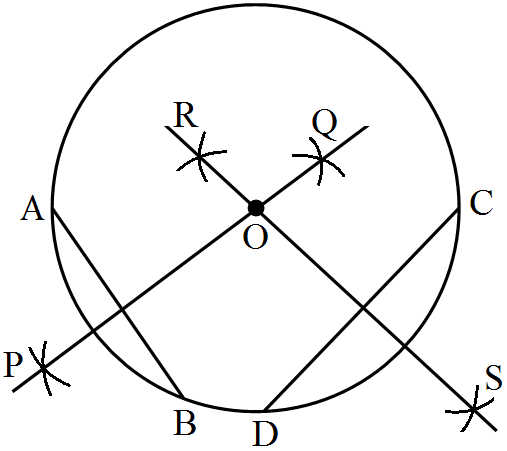
Steps of construction:
$1. O$ as the centre and any radius draw a circle.
$2.$ Draw two chords $AB$ and $CD$.
$3.$ Keeping $A$ as centre and radius more than half of $AB$ draw arcs, one on each side of $AB$.
$4.$ Keeping $B$ as centre and the same radius draw arcs cutting the previous arcs at point $P$ and $Q$ respectively.
$5.$ Join the points $P$ and $Q$.
$6.$ Keeping $D$ as centre and radius more than half of $DC$ draw arcs, one on each side of $DC$.
$7.$ Keeping $C$ as centre and the same radius draw arcs cutting the previous arcs at points $R$ and $S$ respectively.
$8.$ Join the points $R$ and $S$.
Both the perpendicular bisectors $PQ$ and $RS$ intersect each other at the centre $O$ of the circle. View full question & answer→Question 204 Marks
Using rulers and compasses only, construct a $\triangle\text{ABC}$ from the following data:
$AB + BC + CA = 12\ cm$, $\angle\text{B}=45^\circ$ and $\angle\text{C}=60^\circ$
Answer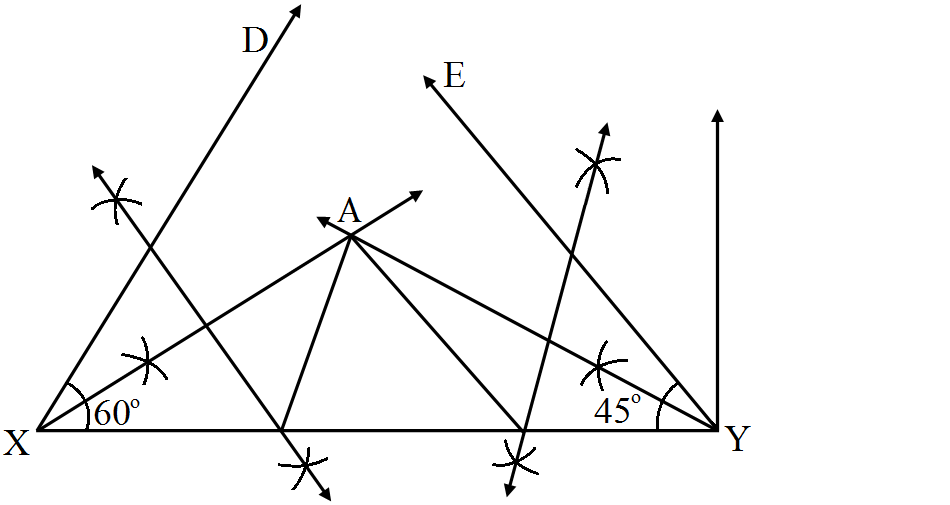
Steps of construction:
$1.$ Draw a line segment $XY$ of $12\ cm$.
$2.$ Draw $\angle\text{DXY}=45^\circ$ and $\angle\text{EYX}=60^\circ.$
$3.$ Draw the angle bisectors of $\angle\text{DXY}$ and $\angle\text{EYX}$ which intersect each other at $A$.
$4.$ Draw the perpendicular bisector of $AX$ and $AY$ which intersect $XY$ at $B$ and $C$ respectively.
$5.$ Join $AB$ and $AC$.
Hence $\triangle\text{ABC}$ is the required triangle. View full question & answer→