Question 12 Marks
Rationalize the denominator of $\frac{1}{{\sqrt 7 - \sqrt 6 }}$
Answer$\frac{1}{{\sqrt 7 - \sqrt 6 }}$
We need to multiply the numerator and denominator of $\frac{1}{{\sqrt 7 - \sqrt 6 }}$ by $\sqrt 7 + \sqrt 6,to get \frac{1}{{\sqrt 7 - \sqrt 6 }} \times \frac{{\sqrt 7 + \sqrt 6 }}{{\sqrt 7 + \sqrt 6 }} = \frac{{\sqrt 7 + \sqrt 6 }}{{\left( {\sqrt 7 - \sqrt 6 } \right)\left( {\sqrt 7 + \sqrt 6 } \right)}}$
We need to apply the formula $\left( {a - b} \right)\left( {a + b} \right) = {a^2} - {b^2}$ in the denominator to get
$\frac{1}{{\sqrt 7 - \sqrt 6 }} = \frac{{\sqrt 7 + \sqrt 6 }}{{{{\left( {\sqrt 7 } \right)}^2} - {{\left( {\sqrt 6 } \right)}^2}}}$
$= \frac{{\sqrt 7 + \sqrt 6 }}{{7 - 6}}$
$= \sqrt 7 + \sqrt 6 .$
Therefore, we conclude that on rationalizing the denominator of $\frac{1}{{\sqrt 7 - \sqrt 6 }}$ we get $\sqrt 7 + \sqrt 6$ .
View full question & answer→Question 22 Marks
Represent $\sqrt{9.3}$ on the number line.
Answer
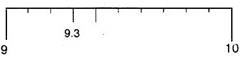
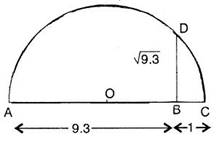
The distance $9.3$ from a fixed point $A$ on a given line to obtain a point $B$ such that $A B=9.3$ units. From $B$ mark a distance of $1$ unit and mark the new point as $C$. Find the mid-point of $A C$ and mark that point as $O$. Draw a semicircle with centre $O$ and radius $O C$. Draw a line perpendicular to $A C$ passing through $B$ and interesting the semi-circle at $D$ . Then $BD =\sqrt{9.3}$.
View full question & answer→Question 32 Marks
Simplify the expression: $(\sqrt{5}-\sqrt{2})(\sqrt{5}+\sqrt{2})$
Answer$\left( {\sqrt 5 - \sqrt 2 } \right)\left( {\sqrt 5 + \sqrt 2 } \right)$ We need to apply the formula $\left( {a - b} \right)\left( {a + b} \right) = {a^2} - {b^2}$ to find value of ${\left( {\sqrt 5 + \sqrt 2 } \right)^2}$
$ (\sqrt 5 - \sqrt 2)(\sqrt 5 + \sqrt 2)$= $ [(\sqrt 5)^2 - (\sqrt 2)^2]$
$= 5 - 2 = 3$
Therefore, on simplifying $\left( {\sqrt 5 - \sqrt 2 } \right)\left( {\sqrt 5 + \sqrt 2 } \right)$,we get $3.$
View full question & answer→Question 42 Marks
Simplify the expression:
${\left( {\sqrt 5 + \sqrt 2 } \right)^2}$
Answer${\left( {\sqrt 5 + \sqrt 2 } \right)^2}$
We need to apply the formula ${\left( {a + b} \right)^2} = {a^2} + 2ab + {b^2} \ to \ find\ value\ of \ {\left( {\sqrt 5 + \sqrt 2 } \right)^2}$
${\left( {\sqrt 5 + \sqrt 2 } \right)^2} = {\left( {\sqrt 5 } \right)^2} + 2 \times \sqrt 5 \times \sqrt 2 + {\left( {\sqrt 2 } \right)^2}$
$ = 5 + 2\sqrt {10} + 2$
$= 7 + 2\sqrt {10}$
Therefore, on simplifying ${\left( {\sqrt 5 + \sqrt 2 } \right)^2}$ , we get $7 + 2\sqrt {10} $ Therefore, on simplifying ${\left( {\sqrt 5 + \sqrt 2 } \right)^2}$, we get $7 + 2\sqrt {10}$
View full question & answer→Question 52 Marks
Simplify the expression:
$\left( {3 + \sqrt 3 } \right)\left( {3 - \sqrt 3 } \right)$
Answer$\left( {3 + \sqrt 3 } \right)\left( {3 - \sqrt 3 } \right)$
We need to apply distributive law to find value of $\left( {3 + \sqrt 3 } \right)\left( {3 - \sqrt 3 } \right)$ $\left( {3 + \sqrt 3 } \right)\left( {3 - \sqrt 3 } \right) = 3\left( {3 - \sqrt 3 } \right) + \sqrt 3 \left( {3 - \sqrt 3 } \right)$
$= 9 - 3\sqrt 3 + 3\sqrt 3 - 3$
$= 6$
Therefore, on simplifying $\left( {3 + \sqrt 3 } \right)\left( {3 - \sqrt 3 } \right)$, we get $6.$
View full question & answer→Question 62 Marks
Simplify the expression:
$\left( {3 + \sqrt 3 } \right)\left( {2 + \sqrt 2 } \right)$
Answer$\left( {3 + \sqrt 3 } \right)\left( {2 + \sqrt 2 } \right)$
We need to apply distributive law to find value of $\left( {3 + \sqrt 3 } \right)\left( {2 + \sqrt 2 } \right)$
$\left( {3 + \sqrt 3 } \right)\left( {2 + \sqrt 2 } \right) = 3\left( {2 + \sqrt 2 } \right) + \sqrt 3 \left( {2 + \sqrt 2 } \right)$
$ = 6 + 3\sqrt 2 + 2\sqrt 3 + \sqrt 6 $
Therefore, on simplifying$ \left( {3 + \sqrt 3 } \right)\left( {2 + \sqrt 2 } \right)$,we get $6 + 3\sqrt 2 + 2\sqrt 3 + \sqrt 6 $
View full question & answer→Question 72 Marks
Classify the number $1.101001000100001......$ as rational or irrational.
Answer$\because$ The decimal expansion is non-terminating non-recurring.
$1.101001000100001......$ is an irrational number.
View full question & answer→Question 82 Marks
Classify the number $7.478478..... $ as rational or irrational.
Answer7.478478..... = $7.\overline{478}$
$\because$ The decimal expansion is non-terminating recurring.
$\therefore$ $7.478478......$ is a rational number.
View full question & answer→Question 92 Marks
Classify the number $0.3796$ as rational or irrational.
Answer$\therefore$ The decimal expansion is terminating.
$\therefore 0.3796$ is a rational number.
View full question & answer→Question 102 Marks
Classify the number $\sqrt {225} $ as rational or irrational.
Answer
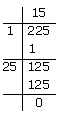
$\because$ $\sqrt {225}$ = 15 = $\frac {15} {1}$
$\therefore$ $\sqrt {225}$ is a rational number.
Here$ p = 15$
q = $1( \neq 0)$ View full question & answer→Question 112 Marks
Classify $\sqrt { 23 }$ as rational or irrational.
Answer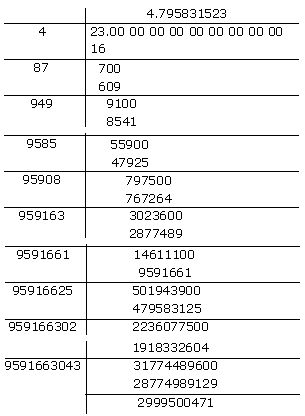
Thus, $\sqrt { 23 } = 4.795831523......$
$\because$ The decimal expansion is non-terminating non-recurring.
$\therefore$ $\sqrt { 23 }$ is an irrational number. View full question & answer→Question 122 Marks
Find three different irrational numbers between the rational numbers $\frac {5} {9} $ and $\frac {9} {11} $.
Answer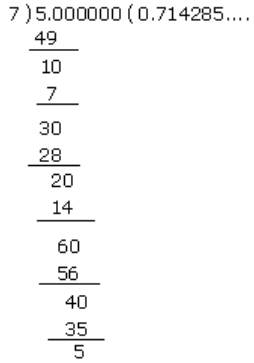
Thus, $\frac {5} {7}$ = 0.714285 ... = $0 . \overline{714285}$
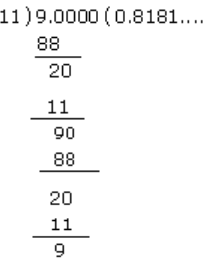
Thus, $\frac {9} {11} $ = 0.8181 ... = $0 . \overline{81}$
Three different irrational numbers between the rational $\frac {5} {9} $ and $\frac {9} {11} $ can be taken as
$0.75 075007500075000075 ...$
$0.7670767000767 ...,$
$0.808008000800008 ...$ View full question & answer→Question 132 Marks
Express $0.99999....$ in the form $\frac{p}{q}$ .Are you surprised by your answer? Discuss why the answer makes sense with your teacher and classmates.
View full question & answer→Question 142 Marks
Write in decimal form and say what kind of decimal expansion: $\frac{329}{400}$
Answer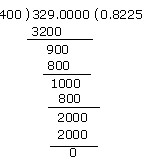
$\frac{329}{400} = 0.8225$
The decimal expansion is terminating. View full question & answer→Question 152 Marks
Write in decimal form and say what kind of decimal expansion: $\frac{2}{{11}}$
Answer$\frac{2}{{11}}$ On dividing $2$ by $11$, we get
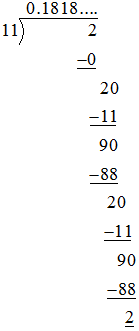
We can observe that while dividing $2$ by $11$, first we got the remainder as $2$ and then $9$, which will continue to be $2$ and $9$ alternately.
Therefore, we conclude that $\frac{2}{{11}} = 0.1818.....{\text{ or }}\frac{2}{{11}} = 0.\overline {18}$ , which is a non-terminating decimal and recurring decimal. View full question & answer→Question 162 Marks
Write in decimal form and state what kind of decimal expansion: $\frac{3}{{13}}$
Answer$\frac{3}{{13}}$ On dividing $3$ by $13$, we get
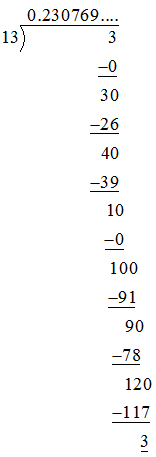
We can observe that while dividing $3$ by $13$ we got the remainder as $3$, which will continue to be $3$ after carrying out $6$ continuous divisions.
Therefore, we conclude that $\frac{3}{{13}} = 0.230769.....{\text{ or }}\frac{3}{{13}} = 0.\overline {230769} $, which is a non-terminating decimal and recurring decimal. View full question & answer→Question 172 Marks
Write in decimal form and say what kind of decimal expansion: 4$\frac {1} {8}$
Answer4$\frac {1} {8}$ $=\frac{4 \times 8+1}{8}$$=\frac{32+1}{8}=\frac{33}{8}$
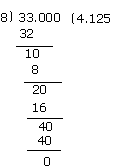
$\therefore$ 4$\frac {1} {8} = 4.125$
The decimal expansion is terminating. View full question & answer→Question 182 Marks
Write in decimal form and say what kind of decimal expansion: $\frac{1}{11}$
Answer
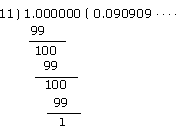
$\therefore$ $\frac {1} {11} = 0.090909 ... = 0 . \overline{09}$
The decimal expansion is non-terminating repeating. View full question & answer→Question 192 Marks
Classroom activity (Constructing the 'square root spiral') : Take a large sheet of paper and construct the 'square root spiral' in the following fashion. Start with a point $O$ and draw a line segment $O P_1$ of unit length. Draw a line segment $P_1 P_2$ perpendicular to $O P_1$ of unit length (see Fig.). Now draw a line segment $P_2 P_3$ perpendicular to $O P_2$. Then draw a line segment $P_3 P_4$ perpendicular to $O P_3$. Continuing in this manner, you can get the line segment $P_{n-1} P_n$ by drawing a line segment of unit length perpendicular to $OP _{n-1}$. In this manner, you will have created the points $P _2$, $P_3, \ldots, P_n, \ldots$, and joined them to create a beautiful spiral depicting $\sqrt{2}, \sqrt{3}, \sqrt{4}, \ldots$
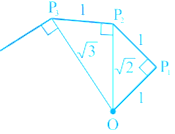
Fig. : Constructing square root spiral AnswerFor the square root spiral follow the given steps:
$i.$ Draw a line $A B$ of length $1$ unit.
$ii.$ Draw another line $B C \perp A B$ of length $1$ unit .
$iii$. Now, Join point $A C$. Here, $A C$ represents a line of length $\sqrt{2}$ units. (This can be easily found using Pythagoras Theorem right $\triangle A B C$
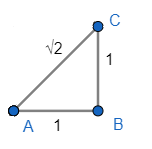
$i.$ Now, Draw a perpendicular $CD$ of length $1$ unit at point $C$ and join points $A$ and $D . A D$ here represents length $\sqrt{3}$
$ii.$ Similarly proceeding further we get Square Root Spiral. View full question & answer→Question 202 Marks
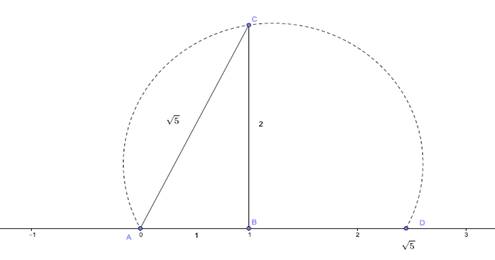
Show how $\sqrt 5 $ can be represented on the number line.
AnswerAccording to the Pythagoras theorem, we can conclude that $(\sqrt{5})^2=(2)^2+(1)^2$ We need to draw a line segment $A B$ of 1 unit on the number line. Then draw a straight line segment $B C$ of $2$ units. Then join the points $C$ and $A$, to form a line segment $B C$. Then draw the arc $A C D$, to get the number $\sqrt{5}$ on the number line.
View full question & answer→Question 212 Marks
Find six rational numbers between $3$ and $4.$
AnswerWe know that there are infinite rational numbers between any two numbers. A rational number is the one that can be written in the form of $\frac{p}{q}$, where p and q are integers and $q \ne 0$ We know that the numbers all lie between $3$ and $4$. We need to rewrite the numbers in $\frac{p}{q}$ form to get the rational numbers between $3$ and $4$. So, we cover it in$\frac{p}{q}$$\eqalign{ & {3 \over 1} = {3 \over 1} \times {{10} \over {10}} = {{30} \over {10}} \cr & {4 \over 1} = {4 \over 1} \times {{10} \over {10}} = {{40} \over {10}} \cr} $
So any six number between ${{30} \over {10}},{{40} \over {10}}$will be the answer example ${{31} \over {10}},{{33} \over {10}},{{34} \over {10}},{{35} \over {10}},{{37} \over {10}},{{38} \over {10}}$
View full question & answer→Question 222 Marks
Is zero a rational number? Can you write it in the form $\frac { p } { q }$, where p and q are integers and $q \neq 0$?
AnswerConsider the definition of a rational number.
A rational number is the one that can be written in the form of $\frac { p } { q }$, where $p$ and $q$ are integers and $q \neq 0$.
Zero can be written as $\frac { 0 } { 1 } , \frac { 0 } { 2 } , \frac { 0 } { 3 } , \frac { 0 } { 4 } , \frac { 0 } { 5 }.....$
So, we arrive at the conclusion that $0$ can be written in form of $\frac { p } { q }$, where $q$ is any integer. Therefore, zero is a rational number.
View full question & answer→Question 232 Marks
Show that $0.2353535... = 0. 2\overline{35}$, can be expressed in the form $\frac{p}{q}$, where $p$ and $q$ are integers and q $\ne 0.$
AnswerLet $x = 0.235... ---- (i)$
Multiplying both sides by $10$
$10x = 2.35....-----(ii)$
Multiplying both sides by $100$
$1000x = 235.35....----(iii)$
Subtracting $(ii)$ from $(iii)$
$1000x - 10x = 235.35...- 2.35...$
$990x = 233$
$x = \frac{233}{990}$
View full question & answer→Question 242 Marks
Show that $0.3333... = 0.\overline 3$ can be expressed in the form $\frac{p}{q}$, where $p$ and $q$ are integers and $q \ne 0.$
AnswerWe have to expressed $0.3333... = 0.\overline 3$ in the form $\frac{p}{q}$, where $p$ and $q$ are integers and $q \ne 0.$
Let $x = 0.3333... ----(i)$
Multiplying eq $(i)$ by $10$, we get
$10 x = 10 \times (0.333...) = 3.333...----(ii)$
Subtracting eq $(i)$ from $(ii)$
$10x - x = 3.333... - .333...$
$9x = 3, i.e., x = $$\frac{1}{3}$
View full question & answer→Question 252 Marks
Simplify: $2 ^ { \frac { 2 } { 3 } } \cdot 2 ^ { \frac { 1 } { 3 } }$
AnswerGiven, $2 ^ { \frac { 2 } { 3 } } \cdot 2 ^ { \frac { 1 } { 3 } }$ We know that $a ^ { m } \cdot a ^ { n } = a ^ { ( m +n) }$.
So, $2 ^ { \frac { 2 } { 3 } } \cdot 2 ^ { \frac { 1 } { 3 } } = ( 2 ) ^ { \frac { 2 } { 3 } + \frac { 1 } { 3 } }$
$= ( 2 ) ^ { \frac { 2+1} { 3} }\\ = ( 2 ) ^ { \frac { 3 } { 3 } }\\=(2)^1\\=2$
Therefore, the value of $2 ^ { \frac { 2 } { 3 } } \cdot 2 ^ { \frac { 1 } { 3 } }$ will be $2$.
View full question & answer→Question 262 Marks
Rationalise the denominator of $\frac{5}{\sqrt{3}-\sqrt{5}}$
AnswerLet $y=\frac{5}{\sqrt{3}-\sqrt{5}}$ and its denominator $=\sqrt{3}-\sqrt{5}$
Here, the conjugate of denominator $(\sqrt{3}-\sqrt{5})$ is $(\sqrt{3}+\sqrt{5})$.
$y=\frac{5}{\sqrt{3} \sqrt{5}} \times \frac{\sqrt{3}+\sqrt{5}}{\sqrt{3}+\sqrt{5}}[\text { by rationalising })$
$=\frac{5(\sqrt{3}+\sqrt{5})}{(\sqrt{3})^2-(\sqrt{5})^2}\left[\because(a-b)(a+b)=a^2-b^2\right]$
$=\frac{5(\sqrt{3}+\sqrt{5})}{3-5}=-\frac{5}{2}(\sqrt{3}+\sqrt{5})$
View full question & answer→Question 272 Marks
Simplify the expression: ($\sqrt{3} + \sqrt{7})^2$
AnswerThe given expression is:
($\sqrt{3} + \sqrt{7})^2$
= ($\sqrt{3})^2 + 2 \times \sqrt{3} \times \sqrt{7} + (\sqrt{7})^2 \left[\because(a+b)^2=a^2+2 a b+b^2\right]$
= 3 + 2$\sqrt{21}$ + 7
$=10+2\sqrt{21}$
View full question & answer→Question 282 Marks
Simplify the expression: (5 + $\sqrt{5}$)(5 - $\sqrt{5}$)
Answer$(5-\sqrt{5})(5+\sqrt{5})$
According to the formula $a^2-b^2=(a+b)(a-b)=(5)^2-(\sqrt{5})^2$
So we get
$=25-5$
$=20$
Hence $(5-\sqrt{5})(5+\sqrt{5})$ is rational.
View full question & answer→Question 292 Marks
Simplify the expression: (5 + $\sqrt{7}$)( 2 + $\sqrt{5}$)
AnswerIt is given that,
(5 + $\sqrt{7}$)(2 + $\sqrt{5}$) [opening both the brackets using distributive property]
= (5 $\times$ 2)+(5 $\times$ $\sqrt{5}$) +( $\sqrt{7}$ $\times$ 2)+( $\sqrt{7}$ $\times$ $\sqrt{5}$)
= 10 + 5$\sqrt{5}$ + 2$\sqrt{7}$ + $\sqrt{7 \times 5}$ = 10 + 5$\sqrt{5}$ + 2$\sqrt{7}$ + $\sqrt{35}$
View full question & answer→Question 302 Marks
Check whether $7 \sqrt{5}, \frac{7}{\sqrt{5}}, \sqrt{2}+21, \pi-2$, are irrational numbers or not.
AnswerRecall that (I) $\sqrt{p}$ is always an irrational number where p is prime number.$(ii)$ Sum of a rational and irrational number is always irrational.
Thus
$7 \sqrt{5} , \frac{7}{\sqrt{5}}$ $\sqrt{2}$ $+ 21, \pi – 2$
So, all these are irrational numbers.
View full question & answer→