Questions

[3 marks Question Answer]

🎯

Test yourself on this topic

15 questions · timed · auto-graded

Question 13 Marks
Give reason, why a matured mammalian erythrocyte lacks nucleus and mitochondria?
Answer
A matured mammalian erythrocyte lacks a nucleus and mitochondria. The lack of a nucleus
increases the surface area-volume ratio of RBCs, thus increasing the area for oxygen absorption.
Also, the lack of a nucleus reduces the size of the cell, making it easy to flow through the blood
vessels and more cells can be accommodated in a small area.
The lack of mitochondria implies that the cell does not use any oxygen absorbed for respiration,
thus increasing the efficiency of the cell to transport oxygen as all the oxygen absorbed is
transported without any loss.
View full question & answer
Question 23 Marks
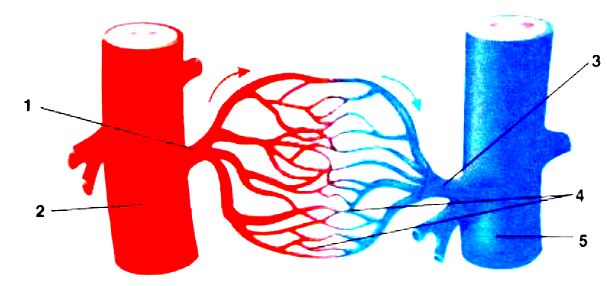
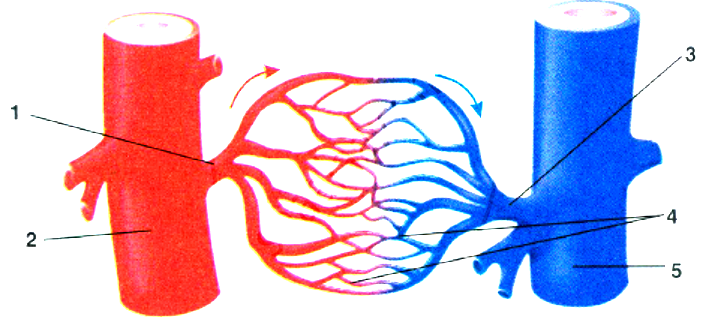
Given below is a diagrammatic representation of certain types of blood vessels in human body.

Where can such an arrangement be found as an example - in lungs or in heart walls?
Answer
The types of blood vessels numbered 1 to 5:
  • 1 represents Arteriole
  • 2 represents Artery
  • 3 represents Venule
  • 4 represents Capillaries
  • 5 represents Vein

Such an arrangement can be found in the Lungs.
View full question & answer
Question 33 Marks
Given below is a diagrammatic representation of certain types of blood vessels in human body.
Identify the types of blood vessels numbered 1 to 5.
Answer
1 - Arteriole
2 - Artery
3 - Venule
4 - Capillaries
5 - Vein
View full question & answer
Question 43 Marks
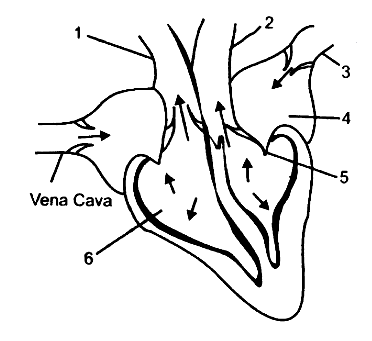
The diagram given below represents the human heart in one phase of its activity. Study the same and then answer the question that follow:
Name the parts numbered 1 to 6.
Answer

1

Pulmonary Artery

2

Aorta

3

Pulmonary Vein

4

Left Atrium

5

Bicuspid Valve

6

Right Ventricle
View full question & answer
Question 53 Marks
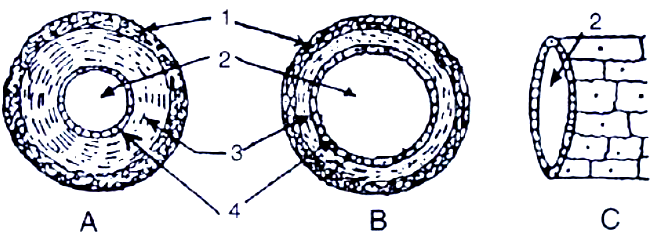
The figures given below show diagrammatic cross-sections of three kinds of blood vessels.

(a) Identify the blood vessels A, B and C
(b) Name the parts labelled 1-4
(c) Mention two structural differences between A and B.
(d) Name the kinds of blood that flow through A and through B respectively.
(e) In which one of the above vessels referred to in (a) above does the exchange of gases actually take place?
Answer
(a) A - Artery, B - Vein, C - Capillary
(b)
1 - External layer made of connective tissue
2 - Lumen
3 - Middle layer of smooth muscles and elastic fibres
4 - Endothelium
(c) An artery has thick muscular walls and a narrow lumen. It does not have any valve.
A vein on the other hand has thin muscular walls and a wider lumen. It has valves to prevent backflow of blood.
(d) A (Artery) - oxygenated blood, B (Vein) - deoxygenated blood
(e) At the capillary level the actual exchange of gases takes place.
View full question & answer
Question 63 Marks
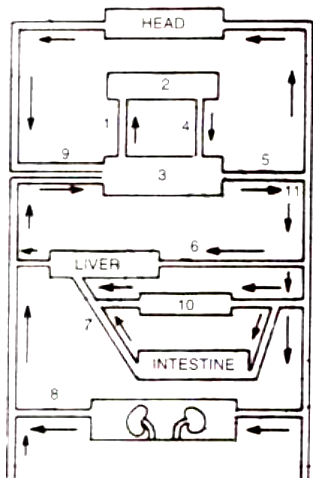
Given below is a highly schematic diagram of the human blood circulatory system.
Which numbers represent the following respectively?
Aorta
Hepatic portal vein
Pulmonary artery
Superior vena cava
Renal vein
Stomach
Answer
Aorta5
Hepatic portal vein7
Pulmonary artery1
Superior vena cava9
Renal vein8
Stomach10
View full question & answer
Question 73 Marks
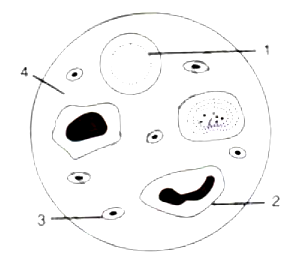
Given below is a diagram of a smear of human blood. Study the same and answer the question that follow:
What is the main function of the parts labeled 1, 2 and 3 respectively?
Answer
Function of part 1 (RBC): Transport of respiratory gases to the tissues and from the tissues, transport of nutrients from the alimentary canal to the tissues.

Function of part 2 (WBC): WBCs play major role in defense mechanism and immunity of the body.

Function of part 3 (Blood Platelet): Blood platelets are the initiator of blood clotting.
View full question & answer
Question 83 Marks
The table below is designed to indicate the transport of certain substance in our body. Fill in the
blanks with suitable answers.
SubstanceFromTo
LungsWhole body
Carbon dioxide
Urea
Digested
carbohydrates
Intestines
Target organs
Answer
SubstanceFromTo
OxygenLungsWhole body
Carbon dioxideWhole bodyLungs
UreaWhole bodyKidneys
Digested carbohydratesIntestinesWhole body
HormonesEndocrine glandsTarget organs
View full question & answer
Question 93 Marks
Match the items in Column ‘A’ with those in column ‘B’ Rewrite the correct matching pairs.
Column AColumn B
SA nodePlasma
Defective hemoglobin in RBCSerum
Muscle fibres located in the heartPacemaker
The liquid squeezed out of blood
during clotting
Sickle cell anemia
Never tires, keep on contracting and
relaxing
Purkinje fibres
Cardiac cycleCardiac muscles
Liquid part of the blood without
corpuscles
0.85 sec
Answer
Column AColumn B
SA nodePacemaker
Defective hemoglobin in RBCSickle cell anemia
Muscle fibres located in the heartPurkinje fibres
The liquid squeezed out of blood
during clotting
Serum
Never tires, keep on contracting and
relaxing
Cardiac muscles
Cardiac cycle0.85 sec
Liquid part of the blood without
corpuscles
Plasma
View full question & answer
Question 103 Marks
What does the term “double circulation” mean?
Answer
Blood flows twice in the heart before it completes one full round. The full round thus includes
pulmonary and systemic circulation. In pulmonary circulation, blood enters the lungs through
pulmonary arteries. Pulmonary veins collect the blood from the lungs and carry it back to the
left atrium.
In systemic circulation, blood from the left ventricle enters the aorta through which the blood is
sent to the body parts. From the body parts blood is collected by veins and sent back to the heart.
Therefore, the blood circulation in the human body is called double circulation.
View full question & answer
Question 113 Marks
Enumerate the structural differences between white blood cells and red blood cells.
Answer
Structural Differences between White Blood Cells and Red Blood Cells:
White Blood CellsRed Blood Cells
1. White blood cells are amoeboid.Red blood cells are minute biconcave disclike
structures.
2. They are nucleated cells.They anucleated cells.
3. Haemoglobin is absent in white
blood cells.
Haemoglobin is present in red blood cells.
View full question & answer
Question 123 Marks
Describe the structural differences between an artery and a vein.
Answer
ArteryVein
An artery is a vessel which carries blood
away from the heart towards any organ.
A vein is a vessel which conveys the
blood away from an organ towards the
heart.
An artery has thick muscular walls.A vein has thin muscular walls.
It has a narrow lumen.It has a broad lumen.
There are no valves.Thin pocket-shaped valves are present in
the veins.
Arteries progressively decrease in size
and branch to form arterioles. Arterioles
further breaks up to form capillaries.
Capillaries unite to form branches called
Venules. Venules further unite to form
veins.
View full question & answer
Question 133 Marks
State any five functions of the blood.
Answer
The functions of the blood are:
(a) Transport of digested food from the alimentary canal to tissues. These substances are
simple sugars like glucose, amino acids, vitamins, mineral salts, etc.
(b) Transport of oxygen in the form of an unstable compound 'oxyhaemoglobin' from the lungsto the tissues.
(c) Transport of carbon dioxide from the tissues to the lungs.
(d) Transport of excretory materials from the tissues to the liver, kidney or the skin for
elimination.
(e) Distribution of hormones from glands to the target sites.
(f) Distribution of heat to keep the body temperature uniform.
(Any five)

View full question & answer
Question 143 Marks
Give reason for the following:
The blood groups of both the donor and recipient must be known before transfusing blood.
Answer
During blood transfusion it is important that the blood groups of the donor and the recipient
are compatible. In case of an incompatible blood transfusion, the recipient develops
antibodies that attack the antigens present on the RBCs of the donor causing the blood cells
to clump together which may result in death. The examination of Rh factor is also necessary
for the blood transfusion. Therefore, the blood groups of both the donor and recipient must
be known before transfusing blood.
View full question & answer
Question 153 Marks
Explain the Term :
Double circulation
Answer
Double circulation: Double circulation in the heart refers to the way blood flows through the heart and the rest of the body in two separate loops or circuits. This system is composed of:
Pulmonary Circulation: Deoxygenated blood is sent from the heart to the lungs to get oxygenated, then returns to the heart. Systemic Circulation: Oxygenated blood from the heart is circulated throughout the body to deliver oxygen, then deoxygenated blood returns to the heart.
This efficient system enables high blood pressure in organs and quick oxygen delivery, vital for high metabolism in mammals and birds.
View full question & answer
[3 marks Question Answer] - Biology STD 10 Questions - Vidyadip