Question
Explain the Term :
Double circulation

Answer

Double circulation: Double circulation in the heart refers to the way blood flows through the heart and the rest of the body in two separate loops or circuits. This system is composed of:
Pulmonary Circulation: Deoxygenated blood is sent from the heart to the lungs to get oxygenated, then returns to the heart. Systemic Circulation: Oxygenated blood from the heart is circulated throughout the body to deliver oxygen, then deoxygenated blood returns to the heart.
This efficient system enables high blood pressure in organs and quick oxygen delivery, vital for high metabolism in mammals and birds.

Need a full question paper?

Generate a complete, print-ready paper with questions like this in minutes — across 16+ boards, with answer keys.

Start Generating Free

Similar questions

How can the knowledge of processes of reproduction help people in limiting the size of their families? Give two concrete examples
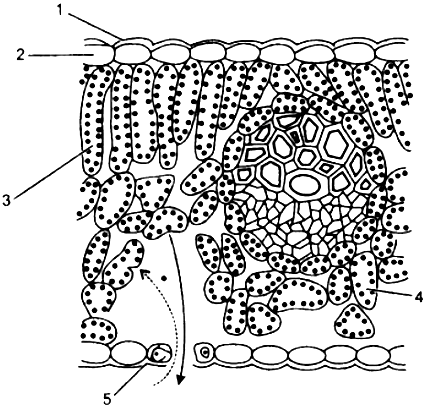
The figure below represents the vertical section of a leaf:

(i) Name the parts labeled 1 to 5.
(ii) What do the two arrows (dotted and solid) indicate in the day time and at night?
(iii) Could you add one more arrow in the figure? If yes, what for?
(iv) How many leaf veins have been shown in this section?
Differentiate Between Transpiration and Guttation.
Write short note on the following:
Guttation
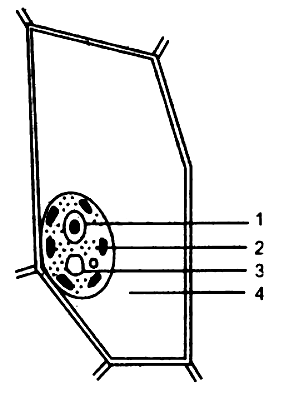
Given below is the diagram of a cell as seen under the microscope after having been placed in a solution:

(i) What is the technical term used for the state/condition of the cell given above?
(ii) Give the technical term for the solution in which the cell was placed.
(iii) Name the parts numbered 1 to 4.
(iv) Is the cell given above a plant cell or an animal cell ? Give two reasons in support of your answer as evident from the diagram.
(v) What would you do to bring this cell back to its original condition?
Explain the Term: Glomerulus
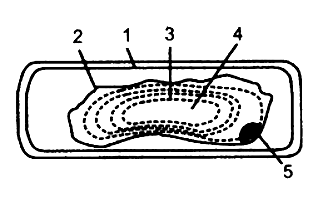
The below diagram represents a plant cell after being placed in a strong sugar solution. Guidelines 1 to 5 indicate the following:

1. Cell wall
2. Plasma membrane.
3. Protoplasm
4. Large vacuole
5. Nucleus
Study the diagram and answer the questions that follow :
(i) What is the state of the cell shown in the diagram?
(ii) Name the structure which acts as a selectively permeable membrane.
(iii) If the cell had been placed in distilled water instead of a strong sugar solution which features: would not have been present?
(iv) If the cell in the diagram possessed chloroplasts where would these be present?
(v) Name any one feature of this plant cell which is not present in animal cells.
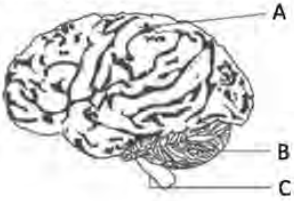
The diagram given below shows a section of the human brain.

Image

(i) Name the parts labelled $A, B$ and $C$.
(ii) Give the main function of each of the parts, $A, B$ and $C$.
(iii) Name the three protective membranes covering the brain.
Match the terms in column I with their explanations in column II.
  Column I (Term)   Column I (Explanation)
a genetics 1 Chromosomes similar in size and shapes
b Autosomes 2 The alternative forms of a gene
c Recessive gene 3 Study of laws of inheritance of characters
d Allele 4 A gene that can express only when in a
similar pair
e Homologous chromosomes 5 Chromosomes other than the pair of sex
chromosomes.