Questions

[3 marks Question Answer]

🎯

Test yourself on this topic

20 questions · timed · auto-graded

Question 63 Marks
What are the general properties of hormones?
Answer
General properties of hormones:
  1. Hormones are secreted by the endocrine glands.
  2. Hormones are specific in function.
  3. Hormonal actions are long lasting.
  4. Hormones are required in very minute quantities.
  5. They are secreted independent of one another.
  6. They act as chemical co-ordinators or chemical messengers.
  7. They are proteinaceous or steroid in nature..
  8. They are secreted in response to specific stimuli.
View full question & answer
Question 73 Marks
Complete the table given below by filling in the blanks numbered 1 to 8.
Gland Hormone Secreted Effect on Body
1 2 Regulates basal metabolism
Pancreas (β-cells) 3 4
5 6 Increases heart beat
7 Thyroid stimulating hormone 8
Answer
GlandHormone SecretedEffect on Body
1- Thyroid2 - ThyroxinRegulates basal metabolism
Pancreas ((3-cells)3 - Insulin4 - Controls blood sugar level
5 - Adrenal 6 - AdrenalineIncreases heart beat
7 - PituitaryThyroid stimulating hormone8 - Stimulates thyroid gland
View full question & answer
Question 83 Marks
What are the two kinds of diabetes? Mention their symptoms and the causes.
Answer
Two kinds of diabetes are:
(i) Diabetes insipidus (ii) Diabetes mellitus.
Symptoms and causes of diabetes insipidus:
(i) It is due to deficiency of antidiuretic hormone (ADH).
(ii) In this urination is frequent and copious, resulting in loss of water from the body and the person feels thirsty.
Symptoms and causes of diabetes mellitus:
(i) It is due to insufficient secretion of insulin hormone.
(ii) Presence of glucose in urine and high level of glucose in blood.
View full question & answer
Question 93 Marks
Write in brief about the causes and symptoms of exophthalmic goiter.
Answer
Exophthalmic goitre or Grave’s disease is caused by overactivity of the thyroid gland. The thyroid increases in size and leads to an increased metabolic rate, a high rate of heart beat and wasting away of the tissues of the body.
The apparent symptoms are:
  1. Goitre (Swelling in the neck).
  2. Protuberance of the eyeballs.
  3. The patient feels tired, nervous and restless.
View full question & answer
Question 103 Marks
People living in hilly regions usually suffer from simple goitre. Explain.
Answer
Iodine is essential for the production of thyroxin by the thyroid gland. The people living in hilly regions receive insufficient iodine in their diet, due to the fact that they drink iodine deficient water from rivers and streams fed by melting snow. Even their diet has little or no iodine. When there is a deficiency of iodine in the diet the thyroid gland enlarges in order to compensate for this deficiency resulting in goitre.
View full question & answer
Question 113 Marks
The thyroid gland is called as nature gland.
Answer
The thyroid gland is also called as nature gland because it secretes thyroxin hormone which is mainly responsible for the normal behaviour of human beings. In adequate supply of hormones human behaviour remains normal. In case of excess supply of hormones in the blood there are increased metabolic activities, raised nervous excitability and increased physical activity accompanied by fatigue and loss of weight.
View full question & answer
Question 123 Marks
Differentiate: Cretinism and Myxedema.
Answer
CretinismMyxedema
Caused by hyposecretion of thyroxine in infants.Caused by hyposecretion of thyroxine in adults.
It is characterized by stunted growth, pot belly, protruding tongue and pigeon chest.It is characterized by puffy appearance due to accumulation of fat in the subcutaneous tissue and oedema (accumulation of water in tissue space).
Mental and sexual retardation takes place.Mental and sexual development is not affected but patients lack alertness.
View full question & answer
Question 133 Marks
Differentiate: Hormones and Enzyme.
Answer
HormonesEnzyme
Act at sites usually far away from source.Act usually within the same cell or at the most close to the cell.
Always transported by blood.Not transported by blood. In some cases transported by ducts.
Chemically may be proteins, steroids or amino acids.Chemically always protein.
View full question & answer
Question 143 Marks
Differentiate: Endocrine gland and Exocrine gland.
Answer
Endocrine glandExocrine gland
(i) These are ductless glands.They may or may not have ducts.
(ii) They pour secretion directly into the blood.The secretion is poured directly at the sight of action or reaches the target.
(iii) They secrete hormones.They secrete enzymes.
(iv) They control long term activities of target organs, e.g., thyroid glands.They control short term activity, e.g., gastric gland.
View full question & answer
Question 153 Marks
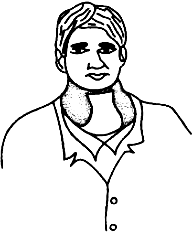
The sketch below shows a certain condition in an individual:

(i) Name the condition.
(ii) What is the underlying cause of this condition?
(iii) Name two other conditions that could have resulted due to a similar cause.
(iv) Which hormone is required for iodine synthesis?
(v) Where is the thyroid gland located?
(vi) The hormone secreted by the thyroid gland is controlled from which hormone?
Answer
(i) Goiter
(ii) The thyroid gland enlarges due to deficiency due to deficiency of iodine in the diet.
(iii)
1. Cretinism in children
2. Myxoedema
(iv) Thyroxin
(v) It is located in a mid-ventral position in the posterior part of the pharynx.
(vi) Thyroid-stimulating hormone/TSH.
View full question & answer
Question 163 Marks
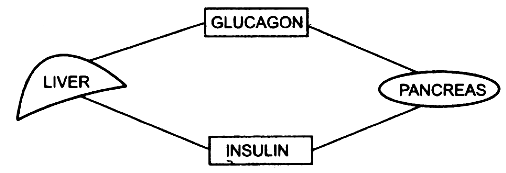
Study the diagram given below and then answer the question that follows

Why is the pancreas referred to as an exo-endocrine gland?
Answer
An endocrine gland is one which does not pour its secretions into a duct, while an exocrine gland is a gland which pours its secretions into a duct. Because the pancreas produces hormones such as insulin, glucagon and somatostatin directly into the blood and not into a duct, it functions as an endocrine gland. Because it secretes the pancreatic juices for digestion via a duct, it functions as an exocrine gland. Hence, the pancreas is an exo-endocrine gland.
View full question & answer
Question 173 Marks
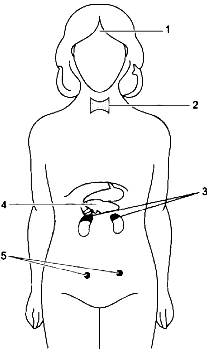
Given below is an outline of the human body showing the important glands.

(i) Name the glands marked 1 to 5.
(ii) Name the hormone secreted by 2. Give one important function of this hormone.
(iii) Name the endocrine cells present in part 3.
(iv) Name the hormone secreted by part 3. Give one important function of this hormone.
Answer
(i)
1. Pituitary,
2. Thyroid
3. Adrenal,
4. Pancreas,
5. Ovary.
(ii) Thyroxine.
It regulates the basal metabolism.
(iii) Islets of LangerhAnswer:
(iv) Adrenalin.
It prepares the body for some emergency by causing the production of glucose from glycogen in the liver, and releasing it into the blood.
View full question & answer
Question 183 Marks
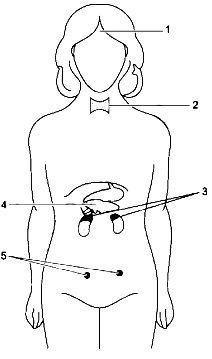
Some of the endocrine glands are shown by the guidelines.

(i) Name the glands 1 to 5.
(ii) Name any two endocrine glands which are not shown in the diagram.
(iii) Name one gland which is both exocrine and endocrine.
Answer
(i)
1. Pituitary,
2. Thyroid
3. Adrenal,
4. Pancreas,
5. Ovary.
(ii) Thymus, Parathyroid.
(iii) Pancreas.
View full question & answer
Question 193 Marks
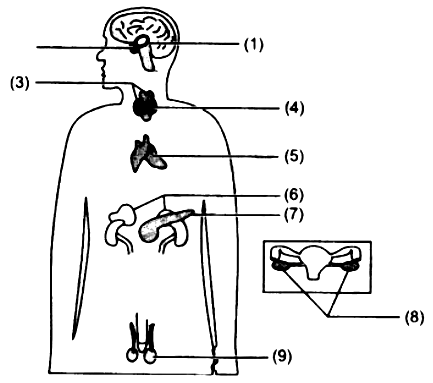
Place the words at the bottom of the page next to the number that shows the location of the Endocrine Glands.
(1) ________
(2) ________
(3) ________
(4) ________
(5) ________
(6) ________
(7) ________
(8) ________
(9) ________
Pancreas Hypothalamus Pituitary Parathyroid Ovaries Adrenal Thyroid Thymus Testes
Answer
(1) Pituitary
(2) Parathyroid
(3) Hypothalamus
(4) Thyroid
(5) Thymus
(6) Adrenal
(7) Pancreas
(8) Ovaries
(9) Tests
View full question & answer
Question 203 Marks
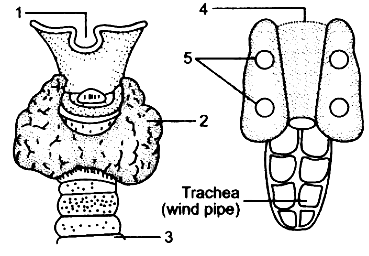
Given alongside are the diagrammatic sketches of some endocrine glands. Observe the figures and answer the following questions:
(i) Label the parts numbered 1 to 5.
(ii) Name the hormones secreted by (2) and (5).
(iii) Which chemicals in our body are greatly affected by hormones?
(iv) What is the chemical nature of hormones?
(v) Name the elements related to the functioning of hormones secreted by the structure (2) and (5).
Answer
(i)
1. Larynx.
2. Left lobe of the thyroid gland.
3. Trachea (windpipe).
4. Oesophagus.
5. Parathyroid glands.
(ii) Structure (2) secretes thyroxin hormone and structure (5) secretes parathormone.
(iii) Enzymes; which constitute the enzyme system of the body.
(iv) Hormones may be proteins, amino acids or steroids.
(v) Iodine is related to the functioning of glands (2) calcium, phosphorus is related to the functioning of the gland (5).
View full question & answer
[3 marks Question Answer] - Biology STD 10 Questions - Vidyadip