Questions

[3 marks Question Answer]

🎯

Test yourself on this topic

16 questions · timed · auto-graded

Question 43 Marks
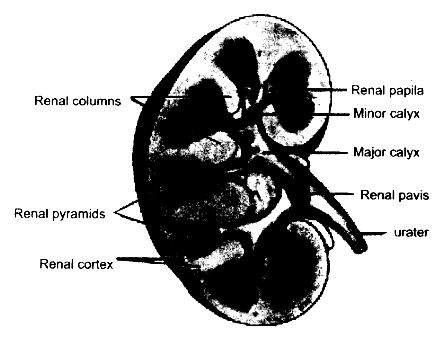
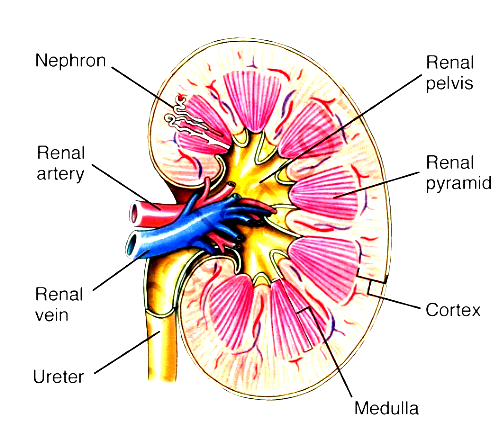
Draw a labeled diagram of the human kidney as seen in a longitudinal section.
Answer
Solution is as follow:
View full question & answer
Question 53 Marks
Write constituents of urine.
Answer

Constituents of Urine: The normal human urine consists of about 95% of water and 5% of solid wastes dissolved in it. The percentage of the solid wastes may slightly vary according to the food taken and according to the time after taking food but usually, these are approximately as follows:

Organic Constituents in (g/L) Inorganic Constituents in (g/L)
Urea — 2-3 Sodium chloride — 9-0
Creatinine — 1-5 Potassium chloride — 2-5
Uric acid — 0-7 Sulphuric acid — 1-8
Others — 2-6 Ammonia — 0-6
Others — 2-5

Besides the normal constituents the urine may pass out certain hormones and also certain medicines like the antibiotics and the excess vitamins.

View full question & answer
Question 63 Marks
Give the working of the nephron.
Answer
In a nephron, the blood .enters by afferent arteriole and is filtered through the glomerulus. The filtrate is passed into the Bowman’s capsule; by the process called ultrafiltration. The filtrate contains useful products like glucose, amino acids, salts, etc. The plasma proteins, blood corpuscles, and platelets are retained in the glomerular mass. The filtrate now passes through Henle’s loop where selective reabsorption of useful products takes place but urea and uric acid are not absorbed. Now the excretory substances are secreted by proximal and distal convoluted tubule and urine is formed.
View full question & answer
Question 73 Marks
What is dialysis? Under what condition is it carried out?
Answer
Dialysis involves the use of artificial kidney or a dialysis machine. The patient's blood is from the radial artery is led through the machine where excess salts and urea is removed. The purified blood is then returned to a vein in the same arm.
Dialysis is carried out in case of failure of both the kidneys. In case there is a permanent damage, then the dialysis is to be repeated for about 12 hours twice a week.
View full question & answer
Question 83 Marks
Explain the Term: Urinary bladder
Answer
Urinary bladder: It lies at the base of the abdomen and has a thin, elastic, and muscular wall. The urinary bladder receives the urine from the ureter. The wall of the bladder relaxes and the bladder expands to hold and store the urine, The urine cannot flow out continuously because of the contraction of the right sphincter muscles at its junction with the urethra. When the bladder is full, it contracts and the ring of sphincter muscles relaxes so that the urine is forced out through the urethra.
View full question & answer
Question 93 Marks
Explain the Term: Loop of Henle
Answer
Loop of Henle: The cells that comprise the loop of Henle are well-adapted for diffusion, filtration, and selective reabsorption. The final changes in the composition and the volume of the nephric filtrate occurs in the loop of Henle and the distal convoluted loop of the tubule. Glucose, amino acids, water, mineral salts, and some other substances leave the loop of Henle to pass into the blood capillaries that surround it.
View full question & answer
Question 103 Marks
Explain the Term: Glomerulus
Answer
Glomerulus: A single afferent arteriole of the renal artery breaks up into a number of capillary branches to form the glomerulus. The blood in the glomerulus is subjected to higher pressure since the diameter of the afferent arteriole is wider than that of the efferent arteriole that leaves the glomerulus, so ultra-filtration takes place.
View full question & answer
Question 113 Marks
Explain the Term: The Bowman’s capsule
Answer
The Bowman’s capsule is also called the Nephric capsule and represents the free end of the nephron. The Bowman’s capsule is a double-walled cup-like structure which lies in the cortex of the kidney. The glomerular filtrate which leaves the blood capillaries of the glomerulus during ultrafiltration enter the capsule and then passes to the first part of the nephric tubule.
View full question & answer
Question 123 Marks
Differentiate between:
Afferent arteriole and Efferent arteriole.
Answer
Afferent arteriole Efferent arteriole
It brings oxygenated blood into the kidney. It carries deoxygenated blood away from the kidney.
It is formed by the branching of the renal artery. It is formed by the fusing of glomerular capillaries.
Its diameter is two times wider than that of the efferent arteriole. Its diameter is two times narrower than that of the afferent arteriole.
View full question & answer
Question 133 Marks
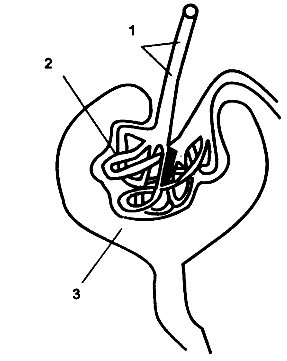
Study the diagram given below and then answer the questions that follow:

(i) Name the region in the kidney where the shown structure is present?
(ii) Name the parts labeled 1, 2,3, and 4.
(iii) Name the stages involved in the formation of urine.
(iv) What is the technical term given to the process occurring in 2 and 3?
Briefly describe the process.
Answer
(i) Renal cortex
(ii) 1. Afferent arteriole
2. Glomerulus
3. Bowman capsule
(iii) Ultrafilteration, reabsorption, and tubular secretion.
(iv) Ultrafilteration: In it blood entering the glomerulus under great pressure, is filtered. The liquid part of the blood filters through the walls of glomerular capillaries and Bowman’s capsule and enters into the nephron where it is called the glomerular filterate.
View full question & answer
Question 143 Marks
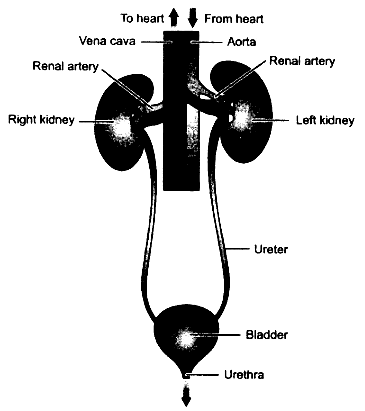
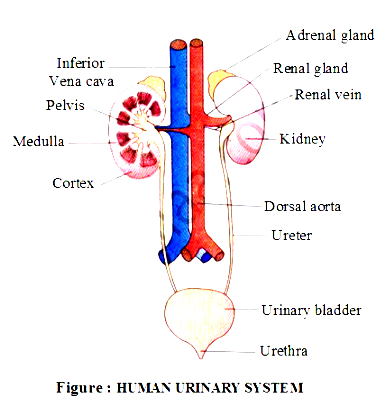
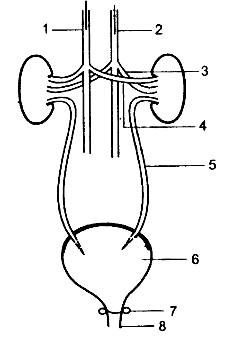
The diagram shows the Excretory System of a Human Being. Study the same and then answer the questions that follow:
(i) Name the parts labeled 1, 2,3, and 4.
(ii) Give the main function of the parts labeled 5,6, 7 and 8.
(iii) Name the endocrine gland which could be added in diagram and state its location/position
Answer
(i)
(1) Renal artery,
(2) Aorta,
(3) Renal arteries,
(4) Renal vein
(ii)
(5) Ureter—Carry urine to the bladder.
(6) Urinary bladder—Store urine
(7) Sphincter muscle—Control the voiding of urine
(8) Urethra—Urine released periodically.
(iii) Adrenal gland—At the top of kidney.
View full question & answer
Question 153 Marks
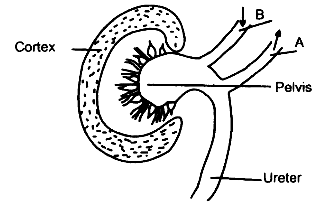
Given below is a simple diagram of the human kidney cut open longitudinally. Answer the following questions:
c
$(v)$ Write two differences in the composition of the blood flowing through blood vessels $A$ and $B.$
Answer
$(i)$ Excretion is the process of removal of all harmful and unwanted products especially nitrogenous products from the body of living beings.
$(ii)$ The units of the kidney are nephrons.
$(iii)$ The dotted cortex of kidney shows the presence of nephrons $($Bowman’s Capsule$)$ in this region.
$(iv)$ Two functions of kidney are:
$(a)$ It expels out all the nitrogenous products produced in the body.
$(b)$ It helps in osmoregulation.
$(v)$ Two differences in the composition of blood flowing through blood vessels $A$ and $B$ are:
$(a)$ A contains blood having a large amount of water and nitrogenous wastes while blood in $B$ is thicker and free from toxic substances.
$(b)\ B$ carries more $O_2$ and nitrogenous waste products as it is Renal Artery. A carries $CO_2$​​​​​​​ and no nitrogenous products.
View full question & answer
Question 163 Marks
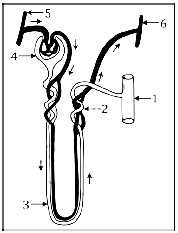
The given diagram represents a nephron and its blood supply. Study the diagram and answer the following questions:
(i) Label parts 1, 2, 3 and 4.
(ii) State the reason for the high hydrostatic pressure in the glomerulus.
(iii) Name the blood vessel which contains the least amount of urea in this diagram.
(iv) Name the two main stages of urine formation.
(v) Name the part of the nephron which lies in the renal medulla.
Answer
(i)

1 – Collecting duct
2 – Distal convoluted tubule (DCT)
3 – Descending limb of loop of Henle
4 – Bowman’s capsule

(ii) The diameter of efferent arteriole is narrower than the diameter of the afferent arteriole which builds the high hydrostatic pressure in the glomerulus.

(iii) Efferent arteriole

(iv) The two main stages of urine formation are ultrafiltration and tubular reabsorption.

(v) Henle’s loop and collecting tubules

View full question & answer
[3 marks Question Answer] - Biology STD 10 Questions - Vidyadip