Question 15 Marks
Explain the functioning of kidney.
Answer
View full question & answer→The kidney plays a major role in the formation of urine. The formation of urine takes place in two steps:
(a) Ultrafiltration: The blood flows through the glomerulus under great pressure. This high
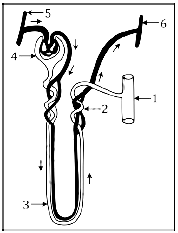
pressure causes the liquid part of the blood to filter out from the glomerulus into the renal tubule (ultrafiltration). During ultrafiltration almost all the liquid part of the blood comes out of the glomerulus and passes into the funnel-shaped Bowman’s capsule. The fluid entering the renal tubule is called the glomerular filtrate consisting of water, urea, salts, glucose, and other plasma solutes. The thicker part of the blood left behind in the glomerulus after ultrafiltration, namely, the two kinds of corpuscles, proteins, and other large molecules are carried forward through the efferent arteriole. Thus, the blood proceeding away from the glomerulus is relatively thick.
(b) Reabsorption: The glomerular filtrate entering the renal tubule is an extremely dilute solution containing a lot of usable materials including glucose and some salts such as those of sodium. As the filtrate passes down the tubule, much of the water is reabsorbed together with the usable substances. But their reabsorption is only to the extent that the normal concentration of the blood is not disturbed. This is called selective reabsorption. The fluid which flows through the last part of the tubule is urine.
Certain substances like potassium (K) in the normal course, and a large number of foreign chemicals including drugs like penicillin are passed into the forming urine in tubular wall, and hence it is called tubular secretion.
(a) Ultrafiltration: The blood flows through the glomerulus under great pressure. This high
pressure causes the liquid part of the blood to filter out from the glomerulus into the renal tubule (ultrafiltration). During ultrafiltration almost all the liquid part of the blood comes out of the glomerulus and passes into the funnel-shaped Bowman’s capsule. The fluid entering the renal tubule is called the glomerular filtrate consisting of water, urea, salts, glucose, and other plasma solutes. The thicker part of the blood left behind in the glomerulus after ultrafiltration, namely, the two kinds of corpuscles, proteins, and other large molecules are carried forward through the efferent arteriole. Thus, the blood proceeding away from the glomerulus is relatively thick.
(b) Reabsorption: The glomerular filtrate entering the renal tubule is an extremely dilute solution containing a lot of usable materials including glucose and some salts such as those of sodium. As the filtrate passes down the tubule, much of the water is reabsorbed together with the usable substances. But their reabsorption is only to the extent that the normal concentration of the blood is not disturbed. This is called selective reabsorption. The fluid which flows through the last part of the tubule is urine.
Certain substances like potassium (K) in the normal course, and a large number of foreign chemicals including drugs like penicillin are passed into the forming urine in tubular wall, and hence it is called tubular secretion.
 c
c