Question
Corpus callosum and Corpus luteum (Function).

Answer

CORPUS CALLOSUMCORPUS LUTEUM
 It connects the two cerebral hemispheres (of brain)
 internally.
 Corpus luteum produces the hormone,   progesterone
 (female sex hormone).
 It enables the communication between two   hemispheres. It prepares the inner lining of the uterus for
 implantation of zygote.
 

Need a full question paper?

Generate a complete, print-ready paper with questions like this in minutes — across 16+ boards, with answer keys.
Start Generating Free

Similar questions

Draw well labeled diagrams of part Artery and Superior vena cava to show the structural.
Draw well labeled diagram of a ‘Neuron’ and name the following parts:
(1) Node of Ranvier (2) Nissil granules (3) Cyton
Briefly explain how the rate of transpiration is affected by
Intensity of light
Differentiate between the following pair:
Uterus and vegina
Draw a labeled schematic representation of mitosis cell division.
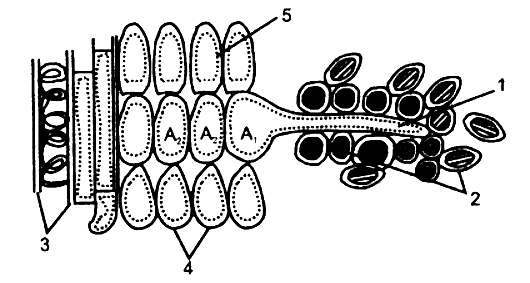
The figure given below is a diagrammatic representation of a part of the cross-section of the root in the root hair zone. Study the same and then answer the questions that follow :

(i) Name the parts indicated by guidelines ‘1’ to ‘5’
(ii) Is the root hair cell unicellular or multi-cellular?
(iii) Draw a labeled diagram of the root hair cell as it would appear if some fertilizer is added to the soil close to it.
(iv) Name the process responsible for the entry of water molecules from the soil into A1 and then A2.
(v) What pressure is responsible for the movement of water in the direction indicated by arrows?
(vi) How is this pressure set up?
Write a short note on sex determination in man.
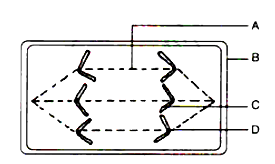
The diagram given alongside represents a stage in cell division.
Study the same and answer the questions that follow:

(i) Identify the stage of cell division.
(ii) Name the parts labeled A,B,C and D.
(iii) What is the unique feature observed in this stage?
(iv) Where does this type of cell division usually occur?
(v) How many daughter cells are formed from this type of cell division?
(vi) Is the dividing cell shown a plant or an animal cell?
Give a reason to support your answer.
Differentiate between the following:
Ethylene and Abscisic Acid