Questions

MCQ

🎯

Test yourself on this topic

37 questions · timed · auto-graded

MCQ 11 Mark
An electrolyte Which completely dissociates into ions is:
  • A
    Alcohol
  • B
    Carbonic acid
  • C
    Sucrose
  • Sodium hydroxide
Answer
Correct option: D.
Sodium hydroxide
An electrolyte Which completely dissociates into ions is : Sodium hydroxide
View full question & answer
MCQ 21 Mark
Electrolysis of acidulated water is an example of ......
  • A
    Reduction
  • B
    oxidation
  • redox reaction
  • D
    synthesis
Answer
Correct option: C.
redox reaction
Electrolysis of acidulated water is an example of redox reaction.
View full question & answer
MCQ 31 Mark
Assertion: In electrolysis of aqueous NaCl the product obtained is not $H _2$ gas.
Reason: Generally, gases are liberated faster than the metals.
  • A
    Assertion and Reason both are correct statements and reason is the correct explanation of the assertion.
  • B
    Assertion and Reason both are correct statements, but reason is not the correct explanation of the assertion.
  • C
    Assertion is true, but reason is false.
  • D
    Assertion is false, but reason is true.
Answer
D. Assertion is false, but reason is true.
Explanation : At cathode there is competition between the following reduction reactions:
$\begin{array}{l}
Na^{+}(aq)+e^{-} \rightarrow Na(s), E_{cell}^{\circ}=-2.71 V \\
H^{+}(aq)+e^{-} \rightarrow \frac{1}{2} H_2(g), E_{cell}^{\circ}=0.00 V
\end{array}$
Thus, assertion is false, but reason is true.
View full question & answer
MCQ 41 Mark
Assertion: In cell current stops flowing when $E _{\text {cell }}=0$.
Reason: Equilibrium of the cell reaction is attained.
  • A
    Assertion and Reason both are correct statements and reason is the correct explanation of the assertion.
  • B
    Assertion and Reason both are correct statements, but reason is not the correct explanation of the assertion.
  • C
    Assertion is true, but reason is false.
  • D
    Assertion is false, but reason is true.
Answer
A. Assertion and Reason both are correct statements and reason is the correct explanation of the assertion.
Explanation: Eventually the electric field is large enough to stop any electrons moving from the positive terminal to the negative terminal. Thus, both assertion and reason are correct statements and reason is the correct explanation of the assertion.
View full question & answer
MCQ 51 Mark
During electrolysis, where do cations migrate?
  • A
    Towards the anode
  • B
    Towards the cathode
  • C
    Away from both electrodes
  • D
    Remain stationary in the solution
Answer
B. Towards the cathode
Explanation: Cations are positively charged and thus move towards the negatively charged cathode where they undergo reduction.
View full question & answer
MCQ 61 Mark
Which of the following best describes reduction in terms of electron movement?
  • A
    Loss of electrons
  • B
    Gain of electrons
  • C
    Movement of electrons from cathode to anode
  • D
    None of the above
Answer
B. Gain of electrons
Explanation: Reduction is the process where a molecule, atom, or ion gains electrons, typically occurring at the cathode in electrolysis.
View full question & answer
MCQ 71 Mark
What is an electrolyte?
  • A
    A device that stores electrical energy.
  • B
    A substance that cannot conduct electricity.
  • C
    A substance that decomposes into ions when melted or dissolved in water.
  • D
    A type of electrode.
Answer
C. A substance that decomposes into ions when melted or dissolved in water.
Explanation: Electrolytes are important for conducting electricity in a solution as they split into ions that can move freely to conduct electricity.
View full question & answer
MCQ 81 Mark
Which electrode is the site of oxidation in electrolysis?
  • A
    Anode
  • B
    Cathode
  • C
    Anion
  • D
    Cation
Answer
A. Anode
Explanation: Oxidation occurs at the anode because this is where electrons are lost by the species being oxidised.
View full question & answer
MCQ 91 Mark
Which of the following is a non-electrolyte?
  • A
    Hydrochloric Acid ( HCl )
  • B
    Ethanol $\left( C _2 H _5 OH \right)$
  • C
    Potassium Hydroxide ( KOH $)$
  • D
    Barium Hydroxide $\left( Ba ( OH )_2\right)$
Answer
B. Ethanol $\left( C _2 H _5 OH \right)$
Explanation: Ethanol is a non-electrolyte because it does not dissociate into ions when dissolved in water. Thus, it does not conduct electricity.
View full question & answer
MCQ 101 Mark
What makes a substance a weak electrolyte?
  • A
    It completely dissociates in water.
  • B
    It partially dissociates in water.
  • C
    It does not dissociate in water.
  • D
    It is insoluble in water.
Answer
B. It partially dissociates in water.
Explanation: Weak electrolytes partially dissociate into ions in solution, which means they produce fewer ions and therefore conduct electricity less efficiently compared to strong electrolytes.
View full question & answer
MCQ 111 Mark
Which of the following is a strong electrolyte?
  • A
    Acetic Acid $\left( CH _3 COOH \right)$
  • B
    Ammonia $\left( NH _3\right)$
  • C
    Sodium Chloride $( NaCl )$
  • D
    Sugar $\left( C _{12} H _{22} O _{11}\right)$
Answer
C. Sodium Chloride ( NaCl )
Explanation: Sodium chloride is a strong electrolyte because it completely dissociates into sodium (Na ${ }^{+}$) and chloride ( $Cl ^{-}$) ions in solution, allowing it to conduct electricity efficiently.
View full question & answer
MCQ 121 Mark
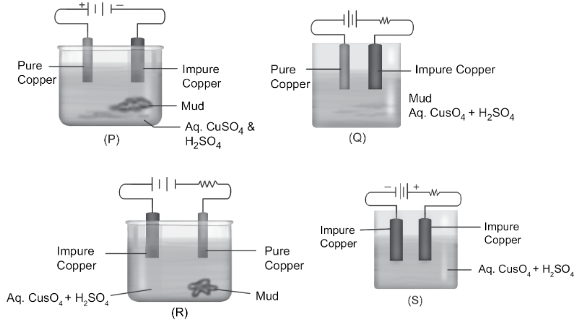
In which of following electrolytic cell [P, Q, R or S] will electrolysis of copper sulphate will
occur. 
Image
  • A
    P
  • B
    Q
  • C
    R
  • D
    S
Answer
B. $Q$
Explanation: Electrode connected to positive terminal is anode which is made of impure copper, the mud is collected under anode called anode mud where electrode connected to negative terminal is cathode made of thin pure metal. In ' P ' anode and cathode are reversed, no refining takes place. In ' $R$ ' mud is collected under cathode which is strip of pure copper. In 'S' cathode and anode are made of impure strip.
View full question & answer
MCQ 131 Mark
Electroplating is a process in which thin film of metal like gold, silver, nickel etc. gets deposited which of the observation shows correction combination with respect to electroplating of silver on brass spoon.
 AnodeCathodeElectrolyte
WSpoonPure silverNa[Ag(CN)2]
XPure SilverSpoonNa[Ag(CN)2]
YSpoonPure silver[Ag(CN)2
ZPure silverSpoonAgNO3
  • A
    W
  • B
    X
  • C
    Y
  • D
    Z
Answer
B. $X$
Explanation: The spoon need to be plated is cleaned and dried then it is made cathode and article that has to be coated is made anotde i.e. pure silver where electrolyte used is sodium silver cyanide or potassium organic cyanide.
Cathode: $Ag ^{+}+e^{-} \rightarrow Ag$
(from electrolyte)
Anode: $Ag -e^{-} \rightarrow Ag ^{+}$
(from anide) (Goes to electrolyte)
In the reaction of dil. Hydrochloric acid $( HCl )$ with Sodium sulphite $\left( Na _2 SO _3\right)$, Sulphur dioxide gas $\left( SO _2\right)$, Sodium chloride $( NaCl )$ and water $\left( H _2 O \right)$ are formed as the products.
$Na_2 SO_3+2 HCl \rightarrow 2 NaCl+H_2 O+SO_2 \uparrow$
While in other combination the reactions that occur are:
$\begin{array}{l}
CaCO_3+2 HCl \rightarrow CaCl_2+H_2 O+CO_2 \uparrow \\
Mg+2 HCl \rightarrow MgCl_2+H_2 \uparrow \\
CaOCl_2+2 HCl \xrightarrow{\Delta} CaCl_2+H_2 O+Cl_2 \uparrow
\end{array}$
View full question & answer
MCQ 141 Mark
Electrolysis of copper sulphate solution using platinum anode and copper or platinum cathode which of the following statement regarding the electrolysis is correct?
P: When the deposition of Cu ions is completed then electrolysis of water takes place
Q : The blue colour of $Cu ^{2+}$ ions in the electrolyte solution fades.
  • A
    Only P
  • B
    Only Q
  • C
    Both P & Q
  • D
    Neither P nor Q
Answer
C. Both P & Q
Explanation: When deposition of Cu is completed then electrolysis of water takes place. Hydrogen gas is liberated at the cathode and oxygen gas is liberated at the anode while the blue colour of $Cu ^{2+}$ ions in electrolyte solution fade due to decrease in $Cu ^{2+}$ ions and finally the solution becomes colourless as soon as $Cu ^{2+}$ ions are finishedDissociation of aq. $CuSO _4$ solution
$CuSO _4 \quad Cu ^{2+}+ SO _4{ }^{2-}$
$H _2 O \quad H ^{+}+ OH ^{-}$
Ions present: $Cu ^{2+}, H ^{+}, SO _4{ }^{2-}, OH ^{-}$
At cathode : $Cu ^{2+}+2 e^{-} \rightarrow Cu ^{-}$
At anode : $4 OH ^{-}-4 e^{-} \rightarrow 4 OH$
$2 OH+2 OH \rightarrow 2 H_2 O+O_2$
View full question & answer
MCQ 151 Mark
When electrolyte dilute $CuSO _4$ solution undergoes dissociation of electrolytes.
Which ions combinations discharge at cathode and anode?
P. Cathode: $Cu ^{2+}$ Anode: $OH ^{-}$
Q. Cathode: $Cu ^{2+}$ Anode: $SO _4{ }^{2-}$
R Cathode : $Cu ^{2+}$ Anode : $Cl ^{-}$
  • A
    Only P
  • B
    Only Q
  • C
    Only R
  • D
    Both Q and R
Answer
A. Only P
Explanation: On dissociation of dil. copper sulphate electrolyte, ions that migrate to cathode is $Cu ^{2+}, H ^{+}$, and the ions that discharge at cathode is $Cu ^{2+}$. Ions that migrate to anode is $SO _4{ }^{2-} OH ^{-}$, where ion discharge at anode is OH .
View full question & answer
MCQ 161 Mark
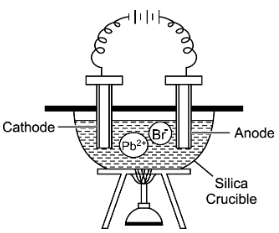
Study the given figure and answer the question that follow:
Image
Why silica crucible is used in this type of electrolysis?
  • A
    Non-reactive
  • B
    Non-conductor of electricity
  • C
    Withstand at high temperature
  • D
    All of these
Answer
D. All of these
Explanation: Silica crucibles are used in this type of electrolysis for several reasons, which include:
(a) Silica crucibles are non-reactive, meaning they do not react with the substances being electrolysed, allowing for a clean and uncontaminated process.
(b) Silica is a non-conductor of electricity, which is important in preventing unwanted electrical interactions in the electrolysis.
(c) Silica crucibles can withstand high temperatures, making them suitable for processes that require hightemperature conditions.
View full question & answer
MCQ 171 Mark
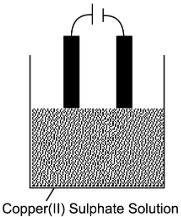
Study the given figure and answer the question that follow:
Image
Write the equation representing the reaction that occurs.
  • A
    At the Cathode: $Cu -2 e ^{-} \rightarrow Cu ^{2+}$
    At the Anode: $Cu ^{2+}+2 e ^{-} \rightarrow Cu$
  • B
    At the Cathode: $Cu ^{+}+2 e ^{-} \rightarrow Cu$
    At the Anode: $Cu ^{2-}-2 e ^{-} \rightarrow Cu ^{2+}$
  • C
    Both (a) and (b)
  • D
    At the Cathode: $Cu ^{2+}+2 e ^{-} \rightarrow Cu$
    At the Anode: $Cu -2 e ^{-} \rightarrow Cu ^{2+}$
Answer
D. At the Cathode: $Cu ^{2+}+2 e ^{-} \rightarrow Cu$
At the Anode: $Cu -2 e ^{-} \rightarrow Cu ^{2+}$
Explanation: Electrode on the left side is the oxidising electrode because anode is always connected to positive terminal of the battery, where copper atoms lose electrons at this electrode.
Hence, The correct equation representing the reaction that occurs during the electrolysis of copper(II) sulphate is:
At the Cathode: $Cu ^{2+}+2 e ^{-} \rightarrow Cu$
At the Anode: $Cu \rightarrow Cu ^{2+}+2 e^{-}$
View full question & answer
MCQ 181 Mark
Copper is a good conductor of electricity, but it is a non-electrolyte. Why?
  • A
    Contains free electrons
  • B
    Metal
  • C
    Does not dissociate into ions
  • D
    All of these
Answer
D. All of these
Explanation: Copper is a good conductor of electricity, but it is a non-electrolyte because it does not dissociate into ions when in its solid form. While copper conducts electricity due to the presence of free electrons that can move within the metal lattice, it does not dissociate into ions like electrolytes do. Hence, all the options are correct.
View full question & answer
MCQ 191 Mark
Sea water is a strong electrolyte. Why?
  • A
    Compounds dissociate into ions
  • B
    Sodium chloride dissolved in it
  • C
    Discharge electrons
  • D
    None of these
Answer
B. Sodium chloride dissolved in it
Explanation: Sea water is a strong electrolyte primarily because sodium chloride (NaCl) is dissolved in it. When sodium chloride dissolves in water, it dissociates into its constituent ions, sodium ions (Na+) and chloride ions (CI). This dissociation into ions allows sea water to conduct electricity effectively, making it a strong electrolyte.
View full question & answer
MCQ 201 Mark
Metals like potassium, calcium, sodium, etc., can be extracted only by electrolysis. Why?
  • A
    Conventional reducing agents
  • B
    Does not supply sufficient energy
  • C
    A large number of hydronium ions
  • D
    Both (a) and (b)
Answer
D. Both (a) and (b)
Explanation: Metals like K, Ca, Na, etc., can be extracted only by electrolysis because conventional reducing agents such as coke, carbon monoxide, hydrogen do not supply sufficient energy to break ionic bonds between the active metals and their chlorides or oxides.
View full question & answer
MCQ 211 Mark
The particles present in strong electrolytes are:
  • A
    Only molecules
  • B
    Mainly ions
  • C
    Ions and molecules
  • D
    Only atoms
Answer
B. Mainly ions
Explanation: A strong electrolyte is one that completely dissociates into ions. These ions move towards the oppositely charged electrodes and help in the electric current to pass and hence, they are good conductor of electricity.
View full question & answer
MCQ 221 Mark
When fused lead bromide is electrolysed we observe:
  • A
    A silver-grey deposit at the anode and a reddish-brown deposit at the cathode
  • B
    A silver-grey deposit at the cathode and a reddish-brown deposit at the anode
  • C
    A silver-grey deposit at the cathode and reddish-brown fumes at the anode
  • D
    Silver grey fumes at the anode and reddish-brown fumes at the cathode
Answer
C. A silver-grey deposit at the cathode and reddish-brown fumes at the anode
Explanation: The lead bromide breaks into lead and bromine. A silver-grey deposit forms at the cathode (negative electrode), and reddish-brown fumes (bromine gas) are produced at the anode (positive electrode).
View full question & answer
MCQ 231 Mark
Which of these will act as a non-electrolyte?
  • A
    Liquid carbon tetrachloride
  • B
    Acetic acid
  • C
    Sodium hydroxide aqueous solution
  • D
    Potassium chloride aqueous solution
Answer
A. Liquid carbon tetrachloride
Explanation: Carbon tetrachloride does not dissociate into ions when dissolved into water. Therefore, it does not conduct electricity and will acts as a non electrolyte.
View full question & answer
MCQ 241 Mark
_______the chemical change that occurs at this electrode is called_______.
  • A
    anode, oxidation
  • B
    anode, reduction
  • C
    cathode, oxidation
  • D
    cathode, reduction
Answer
D. cathode, reduction
Explanation: In an electrolytic cell, the electrode at which electrons enter any solution is a cathode, and the change that occurs in the electrode is reduction.
View full question & answer
MCQ 251 Mark
Element $X$ is extracted by the electrolysis of a molten compound of elements $X$ and $Y$. The electrode reactions are as shown.
At the cathode: $X ^{2+}( I )+2 e ^{-} \rightarrow X$
(I) At the anode: $2 Y ^{2-}$ (I) $\rightarrow Y _2(g)+4 e ^{-}$
What is?
  • A
    Aluminium oxide
  • B
    Calcium chloride
  • C
    Magnesium oxide
  • D
    Potassium chloride
Answer
C. Magnesium oxide
Explanation: The given electrode reactions for the electrolysis of a compound of elements $X$ and $Y$ are as follows:
At the cathode: $2 X ^{2+}(1)+2 e ^{-} \rightarrow X ( l )$
At the anode: $2 Y ^{2-}( l ) \rightarrow Y _2(g)+4 e ^{-}$
From these reactions, it appears that element $X$ is being reduced at the cathode to form $X$ in its liquid state, and element $Y$ is being oxidised at the anode to form $Y_2$ in its gaseous state. Based on these reactions, the most likely compound being electrolysed is magnesium oxide $( MgO )$, where $X$ is magnesium $( Mg )$ and $Y$ is oxygen $( O )$.
View full question & answer
MCQ 261 Mark
The electrolysis of acidified water is an example of: [Board Question].
  • A
    Reduction
  • B
    Oxidation
  • C
    Redox reaction
  • D
    Synthesis
Answer
C. Redox reaction
Explanation: The electrolysis of acidified water is an example of a redox reaction (a reduction-oxidation reaction) because it involves both reduction at the cathode and oxidation at the anode simultaneously.
View full question & answer
MCQ 271 Mark
An electrolyte which completely dissociates into ions is:[Board Question].
  • A
    Alcohol
  • B
    Carbonic acid
  • C
    Sucrose
  • D
    Sodium hydroxide
Answer
D.Sodium hydroxide
Explanation: When we dissolve Sodium hydroxide (NaOH) in water, it separates into two positively charged sodium ions and negatively charged hydroxide ions. Hence, an electrolyte which completely dissociates into ions is sodium hydroxide.
View full question & answer
MCQ 281 Mark
The metallic electrode which does not take part in an electrolytic reaction: (Inert electrode).
  • A
    Cu
  • B
    Ag
  • C
    Pt
  • D
    Ni
Answer
C. Pt
Explanation: The metallic electrode that does not take part in an electrolytic reaction is indeed called an inert electrode, and one common example of an inert electrode is platinum (Pt).
View full question & answer
MCQ 291 Mark
What is the product formed at the cathode in the electrolysis of aqueous $CuSO _4$ ?
  • A
    Copper metal
  • B
    Oxygen gas
  • C
    Hydrogen gas
  • D
    Sulphur
Answer
A. Copper metal
Explanation: In the electrolysis of aqueous $CuSO _4, Cu ^{2+}, SO _4{ }^{2-}, H ^{+}$and OH- are the ions formed after dissociation. Copper ions have much higher reduction potential than water. Hence, these ions are easily reduced and deposited as Cu at the cathode
View full question & answer
MCQ 301 Mark
With platinum electrodes, hydrogen is liberated at the_______and oxygen at the_______during the electrolysis of acidified water.
  • A
    cathode, anode
  • B
    anode, cathode
  • C
    anode, anode
  • D
    cathode, cathode
Answer
A. cathode, anode
Explanation: During the electrolysis of acidified water with platinum electrodes, the $H ^{+}$ion is reduced at the cathode, so hydrogen is liberated at the cathode, whereas $O _2^{-}$ion is oxidised at anode, and thus oxygen is liberated at the anode.
View full question & answer
MCQ 311 Mark
Ionisation is a_______process.
  • A
    irreversible
  • B
    reversible
  • C
    both (a) and (b)
  • D
    none of these
Answer
B. reversible
Explanation: In solution, the particles are in a condition of disorder or random movement. Upon colliding they may combine to give unionised molecules. Thus, ionisation is a reversible process in which the solution contains ions of electrolyte together with unionised molecules.
View full question & answer
MCQ 321 Mark
Pure water consists almost entirely of_______.
  • A
    ions
  • B
    atoms
  • C
    ions and molecules
  • D
    molecules
Answer
D. molecules
Explanation: Water has very low ionisation constant so it dissociates very less into the ions and pure water consists almost entirely of molecules. Thus, pure water consists of molecules only.
View full question & answer
MCQ 331 Mark
Water is_______.
  • A
    strong electrolyte
  • B
    non-electrolyte
  • C
    weak electrolyte
  • D
    none of these
Answer
C. weak electrolyte
Explanation: Pure water molecules do not contain enough ions to transfer electrons from one end to another. This property makes water a weak electrolyte.
View full question & answer
MCQ 341 Mark
A strong electrolyte is one which_______.
  • A
    is completely ionised in the solution
  • B
    dissociates partially in solution
  • C
    is having low electrical conductivity
  • D
    Ionises partially
Answer
A. is completely ionised in the solution
Explanation: A strong electrolyte is one that completely dissociates in a solution. HCl (hydrochloric acid), H2SO4, NaOH and KOH are all examples of strong electrolytes
View full question & answer
MCQ 351 Mark
A weak electrolyte is one which______________.
  • A
    dissociates completely
  • B
    is feebly ionised in the solution
  • C
    ionises completely
  • D
    is having high electrical conductivity
Answer
B. is feebly ionised in the solution
Explanation: A weak electrolyte is one which dissociate partially or is feebly ionised in an aqueous solution.
View full question & answer
MCQ 361 Mark
The solution of a substance which conducts electricity is called_______.
  • A
    An electrolyte
  • B
    A conductor
  • C
    An insulator
  • D
    None of these
Answer
A. An electrolyte
Explanation: The solution of a substance which conducts electricity is called an electrolyte
View full question & answer
MCQ 371 Mark
Electrolysis is the passage of_______through a liquid or a solution accompanied by a_______change.
  • A
    Chemical, electricity
  • B
    Electricity, chemical
  • C
    Electrons, chemical
  • D
    Electricity, physical
Answer
B. Electricity, chemical
Explanation: Electrolysis is the passage of electricity through a liquid or a solution accompanied by a chemical change.
View full question & answer
MCQ - Chemistry STD 10 Questions - Vidyadip