Question types

Hydrogen Chloride question types

92 questions across 8 question groups — pick any mix to generate a Chemistry paper with step-by-step answer keys.

92
Questions
8
Question groups
5
Question types
Sample Questions

Hydrogen Chloride questions

One sample from each question group in this chapter. Select any group above to see the full set with answer keys.

Q 1MCQ1 Mark
Assertion (A): Dry HCl is collected by the downward displacement of air.
Reason (R): HCl is heavier than air.
  • A
    Both A and R are true and R is the correct explanation of A
  • B
    Both A and R are true but R is not the correct explanation of A
  • C
    A is true but R is false
  • A is false but R is true

Answer: D.

View full solution
Q 2MCQ1 Mark
Assertion (A): In moist air, HCl strongly fumes.
Reason (R): HCl dissolves in water vapour to form tiny droplets of hydrochloric acid.
  • Both A and R are true and R is the correct explanation of A
  • B
    Both A and R are true but R is not the correct explanation of A
  • C
    A is true but R is false
  • D
    A is false but R is true

Answer: A.

View full solution
Q 3MCQ1 Mark
Assertion (A): HCl stains the skin or dry wood to amber-brown colour.
Reason (R): HCl is a corrosive acid.
  • Both A and R are true and R is the correct explanation of A
  • B
    Both A and R are true but R is not the correct explanation of A
  • C
    A is true but R is false
  • D
    A is false but R is true

Answer: A.

View full solution
Q 4MCQ1 Mark
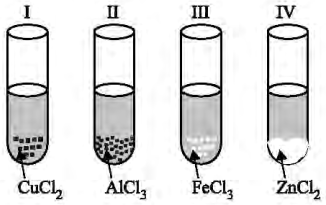
A student added dilute H2SO4 in various metallic chlorides present in four test tubes during the preparation of HCl gas.
Image
In which test tube(s), she would observe blue colouration in the test tubes?
  • Only (I)
  • B
    Only (III)
  • C
    both (I) and (III)
  • D
    both (II) and (IV)

Answer: A.

View full solution
Q 5MCQ1 Mark
The solution of nitrate(s) of metal(s) which form white precipitate with dil. HCl are:
  • A
    Zn(NO3)2 sol
  • B
    Pb(NO3)2 sol
  • C
    AgNO3 sol
  • both (b) and (c )

Answer: D.

View full solution
Two blank spaces A and B are left in the following table. Identify both of them.
Lab preparation ofReactants usedProducts formedDrying agentMethod of collection
HCI gasNaCl + H2SO4____A____Conc. H2SO4____B____
View full solution
In the laboratory preparation of HCl gas from sodium chloride, state why the following are preferred.
(i) Conc. H2SO4 as reactant.
(ii) Temperature of reaction mixture below 200°C.
View full solution
State one relevant observation for each of the following :
(i) A small piece of zinc is added to dilute hydrochloric acid.
(ii) Dilute hydrochloric acid is added to silver nitrate solution.
(iii) Hydrogen chloride gas fumes in moist air.
View full solution
State one relevant observation for each of the following :
(i) When dilute hydrochloric acid is added to sodium carbonate crystals.
(ii) Action of dilute hydrochloric acid on iron (II) sulphide.
(iii) Lead nitrate solution is mixed with dilute hydrochloric acid and heated.
View full solution
(a) Name the acid used for the preparation of hydrogen chloride gas in the laboratory. Why is this particular acid preferred to other acids?
(b) For the preparation of hydrochloric acid in the laboratory :
(i) Why is direct absorption of hydrogen chloride gas in water not feasible?
(ii) What arrangement is done to dissolve hydrogen chloride gas in water?
View full solution
When sodium chloride is heated with concentrated sulphuric acid below 200°C, one of the products formed is ________. [sodium hydrogen sulphate/sodium sulphate/chlorine]
View full solution
Give balanced chemical equation for the following :
(i) Action of dilute hydrochloric acid on sodium sulphide.
(ii) Action of hydrochloric acid on sodium bicarbonate.
(iii) Action of dilute hydrochloric acid and magnesium sulphite.
(iv) Action of dilute hydrochloric acid on iron.
View full solution
(a) What is the property of concentrated sulphuric acid which allows it to be used in the preparation of hydrogen chloride and nitric acid?
(b) What property of hydrogen chloride is demonstrated when it is collected by the downward delivery (upward displacement)?
(c) Why is hydrogen chloride not collected over water?
(d) What is the property of nitric acid which allows it to react with copper?
View full solution
(a) Hydrogen is burnt in a greenish-yellow gas A then another gas B is formed. The gas B gives dense white fumes with ammonia liquor. Name the gases A and B.
(b) Burning sodium is taken in the gas B, when it forms a salt C and another colourless gas D. The salt solution of C gives a curdy white precipitate with silver nitrate solution. The white precipitate is soluble in excess of ammonium hydroxide.
(i) Name the salt C and Name the gas D.
(ii) Write the chemical equations for the reaction between
(1) B and sodium, (2) C and silver nitrate, (3) white precipitate and ammonium hydroxide
View full solution
A colourless gas G fumes strongly in the air. The gas gives dense white fumes when a glass rod dipped in ammonia solution is held near the gas. Answer the following questions:
(a) Name the gas G.
(b) Name two chemicals used in the preparation of the gas G.
(c) Write the chemical equations for the reaction of the chemicals named in (b) when:
(i) the reaction mixture is not heated.
(ii) the reaction mixture is heated above 200°C.
(d) Why does the gas G fume strongly in air?
View full solution
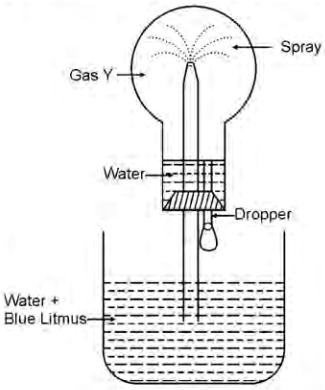
Study the figure given alongside and answer the questions that follow :
Image
(i) Name the experiment illustrated here.
(ii) Identify the gas Y.
(iii) What property of gas Y demonstrated by this experiment?
(iv) Explain the observations of the experiment.
View full solution
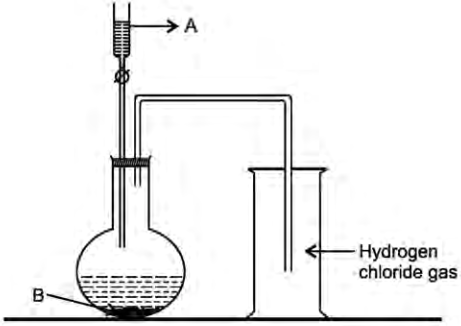
The diagram shows an apparatus for the laboratory preparation of hydrogen chloride.
(i) Identify A and B.
(ii) Write the equation for the reaction.
(iii) How would you check whether or not the gas jar is filled with hydrogen chloride? Write the equation involved.
(iv) What does the method of collection tell you about the density of hydrogen chloride? Write the equation involved.
Image
View full solution
Column AColumn B
(a) Boiling point of liquid HCl1. Orange to Pink
(b) Melting point of liquid HCl2. Pink to colourless
(c) Effect of HCl on litmus solution3. -85°C
(d) Effect of HCl on methyl orange solution4. Blue to Red
5. -115°C
View full solution

Generate a Hydrogen Chloride paper free

Pick question groups from the list above, set marks and difficulty, and export a branded PDF with step-by-step answer keys. First 3 chapters free — no signup.

Download App