Questions

[3 Mark Question Answer]

🎯

Test yourself on this topic

12 questions · timed · auto-graded

Question 13 Marks
State one relevant observation for each of the following :
(i) A small piece of zinc is added to dilute hydrochloric acid.
(ii) Dilute hydrochloric acid is added to silver nitrate solution.
(iii) Hydrogen chloride gas fumes in moist air.
Answer
(i) The reaction starts with effervescence and evolution of a colourless gas hydrogen.
(ii) A curdy white precipitate of silver chloride is formed.
(iii) Hydrogen chloride gas dissolves in water vapour to from tiny droplets of hydrochloric acid.
View full question & answer
Question 23 Marks
State one relevant observation for each of the following :
(i) When dilute hydrochloric acid is added to sodium carbonate crystals.
(ii) Action of dilute hydrochloric acid on iron (II) sulphide.
(iii) Lead nitrate solution is mixed with dilute hydrochloric acid and heated.
Answer
(i) Lot of effervescence takes place with evolution of a colourless gas, i.e., carbon dioxide. The reaction mixture gets warm and crystals of sodium carbonate dissolve to form a colourless solution.
(ii) A foul smelling gas like rotten eggs is given off.
(iii) A thick white precipitate of lead chloride is formed.
View full question & answer
Question 33 Marks
(a) Name the acid used for the preparation of hydrogen chloride gas in the laboratory. Why is this particular acid preferred to other acids?
(b) For the preparation of hydrochloric acid in the laboratory :
(i) Why is direct absorption of hydrogen chloride gas in water not feasible?
(ii) What arrangement is done to dissolve hydrogen chloride gas in water?
Answer
(a) Conc. sulphuric acid.
Because it is non-volatile and has a high boiling point. So it displaces the volatile hydrogen chloride gas from the salt sodium chloride.
(b) (i) Because, if hydrogen chloride gas is directly absorbed in water, it leads to back suction and due to back suction the water enters the hot flask and breaks it.
(ii) An inverted funnel is attached to the delivery tube with the help of a rubber tubing. The rim of the funnel is placed in a beaker of water such that rim is 2 mm below the surface of water.
View full question & answer
Question 43 Marks
Write balanced chemical equations for the reaction of dilute hydrochloric acid with each of the following:
(i) iron (ii) sodium hydrogen carbonate (iii) iron(II) sulphide
Answer
(i) Fe(s) + 2HCl (aq) → FeCl2(aq) + H2(g)
(ii) NaHCO3(s) + HCl(aq) → NaCl(aq) + H2O(l) + CO2(g)
(iii) FeS(s) + 2HCl(aq) → FeCl2(aq) + H2S(g)
View full question & answer
Question 53 Marks
What is aqua regia? How does it help in dissolving gold or platinum? Support your answer with chemical equations.
Answer
A mixture of 1 part (by weight) of conc. nitric acid and 3 parts (by weight) of conc. hydrochloric acid is called aqua regia.
Conc. HCl and conc. HNO3 react to form nascent chlorine which reacts with gold or platinum to form their respective soluble chlorides.
HNO3 + 3HCl (conc.) → 2H2O + NOCI + 2(CI)
Au + 3(CI) → AuCl3 ; Pt + 4(CI) → PtCl4
View full question & answer
Question 63 Marks
(a) Hydrogen is burnt in a greenish-yellow gas A then another gas B is formed. The gas B gives dense white fumes with ammonia liquor. Name the gases A and B.
(b) Write chemical equations in support of your answer in (a).
Answer
(a) A is chlorine gas.
B is hydrogen chloride gas.
(b) H2 + Cl2 → 2HCl
NH4OH + HCl → NH4Cl + H2O
View full question & answer
Question 73 Marks
How will you obtain the following from dil. HCl acid? Give equations.
(i) hydrogen (ii) carbon dioxide (iii) sulphur dioxide
Answer
(i) When zinc metal is treated with dilute HCl, it liberates hydrogen gas,
Zn + 2HCl (dil.) → ZnCl2 + H2
(ii) When sodium carbonate is treated with dilute HCl, it liberates carbon dioxide gas.
Na2CO3 + 2HCl (dil.) → 2NaCl + CO2 + H2O
(iii) When sodium sulphite is treated with dilute HCl, it liberates sulphur dioxide gas.
Na2SO3 + 2HCl (dil.) → 2NaCl + SO2 + H2O
View full question & answer
Question 83 Marks
Hydrogen chloride gas is prepared in the laboratory using concentrated sulphuric acid and sodium chloride. Answer the questions that follow based on this reaction :
(i) Give the balanced chemical equation for the reaction with suitable condition(s) if any.
(ii) Why is concentrated sulphuric acid used instead of concentrated nitric acid?
(iii) How is the gas collected?
Answer
(i) NaCl (s) $+ H _2 SO _4$ (aq) $\xrightarrow{<200^{\circ} C } NaHSO _4$ (aq) + HCl (g)
(ii) Conc. sulphuric acid is used since it is non-volatile and has a high boiling point. So it displaces the volatile hydrogen chloride from the salt sodium chloride.
(iii) Dry hydrogen chloride gas is collected by the upward displacement of air.
View full question & answer
Question 93 Marks
When concentrated hydrochloric acid is treated with potassium permanganate crystals a greenish yellow gas is given out.
(i) Name the gas evolved.
(ii) Write a fully balanced chemical equation for the reaction.
(iii) Is hydrochloric acid acting as oxidising agent or reducing agent?
Answer
(i) The gas evolved is chlorine gas.
(ii) 2KMnO4 + 16HCl → 2KCl + 2MnCl2 + 8H2O + 5CI2
(iii) Hydrochloric acid acts as a reducing agent.
View full question & answer
Question 103 Marks
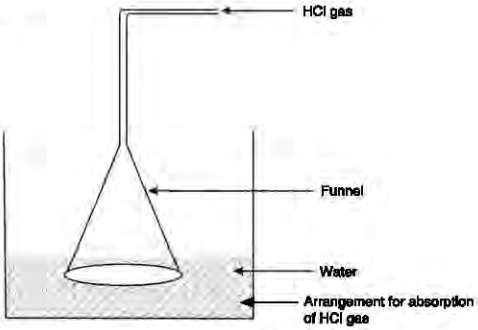
In the laboratory preparation of hydrochloric acid, HCl gas is dissolved in water.
(a) Draw a diagram to show the arrangement used for the absorption of HCl in water.
(b) Why is such an arrangement necessary? Give two reasons.
(c) Write the chemical equations for the laboratory preparation of HCl gas when the reactants are:
(i) below 200° С (ii) above 200° С
Answer
(a)
Image
(b) (i) It prevents the back suction of the gas
(ii) It helps in concentration of hydrochloric acid as it provides large surface area for the absorption of HCl gas
(c) (i) $NaCl + H _2 SO _4 \xrightarrow{<200^{\circ} C } NaHSO _4+ HCl$
(ii) $NaHSO _4+ NaCl \xrightarrow{>200^{\circ} C } Na _2 SO _4+ HCl$
View full question & answer
Question 113 Marks
To a solution of hydrogen chloride, the following substances are added separately in small portions. Copy and complete the table given below.
No.Substance addedGas evolvedOdour
(i)Sodium sulphite________________
(ii)Calcium carbonate________________
(iii)Magnesium ribbon________________
Answer
No.Substance addedGas evolvedOdour
(i)Sodium sulphiteSulphur dioxideSuffocating gas which causes coughing
(ii)Calcium carbonateCarbon dioxideFaint acidic smell
(iii)Magnesium ribbonHydrogen gasOdourless
View full question & answer
Question 123 Marks
Give balanced chemical equation for the following :
(i) Sodium thiosulphate and dilute HCl.
(ii) Calcium hydrogen carbonate and dilute HCI.
(iii) Concentrated hydrochloric acid and potassium permanganate crystals.
Answer
(i) Na2S2O3 + 2HCl → 2NaCl + H2O + SO2 + S
(ii) Ca(HCO3)2 + 2HCl → CaCl2 + 2H2O + 2CO2
(iii) 2KMnO4 + 16HCl(conc.) → 2KCl + 2MnCl2 + 8H2O + 5Cl2
View full question & answer
[3 Mark Question Answer] - Chemistry STD 10 Questions - Vidyadip