Question
What is aqua regia? How does it help in dissolving gold or platinum? Support your answer with chemical equations.

Answer

A mixture of 1 part (by weight) of conc. nitric acid and 3 parts (by weight) of conc. hydrochloric acid is called aqua regia.
Conc. HCl and conc. HNO3 react to form nascent chlorine which reacts with gold or platinum to form their respective soluble chlorides.
HNO3 + 3HCl (conc.) → 2H2O + NOCI + 2(CI)
Au + 3(CI) → AuCl3 ; Pt + 4(CI) → PtCl4

Need a full question paper?

Generate a complete, print-ready paper with questions like this in minutes — across 16+ boards, with answer keys.
Start Generating Free

Similar questions

Solve the following :
The vapour density of a gas is 8. What would be the volume occupied by 24.0 of the gas at STP?
The electronic configuration of $N_2$ is $2, 5$. How many electrons in the outer shell of a $N$ atom are not involved in the formation of a nitrogen molecule?
Give composition and uses of the following alloys. Mention the reason for its use.
Stainless steel
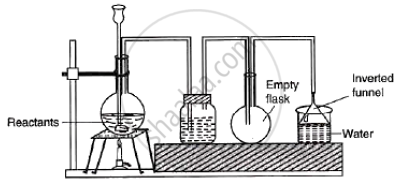
The given set up in the figure is for the preparation of an acid.

(a) Name the acid prepared by this method.
(b) name the reactants used.
(c) why empty flask is used
(d) what is the drying agent used? Why is this drying agent chosen?
(e) what is the role of the inverted funnel in the arrangement
What volume of oxygen would be required for complete combustion of $100L$ of ethane according to the following equation?
$2C_2H_6 + 7O_2\rightarrow 4CO_2 + 6H_2O$
(a) Fe + S → Fe2+S2-
Which substance in the above reaction is (i) oxidising agent (ii) reducing agent and why?
(b) 2Fe + 3Cl2 → 2Fe3+ + 2Cl3-
In the above reaction, which substance is (i) oxidised (ii) reduced, and why?
Write the structural formulae and IUPAC name of the second and third
homologues.
Nitric acid cannot be concentrated beyond 68% by the distillation of a dilute solution of $HNO_3$​​​​​​​. State the reason.
How do metals differ from non-metals in :
(i) ion formation
(ii) electronic configuration
(iii) chemical nature of their oxides?
A gas of $32 g$ mass has a volume of $20$ litres at $\text{STP}$. Calculate the gram molecular weight of the gas.