Questions · Page 2 of 2

[2 Mark Question Answer]

Question 512 Marks
Explain briefly how a fuse protects an electric circuit.
Answer
The fuse helps to control the maximum current in an electrical circuit. The fuse protects an electrical circuit by melting and breaking the circuit, whenever the current exceeds the pre-determined limit in the circuit. Due to low melting point, the fuse wire melts and then breaks the circuit.
View full question & answer
Question 522 Marks
A bulb marked 12 V, 24 W operates on a 12 volt car battery for 20 minutes. Calculate:
(i) The current flowing through it, and
(ii) The energy liberated.
Answer
Given, Voltage = 12 V, power = 24 W, time = 20 mins. = 1200 s.
(i) Currrent, I = $I=\frac{P}{V}=\frac{24}{12}=2 \mathrm{~A}$
(ii) energy liberated, H = VIt = 12 x 2 x 1200 = 28,800 J
View full question & answer
Question 532 Marks
A radio set of 60 W runs for 50 hours. How much electrical energy is consumed? Give your answer in kWh.
Answer
We know that, E =Pt
Given, P = 60 W= 0.06 kW
and, t = 50 hours
.·. E=0.06 x 50=3kWh
View full question & answer
Question 542 Marks
What do you mean by watt-hour?
Answer
Watt-hour is the commercial unit of electrical energy.
One watt-hour is the electrical energy consumed by an electrical appliance of power 1 watt when it is used for 1 hour.
1Wh = 3600 J
View full question & answer
Question 552 Marks
What will be the current drawn by an electric bulb of 40 W when it is connected to a source of 220 V?
Answer
We know that, P =VI
$I=\frac{P}{V}=\frac{40}{220}$ = 0.11 A
View full question & answer
Question 562 Marks
What is electrical resistance? Write its SI unit.
Answer
The obstruction offered to the flow of current by the wire is called its electrical resistance. It is a kind of friction between the free electrons and the atoms of the conductor along which they flow.
Its SI unit is 'ohm'.
View full question & answer
Question 572 Marks
State Ohm's law. Is it always true?
Answer
According to Ohm's law, the current flowing in a conductor is directly proportional to the potential difference across its ends provided the physical conditions and temperature of conductor remains constant.
No, it is not always true. E.g. Diode valve, junction diode etc. do not obey Ohm's law.
View full question & answer
Question 582 Marks
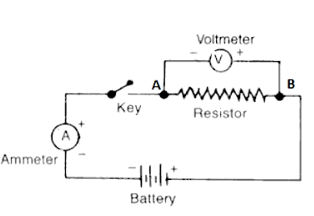
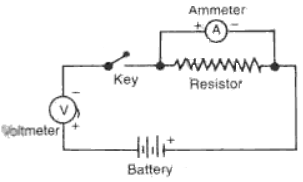
What is wrong with the circuit diagram (Fig. 34)? Carefully check the symbols and assign proper positive and negative signs to them.Image
Answer
In the given diagram, ammeter is connected in parallel and voltmeter in series, which is wrong. Also the terminals of the two devices are wrongly connected to the battery.
Correct diagram:
Image
View full question & answer
Question 592 Marks
What do you understand by an electric circuit?
Answer
An electrical circuit is a continuous path comprising of conducting wires and resistances between the terminals of a battery, along which an electric current is set up. It is represented by drawing a circuit diagram.
View full question & answer
Question 602 Marks
What do you mean by a cell?
Answer
An electric cell is a device in which a constant difference in potential is maintained between the two conductors by a chemical reaction. Thus, a cell can be used as a source of electrons or current. In a cell, chemical energy changes into electrical energy when it is in use.
View full question & answer
Question 612 Marks
A simple electric circuit has 24 V battery and a resistor of 60 Ω. What will be the current in the circuit? The resistance of the connecting wires is negligible.
Answer
current $=\frac{\text { potentia difference }(V)}{\text { Resistance }(R)}$
Here, $V=24$ volt, $R=60 \Omega$
current $=\frac{24}{60}=0.4 \mathrm{~A}$
View full question & answer
Question 622 Marks
What is a voltmeter? How is it connected in a circuit?
Answer
The instrument used to measure electric potential or potential difference is called a voltmeter. It has a very high resistance and is always connected in parallel.
View full question & answer
Question 632 Marks
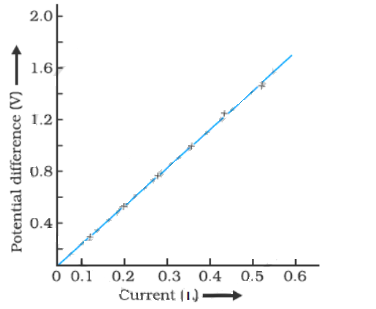
What kind of plot would you except when current (I) is plotted against potential difference (V) for a conductor, at constant temperature?
Answer
At constant temperature, if current is plotted against potential difference, the plot will be a straight line making some slope with the x-axis as shown in figure below:

Image

View full question & answer
Question 642 Marks
Give two uses of conductors.
Answer
Two uses of conductors:
(i) Connecting wires are made of conductors like copper.
(ii) Conductors are used as electrolytes in cells
View full question & answer
Question 652 Marks
State the law which relates the current in a conductor to the potential difference across its ends.
Answer
Ohm's law relates the current in a conductor to the potential difference across its ends.
According to Ohm's law, the current flowing in a conductor is directly proportional to the potential difference across its ends provided the physical conditions and temperature of conductor remains constant.
View full question & answer
Question 662 Marks
How will you oonnect five resistors, each of the value one ohm, to obtain an equivalent resistance of $0.2 \Omega$
Answer
Five resistors each of value 1 ohm s hou Id be connected in paral le I to obtain an equivalent resistance of O. 2 ohm.
Equivalant parallel Resistance
$R_p=\left(\frac{\text { Resistance of each resistor }}{\text { No. of resistors }}\right)=\frac{1}{5}=0.2 \Omega$
View full question & answer
Question 672 Marks
What is the equivalent resistance of 5 equal resistors, each of value $2 \Omega$ 1 when oonnected in (a) Series ( b) ParaIleI?
Answer
(a) In series:
Equivalant series Resistance,Rs $=2+2+2+2+2=10 \Omega$
(b)in parallel
Equivalant parallel Resistance $R_p=\left(\frac{\text { Resistance of each resistor }}{\text { No. of Resistors }}\right)=\frac{2}{5} \Omega$
View full question & answer
Question 682 Marks
What is the value of a resistance if 20 V drives 2 A through it?
Answer
A/c to Ohm's law,
$R=\frac{V}{l}=\frac{20}{2}=10 \Omega$
View full question & answer
Question 692 Marks
A potential difference of 6 V is applied across a 3 Ω resistor. What is the current flowinq throuqh the circuit?
Answer
Let I be the current flowing through it.
Given, potential difference, V 6 volt and Resistance, R = 3 Ω
AIC to Ohm's law,
$\mathrm{I}=\frac{\mathrm{V}}{\mathrm{R}}=\frac{6}{3}=2 \mathrm{~A}$
View full question & answer
Question 702 Marks
What potential difference is needed to drive a current o f 1 A through a 5 Ω resistor?
Answer
Let the required potential difference be V
Given, current I = 1 A and Resistance, R = 5 Ω
AIC to Ohm's law,
V = IR= (1) x (5) = 5 volt
View full question & answer
Question 712 Marks
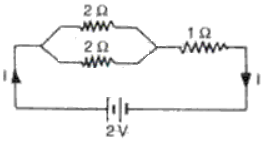
What is the current in the circuit shown (Fig. )

Image

Answer
Given, potential difference, V = 2 volt
Let R be the equivalent resistance of the circuit and I be the current flowing through it; then
$R=\left[\left(\frac{1}{2}+\frac{1}{2}\right)^{-1}+(1)\right]$
$R=[1+1]=2 \Omega$
$\therefore I=\frac{V}{R}=\frac{2}{2}=1 \mathrm{~A}$
View full question & answer
Question 722 Marks
The potential difference between the terminals of an electric iron is 240 V and the current flowing through it is 6 A. What is the resistance of the electric iron?
Answer
A/c to Ohm's law,
$R=\frac{V}{I}$
Here, $V=240$ volt and $I=6 A$
$\mathrm{R}=\frac{240}{6}=40 \Omega$
Thus the resistance of the electriciron is $40 \Omega$
View full question & answer
Question 732 Marks
Potential difference between two points of a wire carrying 2 ampere current is 0.1 volt. Calculate the resistance between these points.
Answer
A/c to Ohm's law,
$R=\frac{V}{l}$
Here V $=0.1$ volt and $\mathrm{I}=2 \mathrm{~A}$
$\mathrm{R}=\frac{0.1}{2}=0.05 \Omega$
View full question & answer
Question 742 Marks
A simple electric circuit has a 30 V battery and a resistor ot 60 o. What will be the current in the circuit? The resistance of the oonnecting wires is negligible.
Answer
A/c to Ohm's law,
$I=\frac{V}{R}$
Here $V=30$ volt and $R=60 \Omega$
$\therefore I=\frac{30}{60}=0.5 \mathrm{~A}$
View full question & answer
Question 752 Marks
Define electric intensity. Write its SI unit. Is it a scalar or a vector physical quantity?
Answer
Electric intensity is defined as the force experienced by a unit positive charge when kept at that point.
Its SI unit is newton per coulomb. It is a vector quantity.
View full question & answer
Question 762 Marks
You have three resistors of values $2 \Omega$,$3 \Omega$, and $5\Omega$. How will you join them so that the total resistance is less than $2 \Omega$?
Answer
To get a total resistance less than 2 ohm, the given resistors should be connected in parallel because in parallel combination the equivalent resistance is less than the resistance smallest connected resistor.
View full question & answer
Question 772 Marks
A wire of uniform thickness with a resistance of 27 O is cut into three equal pieces and they are joined in parallel. Find the resistance of the parallel combination.
Answer
When a wire of uniform thickness with resistance 27 ohm is cut into three equal pieces, the resistance of each piece =$27 / 3=9 \mathrm{ohm}$.Now, equivalent resistance of three 9 ohm resistors connected in parallel is:
$\mathrm{R}_{\mathrm{p}}=\left[\frac{1}{9}+\frac{1}{9}+\frac{1}{9}\right]^{-1}=3 \Omega$
View full question & answer
Question 782 Marks
A battery of e.m.f. 15 V and internal resistance 3 ohm is connected to two resistors of resistance 3 ohm and 6 ohm in series. Find:
(i) The current through the battery,
(ii) The p.d. between the terminals of the battery.
Answer
Given, em $e=15 v$
Internal resistance, $r=3 \Omega$
Resistance of given two resistors in series,$\mathrm{R},=3+6=9 \Omega$
Current $=\frac{\mathrm{emf}}{\text { Total resistance of circuit }}=\frac{15}{9+3}=\frac{15}{12}=1.25 \mathrm{~A}$
(ii) Potential difference= emf - voltage drop= e - (Ir)
Now, voltage drop= current x internal resistance=$1.25 \times 3=3.75$
p.d. $=15-3.75=11.25 \mathrm{~V}$
View full question & answer
Question 792 Marks
How many electrons are present in 1 C?
Answer
The charge on one electron is 1. $6 \times 10^{-19}$ coulombs.
Therefore , IC charge Carries $\left(\frac{1}{1.6 \times 10^{19}}\right)$$=6.25 \times 10^{18}$ electrons.
View full question & answer
Question 802 Marks
What do you mean by electric current?
Answer
The rate of movement of charge from one point to another through a section of the conductor is called electric current. Current refers to rate of flow of charges in a conductor.
I = Q/t
View full question & answer
Question 812 Marks
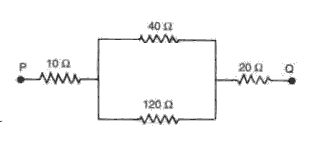
Find the effective resistance in the following circuit diagrams (Fig.):

Image

Answer
(b) In the given network, the parallel combination of resistors$40 \Omega$ and $120\Omega$ is connected in series with the $10 \Omega$ and $20 \Omega$; resistors.
:. Resistance in para!! el is:
$\frac{1}{R_p}=\frac{1}{40}+\frac{1}{120}=\frac{4}{120}=\frac{1}{30}$
$\therefore R_p=3 \Omega$
Effective resistance between P and Q is
$R=10+30+20=60 \Omega$
View full question & answer
Question 822 Marks
The voltage across a 3Ω resistance is 6 V. How large is the current? What is
the resistance of a filament lamp when a voltage of 3 V across it causes a current of 0.5 A?
Answer
If voltage, V = 6 volt and resistance $\mathrm{R}=3 \Omega$
The a/c to ohm's law, current $I=\frac{V}{R}=\frac{6}{3}=2 A$
For filament lamp:
Given that, voltage= 3 V, current= 0.5 A.
let R be the resistance of the filament lamp;
then $\mathrm{R}=\frac{\mathrm{V}}{\mathrm{I}}=\frac{3}{0.5}=6 \Omega$
View full question & answer
Question 832 Marks
A charge of 80 C flows in a conductor for 2 minutes.
(a) Calculate the current flowing through the conductor.
(b) If the current through a heater is 4 A what charge must be passing in 8 seconds?
Answer
(a) Given, charge q = 80 C, time t = 2 minutes= 120 s
current,$I=\frac{q}{t}=\frac{80}{120}$=$0.67 \mathrm{~A}$
(b) Given, current I= 4 A, time = 8 s
Let q be the charge pas sing in 8s
Then, q =It = 4 x 8 = 32 C
View full question & answer
Question 842 Marks
Define the following:
Super conductors.
Answer
Superconductors: Substance whose resistance decreases tremendously with the decrease in temperature and reaches nearly zero around absolute zero temperature are named as superconductors; e.g. lead, tin etc.
View full question & answer
Question 852 Marks
Define the following:
Semiconductors
Answer
Semiconductors: Substances whose resistance decreases with the increase in temperature are named as semiconductors. E.g. manganin, constantan etc.
View full question & answer
Question 862 Marks
Define the following:
Electromotive force
Answer
Electromotive force: When no current is drawn from a cell, when the cell is in open circuit, the potential difference between the terminals of the cell is called its electromotive force (or e.m.f.).
View full question & answer
Question 872 Marks
Define the following:
(i) Coulomb
(ii) Ohm
Answer
(i) Coulomb: It is the unit of charge.
(ii) Ohm: It is the unit of resistance. The resistance of a conductor is said to be 1 ohm, if 1 ampere current flows through it, when the potential difference across its ends is 1 volt.
View full question & answer
Question 882 Marks
Define the following:
Potential difference
Answer
Potential difference: The potential difference between two points may be defined as the work done in moving a unit positive charge from one point to the other.
View full question & answer
[2 Mark Question Answer] - Page 2 - Physics STD 10 Questions - Vidyadip