Question
State two circumstances when one may get an electric shock from an electrical gadget. What preventive measure must be provided with the gadget to avoid it?

Answer

One may get an electric shock from an electrical gadget in the following two cases:
(i) If the fuse is put in the neutral wire instead of live wire and due to fault, if an excessive current flows in the circuit, the fuse burns, current stops flowing in the circuit but the appliance remains connected to the high potential point of the supply through the live wire. In this situation, if a person touches the faulty appliance, he may get an electric shock as the person will come in contact with the live wire through the appliance.
Preventive measure: The fuse must always be connected in the live wire.
(ii) When the live wire of a faulty appliance comes in direct contact with its metallic case due to break of insulation after constant use (or otherwise), the appliance acquires the high potential of the live wire. A person touching it will get a shock because current flows through his body to earth.
Preventive measure: Proper 'earthing' of the electric appliance should be done.

Need a full question paper?

Generate a complete, print-ready paper with questions like this in minutes — across 16+ boards, with answer keys.

Start Generating Free

Similar questions

In an experiment, $17 g$ of ice is used to bring down the temperature of $40 g$ of water at $34^{\circ} C$ to its freezing temperature. The specific heat capacity of water is $4.2 Jkg ^{-1} K ^{-1}$. Calculate the specific latent heat of ice. State one important assumption made in the above calculation.
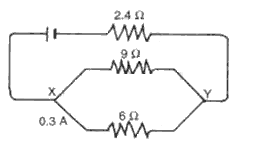
A current of 0.3 A is flowing through a branch of 6 Ω resistors in a junction as shown in fig. . Calculate the
(a) P.d. across the junction XY,
(b) Current flowing through 9Ω and 24Ω
( c) P.d. across 24 Ω resistor, and
( d) e.m.f. of the cell.

Image

How will you investigate the existence of the radiation beyond the red and violet extremes of the spectrum?
Describe a method to determine the specific heat capacity of a solid (say, a piece of copper).
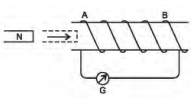
(i) The diagram shows an insulated copper coil wound over a thin cardboard tube and connected to centre zero galvanometer G. It is noticed that the galvanometer needle shows deflection towards the right when the powerful magnet is moved towards the coil as shown in the diagram.
Image
Now, answer the following questions:
(a) Explain why there is a deflection in the galyanometer.
(b) When viewed from end A , what is the direction of current in the coil (clockwise/anticlockwise)?
(c) What is your observation when the magnet is suddenly pulled away from the coil?
(d) What is your observation in the galvanometer when both the magnet and the coil are mounted on trolley and then moved towards the right with the same speed?
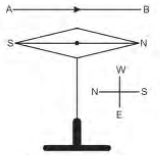
(ii) Diagram given shows a freely suspended magnetic needle.
(a) Why does the needle move in the above situations?
(b) Name and state the law which will determine the direction of motion of magnetic needle.
Image
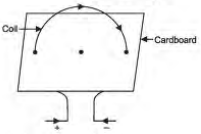
(iii) (a) Copy the diagram given and draw the lines of the magnetic field produced due to the flow of current.
(b) State one way of increasing the magnetic strength of the coil.
(c) Give three characteristics of magnetic lines of force in (a).
Image
Suppose there are three resistors $A, B$, and $C$ having resistances $r_1, r_2$, and $r_3$ respectively. If $R$ represents their equivalent resistance, establish the following relation $\frac{1}{ R }=\frac{1}{ r _1}+\frac{1}{ r _2}+\frac{1}{ r _3}$,when joined in parallel.
 
What do you mean by dynamic and static equilibrium? Give one example of each.
The primary coil of a transformed has 800 urns and the secondary coil has 8 turns. It is connected to a 220 V a.c. supply. What will be the output voltage?
Draw a circuit diagram using the dual control switches to light a staircase electric light and explain its working.
Prove that
Refractive index $=\frac{\text { Real depth }}{\text { Apparent depth }}$