Question
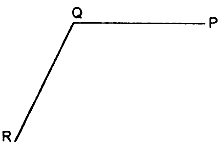
In your note-book copy the following angle using ruler and a pair compass only.

Answer

Steps of Construction: 1. At point A draw line AB = QP
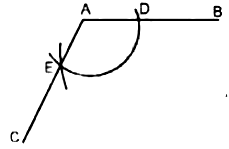
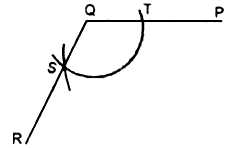
2. With Q as centre, draw an arc of any suitable radius, to cut the arms of the angle A + C and D.
3. With A as centre, draw the arc of the same size as drawn for C and D. Let this arc cuts line AB at D.
4. In your compasses, take the distance equal to distance between 7 and
5; and then with D as centre, draw an arc which cuts the earlier arc at E. 5. Join AE and produced upto a suitable point C. ∠BAC, so obtained is the angle equal to the given ∠PQR.
Need a full question paper?

Generate a complete, print-ready paper with questions like this in minutes — across 16+ boards, with answer keys.

Start Generating Free

Similar questions

Change the following groups of fractions to like fractions:
$\frac{1}{3}, \frac{2}{5}, \frac{3}{4}, \frac{1}{6}$
Using ruler and a pair compass only, construct a triangle PQR, given PQ = 5.5 cm, QR = 7.5 cm and RP = 6 cm. Draw the bisectors of the interior angles at P, Q and R. Do these bisectors meet at the same point ?
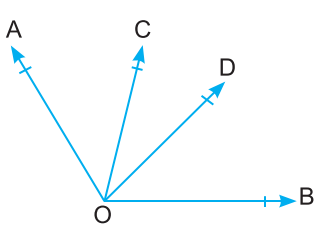
Look at the adjoining figure and state which of the following statements are true and which are false :
(i) Point C is in the interior of $\angle AOC$.
(ii) Point C is in the interior of $\angle AOD$.
(iii) Point D is in the interior of $\angle AOC$.
(iv) Point B is in the exterior of $\angle AOD$.
(v) Point C lies on $\angle AOB$.
Image
A man distributes ₹ 21600 among his three sons $A, B$ and $C$ in the ratio $5: 6: 7$ respectively.
Q.1. A's share is:
(a) ₹ 7200$\quad$(b) ₹ 6000$\quad$(c) ₹ 3600$\quad$(d) ₹ 5400
Q.2. B's share is :
(a) ₹ 7200$\quad$(b) ₹ 6400$\quad$(c) ₹ 5600$\quad$(d) ₹ 4800
Q.3. C's share is :
(a) ₹ 7600$\quad$(b) ₹ 9200$\quad$(c) ₹ 8400$\quad$(d) ₹ 8600
Q.4. If ₹ 600 is added to each of their shares, then the new ratio of their shares would be :
(a) $11: 12: 13$$\quad$(b) $11: 13: 15$$\quad$(c) $13: 15: 17$$\quad$(d) $19: 21: 23$
Find three consecutive integers such that their sum is 78.
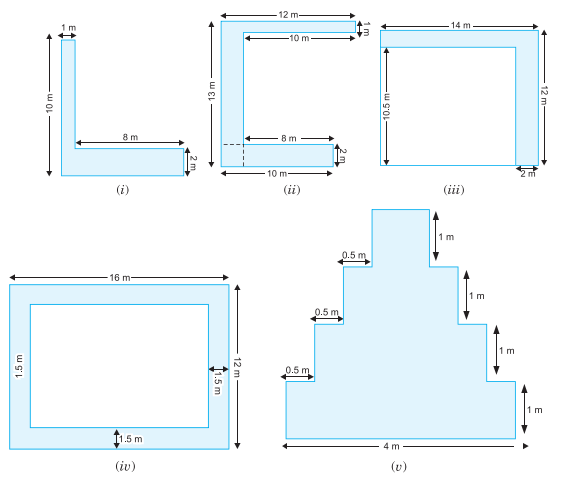
Calculate the area of each one of the shaded regions given below :
Image
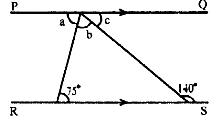
In the following figures, PQ is parallel to RS. Find the angles a, b and c:
Construct traingle ABC, when: BC = 3 cm, AC = 4 cm and AB = 5 cm. Measure angle ACB. Give a special name to this triangle.
When three consecutive natural numbers are added, the sum is 66, find the numbers.
Evaluate:
$1 \frac{4}{13} \text { of } 2 \frac{2}{7} \div \frac{68}{91}-\left(1 \frac{1}{2}-1 \frac{1}{3}\right)$