Questions

[5 marks sum]

🎯

Test yourself on this topic

17 questions · timed · auto-graded

Question 15 Marks
Construct a ∆ PQR such that PQ = 6 cm, ∠QPR = 45° and angle PQR = 60°. Locate its incentre and then draw its incircle.
Answer
Steps of Construction :
(i) Draw a line segment $P Q=6 cm$.
(ii) At $P$ draw rays making an angle of $45^{\circ}$ and at $Q$, making an angle of $60^{\circ}$, intersecting each other at $R$.
(iii) Draw the bisectors of $\angle P$ and $\angle Q$ intersecting each other at I.
(iv) From I, draw $IL \perp PQ$.
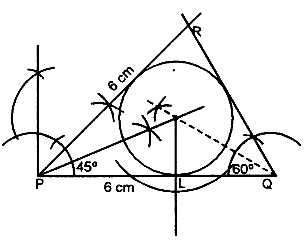
(v) With centre I and radius IL, draw a circle which touches the sides of $\triangle PQR$ internally. This is the required incircle whose $I$ is incentre.
View full question & answer
Question 25 Marks
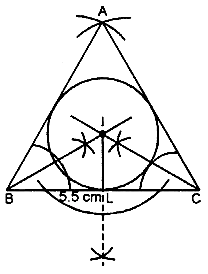
Construct an equilateral ∆ DEF whose one side is 5.5 cm. Construct an incircle to this triangle.
Answer
Steps of Construction :
(i) Draw a line segment $BC =5.5 cm$.

(ii) With centres $B$ and $C$ and radius $5.5 cm$ each draw two arcs intersecting each other at $A$.
(iii) Join $A B$ and $A C$.
(iv) Draw the perpendicular bisectors of $\angle B$ and $\angle C$ intersecting each other at $I$.
(v) From I, draw IL $\perp B C$
(vi) With centre I and radius IL, draw a circle which touches the sides of the $\triangle A B C$ internally.
This is the required incircle.
View full question & answer
Question 35 Marks
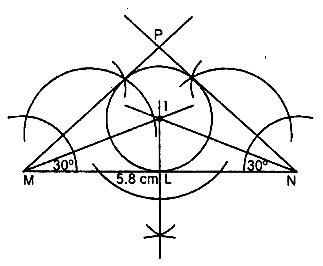
Construct an isosceles ∆ MNP such that base MN = 5.8 cm, base angle MNP = 30°. Construct an incircle to this triangle and measure its radius.
Answer
Steps of Construction :
(i) Draw a line segment $MN =5.8 cm$.


(ii) At $M$ and $N$, draw two rays making an angle of $30^{\circ}$ each which intersect each other at $P$.
(iii) Now draw the angle bisectors of $\angle M$ and $\angle N$ which intersects each other at I.
(iv) From I, draw the perpendicular IL on MN.
(v) With centre I and radius IL, draw a circle which touches the sides of the $\triangle$ PMN internally.
On measuring the required incircle and its radius is $0.6 cm$.
View full question & answer
Question 45 Marks
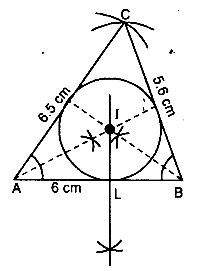
Construct a ∆ ABC such that AB = 6 cm, BC = 5.6 cm and CA = 6.5 cm.
Inscribe a circle to this triangle and measure its radius.
Answer
Steps of Construction :
(i) Draw a line segment $A B=6 cm$.

(ii) With centre $A$ and radius $6.5 cm$ and with centre $B$ and radius 5.6 $cm$, draw arcs intersecting each other at $C$.
(iii) Join $AC$ and $BC$.
(iv) Draw the angle bisector of $\angle A$ and $\angle B$ intersecting each other at I.
(v) From I, draw IL $\perp AB$
(vi) With centre I and radius IL, draw a circle which touches the sides of $\triangle ABC$ internally.
On measuring the required incircle whose radius is $1.6 cm$.
View full question & answer
Question 55 Marks
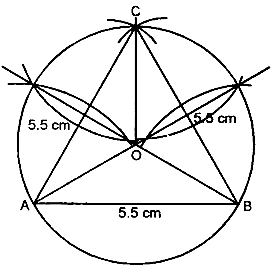
Construct an equilateral triangle ABC such that it's one side = 5.5 cm. Construct a circumcircle to this triangle.
Answer
Steps of Construction :
(i) Draw a line segment $A B=5.5 cm$

(ii) With centres $A$ and $B$ and radius $5.5 cm$, draw two arcs intersecting each other at $C$.
(iii) Join $A C$ and $B C$.
$\triangle A B C$ is the required triangle.
(iv) Draw perpendicular bisectors of sides $A C$ and $B C$ which intersect each other at $O$.
(v) Join $O A, O B$ and $O C$.
(vi) With centre $O$ and radius $OA$ or $OB$ or $OC$, draw a circle which passes through $A, B$ and $C$. This is the required circumcircle.
View full question & answer
Question 65 Marks
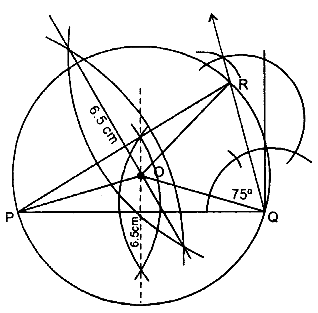
Construct an isosceles ∆ PQR such that PQ = PR = 6.5 cm and ∠PQR = 75°. Using a ruler and compasses only constructs a circumcircle to this triangle.
Answer
Steps of Construction :
(i) Draw a line segment $PQ =6.5 cm$
(ii) At $Q$, draw a ray making an angle of $75^{\circ}$.

(iii) Through P, with a radius of $6.5 cm$, draw an arc which intersects the angle ray at $R$.
(iv) Join PR,
$\triangle P Q R$ is the required triangle.
(v) Draw the perpendicular bisectors of sides PQ and PR intersecting each other at $O$.
(vi) Join $OP , OQ$ and $OR$.
(vii) With centre $O$ and radius equal to $O P$ or $O Q$ or $O R$ draw a circle which passes through $P, Q$ and $R$. This is the required circumcircle of $\triangle PQR$
View full question & answer
Question 75 Marks
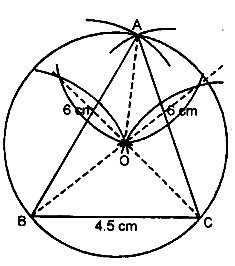
Construct a ∆ ABC such that AB = 6 cm, BC = 4.5 cm and AC = 5.5 cm. Construct a circumcircle of this triangle.
Answer
Steps of Construction :
(i) Draw a line segment $BC =4.5 cm$

(ii) With centre $B$ and radius $6 cm$, draw are arc
(iii) With centre $C$ and radius $5.5 cm$, draw another arc intersecting the first arc at $A$.
(iv) Join $A B$ and $A C$.
$\triangle ABC$ is the required triangle.
(v) Draw the perpendicular bisectors of $A B$ and $A C$. Which intersects each other at $O$.
(vi) Join $O B, O C$ and $O A$.
(vii) With centre $O$ and radius $OA$, draw a circle which passes through A, B and C.
This is the required circumcircle of $\triangle A B C$.
View full question & answer
Question 85 Marks
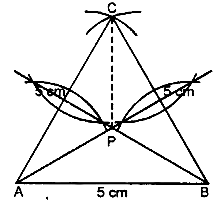
Construct an equilateral Δ ABC such that:
AB = 5 cm. Draw the perpendicular bisectors of BC and AC. Let P be the point of intersection of these two bisectors. Measure PA, PB, and PC.
Answer
Steps of Construction :
(i) Draw a line segment $A B=5 cm$.

(ii) With centres $A$ and $B$ and radius $5 cm$ each, draw two arcs intersecting each other at $C$.
(iii) Join $A C$ and $B C \triangle A B C$ is the required triangle.
(iv) Draw the perpendicular bisectors of sides $A C$ and $B C$ which intersect each other at $P$.
(v) Join PA, PB, and PC.
On measuring, each is $2.8 cm$.
View full question & answer
Question 95 Marks
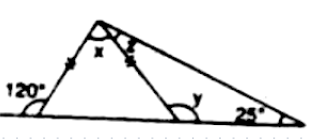
Apply the properties of isosceles and equilateral triangles to find the unknown angles in the given figure:
Image
Answer
In the fig.,
a = b ..........(Angles opposite to equal sides)
∴ y = 120°
But a + 120° = 180° ..............(Linear pair)
⇒ a = 180°− 120° = 60°
∴ b = 60°
But x + a + b = 180° ...............(Angles of a triangle)
⇒ x + 60° + 60° = 180°
⇒ x + 120° = 180°
∴ x = 180°− 120° = 60°
b = z + 25 .........(Exterior angle of a triangle is equal to the sum of its interior opposite angles)
⇒ 60° = z + 25°
⇒ z = 60°− 25° = 35°
Hence x = 60°, y = 120° and z = 35°
View full question & answer
Question 105 Marks
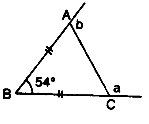
In $\triangle A B C, B A$ and $B C$ are produced. Find the angles $a$ and $h$. if $A B=$ BC.
Answer
In $\triangle A B C$, sides $B A$ and $B C$ are produced
$ \angle A B C=54^{\circ} ; A B=B C $
Now in $\triangle \mathrm{ABC}$,
$ \angle \mathrm{BAC}+\angle \mathrm{BCA}+\angle \mathrm{ABC}=180^{\circ} . $........ (Angles of a triangle)
$ \Rightarrow \angle \mathrm{BAC}+\angle \mathrm{BAC}+54^{\circ}=180^{\circ} $
$ (\because A B=B C) $
$ \Rightarrow 2 \angle \mathrm{BAC}=180^{\circ}-54^{\circ} $
$ \Rightarrow 2 \angle \mathrm{BAC}=126^{\circ} $
$\therefore \angle \mathrm{BAC}=\frac{126^{\circ}}{2}=63^{\circ}$ and $\angle \mathrm{BCA}=63^{\circ}$
$ \angle \mathrm{BAC}+\mathrm{b}=180^{\circ} $.......... (Linear pair)
$ \Rightarrow 63^{\circ}+\mathrm{b}=180^{\circ} $
$ \Rightarrow \mathrm{b}=180^{\circ}-63^{\circ}=117^{\circ} $
and $\angle \mathrm{BCA}+\mathrm{a}=180^{\circ}$. (Linear pair)
$ \therefore 63^{\circ}+\mathrm{a}=180^{\circ} $
$ \Rightarrow \mathrm{a}=180^{\circ}-63^{\circ}=117^{\circ} $
Hence $\mathrm{a}=117^{\circ}, \mathrm{b}=117$
View full question & answer
Question 115 Marks
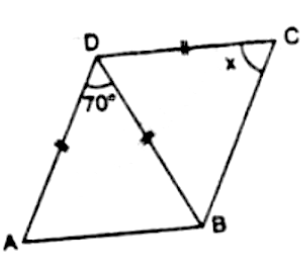
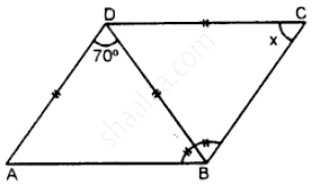
Find $x$ in Figure Given: $D A=D B=D C, B D$ bisects $\angle A B C$ and $\angle A D B=$$70^{\circ}$.
Image
Answer
In the figure,
$D A=D B=D C$
$B D$ bisects $\angle A B C$
and $\angle ADB =70^{\circ}$
Image
But $\angle ADB +\angle DAB +\angle DBA =180^{\circ}$ (Angles of a triangle)
$ \Rightarrow 70^{\circ}+\angle DBA +\angle DBA =180^{\circ} \ldots \ldots . .(\because DA = DB )$
$\Rightarrow 70^{\circ}+2 \angle DBA =180^{\circ}$
$\Rightarrow 2 \angle DBA =180^{\circ}-70^{\circ}$
$=110^{\circ}$
$\therefore \angle DBA =\frac{110^{\circ}}{2}=55^{\circ} $
$\because B D$ is the bisector of $\angle A B C$,
$\therefore \angle DBA =\angle DBC =55^{\circ}$
But in $\triangle DBC$,
$D B=D C$
$\therefore \angle DCB =\angle DBC$
$\Rightarrow x=55^{\circ}$
View full question & answer
Question 125 Marks
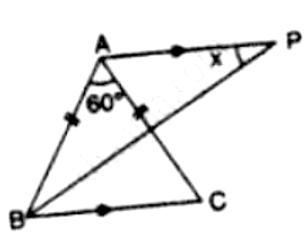
In Figure, $B P$ bisects $\angle A B C$ and $A B=A C$. Find $x$
Image
Answer
In the figure,
$A B=A C$ and $B P$ bisects $\angle A B C$
$A P \| B C$ is drawn.
Now $\angle \mathrm{PBC}=\angle \mathrm{PBA}$ ( $\because P B$ is the bisector of $\angle A B C$ )
$\because A P \| B C$
$\therefore \angle \mathrm{APB}=\angle \mathrm{PBC}$ ....... (Alternate angles)
$ \Rightarrow x=\angle \mathrm{PBC} $
In $\triangle \mathrm{ABC}, \angle \mathrm{A}=60^{\circ}$
and $\angle B=\angle C$. $\ldots(\because A B=A C)$
But $\angle A+\angle B+\angle C=180^{\circ}$......... (Angles of a triangle)
$\Rightarrow 60^{\circ}+\angle B+\angle C=180^{\circ}$
$\Rightarrow 60^{\circ}+\angle B+\angle B=180^{\circ}$
$\Rightarrow 2 \angle \mathrm{B}=180^{\circ}-60^{\circ}=120^{\circ}$
$\therefore \angle B=\frac{120^{\circ}}{2}=60^{\circ}$
$\Rightarrow \frac{1}{2} \angle \mathrm{B}=\frac{60^{\circ}}{2}=30^{\circ}$
$\Rightarrow \angle \mathrm{PBC}=30^{\circ}$
$\therefore$ From (i),
$ x=30^{\circ} $
View full question & answer
Question 135 Marks
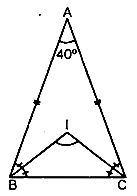
In the given figure, BI is the bisector of ∠ABC and Cl is the bisector of ∠ACB. Find ∠BIC.
Answer
$
\text { In } \triangle A B C \text {, }
$
$B I$ is the bisector of $\angle A B C$ and $C I$ is the bisector of $\angle A C B$.

$\begin{aligned} & \because A B=A C \\ & \therefore \angle B=\angle C\end{aligned}$ ......(Angles opposite to equal sides)
But $\angle A =40^{\circ}$
and $\angle A+\angle B+\angle C=180^{\circ}$. (Angles of a triangle)
$
\begin{aligned}
& \Rightarrow 40^{\circ}+\angle B+\angle B=180^{\circ} \\
& \Rightarrow 40^{\circ}+2 \angle B =180^{\circ} \\
& \Rightarrow 2 \angle B=180^{\circ}-40^{\circ}=140^{\circ} \\
& \Rightarrow \angle B=\frac{140^{\circ}}{2}=70^{\circ}
\end{aligned}
$
$
\therefore \angle ABC =\angle ACB =70^{\circ}
$
But $BI$ and $Cl$ are the bisectors of $\angle ABC$ and $\angle ACB$ respectively.
$
\therefore \angle BC =\frac{1}{2} \angle ABC =\frac{1}{2}\left(70^{\circ}\right)=35^{\circ}
$
and $\angle ICB =\frac{1}{2} \angle ACB =\frac{1}{2} \times 70^{\circ}=35^{\circ}$
Now in $\triangle I B C$
$
\begin{aligned}
& \angle BIC +\angle IBC +\angle ICB =180^{\circ} . \ldots \ldots . . \text { (Angles of a triangle) } \\
& \Rightarrow \angle B I C+35^{\circ}+35^{\circ}=180^{\circ} \\
& \Rightarrow \angle BIC +70^{\circ}=180^{\circ} \\
& \Rightarrow \angle BIC =180^{\circ}-70^{\circ}=110^{\circ}
\end{aligned}
$
Hence $\angle BIC =110^{\circ}$
View full question & answer
Question 145 Marks
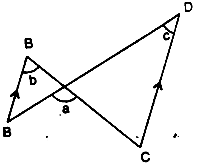
In the given figure, show that: $\angle a =\angle b +\angle c$

(i) If $\angle b =60^{\circ}$ and $\angle c =50^{\circ}$; find $\angle a$.
(ii) If $\angle a =100^{\circ}$ and $\angle b =55^{\circ}$ : find $\angle c$.
(iii) If $\angle a =108^{\circ}$ and $\angle c =48^{\circ}$; find $\angle b$.
Answer
∵ AB || CD
∴ b = c and ∠A = ∠C ........(Alternate angles)
Now in Δ PCD,
Ext. ∠APC = ∠C + ∠D
⇒ a = b + c
(i) If b = 60°, c = 50°, then
a = b + c = 60° + 50° = 110°
(ii) If a = 100° and b = 55°,
then a = b + c
⇒ 100° = 55°+ c
⇒ c = 100°− 55° = 45°
(iii) If a = 108° and c = 48°
then a = b + c
⇒ 108° = b + 48°
⇒ b = 108°− 48° = 60°
View full question & answer
Question 155 Marks
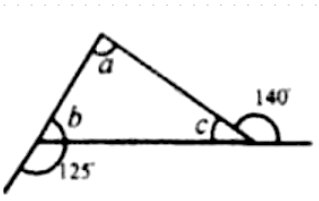
Find the unknown marked angles in the given figure:
Image
Answer
We know that in a triangle if one side of it is produced, then
Exterior angle = sum of its interior opposite angles.
In fig., 125° = a + c .......(i)
and 140° = a + b ............(ii)
Adding, we get
a + c + a + b = 125° + 140°
⇒ a + a + b + c = 265°
But a + b + c = 180° ........(sum of angles of a triangle)
∴ a + 180° = 265°
⇒ a = 265° − 180° = 85°
But a + b = 140°
⇒ 85° + b = 140°
⇒ b = 140°− 85° = 55°
and a + c = 125°
⇒ 85° + c = 125°
⇒ c = 125° − 85° = 40°
Hence a = 85°, b = 55° and c = 40°
View full question & answer
Question 165 Marks
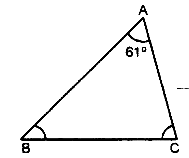
One angle of a triangle is $61^{\circ}$ and the other two angles are in the ratio $1 \frac{1}{2}: 1 \frac{1}{3}$. Find these angles.
Answer
In $\triangle A B C$
Let $\angle A=61^{\circ}$
But $\angle A+\angle B+\angle C=180^{\circ}$ ...........(Angles of a triangle)

$
\begin{aligned}
& \Rightarrow 61^{\circ}+\angle B+\angle C=180^{\circ} \\
& \Rightarrow \angle B+\angle C=180^{\circ}-61^{\circ}=119^{\circ} \\
& \text { But } \angle B: \angle C=1 \frac{1}{2}: 1 \frac{1}{3}=\frac{3}{2}: \frac{4}{3} \\
& =\frac{9: 8}{6} \\
& =9: 8
\end{aligned}
$
Let $\angle B=9 x$ and $\angle C=8 x$,
then, $9 x+8 x=119^{\circ}$
$
\begin{aligned}
& \Rightarrow 17 x=119^{\circ} \\
& \Rightarrow x=\frac{119^{\circ}}{17}=7^{\circ} \\
& \therefore \angle B=9 x=9 \times 7^{\circ}=63^{\circ} \\
& \angle C=8 x=8 \times 7^{\circ}=56^{\circ}
\end{aligned}
$
View full question & answer
Question 175 Marks
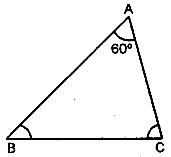
One angle of a triangle is 60°. The other two angles are in the ratio of 5: 7. Find the two angles.
Answer
$
\text { In } \triangle A B C \text {, }
$
Let $\angle A=60^{\circ}$ and then $\angle B: \angle C=5: 7$
But $\angle A +\angle B +\angle C =180^{\circ}$ ..........(Angles of a triangle)

$\begin{aligned} & \Rightarrow 60^{\circ}+\angle B+\angle C=180^{\circ} \\ & \Rightarrow \angle B+\angle C=180^{\circ}-60^{\circ}=120^{\circ} \\ & \text { Let } \angle B=5 x \text { and } \angle C=7 x \\ & \therefore 5 x+7 x=120^{\circ} \\ & \Rightarrow 12 x =120^{\circ} \\ & \Rightarrow x =\frac{120^{\circ}}{12}=10^{\circ} \\ & \therefore \angle B =5 x =5 \times 10^{\circ}=50^{\circ} \\ & \angle C =7 x =7 \times 10^{\circ}=70^{\circ}\end{aligned}$
View full question & answer
[5 marks sum] - MATHS STD 7 Questions - Vidyadip