Question types

Respiration in Plants question types

58 questions across 7 question groups — pick any mix to generate a BIOLOGY paper with step-by-step answer keys.

58
Questions
7
Question groups
5
Question types
Sample Questions

Respiration in Plants questions

One sample from each question group in this chapter. Select any group above to see the full set with answer keys.

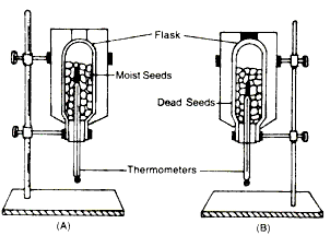
Moist germinated seeds were placed in a thermos flask $A,$ and germinating seeds, which were boiled and then soaked in$5$ percent formalin, were placed in thermos flask $B$. Thermometers were inserted in the flask and the mouth of each flask plugged with moist cotton wool. The two flasks were fixed upside down as shown in the fig. $10.9.$ The temperature on both thermometers was noted. After about $48$ hours, the temperature in
Image
flask A was found to be much higher than that in flask $B$.
$(a)$ State the object of using the apparatus..
$(b)$ Explain, why a rise in temperature occurs in flask $A$
$(c)$ If 5 percent formalin was not used after boiling the seeds, the temperature of flask $B$ would have risen considerably. Explain.
View full solution
Differentiate between aerobic and anaerobic respiration (end-products of the process)
View full solution
Q 6MCQ1 Mark
Mitochondria is the storage house for:
  • A
    $\text{NADH}$
  • B
    Pyruvic acid
  • $\text{ATP}$
  • D
    Citric acid

Answer: C.

View full solution
Q 7MCQ1 Mark
The energy liberated in aerobic respiration is
  • A
    $637$ Kcal
  • B
    $600$ Kcal
  • $673$ Kcal
  • D
    $693$ Kcal

Answer: C.

View full solution
Q 8MCQ1 Mark
Where does glycolysis take place?
  • In cytoplasm
  • B
    In chloroplast
  • C
    In ribosome
  • D
    In mitochondria

Answer: A.

View full solution
Q 10MCQ1 Mark
The energy liberated during respiration is stored in the form of
  • A
    heat
  • $\text{ATP}$
  • C
    $\text{ADP}$
  • D
    $\text{NADP}$

Answer: B.

View full solution
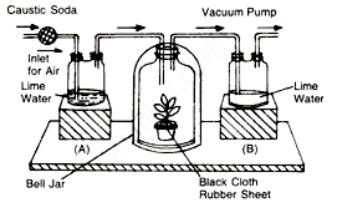
Given alongside is an experimental set up to demonstrate a phenomenon in a plant:
(a) What is the aim of this experiment?
(b) Why was the bell jar covered with a black cloth?
(c) What is the function of caustic soda in this experiment?
(d) Give an overall chemical equation of the process mentioned in (a) above. (e) Mention one precaution that should be taken to ensure more accurate results.
What change, if any, would you observe in the lime water in Flask A and B? In each case give a reason for your answer.
Image
View full solution
Match the terms of column A with the statements in column B:
Column AColumn B
(i) Yeast(a) partial breakdown of food substance.
(ii) Glucose(b) nutrients are oxidized without using molecular oxygen by the process of fermentation.
(iii) Anaerobic(c) is the best organic substrate for respiration.
(iv) Glycolysis(d) the intermediate substance in the breakdown of glucose.
(v) Pyruvic acid(e) the series of changes from glucose to pyruvic acid in respiration.
View full solution
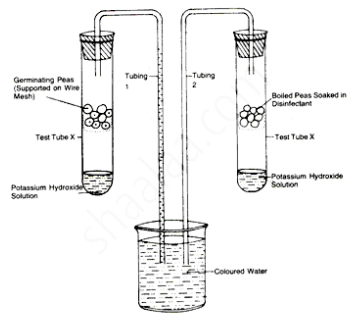
The given fig. refers to an apparatus which is used to demonstrate a physiological process:
Image
(a) What is the purpose of keeping potassium hydroxide solution in test tubes X and Y?
(b) What is the purpose of keeping boiled peas soaked in disinfectant in test tube Y?
(c) Why has coloured water risen in tube 1?
(d) Name the biological process which causes the above rise.
(e) Define the biological process shown in the experiment.
View full solution
Browse all question groups ↑

Generate a Respiration in Plants paper free

Pick question groups from the list above, set marks and difficulty, and export a branded PDF with step-by-step answer keys. First 3 chapters free — no signup.

Download App
Generate Paper FreeAll BIOLOGY chapters