Questions

[5 Mark Question Answer]

🎯

Test yourself on this topic

11 questions · timed · auto-graded

Question 15 Marks
Describe the major air pollutants. How does carbon monoxide pollute our environment?
Answer
Major air pollutants: Carbon monoxide, carbon dioxide, chlorofluorocarbons, lead, ozone, oxides of nitrogen, sulphur dioxide, suspended particulate matter
Carbon monoxide is a highly poisonous gas.
When inhaled, it passes through the lungs directly into the bloodstream. There it combines with haemoglobin, the substance which carries oxygen to body tissues. Because haemoglobin binds with carbon monoxide more than 200 times more strongly than oxygen, even low concentrations of carbon monoxide in the air have magnified effects on the body.
It reduces the oxygen-carrying capacity of blood by an amount equivalent to the amount of haemoglobin converted to carboxyhaemoglobin.
Haemoglobin + CO → Carboxyhaemoglobin
Because the heart and brain are two organs most sensitive to oxygen depletion, they show the most serious effects of carbon monoxide exposure.
In high concentration, carbon monoxide may kill by paralysing normal brain action.
View full question & answer
Question 25 Marks
State the chemicals responsible for ozone layer destruction.
Answer
Chemicals responsible for the destruction of the ozone layer:
(1) Excessive use of $CFCs:$
CFCs enter the atmosphere because of their excessive use in solvents, aerosol sprays, propellants, refrigerants and blowing agents for plastic foams.
CFCs are decomposed by UV rays to highly reactive chlorine which is produced in the atomic form.
$CF_2 Cl_{2(g)} \rightarrow CF_2 Cl_{(g)}+Cl_{(g)}$
This free radical $( Cl )$ reacts with ozone, and chlorine monoxide is formed.
$Cl_{(g)}+O_{3(g)}-ClO_{(g)}+O_{2(g)}$
This causes depletion of ozone, and chlorine monoxide further reacts with atomic oxygen to produce more free radicals of chlorine.
$ClO_{(g)}+O_{(g)} \rightarrow Cl_{(g)}+O_{2(g)}$
Again this free radical (CI) destroys ozone, and the process continues giving rise to large-scale ozone depletion.
(2) The fuel of planes:
When the fuel of planes burns, a large quantity of nitric oxide and other gases is emitted in the atmosphere. Nitric oxide reacts with ozone to form nitrogen dioxide and nitrogen trioxide.
$NO_{(g)}+O_{3(g)} \rightarrow NO_{2(g)}+O_{2(g)}$
$NO_{2(g)}+O_{3(g)} \rightarrow NO_{3(g)}+O_{2(g)}$
This also causes depletion of ozone.
View full question & answer
Question 35 Marks
Give the composition, causes, and effects of acid rain.
Answer
When oxides of sulphur and nitrogen of air come in contact with water or rain, they form corresponding acids and constitute acid rain.
Causes of acid rain:
The cause of acid rain is the formation of mineral acids such as nitric acid, sulphuric acid, and carbonic acid.
Effects of acid rain:
  • Acid rain removes or leaches away elements in soil such as calcium and potassium, and soil thus loses its fertility. In this way, it damages forests.
  • It makes water in lakes and rivers acidic and may no longer support aquatic life.
  • Acid rain causes extensive damage to buildings and monuments or marble, limestone, slate, and mortar. These materials become pitted and weakened mechanically. The Taj Mahal is one such example.
  • $CaCO_3 + H_2SO_4 → CaSO_4 + CO_2 + H_2O$
    $CaCO_3 + 2HNO_3 → Ca(NO_3)_2 + CO_2 + H_2O$
View full question & answer
Question 45 Marks
How do you propose to control:
Carbon monoxide emission
Answer
Carbon monoxide pollution can be controlled in the following ways:
- By switching over from internal combustion engines to electrically powered cars.
- Many pollution control devices are now installed in cars. Most of these devices help reduce pollution by burning gasoline completely. The complete combustion of gasoline produces only carbon dioxide and water vapour.
$2 \mathrm{C}_8 \mathrm{H}_{18}+5 \mathrm{O}_2 \rightarrow 16 \mathrm{CO}_2+18 \mathrm{H}_2 \mathrm{O}$
- By using substitute fuels for gasoline: Natural gas [both compressed (CNG) and liquefied (LNG)] is now increasingly being used as fuel. Alcohols are other feasible substitutes.
- By using catalytic convertors
- Nitrogen oxide is reduced to nitrogen and oxygen in the presence of finely divided platinum or palladium as a catalyst.
$\begin{gathered}2 \mathrm{NO} \xrightarrow{\mathrm{Pt}} \mathrm{N}_2+\mathrm{O}_2 \\ 2 \mathrm{NO}_2 \xrightarrow[0]{\mathrm{Pt}} \mathrm{N}_2+2 \mathrm{O}_2\end{gathered}$
- Carbon monoxide changes to carbon dioxide in the presence of finely divided platinum as a catalyst.
$\mathrm{CO} \xrightarrow[0]{\stackrel{\mathrm{Pt}}{\longrightarrow}} \mathrm{CO}_2+\mathrm{H}_2 \mathrm{O}$
View full question & answer
Question 55 Marks
How can we reduce global warming?
Answer
Ways of reducing global warming:
  • Minimize the use of automobiles: Depending on the situation, one can use a bicycle, the public transport system, and carpools.
  • Plant more trees to increase green cover.
  • Avoid burning of dry leaves and wood.
  • Avoid smoking. It is illegal to smoke in public places and workplaces because smoke is harmful not only for the one who is smoking but also for others sitting nearby.
  • Help people in understanding global warming; most people are unaware of it.
View full question & answer
Question 65 Marks
Our atmosphere acts as a greenhouse. Explain.
Answer
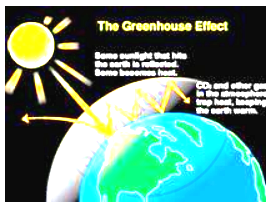
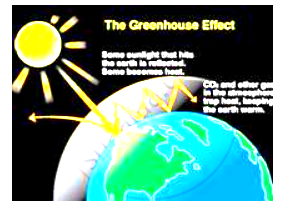
Our atmosphere contains greenhouse gases such as $CO _2$, water vapour, $O _3, CH _4$, oxides of nitrogen and CFCs and allows the sun rays to come in. Sunlight reaching the Earth consists of three types of radiation-UV radiation, visible radiation, and IR radiation. As sunlight passes through the atmosphere, most UV radiation is absorbed by ozone; $30 \%$ of IR radiation reaches the Earth's surface, heating it up. As the Earth's surface becomes hot, it starts emitting radiation with less energy than the incoming radiation and thus with a longer wavelength. Some emitted IR radiation escapes from the Earth's surface and some is absorbed by $CO _2$, thus remaining on the Earth. Trapped radiation warms the Earth's surface and lower layers of the atmosphere.
View full question & answer
Question 75 Marks
State the effects of greenhouse gases on the atmosphere.
Answer
Effects of global warming
  • Rise in sea level: Due to global warming, glaciers and polar ice caps have started to melt, and gradually this may lead to an increase in the sea level. This will in turn flood several coastal areas in countries such as India, Bangladesh, the Netherlands, and the Maldives.
  • Global warming will cause more water to evaporate from water bodies, thus forming more water vapour. Because water vapour also contributes to the greenhouse effect, global warming will further increase.
  • Global warming can lead to changes in the rain pattern and thus shift in crop zones. For example, wheat-producing zones will shift from Russia and Canada to the less fertile polar regions.
  • Change in rain patterns due to global warming will also affect trees and plants in forests which are natural habitats of wildlife. With the destruction of forests, many species of wildlife will also begin to die out.
View full question & answer
Question 85 Marks
What are green house gases? How are they responsible for global warming?
Answer
Gases that contribute to the greenhouse effect are called greenhouse gases. These gases are carbon dioxide, water vapour, oxides of nitrogen, methane, ozone, and chlorofluorocarbons. Sunlight reaching Earth consists of three types of radiation-UV radiation, visible radiation, and IR radiation. As sunlight passes through the atmosphere, most UV radiation is absorbed by ozone; 30% of IR radiation reaches the Earth's surface, heating it up. As the Earth's surface becomes hot, it starts emitting radiation with less energy than the incoming radiation and thus with a longer wavelength. Some emitted IR radiation escapes from the Earth's surface and some is absorbed by $CO_2$​​​​​​​, thus remaining on the Earth. Trapped radiation warms the Earth's surface and lower layers of the atmosphere.
View full question & answer
Question 95 Marks
State the main sources and effects of carbon monoxide.
Answer
Carbon monoxide is formed by incomplete combustion of fuels in homes, factories and automobiles.
Effects of carbon monoxide are as follows:
It is a highly poisonous gas.
It reduces the oxygen-carrying capacity of blood by an amount equivalent to the amount of haemoglobin converted to carboxyhaemoglobin.
Haemoglobin + CO → Carboxyhaemoglobin
Because heart and brain are the two tissues most sensitive to oxygen depletion, they show the most serious effects of carbon monoxide exposure.
In high concentrations, carbon monoxide may kill by paralysing normal brain action.
View full question & answer
Question 105 Marks
How do the oxides of nitrogen enter the atmosphere?
Answer
  • Oxides of nitrogen, nitric oxide (NO) and nitrogen dioxide ($NO_2$​​​​​​​), enter the atmosphere in the following ways:
  • On the burning of fuels in furnaces, the temperature increases. At high temperatures, nitrogen and oxygen present in the air combine to form oxides of nitrogen.
  • Oxides of nitrogen are produced during the burning of fuel in an internal combustion engine. They enter the atmosphere as exhaust gases.
  • During thunderstorms, nitric oxide is formed by the reaction between atmospheric nitrogen and oxygen in the presence of electric discharge.
  • Nitric oxide further reacts with atmospheric oxygen and ozone to form nitrogen dioxide.
View full question & answer
Question 115 Marks
How can we control carbon monoxide poisoning?
Answer
Carbon monoxide pollution can be controlled in the following ways:
By switching over from internal combustion engines to electrically powered cars.
Many pollution control devices are now installed in cars. Most of these devices help reduce pollution by burning gasoline completely. The complete combustion of gasoline produces only carbon dioxide and water vapor.
$2 \mathrm{C}_8 \mathrm{H}_{18}+5 \mathrm{O}_2 \longrightarrow 16 \mathrm{CO}_2+18 \mathrm{H}_2 \mathrm{O}$
By using substitute fuels for gasoline: Natural gas in both compressed (CNG) and liquefied (LNG) forms are now increasingly being used as fuel. Alcohols are other feasible substitutes.
By using catalytic converters:
i. Nitrogen oxide is reduced to nitrogen and oxygen in the presence of finely divided platinum or palladium as a catalyst.
$\begin{gathered}2 \mathrm{NO} \xrightarrow{\mathrm{Pt}} \mathrm{N}_2+\mathrm{O}_2 \\ 2 \mathrm{NO}_2 \xrightarrow{\mathrm{Pt}} \mathrm{N}_2+2 \mathrm{O}_2\end{gathered}$
Carbon monoxide changes to carbon dioxide in the presence of finely divided platinum as a catalyst.
$\mathrm{CO} \underset{(0)}{\mathrm{Pt}} \mathrm{CO}_2+\mathrm{H}_2 \mathrm{O}$
View full question & answer
[5 Mark Question Answer] - CHEMISTRY STD 9 Questions - Vidyadip