Question
Our atmosphere acts as a greenhouse. Explain.
Answer

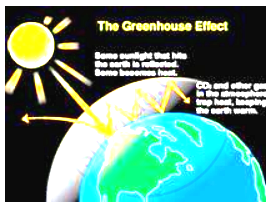
Our atmosphere contains greenhouse gases such as $CO _2$, water vapour, $O _3, CH _4$, oxides of nitrogen and CFCs and allows the sun rays to come in. Sunlight reaching the Earth consists of three types of radiation-UV radiation, visible radiation, and IR radiation. As sunlight passes through the atmosphere, most UV radiation is absorbed by ozone; $30 \%$ of IR radiation reaches the Earth's surface, heating it up. As the Earth's surface becomes hot, it starts emitting radiation with less energy than the incoming radiation and thus with a longer wavelength. Some emitted IR radiation escapes from the Earth's surface and some is absorbed by $CO _2$, thus remaining on the Earth. Trapped radiation warms the Earth's surface and lower layers of the atmosphere.

Need a full question paper?

Generate a complete, print-ready paper with questions like this in minutes — across 16+ boards, with answer keys.

Start Generating Free

Similar questions

What do you understand by the following terms?
What is meant by aqueous tension? How is the pressure exerted by a gas corrected to account for aqueous tension?
Give the assumptions of the kinetic molecular theory.
Give its
(i) mathematical expression
(ii) graphical representation and
(iii) significance.
A given amount of gas A is confined in a chamber of constant volume. When the chamber is immersed in a bath of melting ice, the pressure of the gas is 100cmHg.
  1. What is the temperature when the pressure is 10cmHg?
  2. What will be the pressure when the chamber is brought to 100°C
Give its
(i) graphical representation,
(ii) mathematical expression
(iii) significance
Match the following:
Compound Formula
1. Boric acid i. $NaOH$
2. Phosphoric acid ii. $SiO_2$
3. Nitrous acid iii. $Na_2CO_3$
4. Nitric acid iv. $KOH$
5. Sulphurous acid v. $CaCO_3$
6. Sulphuric acid vi. $NaHCO_3$
7. Hydrochloric acid vii. $H_2S$
8. Silica (sand) viii. $H_2O$
9. Caustic soda (sodium hydroxide) ix. $PH_3$
10. Caustic potash (potassium hydroxide) x. $CH_4$
11. Washing soda (sodium carbonate) xi. $NH_3$
12. Baking soda (sodium bicarbonate) xii. $HCl$
13. Lime stone (calcium carbonate) xiii. $H_2SO_3$
14. Water xiv. $HNO_3$
15. Hydrogen sulphide xv. $HNO_2$
16. Ammonia xvi. $H_3BO_3$
17. Phosphine xvii. $H_3PO_4$
18. Methane xviii. $H_2SO_4$
State the effects of greenhouse gases on the atmosphere.
Complete the following table and write your observations.
Hydrogen sulphide Ammonia Sulphur dioxide Hydrogen chloride
Shake the gas with red litmus solution
Shake the gas with blue litmus solution
Apply a burning splint to a gas
When hydrogen is passed over a black solid compound A, the products are a 'colorless liquid' and a 'reddish-brown metal B'.
Substance B is divided into two parts each placed in separate test tubes.
Dilute HCl is added to one part of substance B and dilute $HNO_3$ to the other.
  1. Name the substances A and B.
  2. Give two tests for the colourless liquid formed in the experiment.
  3. What happens to substance A when it reacts with hydrogen? Give reasons for your answer.
  4. Write an equation for the reaction between hydrogen and substance A.
  5. Is there any reaction between substance B and dilute hydrochloric acid? Give reasons for your answer.