Question 12 Marks
Draw a line segment of length $\sqrt{8} \mathrm{~cm}$.
Answer$\sqrt{8}=\sqrt{3^2-1}$
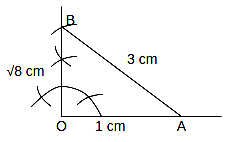
View full question & answer→Question 22 Marks
Show that Negative of an irrational number is irrational.
AnswerLet us assume that $\mathrm{x}$ is an irrational number such that $-\mathrm{x}$ is rational.
So, $-\mathrm{x}=\frac{\mathrm{a}}{\mathrm{b}}$ where $\mathrm{a}, \mathrm{b}$ are integer and $\mathrm{b} \neq 0$
$x=\frac{-a}{b}$
Since, $-\mathrm{a}, \mathrm{b}$ is also integer and $\mathrm{b} \neq 0$.
So $\mathrm{x}$ is a rational number it contradict our assumption.
$\therefore-\mathrm{x}$ is irrational.
View full question & answer→Question 32 Marks
Simplify : $\frac{\sqrt{18}}{5 \sqrt{18}+3 \sqrt{72}-2 \sqrt{162}}$
Answer$ \frac{\sqrt{18}}{5 \sqrt{18}+3 \sqrt{72}-2 \sqrt{162}}$
$ =\frac{\sqrt{9 \times 2}}{5 \sqrt{9 \times 2}+3 \sqrt{36 \times 2}-2 \sqrt{81 \times 2}}$
$ =\frac{3 \sqrt{2}}{15 \sqrt{2}+18 \sqrt{2}-18 \sqrt{2}}$
$ =\frac{3 \sqrt{2}}{15 \sqrt{2}}$
$ =\frac{1}{5}$
View full question & answer→Question 42 Marks
Show that $x$ is rational, if $x^2 = 16.$
Answer$ x^2=16 $
$ x=\sqrt{16} $
$ x=\sqrt{4 \times 4} $
$ x=4$
It is rational.
View full question & answer→Question 52 Marks
Show that $x $ is rational, if $x^2 = 0.0004.$
Answer$ x^2=0.0004 $
$ x=\frac{0.0004}{10000} $
$ x=\sqrt{\frac{4}{10000}} $
$ x=\frac{2}{100} $
$x=0.02$
It is a Rational.
View full question & answer→Question 62 Marks
Show that $x$ is rational, if $x^2=1 \frac{7}{9}$
Answer$x^2=1 \frac{7}{9}$
$\mathrm{x}^2=\frac{16}{9}$
$x=\sqrt{\frac{16}{9}}$
$ x=\frac{4}{3}$
It is a Rational.
View full question & answer→Question 72 Marks
Show that $x$ is irrational, if $x^2 = 0.009.$
Answer$x^2=0.009$
$x=\sqrt{\frac{9}{1000}}$
$x=\frac{3}{10 \sqrt{10}}$
It is a irrational.
View full question & answer→Question 82 Marks
Show that $x$ is irrational, if $x^2 = 27.$
Answer$ x^2=27 $
$ x=\sqrt{27} $
$ x=\sqrt{3 \times 3 \times 3} $
$ x=3 \sqrt{3}$
It is a Irrational.
View full question & answer→Question 92 Marks
If $\mathrm{x}=2 \sqrt{ } 3+2 \sqrt{2}$, find $:\left(x+\frac{1}{x}\right)^2$
Answer$ \left(x+\frac{1}{x}\right)^2=\left[5 \sqrt{3}+3 \frac{\sqrt{2}}{2}\right]^2$
$ =\frac{75+18+30 \sqrt{6}}{4}$
$ =\frac{93+30 \sqrt{6}}{4}$
View full question & answer→Question 102 Marks
If $\mathrm{x}=2 \sqrt{3+2 } \sqrt{2 } $, find $:\left(x+\frac{1}{x}\right)$
Answer$ x+\frac{1}{x}=2 \sqrt{3}+2 \sqrt{2}+\frac{\sqrt{3}-\sqrt{2}}{2}$
$ =2(\sqrt{3}+\sqrt{2})+\frac{\sqrt{3}-\sqrt{2}}{2}$
$ =\frac{4(\sqrt{3}+\sqrt{2})+(\sqrt{3}-\sqrt{2})}{2}$
$ =\frac{4 \sqrt{3}+4 \sqrt{2}+\sqrt{3}-\sqrt{2}}{2}$
$ =\frac{5 \sqrt{3}+3 \sqrt{2}}{2}$
View full question & answer→Question 112 Marks
If $x=2 \sqrt{3}+2 \sqrt{2}$, find: $\frac{1}{x}$
Answer$ \frac{1}{x}=\frac{1}{2 \sqrt{3}+2 \sqrt{2}} \times \frac{2 \sqrt{3}-2 \sqrt{2}}{2 \sqrt{3}-2 \sqrt{2}}$
$ =\frac{2 \sqrt{3}-2 \sqrt{2}}{(2 \sqrt{3})^2-(2 \sqrt{2})^2}$
$ =\frac{2 \sqrt{3}-2 \sqrt{2}}{12-8}$
$ =\frac{\not 2^1(\sqrt{3}-\sqrt{2})}{\not{A}_2}$
$ =\frac{\sqrt{3}-\sqrt{2}}{2}$
View full question & answer→Question 122 Marks
If $x=\frac{\sqrt{5}-2}{\sqrt{5}+2}$ and $y=\frac{\sqrt{5}+2}{\sqrt{5}-2} ;$ find :
Answer$ x^2 =\left[\frac{\sqrt{5}-2}{\sqrt{5}+2}\right]^2 $
$=\frac{5+4-4 \sqrt{5}}{5+4+4 \sqrt{5}} $
$=\frac{9-4 \sqrt{5}}{9+4 \sqrt{5}}$
$=\frac{9-4 \sqrt{5}}{9+4 \sqrt{5}} \times\left[\frac{9-4 \sqrt{5}}{9-4 \sqrt{5}}\right]$
$=\frac{(9-4 \sqrt{5})^2}{(9)^2-(4 \sqrt{5})^2}$
$=\frac{81+80-72 \sqrt{5}}{81-80}$
$=161-72 \sqrt{5}$
View full question & answer→Question 132 Marks
Simplify : $\frac{\sqrt{2}}{\sqrt{6}-\sqrt{2}}-\frac{\sqrt{3}}{\sqrt{6}+\sqrt{2}}$
Answer$ \frac{\sqrt{2}}{\sqrt{6}-\sqrt{2}}-\frac{\sqrt{3}}{\sqrt{6}+\sqrt{2}}$
$=\frac{\sqrt{2}}{\sqrt{6}-2}-\frac{\sqrt{3}}{\sqrt{6}+\sqrt{2}}$
$=\frac{\sqrt{2}(\sqrt{6}+\sqrt{2})-\sqrt{3}(\sqrt{6}-\sqrt{2})}{(\sqrt{6})^2-(\sqrt{2})^2}$
$ =\frac{\sqrt{12}+2-\sqrt{18}+\sqrt{6}}{6-2}$
$ =\frac{2 \sqrt{3}+2-3 \sqrt{2}+\sqrt{6}}{4}$
View full question & answer→Question 142 Marks
Simplify :$\frac{22}{2 \sqrt{3}+1}+\frac{17}{2 \sqrt{3}-1}$
Answer$ \frac{22}{2 \sqrt{3}+1}+\frac{17}{2 \sqrt{3}-1}$
$ =\frac{22(2 \sqrt{3}-1)+17(2 \sqrt{3}+1)}{(2 \sqrt{3}+1)(2 \sqrt{3}-1)}$
$ =\frac{44 \sqrt{3}-22+34 \sqrt{3}+17}{(2 \sqrt{3})^2-1}$
$ =\frac{78 \sqrt{3}-5}{12-1}$
$ =\frac{78 \sqrt{3}-5}{11}$
View full question & answer→Question 152 Marks
Find the values of $'a \ ' $ and $ ' b\ ' $ in each of the following $:\frac{5+3 \sqrt{2}}{5-3 \sqrt{2}}=a+b \sqrt{2}$
Answer$ \frac{5+3 \sqrt{2}}{5-3 \sqrt{2}}=a+b \sqrt{2}$
$ \frac{5+3 \sqrt{2}}{5-3 \sqrt{2}} \times \frac{5+3 \sqrt{2}}{5+3 \sqrt{2}}=a+b \sqrt{2}$
$ \frac{(5+3 \sqrt{2})^2}{(5)^2-(3 \sqrt{2})^2}=a+b \sqrt{2}$
$ \frac{25+18+30 \sqrt{2}}{25-18}=a+b \sqrt{2}$
$ \frac{43+30 \sqrt{2}}{7}=a+b \sqrt{2}$
$ a=\frac{43}{7}, b=\frac{30}{7}$
View full question & answer→Question 162 Marks
Find the values of $'a\ '$ and $'b\ '$ in each of the following: $\frac{3}{\sqrt{3}-\sqrt{2}}=a \sqrt{3}-b \sqrt{2}$
Answer$ \frac{3}{\sqrt{3}-\sqrt{2}}=a \sqrt{3}-b \sqrt{2}$
$ \frac{3}{\sqrt{3}-\sqrt{2}} \times \frac{\sqrt{3}+\sqrt{2}}{\sqrt{3}+\sqrt{2}}=a \sqrt{3}-b \sqrt{2}$
$ \frac{3(\sqrt{3}+\sqrt{2})}{3-2}=a \sqrt{3}-b \sqrt{2}$
$ (3 \sqrt{3}+3 \sqrt{2})=a \sqrt{3}-b \sqrt{2}$
$ \Rightarrow a=3, b=-3$
View full question & answer→Question 172 Marks
Find the values of $' a\ ' $ and $ ' b\ ' $ in each of the following :$\frac{\sqrt{7}-2}{\sqrt{7}+2}=a \sqrt{7}+b$
Answer$ \frac{\sqrt{7}-2}{\sqrt{7}+2}=a \sqrt{7}+b$
$ \frac{(\sqrt{7}-2)^2}{(\sqrt{7})^2-(2)^2}=a \sqrt{7}+b$
$ \frac{7+4-4 \sqrt{7}}{7-4}=a \sqrt{7}+b$
$ \frac{11-4 \sqrt{7}}{3}=a \sqrt{7}+b$
$ a=-\frac{4}{3}, b=\frac{11}{3}$
View full question & answer→Question 182 Marks
Find the values of $' a \ ' $ and $ ' b\ ' $ in each of the following : $\frac{2+\sqrt{3}}{2-\sqrt{3}}=a+b \sqrt{3}$
Answer$ \frac{2+\sqrt{3}}{2-\sqrt{3}} \times \frac{2+\sqrt{3}}{2+\sqrt{3}}=a+b \sqrt{3}$
$ =\frac{(2+\sqrt{3})^2}{(2)^2-(\sqrt{3})^2}=a+b \sqrt{3}$
$ =\frac{4+3+4 \sqrt{3}}{4-3}=a+b \sqrt{3}$
$ 7+4 \sqrt{ } 3=a+b \sqrt{3}$
$ a=7, b=4$
View full question & answer→Question 192 Marks
Rationalise the denominators of : $\frac{\sqrt{6}-\sqrt{5}}{\sqrt{6}+\sqrt{5}}$
Answer$ \frac{\sqrt{6}-\sqrt{5}}{\sqrt{6}+\sqrt{5}} \times \frac{\sqrt{6}-\sqrt{5}}{\sqrt{6}-\sqrt{5}}$
$ =\frac{6+5-2 \sqrt{ } 30}{(\sqrt{ } 6)^2-(\sqrt{ } 5)^2}$
$ =\frac{11-2 \sqrt{ } 30}{6-5}$
$ =11-2 \sqrt{ } 30$
View full question & answer→Question 202 Marks
Rationalise the denominators of : $\frac{\sqrt{3}-\sqrt{2}}{\sqrt{3}+\sqrt{2}}$
Answer$ \frac{\sqrt{3}-\sqrt{2}}{\sqrt{3}+\sqrt{2}} \times \frac{\sqrt{3}-\sqrt{2}}{\sqrt{3}-\sqrt{2}}$
$ =\frac{(\sqrt{3}-\sqrt{2})^2}{(\sqrt{3})^2-(\sqrt{2})^2}$
$ =\frac{3+2-2 \sqrt{6}}{3-2}$
$ =5-2 \sqrt{ } 6$
View full question & answer→Question 212 Marks
Rationalise the denominators of : $\frac{\sqrt{3}+1}{\sqrt{3}-1}$
Answer$ \frac{\sqrt{3}+1}{\sqrt{3}-1} \times \frac{\sqrt{3}+1}{\sqrt{3}+1}$
$= \frac{(\sqrt{3}+1)^2}{(\sqrt{3})^3-(1)^2}$
$= \frac{3+1+2 \sqrt{3}}{3-1}$
$= \frac{4+2 \sqrt{3}}{2}$
$= \frac{2(2+\sqrt{3})}{2}$
$= 2+\sqrt{3}$
View full question & answer→Question 222 Marks
Rationalise the denominators of : $\frac{2-\sqrt{ } 3}{2+\sqrt{ } 3}$
Answer$
\frac{2-\sqrt{ } 3}{2+\sqrt{ } 3} \times \frac{2-\sqrt{ } 3}{2-\sqrt{ } 3}$
$ =\frac{(2-\sqrt{ } 3)^2}{(2)^2-(\sqrt{ } 3)^2}$
$=\frac{4+3-4 \sqrt{ } 3}{4-3}$
$ =\frac{7-4 \sqrt{ } 3}{1}$
$ =7-4 \sqrt{ } 3$
View full question & answer→Question 232 Marks
Rationalise the denominators of : $\frac{3}{\sqrt{5}+\sqrt{2}}$
Answer$ \frac{3}{\sqrt{5}+\sqrt{2}} \times\left(\frac{\sqrt{5}-\sqrt{2}}{\sqrt{5}-\sqrt{2}}\right)$
$= \frac{3(\sqrt{5}-\sqrt{2})}{(\sqrt{5})^2-(\sqrt{2})^2}$
$= \frac{3(\sqrt{5}-\sqrt{2})}{5-2}$
$= \sqrt{5}-\sqrt{2}$
View full question & answer→Question 242 Marks
Rationalise the denominators of : $\frac{1}{\sqrt{3}-\sqrt{2}}$
Answer$ \frac{1}{\sqrt{3}-\sqrt{2}} \times\left(\frac{\sqrt{3}+\sqrt{2}}{\sqrt{3}+\sqrt{2}}\right)$
$=\frac{\sqrt{3+\sqrt{2}}}{(\sqrt{3})^2-(\sqrt{2})^2}$
$=\frac{\sqrt{3}+\sqrt{2}}{3-2}$
$ =\sqrt{3}+\sqrt{2}$
View full question & answer→Question 252 Marks
Rationalise the denominators of : $\frac{3}{\sqrt{5}}$
Answer$\frac{3}{\sqrt{5}} \times \frac{\sqrt{5}}{\sqrt{5}}=\frac{3 \sqrt{5}}{5}$
View full question & answer→Question 262 Marks
Write the lowestrationalising factor of$ :15 - 3\sqrt2$
Answer$15-3 \sqrt{ 2} $
$15-3 \sqrt{2} =3(5-\sqrt{ 2} )$
$ =3(5-\sqrt{2 } )(5+\sqrt{ 2} )$
$ =3 \times\left[5^2-(\sqrt{2})^2\right]$
$ =3 \times[25-2]$
$ =3 \times 23$
$ =69$
Its lowest rationalizing factor is $5+\sqrt{ 2} $.
View full question & answer→Question 272 Marks
Write the lowest rationalising factor of : $\sqrt13 + 3$
Answer$( \sqrt13 + 3 )( \sqrt13 - 3 )$
$= ( \sqrt13 )^2 - 3^2$
$=13 - 9 $
$= 4$
Its lowest rationalizing factor is $\sqrt13 - 3.$
View full question & answer→Question 282 Marks
Write the lowest rationalising factor of : $\sqrt{5 } -\sqrt{2}$
Answer$ \sqrt{5}-\sqrt{2}$
$ (\sqrt{5}-\sqrt{2})(\sqrt{5}+\sqrt{2}) $
$=(\sqrt{5})^2-(\sqrt{2})^2$
$=3$
Therefore lowest rationalizing factor is $\sqrt{5}+\sqrt{2}$
View full question & answer→Question 292 Marks
Write the lowestrationalising factor of $:\sqrt18 - \sqrt50$
Answer$ \sqrt{18 } -\sqrt{50 } $
$ \sqrt{18 } -\sqrt{50}=\sqrt{2 \times 3 \times 3}-\sqrt{5 \times 5 \times 2}$
$=3 \sqrt{2-5 } \sqrt{2 } $
$=-2 \sqrt{ 2} $
$\therefore$ lowest rationalizing factor is $\sqrt{ 2} $
View full question & answer→Question 302 Marks
Write the lowest rationalising factor of $: 7 - \sqrt7$
Answer$7 - \sqrt7$
$( 7 - \sqrt7 )( 7 + \sqrt7 )$
$= 49 - 7$
$= 42$
Therefore, lowestrationalizing factor is $( 7 + \sqrt7 ).$
View full question & answer→Question 312 Marks
If $\sqrt{2}=1.4$ and $\sqrt{3}=1.7$, find the value of $\frac{2-\sqrt{3}}{\sqrt{3}}$
Answer$ \frac{2-\sqrt{3}}{\sqrt{3}}$
$ =\frac{2-\sqrt{3}}{\sqrt{3}} \times \frac{\sqrt{3}}{\sqrt{3}}$
$ =\frac{(2-\sqrt{3}) \times \sqrt{3}}{\sqrt{3} \times \sqrt{3}}$
$ =\frac{2 \sqrt{3}-3}{3}$
$ =\frac{2}{\sqrt{ } 3}-\frac{\sqrt{ } 3}{\sqrt{ } 3}$
$ =\frac{2 \times 1.7-3}{3}$
$ =\frac{3.4-3}{3}$
$ =\frac{0.4}{3}$
$ =0.13$
View full question & answer→Question 322 Marks
If $\sqrt{2 } =1.4$ and $\sqrt{ 3} =1.7$, find the value of $: \frac{1}{3+2 \sqrt{2 } }$
Answer$\sqrt{2 } =1.4$ and $\sqrt{ 3} =1.7$
$\frac{1}{3+2 \sqrt{2 } }$
$ =\frac{1}{3+2 \sqrt{ 2} } \times \frac{3-2 \sqrt{ 2} }{3-2 \sqrt{2 } }$
$ =\frac{3-2 \sqrt{2 } }{(3)^2-(2 \sqrt{2 } )^2}$
$ =\frac{3-2 \sqrt{2 } }{9-8}$
$ =3-2 \sqrt{2 } $
$ =3-2(1.4)$
$ =3-2.8$
$ =0.2$
View full question & answer→Question 332 Marks
If $\sqrt{2 } =1.4$ and $\sqrt{3 } =1.7$, find the value of $: \frac{1}{\sqrt{3 } -\sqrt{2 } }$
Answer$ \sqrt{2 } =1.4$ and $\sqrt{3 } =1.7$
$ \frac{1}{\sqrt{ 3} -\sqrt{ 2} }$
$ =\frac{1}{\sqrt{ 3} -\sqrt{2 } } \times \frac{\sqrt{3 } +\sqrt{ 2} }{\sqrt{ 3} +\sqrt{2 } }$
$ =\frac{\sqrt{ 3} +\sqrt{ 2} }{(\sqrt{3 } )^2-(\sqrt{ 2} )^2}$
$ =\frac{\sqrt{ 3} +\sqrt{2 } }{3-2}$
$ =\sqrt{ 3} +\sqrt{ 2} $
$ =1.7+1.4$
$ =3.1$
View full question & answer→Question 342 Marks
Given universal set $=\left\{-6,-5 \frac{3}{4},-\sqrt{4},-\frac{3}{5},-\frac{3}{8}, 0, \frac{4}{5}, 1,1 \frac{2}{3}, \sqrt{8}, 3.01, \pi, 8.47\right\}$
From the given set, find : set of non$-$negative integers
AnswerGiven universal set $=\left\{-6,-5 \frac{3}{4},-\sqrt{4},-\frac{3}{5},-\frac{3}{8}, 0, \frac{4}{5}, 1,1 \frac{2}{3}, \sqrt{8}, 3.01, \pi, 8.47\right\}$
We need to find the set of non$-$negative integers.
Set of non$-$negative integers consists of zero and the natural numbers.
The set of non-negative integers is $Z^{+}$and $Z^{+}=\{0,1,2,3, \ldots \ldots$.
Here the set of integers is $U \cap Z^{+}=\{0,1\}$
View full question & answer→Question 352 Marks
Given universal set $=\left\{-6,-5 \frac{3}{4},-\sqrt{4},-\frac{3}{5},-\frac{3}{8}, 0, \frac{4}{5}, 1,1 \frac{2}{3}, \sqrt{8}, 3.01, \pi, 8.47\right\}$
From the given set, find : set of integers
AnswerGiven Universal set is
$\left\{-6,-5 \frac{3}{4},-\sqrt{4},-\frac{3}{5},-\frac{3}{8}, 0, \frac{4}{5}, 1,1 \frac{2}{3}, \sqrt{8}, 3.01, \pi, 8.47\right\}$
We need to find the set of integers.
Set of integers consists of zero, the natural numbers and their additive inverses.
The set of integers is $ Z.$
$Z=\{\ldots \ldots-3,-2,-1,0,1,2,3, \ldots \ldots .\}$
Here the set of integers is $U \cap Z=\{-6, \sqrt{ 4} ,0,1\}$
View full question & answer→Question 362 Marks
Find the square of : $3 + 2\sqrt5$
Answer$( 3 + 2\sqrt5 )^2$
$= 3^2 + 2( 3 )( 2\sqrt5) + ( 2\sqrt5 )^2$
$= 9 + 12\sqrt5 + 20$
$= 29 + 12\sqrt5$
View full question & answer→Question 372 Marks
Find the square of : $\sqrt5 - 2$
Answer$( \sqrt5 - 2 )^2$
$= ( \sqrt5 )^2 - 2( \sqrt5 )( 2 ) + ( 2 )^2$
$= 5 - 4\sqrt5 + 4$
$= 9 - 4\sqrt5$
View full question & answer→Question 382 Marks
Find the square of : $\sqrt3 + \sqrt2$
Answer$( \sqrt3 + \sqrt2 )^2$
$= ( \sqrt3 )^2 + 2( \sqrt3 )( \sqrt2 ) + ( \sqrt2 )^2$
$= 3 + 2\sqrt6 + 2$
$= 5 + 2\sqrt6$
View full question & answer→Question 392 Marks
Find the square of : $\frac{3 \sqrt{5}}{5}$
Answer$ \left(\frac{3 \sqrt{5}}{5}\right)^2$
$=\frac{3^2(\sqrt{5})^2}{5^2}$
$ =\frac{9 \times 5}{25}$
$=\frac{9}{5}$
$=1 \frac{4}{5}$
View full question & answer→Question 402 Marks
Simplify : $(\sqrt3 - \sqrt2 )^2$
Answer$(\sqrt3 - \sqrt2 )^2$
$= ( \sqrt3 )^2 + ( \sqrt2 )^2 - 2\times\sqrt3 \times\sqrt2$
$= 3 + 2 - 2\sqrt6$
$= 5 - 2\sqrt6$
View full question & answer→Question 412 Marks
Simplify $: (3 + \sqrt2 )( 4 + \sqrt7)$
Answer$( 3 + \sqrt2 )( 4 + \sqrt7 )$
$= 3 \times 4 + 3 \times \sqrt7 + 4 \times \sqrt2 + \sqrt2 \times \sqrt7$
$= 12 + 3\sqrt7 + 4\sqrt2 + \sqrt14$
View full question & answer→Question 422 Marks
Simplify : $\frac{\sqrt[4]{243}}{\sqrt[4]{3}}$
Answer$ \frac{\sqrt[4]{243}}{\sqrt[4]{3}}$
$ =\frac{\sqrt[4]{3^5}}{\sqrt[4]{3}}$
$ =\frac{3^{5 \times \frac{1}{4}}}{3^{\frac{1}{4}}}$
$ =\frac{3^{\frac{5}{4}}}{3^{\frac{1}{4}}}$
$ =3^{\frac{5}{4}-\frac{1}{4}}$
$ =3^{\frac{4}{4}}$
$ =3^1$
$ =3$
View full question & answer→Question 432 Marks
Simplify : $\sqrt[5]{16} \times \sqrt[5]{2}$
Answer$ \sqrt[5]{16} \times \sqrt[5]{2}$
$ =16^{\frac{1}{5}} \times 2^{\frac{1}{5}}$
$ =2^{4 \times \frac{1}{5}} \times 2^{\frac{1}{5}}$
$ =2^{\frac{4}{5}} \times 2^{\frac{1}{5}}$
$ =2^{\frac{5}{5}}$
$ =2^1$
$ =2$
View full question & answer→Question 442 Marks
Insert five irrational numbers between $2 \sqrt{5}$ and $3 \sqrt{3}$.
AnswerWe know that $2 \sqrt{5}=\sqrt{4 \times 5}=\sqrt{20}$ and
$3 \sqrt{3}=\sqrt{9 \times 3}=\sqrt{27}$
Thus, We have,
$\sqrt{20}<\sqrt{21}<\sqrt{22}<\sqrt{23}<\sqrt{24}<\sqrt{25}<\sqrt{26}<\sqrt{27}$
So any five irrational numbers between $2 \sqrt{5}$ and $3 \sqrt{3}$ are :
$\sqrt{21}, \sqrt{22}, \sqrt{23}, \sqrt{24} \text {, and } \sqrt{26}$
View full question & answer→Question 452 Marks
Insert two irrational numbers between $5$ and $6.$
AnswerWe know that $5 = \sqrt25$ and $6 = \sqrt36.$Thus consider the numbers.
$\sqrt25 < \sqrt26 < \sqrt27 < \sqrt28 < \sqrt29 < \sqrt30 < \sqrt31 < \sqrt32 < \sqrt33 < \sqrt34 < \sqrt35 < \sqrt36.$
Therefore$, $ any two irrational numbers between $ 5 $ and $6$ is $\sqrt27$ and $\sqrt28.$
View full question & answer→Question 462 Marks
State, whether the following number is rational or not : $\left(\frac{\sqrt{7 } }{6 \sqrt{2}}\right)^2$
Answer$\left(\frac{\sqrt{7}}{6 \sqrt{2}}\right)^2$
$=\frac{(\sqrt{ 7} )^2}{\left(6^2 \times \sqrt{ 2} \right)^2} \ldots\left[\because\left(\frac{a}{b}\right)^2=\frac{a^2}{b^2}\right]$
$ =\frac{7}{36 \times 2}$
$ =\frac{7}{72}$
$\frac{7}{72}$ is rational Number
$\therefore\left(\frac{\sqrt{ 7} }{6 \sqrt{2}}\right)^2$ is a rational Number.
View full question & answer→Question 472 Marks
Compare: $\sqrt{24}$ and $\sqrt[3]{35}$
Answer$\sqrt{24}=(24)^{\frac{1}{2}} \text { and } \sqrt[3]{35}=35^{\frac{1}{3}}$
$\text{L.C.M}$. of $2$ and $3$ is $6 .$
$\frac{1}{2} \times \frac{3}{3}=\frac{3}{6}, \frac{1}{3} \times \frac{2}{2}=\frac{2}{6}$
$ \Rightarrow 24^{\frac{1}{2}}=24^{\frac{3}{6}}=\left(24^3\right)^{\frac{1}{6}}=(13824)^{\frac{1}{6}}$
$ \Rightarrow 35^{\frac{1}{3}}=35^{\frac{2}{6}}=\left(35^2\right)^{\frac{1}{6}}=(1225)^{\frac{1}{6}}$
$ \Rightarrow 13824 > 1225$
$ \Rightarrow 13824^{\frac{1}{6}} > \sqrt[3]{35}$
$ \Rightarrow \sqrt{24} > \sqrt[3]{35}$
View full question & answer→Question 482 Marks
Write in descending order : $7\sqrt3$ and $3\sqrt7$
Answer$ 7 \sqrt{3 } =\sqrt{7^2 \times 3}=\sqrt{147}$
$ 3 \sqrt{ 7 }=\sqrt{3^2 \times 7}=\sqrt{63}$
$ 147>63$
$ \Rightarrow \sqrt{147}>\sqrt{63}$
$ \Rightarrow 7 \sqrt{ 3}>3 \sqrt{ 7} $
View full question & answer→Question 492 Marks
Write in descending order : $2 \sqrt[3]{6}$ and $3 \sqrt[4]{2}$
Answer$2 \sqrt[4]{6}=\sqrt[4]{2^4 \times 6}=\sqrt[4]{96}$
$ 3 \sqrt[4]{2}=\sqrt[4]{3^4}=\sqrt[4]{162}$
Since $162>96$
$\Rightarrow \sqrt[4]{162}>\sqrt[4]{96}$
$\Rightarrow 3 \sqrt[4]{2}>2 \sqrt[4]{6}$
View full question & answer→Question 502 Marks
Write in ascending order $: 6\sqrt5, 7\sqrt3, $ and $8\sqrt2$
Answer$ 6 \sqrt{ 5} =\sqrt{6^2 \times 5}=\sqrt{180}$
$ 7 \sqrt{ 3}=\sqrt{7^2 \times 3}=\sqrt{147}$
$ 8 \sqrt{ 2} =\sqrt{8^2 \times 2}=\sqrt{128}$
and $128<147<180$
$ \therefore \sqrt{128 } <\sqrt{147 } <\sqrt{ 180 }$
$ \Rightarrow 8 \sqrt{2 } <7 \sqrt{ 3 }<6 \sqrt{ 5}$
View full question & answer→