Question 14 Marks
In the following diagram, $\mathrm{AP}$ and $\mathrm{BQ}$ are equal and parallel to each other.
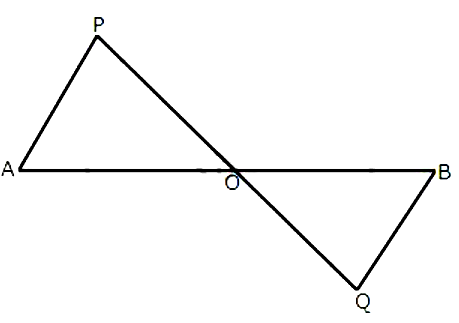
Prove that$:(i) \triangle \mathrm{AOP} \cong \triangle \mathrm{BOQ}.(ii) \mathrm{AB}$ and $\mathrm{PQ}$ bisect each other.
AnswerIn the figure, $AP$ and $BQ$ are equal and parallel to each other.
$\therefore AP = BQ$ and $AP \| BQ.$
We need to prove that
$(i) \triangle AOP\cong \triangle BOQ.$
$(ii) AB$ and $PQ$ bisect each other$(i) \because AP \| BQ$
$\therefore \angle APO =\angle BOQ...[$ Alternate angles $] ...(1)$
and $\angle PAO =\angle QBO...[$ Alternate angles$ ] ...(2)$
Now in $\triangle AOP$ and $\triangle BOQ.$
$\angle APO =\angle BQO...$[ from $(1) ]$
$AP = BQ...[$ given $]$
$\angle PAO = \angle QBO...[$ from $(1) ]$
$\therefore $ By Angel$-$Side$-$Angel criterion of congruence, we have
$\triangle AOP≅ \triangle BOQ.$
$(ii)$ The corresponding parts of the congruent triangles are congruent.
$\therefore OP = OQ...[$ c. p. c .t $]$
$OA = OB...[$ c. p. c .t$ ]$
Hence $AB$ and $PQ$ bisect each other.
View full question & answer→Question 24 Marks
In the following figures, the sides $A B$ and $B C$ and the median $A D$ of $\triangle A B C$ are equal to the sides $P Q$ and $Q R$ and median $P S$ of the $\triangle P Q R$.Prove that $\triangle A B C$ and $\triangle P Q R$ are congruent.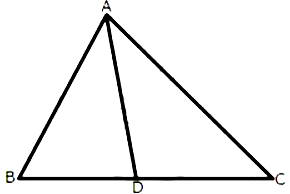
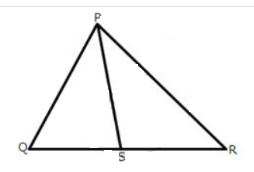
AnswerGiven$:AB = PQ ; BC = QR ; AD = PS$
To prove: $ΔABC \cong ΔPQR$
Proof:
$BC = QR$
$2 BD = 2 QS$
$BD = QS...(i)$
In $Δ ABD$ and $Δ PQS$
$AB = PQ...[$Given$]$
$BD = QS...[$From equation $(i)]$
$AD = PS...[$Given$]$
$∴ ΔABD ≅ ΔPQS...[$by $\text{SAS}$ rule$]$
Then, $∠B = ∠Q ...[$by c.p.c.t.s.$] ...(ii)$
In $ΔABC$ and $ΔPQR$
$AB = PQ...[$Given$]$
$∠B = ∠Q...[ii]$
$BC = QR ...[$Given$]$
$∴ ΔABC \cong ΔPQR...[$by $\text{SAS}$ rule$]$
Hence proved.
View full question & answer→Question 34 Marks
In the parallelogram $\text{ABCD},$ the angles $A$ and $C$ are obtuse. Points $X$ and $Y$ are taken on the diagonal $BD$ such that the angles $XAD$ and $YCB$ are right angles.Prove that: $XA = YC.$
Answer$\mathrm{ABCD}$ is a parallelogram in which $\angle \mathrm{A}$ and $\angle \mathrm{C}$ are obtuse.
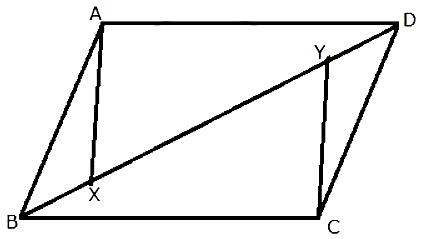
Points $X$ and $Y$ are taken on the diagonal $BD.$
Such that $\angle X A D=\angle Y C B=90^{\circ}$.
We need to prove that $X A=Y C$
Proof:
In $\triangle X A D$ and $\triangle Y C B$
$\angle \mathrm{XAD}=\angle \mathrm{YCB}=90^{\circ} \ldots[$ Given $]$
$\mathrm{AD}=\mathrm{BC} \ldots $[ Opposite sides of a parallelogram $]$
$\angle \mathrm{ADX}=\angle \mathrm{CBY} \ldots $[ Alternate angles $]$
$\therefore$ By Angle$-$Side$-$Angle criterion of congruence,
$\triangle \mathrm{XAD} \cong \triangle \mathrm{YCB}
$The corresponding parts of the congruent triangles are congruent.
$\therefore \mathrm{XA}=\mathrm{YC} \ldots [$ c.p.c.t. $] $
Hence proved. View full question & answer→Question 44 Marks
In a $\triangle ABC, BD$ is the median to the side $AC, BD$ is produced to $E$ such that $BD = DE.$Prove that: $AE$ is parallel to $BC$.
AnswerGiven: $A(\triangle A B C)$ in which $B D$ is the median to $A C$.
$B D$ is produced to $E$ such that $B D=D E$ ,
We need to prove that $AE \| BC$.
Construction: Join $AE$
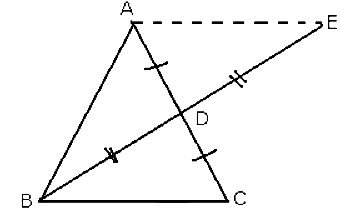
Proof:
$\mathrm{AD}=\mathrm{DC} \ldots[\mathrm{BD}$ is median to $\mathrm{AC}]\dots...(1)$
In $\triangle B D C$ and $\triangle A D E$,
$B D=D E ... [$ Given$ ]$
$\angle \mathrm{BDC}=\angle \mathrm{ADE}=90^{\circ} \ldots[$ Vertically opposite angles $]$
$\mathrm{AD}=\mathrm{DC} ...[$ from$(1) ]$
$\therefore$ By Side$-$Angle$-$Side Criterion of congruence,
$\triangle \mathrm{BDC} \cong \triangle \mathrm{ADE}$
The corresponding parts of the congruent triangles are congruent.
$\therefore \angle \mathrm{EAD}=\angle \mathrm{BCD} \text {...[ c.p.c.t. ] }$
But these are alternate angles and $A C$ is the transversal.
Thus, $AE \| BC.$ View full question & answer→Question 54 Marks
In quadrilateral $\text{ABCD, AD = BC}$ and $\ce{BD = CA}.$ Prove that: $(i)\angle ADB =\angle BCA$ $(ii)\angle DAB =\angle CBA$
Answer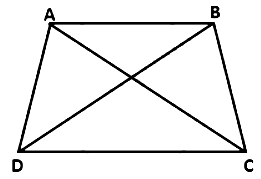
Given: In quadrilateral $\mathrm{ABCD}, \mathrm{AD}=\mathrm{BC}$ and $\mathrm{BD}=\mathrm{AC}$.
To Prove:
$(i) \angle \mathrm{ADB}=\angle \mathrm{BCA}$
$(ii) \angle \mathrm{DAB}=\angle \mathrm{CBA}$
Proof:
In $\triangle \mathrm{ABD}$ and $\triangle \mathrm{BAC}$,
$A D=B C ....($given$)$
$B D=C A ....($given$)$
$A B=A B ....($common$)$
$\therefore \triangle \mathrm{ABD} \cong \triangle \mathrm{BAC} \ldots. ($by $\text{SSS}$ congruence criterion$)$
$\angle \mathrm{ADB}=\angle \mathrm{BCA}$
$\angle \mathrm{DAB}=\angle \mathrm{CBA}$ View full question & answer→Question 64 Marks
A point $O$ is taken inside a rhombus $\text{ABCD}$ such that its distance from the vertices $B$ and $D$ are equal. Show that $\text{AOC}$ is a straight line.
Answer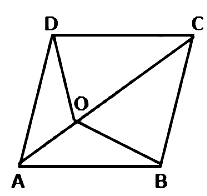
In $\triangle A O D$ and $\triangle A O B$,
$A D=A B ...($given$)$
$\mathrm{AO}=\mathrm{AO} ...($Common$)$
$O D=O B ...($given$)$
$\Rightarrow \triangle \mathrm{AOD} \cong \triangle \mathrm{AOB} \ldots ($by $\text{SSS}$ congruence criterion$)$
$ \Rightarrow \angle \mathrm{AOD}=\angle \mathrm{AOB} \ldots \text { (c.p.c.t.) } \text {..(i) }$
Similarly, $\triangle \mathrm{DOC} \cong \triangle \mathrm{BOC}$
$ \Rightarrow \angle \mathrm{DOC}=\angle \mathrm{BOC} \ldots \text { (c.p.c.t.) } \ldots \text { (ii) }$
But, $\angle \mathrm{AOB}+\angle \mathrm{AOD}+\angle \mathrm{COD}+\angle \mathrm{BOC}=4$ Right angles $\ldots[$ Sum of the angles at a point is $4$ Right angles $]$
$\Rightarrow 2 \angle \mathrm{AOD}+2 \angle \mathrm{COD}=4$ Right angles$ \dots...$ Using $(i)$ and $(ii) ]$
$ \Rightarrow \angle \mathrm{AOD}+\angle \mathrm{COD}=2$ Right angles
$ \Rightarrow \angle \mathrm{AOD}+\angle \mathrm{COD}=180^{\circ}$
$\Rightarrow \angle \mathrm{AOD}$ and $\angle \mathrm{COD}$ form a linear pair.
$\Rightarrow A O$ and $O C$ are in the same straight line.
$\Rightarrow \mathrm{AOC}$ is a straight line. View full question & answer→Question 74 Marks
In the following figure, $\angle A=\angle C$ and $A B=B C$. Prove that $\triangle A B D \cong \triangle C B E$.
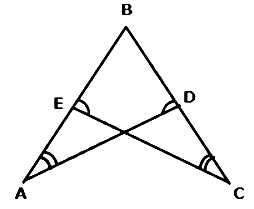
Answer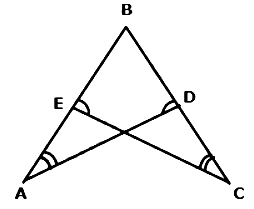
In triangles $A O E$ and $C O D$,
$\angle A=\angle C \dots...$(given$)$
$\angle \mathrm{AOE}=\angle \mathrm{COD} \dots...($vertically opposite angles$)$
$\begin{aligned} & \therefore \angle \mathrm{A}+\angle \mathrm{AOE}=\angle \mathrm{C}+\angle \mathrm{COD} \\ & \Rightarrow 180^{\circ}-\angle \mathrm{AEO}=180^{\circ}-\angle \mathrm{CDO}\end{aligned}$
$\Rightarrow \angle \mathrm{AEO}=\angle \mathrm{CDO} \dots....(i)$
Now,$\angle \mathrm{AEO}+\angle \mathrm{OEB}=180^{\circ} \quad \ldots...($linear pair$)$
And, $\angle C D O+\angle O D B=180^{\circ}....$(linear pair$)$
$\therefore \angle \mathrm{AEO}+\angle \mathrm{OEB}=\angle \mathrm{CDO}+\angle \mathrm{ODB}$
$\Rightarrow \angle \mathrm{OEB}=\angle \mathrm{ODB} \dots....[$ Using $(i) ]$
$\Rightarrow \angle \mathrm{CEB}=\angle \mathrm{ADB}$ ....(ii)
Now, in $\triangle \mathrm{ABD}$ and $\triangle \mathrm{CBE}$,
$\angle A=\angle C \dots.... ($given$)$
$\angle \mathrm{ADB}=\angle \mathrm{CEB}$ ...[ From (ii) ]
$A B=B C \dots....$(given$)$
$\Rightarrow \triangle \mathrm{ABD} \cong \triangle \mathrm{CBE} \dots...($by $\text{AAS}$ congruence criterion$).$ View full question & answer→Question 84 Marks
$\text{PQRS}$ is a parallelogram. $L$ and $M$ are points on $PQ$ and $SR$ respectively such that $PL = MR.$
Show that $LM$ and $QS$ bisect each other.
Answer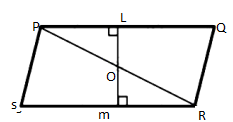
Given: $PL = MR$
To prove $SR = PQ ...(ii) ($parallelogram opposite sides$)$
$SP - PQ$ and $SR - MR$
$LQ = SM \dots(iii)$
In $\triangle LOQ \ \&\ \triangle MOS$
$\angle LQO =\angle MSO \quad \ldots .($ alternate interior angles $)$
$\angle OLQ =\angle OMS \quad \ldots .($ alternate interior angles $)$
$LQ = SM \quad \dots( $from $(iii) )$
$\triangle LOQ \cong \angle MSO \quad...($by $\text{ASA}$ congruence $)$
Then, $OL = OM$
$O Q=O S \quad \ldots ($by $\text{c.p.c.t.c})$
Hence,$ LM$ and $QS$ bisect each other. View full question & answer→Question 94 Marks
In a $ \triangle, ABC, AB = BC, AD$ is perpendicular to side $BC$ and $CE$ is perpendicular to side $AB$.Prove that: $AD = CE.$
Answer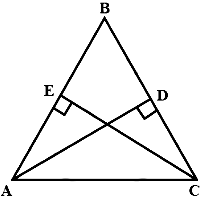
In $\triangle A B D$ and $\triangle C B E , A B=B C \dots($given$) A D \perp B C,C E \perp A B$
To proved:
In $\triangle A B D$ and $\triangle C B E$,
$A B=B C \dots....($given$)$
$\angle \mathrm{ADB}=\angle \mathrm{CEB}=90^{\circ} \ldots .[$ Perpendiculars $]$
$\angle B=\angle B \dots....($Common angle$)$
$\therefore \triangle \mathrm{ABD} \cong \triangle \mathrm{CBE} \dots....($by $\text{SAS}$ congruence$)$
$\Rightarrow A D=C E \dots...($ c.p.c.t.$)$
View full question & answer→Question 104 Marks
The following figure has shown a $\triangle A B C$ in which $A B=A C$. $M$ is a point on $A B$ and $N$ is a point on $A C$ such that $B M=C N$.Prove that: $(i) \mathrm{BN}=\mathrm{CM}, (ii) \triangle \mathrm{BMC} \cong \triangle C N B$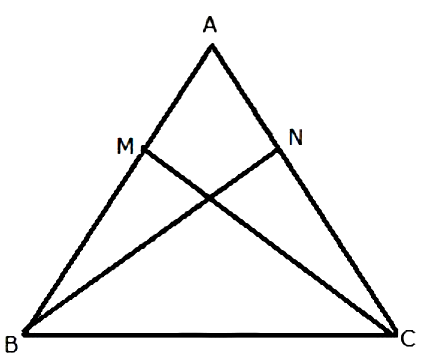
AnswerIn $\triangle A B C, A B=A C \dots m$ and $N$ are points on
$A B$ and $A C$ such that $B M=C N$
$\mathrm{BN}$ and $\mathrm{CM}$ are joined
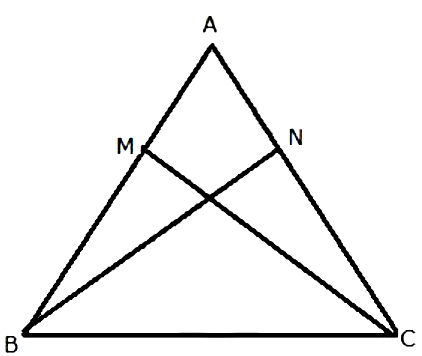
$(i)$ The corresponding parts of the congruent triangles are congruent.
$\therefore \mathrm{CM}=\mathrm{BN} \dots .[$ c.p.c.t $] \dots...(1)$
$(ii)$ Consider the triangles $\triangle \mathrm{BMC}$ and $\triangle C N B$
$\mathrm{BM}=\mathrm{CN} \ldots[$ given $] $
$\mathrm{BC}=\mathrm{BC} \ldots[$ common $]$
$\mathrm{Cm}=\mathrm{BN} . .[$ from $(1) ]$
$\therefore$ By Side$-$Side$-$Side criterion of congruence,
we have $\triangle B M C \cong \triangle C N B$ View full question & answer→Question 114 Marks
If $AP$ bisects $\angle BAC$ and $M$ is any point on $AP,$ prove that the perpendiculars drawn from $M$ to $AB$ and $AC$ are equal.
AnswerFrom $M$, draw $M L$ such that $M L$ is perpendicular to $A B$ and $M N$ is perpendicular to $\mathrm{AC}$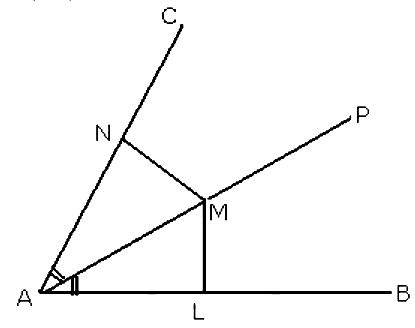
In $\triangle \mathrm{ALM}$ and $\triangle \mathrm{ANM}$
$\angle \mathrm{LAM}=\angle \mathrm{MAN} \ldots[\because \mathrm{AP}$ is the bisector of $\mathrm{BAC}]$
$ \angle \mathrm{ALM}=\angle \mathrm{ANM}=90^{\circ} \ldots[\because \mathrm{ML} \perp \mathrm{AB}, \mathrm{MN} \perp \mathrm{AC}]$
$ \mathrm{AM}=\mathrm{AM} \ldots[$ Common $]$
$\therefore$ By Angel$-$Angel$-$Side criterion of congruence,
$\triangle \mathrm{ALM} \cong \triangle \mathrm{ANM}$
The corresponding parts of the congruent triangles are congruent.
$\therefore \mathrm{ML}=\mathrm{MN} \ldots[$ c. p.c.t $]$
Hence proved.
View full question & answer→Question 124 Marks
A $\triangle ABC$ has $B =C.$Prove that: The perpendiculars from $B$ and $C$ to the opposite sides are equal.
AnswerGiven: $A \triangle A B C$ in which $\angle B=\angle C$.
$B P$ is perpendicular from $D$ to $A C$
$C Q$ is the perpendicular from $C$ to $A B$
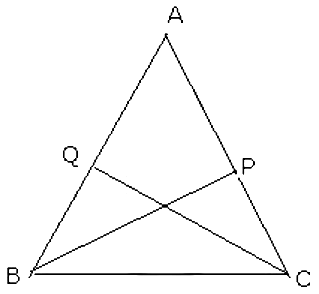
We need to prove that
$\mathrm{BP}=\mathrm{CQ}$
Proof:
In $\triangle \mathrm{BPC}$ and $\triangle \mathrm{CQB}$
$\angle \mathrm{B}=\angle \mathrm{C} \ldots[$ Given $]$
$\angle \mathrm{BPC}=\angle \mathrm{CQB}=90 \ldots[\mathrm{BP} \mathrm{AC}$ and $\mathrm{CQ} \mathrm{AB}]$
$\mathrm{BC}=\mathrm{BC} \ldots[$Common $] $
$\therefore$ BY Angel$-$Angel$-$Side criterion of congruence,
$\triangle \mathrm{BPC} \cong \triangle \mathrm{CQB}$
The corresponding parts of the congruent triangles are congruent.
$\mathrm{BP}=\mathrm{CQ} \ldots [$ c p.c.t $]$ View full question & answer→Question 134 Marks
The following figure shows a circle with center $O$.
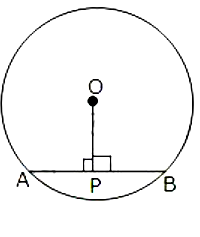
If $O P$ is perpendicular to $A B$, prove that $A P=B P$.
AnswerGiven: In the figure, $\mathrm{O}$ is the center of the circle, and $\mathrm{AB}$ is a chord. $\mathrm{P}$ is a point on $A B$ such that $A P=P B$. We need to prove that, $\mathrm{AAP}=\mathrm{BP}$
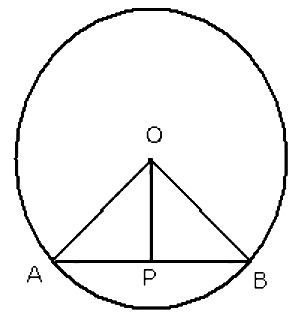
Construction: Join $\mathrm{OA}$ and $\mathrm{OB}$
Proof:
In right triangles $\triangle \mathrm{OAP}$ and $\triangle \mathrm{OBP}$
Hypotenuse $\mathrm{OA}=\mathrm{OB} \quad \dots.....[$ radii of the same circle $]$
Side $O P=O P \quad \ldots[$ common $]$
$\therefore$ By Right Angle$-$ Hypotenuse$-$ Side criterion of congruency,
$\triangle \mathrm{OAP} \cong$ $\triangle \mathrm{OBP}$
The corresponding parts of the congruent triangles are congruent.
$\therefore A P=B P \dots.....[$ by c.p.c.t $]$
Hence proved.
View full question & answer→Question 144 Marks
In the given figure: $A B \| F D, A C \| G E$ and $B D=C E$;
prove that: $(i)\mathrm{BG}=\mathrm{DF} \text { (ii) } \mathrm{CF}=\mathrm{EG}$
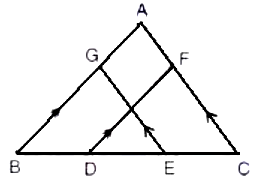
AnswerIn the given figure $A B \| F D$,
$\Rightarrow \angle \mathrm{ABC}=\angle \mathrm{FDC}$
Also $\mathrm{AC} \| \mathrm{GE}$
$ \Rightarrow \angle \mathrm{ACB}=\angle \mathrm{GEB}$
Consider the two triangles $\triangle \mathrm{GBE}$ and $\triangle \mathrm{FDC}$
$\angle \mathrm{B}=\angle \mathrm{D}$
$ \angle \mathrm{C}=\angle \mathrm{E}$
Also given that
$\mathrm{BD}=\mathrm{CE}$
$ \Rightarrow \mathrm{BD}+\mathrm{DE}=\mathrm{CE}+\mathrm{DE}$
$ \Rightarrow \mathrm{BE}=\mathrm{DC}$
$\therefore$ By Angel$-$Side$-$SIde$-$Angel criterion of congruence
$\Delta \mathrm{GBE} \cong \triangle \mathrm{FDC}$
$ \therefore \frac{\mathrm{GB}}{\mathrm{FD}}=\frac{\mathrm{BE}}{\mathrm{DC}}=\frac{\mathrm{GE}}{\mathrm{FC}}$
But $\mathrm{BE}=\mathrm{DC}$
$ \Rightarrow \frac{\mathrm{BE}}{\mathrm{DC}}=\frac{\mathrm{BE}}{\mathrm{BE}}=1$
$ \therefore \frac{\mathrm{GB}}{\mathrm{FD}}=\frac{\mathrm{BE}}{\mathrm{DC}}=1$
$ \Rightarrow \mathrm{GB}=\mathrm{FD}$
$ \therefore \frac{\mathrm{GE}}{\mathrm{FC}}=\frac{\mathrm{BE}}{\mathrm{DC}}$
$=1$
$ \Rightarrow \mathrm{GE}=\mathrm{FC}$
View full question & answer→Question 154 Marks
$\text{ABCD}$ is a parallelogram. The sides $AB$ and $AD$ are produced to $E$ and $F$ respectively, such produced to $E$ and $F$ respectively, such that $AB = BE$ and $AD = DF.$Prove that: $\triangle BEC \cong \triangle DCF.$
Answer$\mathrm{ABCD}$ is a parallelogram, The sides $\mathrm{AB}$ and $\mathrm{AD}$ are produced to $\mathrm{E}$ and $F$ respectively,
such that $A B=B E$ and $A D=D F$
We need to prove that $\triangle B E C \cong \triangle D C F$.
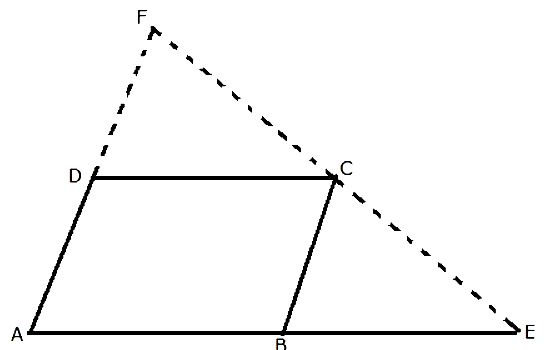
Proof:
$\mathrm{AB}=\mathrm{DC} \ldots [$ Opposite sides of a parallelogram$ ] \dots...(1)$
$\mathrm{AB}=\mathrm{BE} \ldots[$ Given $] \ldots(2)$
From $(1)$ and $(2)$, We have
$\mathrm{BE}=\mathrm{DC}\ldots (3)$
$\mathrm{AD}=\mathrm{BC} \ldots [$ Opposite sides of a parallelogram $] \dots...(4)$
$\mathrm{AD}=\mathrm{DF} \ldots. [$Given$] \ldots (5)$
From $(4)$ and $(5),$ we have
$B C=D F\ldots(6)$
Since $A D \| B C$, the corresponding angles are equal.
$\therefore \angle \mathrm{DAB}=\angle \mathrm{CBE}\ldots(7)$
Since $A B \| DC$, the corresponding angles are equal.
$\therefore \angle \mathrm{DAB}=\angle \mathrm{FDC}\text...(8)$
From $(7)$ and $(8)$, we have
$\angle \mathrm{CBE}=\angle \mathrm{FDC}$
In $\triangle B E C$ and $\triangle D C F$
$B F=D C\dots ....[$ from $(3) ]$
$\angle \mathrm{CBE}=\angle \mathrm{FDC}\dots...[$ from $(9) ]$
$B C=D F \dots....[$ from$ (6)]$
$\therefore$ By Side$-$Angle$-$Side criterion of congruence,
$\triangle \mathrm{BEC} \cong \triangle \mathrm{DCF}$
Hence proved. View full question & answer→Question 164 Marks
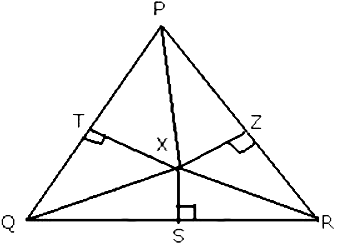
In the adjoining figure, $\mathrm{OX}$ and $\mathrm{RX}$ are the bisectors of the angles $Q$ and $R$ respectively of the $\triangle P Q R$.If $X S \perp Q R$ and $X T \perp P Q$;
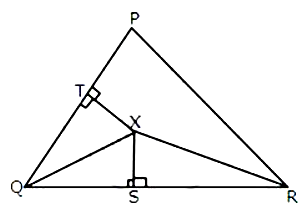
prove that: $(i) \triangle \mathrm{XTQ} \cong \triangle \mathrm{XSQ}.(ii) \mathrm{PX}$ bisects angle $\mathrm{P}$ AnswerGiven: $A(\triangle P Q R)$ in which $Q X$ is the bisector of $\angle Q$. and $R X$ is the bisector of $\angle R$.
$\mathrm{XS} \perp \mathrm{QR}$ and $\mathrm{XT} \perp \mathrm{PQ}$.
We need to prove that
$(i) \triangle \mathrm{XTQ} \cong \triangle \mathrm{XSQ}$.
$(ii) PX$ bisects $\angle \mathrm{P}$.
Construction: Draw $XZ \perp \mathrm{PR}$ and join $PX.$
Proof:
$(i)$ In $\triangle \mathrm{XTQ}$ and $\triangle \mathrm{XSQ}$,
$\angle \mathrm{QTX}=\angle \mathrm{QSX}=90^{\circ} \ldots[\mathrm{XS} \perp \mathrm{QR}$ and $\mathrm{XT} \perp \mathrm{PQ}]$
$\angle \mathrm{TQX}=\angle \mathrm{SQX} \quad\dots... [\mathrm{QX}$ is bisector of $\angle \mathrm{Q}]$
$\mathrm{QX}=\mathrm{QX} \quad\dots...[$ Common$]$
$\therefore$ By Angle$-$Angle$-$Side Criterion of congruence,
$\Delta \mathrm{XTQ} \cong \triangle \mathrm{XSQ}$
$(ii)$ The corresponding parts of the congruent triangles are congruent.
$\therefore \mathrm{XT}=\mathrm{XS} \ldots [\text{ c.p.c.t.}]$
In $\triangle X S R \cong \triangle X Z R $
$\angle X S R=\angle X Z R=90^{\circ} \ldots\left[X S \perp Q R \text { and } \angle X S R=90^{\circ}\right]$
$\angle S R X=\angle Z R X \ldots[R X \text { is bisector of } \angle R]$
$R X=R X \ldots .[$Common$]$
$\therefore$ By Angle$-$Angle$-$Side criterion of congruence,
$\triangle X S R \cong \triangle X Z R$
The corresponding parts of the congruent triangles are congruent.
$\therefore \mathrm{XS}=\mathrm{XZ} \ldots[\text{ c.p.c.t.} ] \dots...(2)$
From $(1)$ and $(2)$
$X T=X Z\ldots . .(3)$
In $\triangle X T P$ and $\triangle X Z P$
$\angle X T P=\angle X Z P=90^{\circ} \dots....[ $Given $]$
$Hyp. XP = Hyp. XP\dots .... [$ Common$ ]$
$X T=X Z\ldots[$ from$(3)]$
$\therefore$ By Right angle$-$Hypotenuse$-$side criterion of congruence,
$\Delta X T P \cong \triangle X Z P$
The corresponding parts of the congruent triangles are congruent.
$\therefore \angle \mathrm{XPT}=\angle \mathrm{XPZ} \dots...[\text {c.p.c.t. }]$
$\therefore$ PX bisects $\angle \mathrm{P}$.
View full question & answer→Question 174 Marks
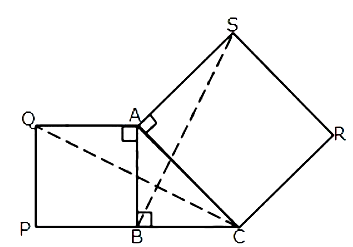
In the figure, given below, $\triangle \mathrm{ABC}$ is right$-$angled at $\mathrm{B} . \mathrm{ABP}$ and $\text{ACRS}$ are squares.
Prove that:
$(i) \triangle \mathrm{ACQ}$ and $\triangle \mathrm{ASB}$ are congruent.
$(ii) \mathrm{CQ}=\mathrm{BS}$. AnswerGiven: $A(\triangle ABC)$ is right$-$angled at $B.$
$\text{ABPQ}$ and $\text{ACRS}$ are squares
To Prove:
$(i) \triangle ACQ \cong \triangle ASB$
$(ii) CQ = BS$
Proof:
$(i)$
$\angle QAB = 90^\circ ...[\text{ ABPQ}$ is a square $] ...(1)$
$\angle SAC = 90^\circ ...[ \text{ACRS}$ is a square $] ...(2)$
From $(1)$ and $(2)$, We have
$\angle QAB = \angle SAC...(3)$
Adding $\angle BAC$ to both sides of $(3)$, We have
$\angle QAB + \angle BAC = \angle SAC + \angle BAC$
$\Rightarrow \angle QAC = \angle SAB...(4)$
In $\triangle ACQ$ and $\triangle ASB,$
$QA = QB...[$ Sides of a square $\text{ABPQ}]$
$\angle QAC = \angle SAB...[$ From$(4) ]$
$AC = AS...[$ sides of a square $\text{ACRS }]$
$\therefore $ By Side $-$Angle$-$Side criterion of congruence,
$\triangle ACQ \cong \triangle ASB$
$(ii)$
The corresponding parts of the congruent triangles are congruent,
$\therefore CQ = BS...[\text{ c.p.c.t.} ]$
View full question & answer→Question 184 Marks
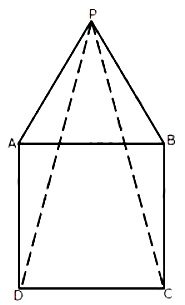
In the following diagram, $\text{ABCD}$ is a square and $\text{APB}$ is an equilateral triangle.
$(i)$Prove that: $\triangle \mathrm{APD} \cong \triangle \mathrm{BPC}$
$(ii)$ Find the angles of $\triangle \mathrm{DPC}$. AnswerGiven: $\text{ABCD}$ is a square and $\triangle A P B$ is an equilateral triangle.
$(i)$ Proof: In $\triangle \mathrm{APB}$,
$A P=P B=A B \dots... [ \text{APB}$ is an equilateral triangle $]$
Also, we have,
$\angle \mathrm{PBA}=\angle \mathrm{PAB}=\angle \mathrm{APB}=60^{\circ}\ldots(1)$
Since $\text{ABCD}$ is a square, we have
$\angle \mathrm{A}=\angle \mathrm{B}=\angle \mathrm{C}=\angle \mathrm{D}=90^{\circ}\ldots(2)$
Since $\angle \mathrm{DAP}=\angle \mathrm{A}+\angle \mathrm{PAB} \dots..(3)$
$\Rightarrow \angle \mathrm{DAP}=90^{\circ}+60^{\circ}$
$\Rightarrow \angle \mathrm{DAP}=150^{\circ} \ldots[$ from $(1)$ and $(2)]\ldots(4)$
Similarly $\angle \mathrm{CBP}=\angle \mathrm{B}+\angle \mathrm{PBA}$
$\Rightarrow \angle C B P=90^{\circ}+60^{\circ}$
$\Rightarrow \angle C B P=150^{\circ} \ldots[$ from $(1)$ and$ (2) ] \ldots(5)$
Similarly $\angle \mathrm{CBP}=\angle \mathrm{B}+\angle \mathrm{PBA}$
$\Rightarrow \angle C B P=90^{\circ}+60^{\circ}$
$ \Rightarrow \angle \mathrm{CBP}=150^{\circ} \ldots[$ from $(1)$ and $(2)] \ldots(5)$
$ \Rightarrow \angle \mathrm{DAP}=\angle \mathrm{CBP} \ldots .[$from $(1)$ and $(2)] \ldots(6)$
In $\triangle \mathrm{APD}$ and $\triangle \mathrm{BPC}$
$A D=B C \ldots[$ Sides of square $A B C D$ ]
$\angle \mathrm{DAP}=\angle \mathrm{CBP} \ldots[$ from(6) $]$
$\mathrm{AP}=\mathrm{BP} \quad$ [ Sides of equilateral $\triangle \mathrm{APB}$ ]
$\therefore$ By Side-AAngel-SIde Criterion of Congruence, we have,
$\triangle \mathrm{APD} \cong \triangle \mathrm{BPC}$
$(ii)$
$A P=P B=A B \ldots .[\triangle A P B$ is an equilateral triangle $] ..(7)$
$A B=B C=C D=D A$... Sides of square $\text{ABCD}] \dots...(8)$
From $(7)$ and $(8),$ we have
$\mathrm{AP}=\mathrm{DA}$ aand $\mathrm{PB}=\mathrm{BC}\ldots(9)$
In $\triangle \mathrm{APD}$,
$\mathrm{AP}=\mathrm{DA} \dots...[$ from $(9)]$
$\angle \mathrm{ADP}=\angle \mathrm{APD} \ldots[$ Angel opposite to equal sides are equal $]\ldots(10)$
$ \angle \mathrm{ADP}+\angle \mathrm{APD}++\angle \mathrm{DAP}+180^{\circ} \ldots[$Sum of angel of a triangle$=
\left.180^{\circ}\right]$
$ \Rightarrow \angle \mathrm{ADP}+\angle \mathrm{ADP}+150^{\circ}=180^{\circ} \quad[$ from $(3), \angle \mathrm{DAP}=150^{\circ}$ from $(10).$
$ \angle \mathrm{ADP}=\angle \mathrm{APD}]$
$ \Rightarrow \angle \mathrm{ADP}+\angle \mathrm{ADP}=180^{\circ}-150^{\circ}$
$ \Rightarrow 2 \angle \mathrm{ADP}=30^{\circ}$
$ \Rightarrow \angle \mathrm{ADP}=\frac{30^{\circ}}{2}$
$\Rightarrow \angle \mathrm{ADP}=15^{\circ}$
We have $\angle \mathrm{PDC}=\angle \mathrm{D}-\angle \mathrm{ADP}$
$\Rightarrow \angle \mathrm{PDC}=90^{\circ}-15^{\circ}$
$\Rightarrow \angle \mathrm{PDC}=75^{\circ}\dots ...(11)$
In $\triangle \mathrm{BPC},$
$ \mathrm{PB}=\mathrm{BC} \ldots[$ from $(9)]$
$ \therefore \angle \mathrm{PCB}=\angle \mathrm{BPC} \ldots[$ Angel opposite to equal sides are equal $] \ldots(12)$
$ \angle \mathrm{PCB}+\angle \mathrm{BPC}+\angle \mathrm{CBP}=180^{\circ} \ldots .[$Sum of angel of a triangle$=180^{\circ}]$
$ \Rightarrow \angle \mathrm{PCB}+\angle \mathrm{PCB}+30^{\circ}=180^{\circ} \ldots .[$ from$ (5), \angle\mathrm{CBP}=150^{\circ}$ from$(12),.$
$ \angle \mathrm{PCB}=\angle \mathrm{BPC}]$
$ \Rightarrow 2 \angle \mathrm{PCB}=180^{\circ}-150^{\circ}$
$ \Rightarrow 2 \angle \mathrm{PCB}=\frac{30^{\circ}}{2}$$
\Rightarrow \angle \mathrm{PCB}=15^{\circ}
$We have $\angle \mathrm{PCD}=\angle \mathrm{C}-\angle \mathrm{PCB}$
$\Rightarrow \angle \mathrm{PCD}=90^{\circ}-15^{\circ}$
$\Rightarrow \angle \mathrm{PCD}=75^{\circ}\ldots$ (13)
In $\triangle \mathrm{DPC}$
$ \angle \mathrm{PDC}=75^{\circ}$
$ \angle \mathrm{PCD}=75^{\circ}$
$ \angle \mathrm{PCD}+\angle \mathrm{PDC}+\angle \mathrm{DPC}=180^{\circ} \ldots[$ Sum of angles of a triangle$ =
180^{\circ}]$
$ \Rightarrow 75^{\circ}+75^{\circ}+\angle \mathrm{DPC}=180^{\circ}$
$ \Rightarrow \angle \mathrm{DPC}=180^{\circ}-150^{\circ}$
$ \Rightarrow \angle \mathrm{DPC}=30^{\circ}$
$\therefore$ Angles of $\text{DPC}$, are: $75^{\circ}, 30^{\circ}, 75^{\circ}$
View full question & answer→Question 194 Marks
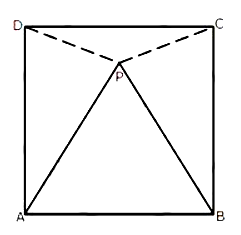
In the following diagram, $\text{ABCD}$ is a square and $\text{APB}$ is an equilateral triangle.
$(i)$ Prove that: $\triangle \mathrm{APD} \cong \triangle \mathrm{BPC}$
$(ii)$ Find the angles of $\triangle \mathrm{DPC}$. AnswerGiven: $\text{ABCD}$ is a Square and $\triangle APB$ is an equilateral triangle.
We need to
$(i)$ Prove that: $\triangle APD \cong \triangle BPC$
$(ii)$ Find the angles of $\triangle DPC$
Proof:
Since $A B$ side is present in both square $\ \&\ $ equilateral triangle
$A P=P B=A B=A D=C D=B C$
$(i)$ In $\triangle BPC,$
$B P=B C$
$\therefore \angle B P C=\angle P C B$
$\angle B P C+\angle P C B+30^{\circ}=180^{\circ}$
$\angle B P C+\angle B P C=150^{\circ}$
$2 \angle B P C=\frac{150^{\circ}}{2}=75^{\circ}$
$\therefore \angle B P C=\angle P C B=75^{\circ}$
$\angle A D P=\angle D P A=75^{\circ}. . .[\text{C.P.C.T.S.}]$
$(ii)$ In $DPC$
$\angle DCP=90^{\circ}-75^{\circ}=15^{\circ}$
$\angle PDC=90^{\circ}-75^{\circ}=15^{\circ}$
$\angle DPC=180^{\circ}-\left(15^{\circ}+15^{\circ}\right)$
$\angle DPC=150^{\circ}$
View full question & answer→Question 204 Marks
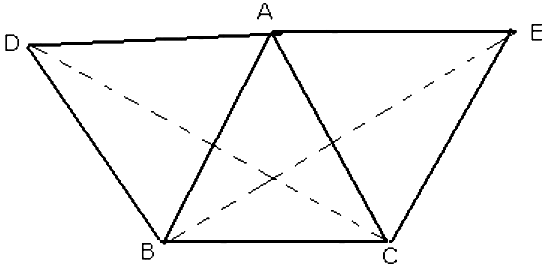
On the sides $AB$ and $AC$ of $\triangle ABC,$ equilateral $\triangle ABD$ and $\text{ACE}$ are drawn.Prove that:$(i)\angle CAD = \angle BAE.(ii) CD = BE$
AnswerGiven: $\triangle A B D$ is an equilateral triangle.
$\triangle A C E$ is an equilateral triangle We need to prove that
$(i) \angle \mathrm{CAD}=\angle \mathrm{BAE}$
Proof:
$(i) \triangle \mathrm{ABD}$ is equilateral
$\therefore$ Each angel $=60^{\circ}$
$\Rightarrow \angle \mathrm{BAD}=60^{\circ}\ldots(1)$
Similarly,
$\triangle \mathrm{ACE}$ is equilateral
$\therefore$ Each angel $=60^{\circ}$
$\Rightarrow \angle C A E=60^{\circ}\ldots(2)$
$\Rightarrow \angle \mathrm{BAD}=\angle \mathrm{CAE} \ldots[$ from $(1)$ and $(2) ]\dots..(3)$
Adding $\angle B A C$ to both sides, we have
$\Rightarrow \angle \mathrm{BAD}+\angle \mathrm{BAC}=\angle \mathrm{CAE}+\angle \mathrm{BAC}$
$\Rightarrow \angle \mathrm{CAD}=\angle \mathrm{BAE}\ldots(4)$
$(ii)$ In $\triangle \mathrm{CAD}$ and $\triangle \mathrm{BAE}$
$A C=A E \quad\dots...[\triangle \mathrm{ACE}$ is equilateral $]$
$\angle C A D=\angle B A E \quad \dots... [$ from $(4)]$
$A D=A B \ldots[\triangle A B D$ is equilateral$]$
$\therefore$ By the Side$-$Angle$-$Side criterion of congruency,
$\triangle \mathrm{CAD} \cong \triangle \mathrm{BAE}$
The corresponding parts of the congruent triangles are congruent.
$\therefore C D=B E \dots...[$ by $\text{c.p.c.t} ]$
Hence proved.
View full question & answer→Question 214 Marks
In $\triangle ABC, AB = AC$ and the bisectors of angles $B$ and $C$ intersect at point $O.$Prove that : $(i)BO = CO;(ii) AO$ bisects $\angle BAC.$
Answer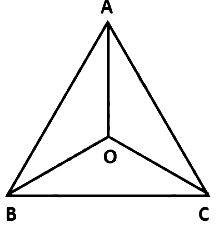
In $\triangle A B C$
$ A B=A C$
$\Rightarrow \angle B=\angle C($angles opposite to equal sides are equal $)$
$\Rightarrow \frac{1}{2} \angle \mathrm{B}=\frac{1}{2} \angle \mathrm{C}$
$\Rightarrow \angle \mathrm{OBC}=\angle \mathrm{OCB} \ldots[\because \mathrm{OB}$ and $\mathrm{OC}$ are bisectors of $\angle \mathrm{B}$ and $\angle \mathrm{C}$ respectively, $\angle \mathrm{OBC}=\frac{1}{2} \angle \mathrm{B}$ and $\left.\angle \mathrm{OCB}=\frac{1}{2} \angle \mathrm{C}\right] \ldots (i)$
$\Rightarrow \mathrm{OB}=\mathrm{OC} \ldots($ Sides opposite to equal angles are equal $)\dots ...(ii)$
Now, in $\triangle A B O$ and $\triangle A C O$,
$A B=A C \ldots($given$)$
$\angle O B C=\angle O C B \ldots[$ from $(\mathrm{i})]$
$O B=O C \ldots[$from $(ii)]\ldots($proved$)$
$\therefore \triangle A B O \cong \triangle A C O \ldots($ by $\text{SAS}$ congruence criterion$)$
$\Rightarrow \angle B A O=\angle C A O \ldots(\text { c.p.c.t. })$
$\Rightarrow AO$ bisects $\angle B A C \ldots($proved$)$ View full question & answer→Question 224 Marks
In the following figure, $\text{ABC}$ is an equilateral triangle in which $Q P$ is parallel to $A C$. Side $A C$ is produced up to point $R$ so that $C R= BP.$
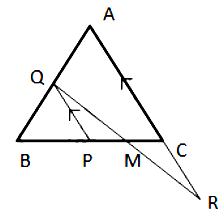
Prove that $QR$ bisects $PC$.Hint: $($ Show that $\triangle \mathrm{QBP}$ is equilateral $\Rightarrow B P=P Q$, but $B P=C R \Rightarrow P Q=C R \Rightarrow \triangle Q P M \cong \Delta R C M) .$ Answer$\triangle ABC$ is an equilateral triangle,
So, each of its angles equals $60^\circ .$
$QP$ is parallel to $AC,$
$\Rightarrow \angle PQB = \angle RAQ = 60^\circ $
ln $\triangle QBP,$
$\angle PQB = \angle BQP = 60^\circ $
So, $\angle PBQ + \angle BQP + \angle BPQ = 180^\circ\dots ....($angle sum property$)$
$\Rightarrow 60^\circ + 60^\circ + \angle BPQ = 180^\circ $
$\Rightarrow \angle BPQ = 60^\circ $
So, $\triangle BPQ$ is an equilateral triangle.
$\Rightarrow QP = BP$
$\Rightarrow QP = CR\dots....(i)$
Now, $\angle QPM + \angle BPQ = 180^\circ\dots ...($linear pair$)$
$\Rightarrow \angle QPM+ 60^\circ = 180^\circ $
$\Rightarrow \angle QPM = 120^\circ $
Also, $\angle RCM+ \angle ACB = 180^\circ\dots ...($linear pair$)$
$\Rightarrow \angle RCM+ 60^\circ = 180^\circ $
$\Rightarrow \angle RCM = 120^\circ $
ln $\triangle RCM$ and $\triangle QMP,$
$\angle RCM = \angle QPM\dots....($each is $120^\circ )$
$\angle RMC = \angle QMP\dots...($vertically opposite angles$)$
$QP= CR\dots....($from$(i))$
$\Rightarrow \triangle RCM \cong \triangle QMP\dots....(\text{AAS}$ congruence criterion$)$
So, $CM = PM$
$\Rightarrow QR$ bisects $PC.$
View full question & answer→Question 234 Marks
The following figure has shown a $\triangle A B C$ in which $A B=A C$. $M$ is a point on $A B$ and $N$ is a point on $A C$ such that $B M=C N$. Prove that: $(i) \mathrm{AM}=\mathrm{AN} (ii) \triangle \mathrm{AMC} \cong \triangle \mathrm{ANB}$
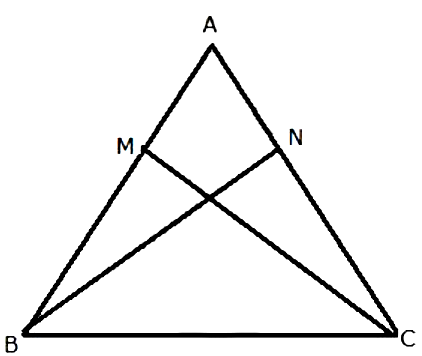
AnswerIn $\triangle A B C, A B=A C . m$ and $N$ are points on $A B$ and $A C$ such that $B M=C N\mathrm{BN}$ and $\mathrm{CM}$ are joined
$(i$) In $\triangle \mathrm{AMC}$ and $\triangle \mathrm{ANB}$
$A B=A C\dots ...[$ Given $] \dots...(1)$
$\mathrm{BM}=\mathrm{CN} \dots....[$ Given $] \dots...(2)$
Subtracting (2) from (1), we have
$A B-B M=A C-C N$
$\Rightarrow \mathrm{AM}=\mathrm{AN}\ldots(3)$
$(ii)$ Consider the triangles $\text{AMC}$ and $\text{ANB}$
$\mathrm{AC}=\mathrm{AB} \ldots[$given$]$
$\angle \mathrm{AMC}=\angle \mathrm{ANB} \ldots[$common $90^{\circ}]$
$\mathrm{AM}=\mathrm{AN} \ldots .[\text { from }(3)]$
$\therefore$ By the Side$-$Angel$-$Side Criterion of congruence,
we have $\triangle \mathrm{AMC} \cong\triangle \mathrm{ANB}$ View full question & answer→Question 244 Marks
In the following figure, $O A=O C$ and $A B=B C$.
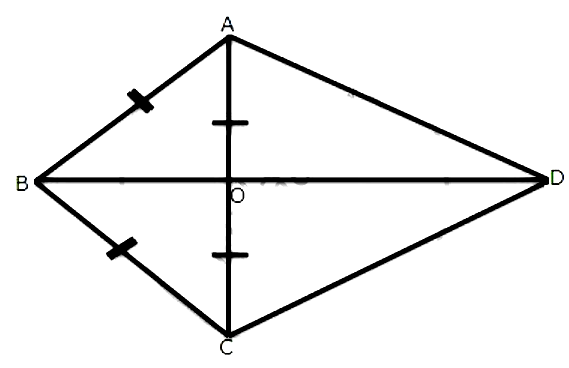
Prove that:$(i) \angle \mathrm{AOB}=900,(ii) \triangle \mathrm{AOD} \cong \triangle \mathrm{COD},(iii) A D=C D$ AnswerGiven:
In the figure, $OA=OC, AB =BC$
We need to prove that,
$AOB = 90^\circ $
$(i)$ In $\triangle ABO$ and $\triangle CBO,$
$AB = BC...[$given $]$
$AO = CO...[$ given $]$
$OB = OB...[$ common$ ]$
$\therefore $By Side$-$Side$-$Side criterion of congruence, we have
$\triangle ABO ≅ \triangle CBO$
The corresponding parts of the congruent triangles are congruent.
$\therefore \angle ABO = \angle CBO\dots...[\text{c. p.c.t.} ]$
$\Rightarrow \angle ABD = \angle CBD$
and $\angle AOB = \angle COB\dots...[\text{c. p.c t }]$
We have
$\angle AOB + \angle COB = 180^\circ\dots .....[$ linear pair$ ]$
$\Rightarrow \angle AOB = \angle COB= 90^\circ $ and $AC \perp BD,(ii)$ In $\triangle AOD$ and $\triangle COD,$
$OD = OD\dots...[$ common $]$
$\angle AOD = \angle COD\dots...[$ each$=90^\circ ]$
$AO = CO\dots...[$ given$]$
$\therefore $By Side$-$Angel$-$Side criterion of congruence, we have
$\triangle AOD \cong \triangle COD$
$(iii)$ The corresponding parts of the congruent
triangles are congruent.
$\therefore AD = CD\dots ...[\text{c. p.c t} ]$
Hence proved.
View full question & answer→Question 254 Marks
From the given diagram, in which $\text{ABCD}$ is a parallelogram, $\text{ABL}$ is a line segment and $\mathrm{E}$ is mid$-$point of $\mathrm{BC}$.Prove that:$(i) \triangle \mathrm{DCE} \cong \triangle \mathrm{LBE}(ii)\mathrm{AB}=\mathrm{BL}.(iii) \mathrm{AL}=2 \mathrm{DC}$
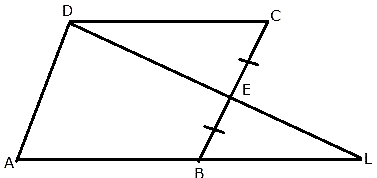
AnswerGiven: $\text{ABCD}$ is a parallelogram in which is the mid$-$point of $B C$. We need to prove that
$(i) \triangle \mathrm{DCE} \cong \triangle \mathrm{LBE}$
$(ii) \mathrm{AB}=\mathrm{BL}$.
$(iii) \mathrm{AL}=2 \mathrm{DC}$
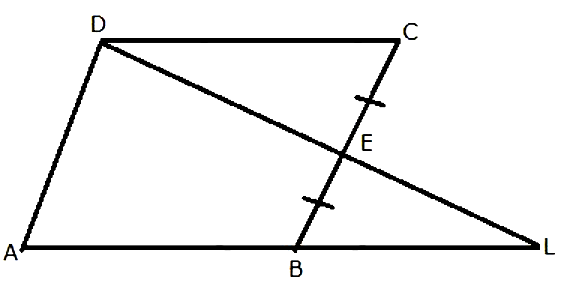
$(i)$ In $\triangle \mathrm{DCE}$ and $\triangle \mathrm{LBE}$
$\angle \mathrm{DCE}=\angle \mathrm{EBL} \ldots[\mathrm{DC} \| \mathrm{AB}$, alternate angels $]$
$\mathrm{CE}=\mathrm{EB} \ldots[\mathrm{E}$ is the midpoint of $\mathrm{BC}]$
$\angle \mathrm{DEC}=\angle \mathrm{LEB} \quad\dots...[$ vertically opposite angels$]$
$\therefore$ By Angel$-$SIde$-$Angel Criterion of congruence, we have,
$\triangle \mathrm{DCE} \cong \triangle \mathrm{LBE}$
The corresponding parts of the congruent triangles are congruent.
$\therefore \mathrm{DC}=\mathrm{LB} \ldots[\text{ c. p. c.t }]\ldots .(1)$
$(ii) \mathrm{DC}=\mathrm{AB} \ldots[$ opposite sides of a parallelogram$]\dots...(2)$
From $(1)$ and $(2), Ab = BL \ldots(3)$
$(iii) \mathrm{Al}=\mathrm{AB}+\mathrm{BL}\ldots(4)$
From $(3)$ and $(4), A l=A B+A B$
$\Rightarrow A L=2 A B$
$\Rightarrow \mathrm{AL}=2 \mathrm{DC}\dots...[$ From $(2) ]$ View full question & answer→Question 264 Marks
A line segment $AB$ is bisected at point $P$ and through point $P$ another line segment $PQ,$ which is perpendicular to $AB$, is drawn. Show that: $QA = QB.$
AnswerGiven: $A \triangle A B Q$ in which $A B$ is bisected at $P$
$\mathrm{PQ}$ is perpendicular to $\mathrm{AB}$
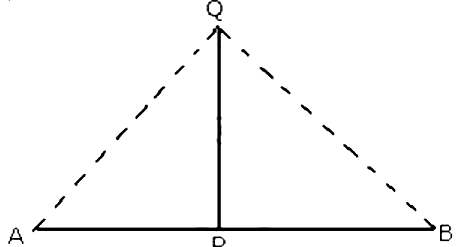
we need to prove that
$Q A=Q B$
Proof:
In $\triangle \mathrm{APQ}$ and $\triangle \mathrm{BPQ}$
$\mathrm{AP}=\mathrm{PB} \ldots[\mathrm{P}$ is the mid$-$point of $\mathrm{AB}]$
$\angle \mathrm{APQ}=\angle \mathrm{BPQ}=90^{\circ} \ldots[\mathrm{PQ}$ is perpendicular to $\mathrm{AB}]$
$\mathrm{PQ}=\mathrm{PQ} \ldots[$Common$]$
$\therefore$ By Side$-$Angel$-$Side criterion of congruence,
$\triangle \mathrm{APQ} \cong \triangle \mathrm{BPQ}$
The corresponding parts of the congruent triangles are congruent.
$\therefore \mathrm{QA}=\mathrm{QB} \ldots[\text { c.p.c.t ] }$ View full question & answer→Question 274 Marks
The perpendicular bisectors of the sides of a $\triangle ABC$ meet at $I$.Prove that: $IA = IB = IC.$
AnswerGiven: $A \triangle A B C$ in which $A D$ is the perpendicular bisector of $B C$
$B E$ is the perpendicular bisector of $C A$
$C F$ is the perpendicular bisector of $A B\ \mathrm{AD}, \mathrm{BE}$ and $\mathrm{CF}$ meet at $I$
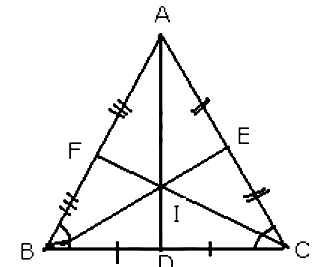
we need to prove that
$I A=I B=I C$
Proof:
In $\triangle \mathrm{BID}$ and $\triangle \mathrm{CID}$
$\mathrm{BD}=\mathrm{DC} \ldots[$ Given$]$
$\angle \mathrm{BDI}=\angle \mathrm{CDI}=90^{\circ} \ldots[\mathrm{AD}$ is the perpendicular bisector of $\mathrm{BC}]$
$\mathrm{DI}=\mathrm{DI} \ldots[$ Common $]$
$\therefore$ By the Side$-$Angle$-$Side criterion of congruence,
$\Delta \mathrm{BID} \cong \triangle \mathrm{CID}$
The corresponding parts of the congruent triangles are congruent.
$\therefore I B=I C \dots...[\text{ c.p.c.t }]$
Similarly, in $\triangle \mathrm{CIE}$ and $\triangle \mathrm{AIE}$
$\mathrm{CE}=\mathrm{AE} \ldots[$ Given $]$
$\angle \mathrm{CEI}=\angle \mathrm{AEI}=90^{\circ} \ldots[\mathrm{AD}$ is the perpendicular bisector of $\mathrm{BC}]$
$\mathrm{IE}=\mathrm{IE} \ldots[$ Common $]$
$\therefore$ By Side$-$Angel$-$Side Criterion of congruence,
$\triangle \mathrm{CIE} \cong \triangle \mathrm{AIE}$
The corresponding parts of the congruent triangles are congruent.
$\therefore \mathrm{IC}=\mathrm{IA} \ldots[\text { c.p.c.t ] }$
Thus, $I \mathrm{\sim A}=\mathrm{IB}=\mathrm{IC}$ View full question & answer→Question 284 Marks
A $\triangle ABC$ has $\angle B = \angle C$.Prove that: The perpendiculars from the mid$-$point of $BC$ to $AB$ and $AC$ are equal.
AnswerGiven: $A \triangle A B C$ in which $\angle B=\angle C$.
$D L$ is the perpendicular from $D$ to $A B$
$D M$ is the perpendicular from $D$ to $A C$
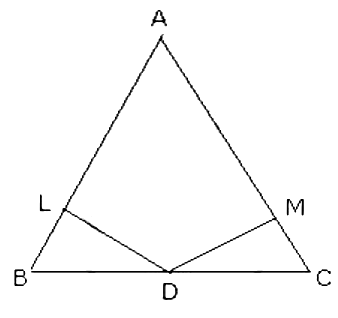
We need to prove that
$\mathrm{DL}=\mathrm{DM}$
Proof:
In $\triangle \mathrm{DLB}$ and $\triangle \mathrm{DMC}$
$\angle \mathrm{DLB}=\angle \mathrm{DMC}=90^{\circ} \ldots[\mathrm{DL} \perp \mathrm{AB}$ and $\mathrm{DM} \perp \mathrm{AC}]$
$\angle B=\angle C \ldots[$Given$]$
$ B D=D C \ldots[D$ is the midpoint of $BC]$
$ \therefore$ By Angel$-$Angel$-$Side Criterion of congruence,
$ \Delta D L B \cong \triangle D M C$
The corresponding parts of the congruent triangles are congruent.
$\therefore \mathrm{DL}=\mathrm{DM} \ldots[\text { c.p.c.t ] }$ View full question & answer→Question 294 Marks
In a$ \triangle ABC, D$ is mid$-$point of $BC; AD$ is produced up to $E$ so that $DE = AD$.Prove that $:(i) \triangle ABD$ and $\triangle ECD$ are congruent.$(ii) AB = CE.(iii) AB$ is parallel to $EC$
AnswerGiven: $A \triangle A B C$ in which $D$ is the mid$-$point of $B C$
$A D$ is produced to $E$ so that $D E=A D$
we need to prove that :
$(i) \triangle \mathrm{ABD}$ and $\triangle \mathrm{ECD}$ are congruent.
$(ii) A B=C E$.
$(iii) A B$ is parallel to $E C$
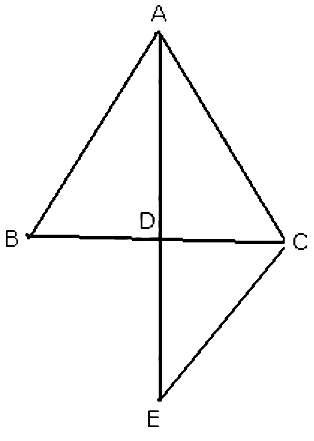
$(i)$ In $\triangle \mathrm{ABD}$ and $\triangle \mathrm{ECD}$
$B D=D C \ldots[D$ is the midpoint of $B C]$
$\mathrm{ADB}=\mathrm{CDE}\dots .. [$ vertically opposite angels $]$
$\mathrm{AD}=\mathrm{DE} \ldots[$ Given $]$
$\therefore$ By Side$-$Angel$-$Side criterion of congruence,
we have, $\triangle \mathrm{ABD} \cong \triangle \mathrm{ECD}$
$(ii)$ The corresponding parts of the congruent triangles are congruent.
$\therefore \mathrm{AB}=\mathrm{EC} \ldots[\text { c.p.c.t }]$
$(iii)$ Also, $DAB = DEC \quad\dots....[ \text{c.p.c t }]$
$\mathrm{AB} \| \mathrm{EC}\dots.....[ DAB$ and $DEC$ are alternate angels $]$ View full question & answer→Question 304 Marks
The given figure shows a circle with center $\mathrm{O}$. $\mathrm{P}$ is mid$-$point of chord $AB.$
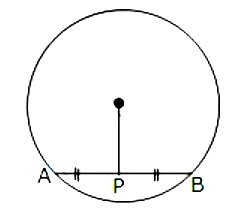
Show that $O P$ is perpendicular to $A B$. AnswerGiven: in the figure, $\mathrm{O}$ is center of the circle, and $\mathrm{AB}$ is chord. $\mathrm{P}$ is a point on $A B$ such that $A P=P B$. We need to prove that, $\mathrm{OP} \perp \mathrm{AB}$
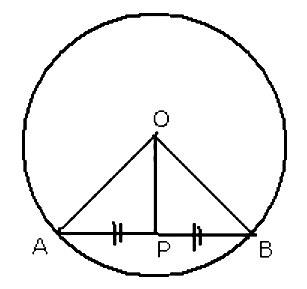
Construction: Join $\mathrm{OA}$ and $\mathrm{OB}$
Proof:
In $\triangle \mathrm{OAP}$ and $\triangle \mathrm{OBP}$
$\mathrm{OA}=\mathrm{OB} \quad\dots...[$radii of the same circle$]$
$\mathrm{OP}=\mathrm{OP} \quad\dots...[$common$]$
$\mathrm{AP}=\mathrm{PB} \ldots [$given$]$
$\therefore$ By Side$-$Side$-$Side criterion of congruency,
$\triangle O A P \cong \triangle O B P$
The corresponding parts of the congruent triangles are congruent.
$\therefore \angle \mathrm{OPA}=\angle \mathrm{OPB}\dots ...[$ by $\text{c.p.c.t}]$
But $\angle \mathrm{OPA}+\angle \mathrm{OPB}+=180^{\circ} \ldots .[$ linear pair $]$
$ \therefore \angle \mathrm{OPA}=\angle \mathrm{OPB}=90^{\circ}$
Hence $\text { OP } \perp \mathrm{AB}$
View full question & answer→Question 314 Marks
If the following pair of the triangle is congruent? state the condition of congruency : In $\triangle ADC$ and $\triangle PQR, BC = QR, \angle A = 90^o, \angle C = \angle R = 40^o$ and $\angle Q = 50^o.$
AnswerIn $\triangle \mathrm{PQR}$
$ \angle \mathrm{R}=40^{\circ}, \angle \mathrm{Q}=50^{\circ}$
$\angle \mathrm{P}+\angle \mathrm{Q}+\angle \mathrm{R}=180^{\circ} \quad\left[\right.$ Sum of all the angels in aa triangle $\left.=180^{\circ}\right]$
$ \Rightarrow \angle P+50^{\circ}+40^{\circ}=180^{\circ}$
$ \Rightarrow \angle P+90^{\circ}=180^{\circ}$
$\Rightarrow \angle \mathrm{P}=180^{\circ}-90^{\circ}$
$\Rightarrow \angle \mathrm{P}=90^{\circ}$
In $\triangle \mathrm{ADC}$ and $\triangle \mathrm{PQR}$
$ \angle \mathrm{A}=\angle \mathrm{P}$
$ \angle \mathrm{C}=\angle \mathrm{R}$
$ \mathrm{BC}=\mathrm{QR}$
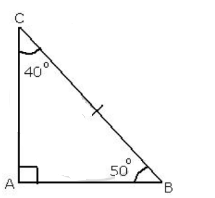
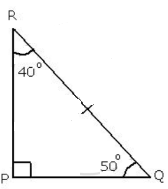
By Angle$-$Angle$-$Side criterion of congruency, the triangles $\triangle A D C$ and $\triangle P Q R$ are congruent to each other.
$\therefore \triangle \mathrm{ADC} \cong \triangle \mathrm{PQR}$ View full question & answer→Question 324 Marks
In the given figure, $A B=D B$ and $A C=D C$.
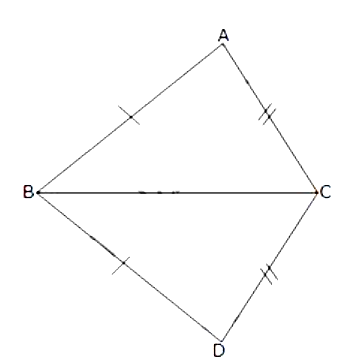
If $\angle \mathrm{ABD}=58^{\circ}, \angle \mathrm{DBC}=(2 \mathrm{x}-4)^{\circ}, \angle \mathrm{ACB}=\mathrm{y}+15^{\circ} $ and $\angle \mathrm{DCB}=63^{\circ};$ find the values of $x$ and $y.$ AnswerGiven: In the figure $\mathrm{AB}=\mathrm{DB}, \mathrm{AC}=\mathrm{DC}, \angle \mathrm{ABD}=58^{\circ}$, $\angle \mathrm{DBC}=(2 \mathrm{x}-4)^{\circ}, \angle \mathrm{ACB}=(\mathrm{y}+15)^{\circ}$ and $\angle \mathrm{DCB}=63^{\circ}$
We need to find the values of $x$ and $y$.
In $\triangle A B C$ and $\triangle D B C$
$\mathrm{AB}=\mathrm{DB} \ldots[$Given $]$
$\mathrm{AC}=\mathrm{DC} \ldots[$ Given $]$
$\mathrm{BC}=\mathrm{BC} \ldots[$common$]$
$\therefore$ By Side$-$SIde$-$Side criterion of congruence, we have,
$\triangle \mathrm{ABC} \cong \triangle \mathrm{DBC}$
The corresponding parts of the congruent triangles are congruent.
$\therefore \angle \mathrm{ABC}=\mathrm{DCB} \ldots[\text { c. p. c.t }]$
$ \Rightarrow \mathrm{y}^{\circ}+15^{\circ}=63^{\circ}$
$ \Rightarrow \mathrm{y}^{\circ}=63^{\circ}-15^{\circ}$
$ \Rightarrow \mathrm{y}^{\circ}=48^{\circ}$
and $\angle \mathrm{ABC}=\angle \mathrm{DBC}\dots... \text{c.p.c.t }]$
But, $\angle \mathrm{DBC}=(2 \mathrm{x}-4)^{\circ}$
We have $\angle \mathrm{ABC}+\angle \mathrm{DBC}=\angle \mathrm{ABD}$
$\Rightarrow(2 x-4)^{\circ}+(2 x-4)^{\circ}=58^{\circ}$
$ \Rightarrow 4 x-8^{\circ}=58^{\circ}$
$ \Rightarrow 4 x=58^{\circ}+8^{\circ}$
$ \Rightarrow 4 x=66^{\circ}$
$ \Rightarrow x=66^{\circ} /(4)^{\prime}$
$ \Rightarrow x=16.5^{\circ}$
Thus the values of $x$ and $y$ are :
$x=16.5^{\circ}$ and $y=48^{\circ}$
View full question & answer→