Questions

[3 Mark Question Answer]

🎯

Test yourself on this topic

17 questions · timed · auto-graded

Question 13 Marks
A train moving with a velocity of $20 m s^{-1} $is brought to rest by applying brakes in $5 s$. Calculate the retardation.
Answer
Initial velocity $u =20 m / s$ Final velocity $v =0$ Time taken $t =5 s$ Let acceleration be ' a '. Using the first equation of motion, $v = u +$ at $0=20+5 a a=-4 m / s ^{-2}$ Thus, retardation $=4 m / s ^{-2}$
View full question & answer
Question 23 Marks
A bullet initially moving with a velocity $20 \ m/s$ strikes a target and comes to rest after penetrating a distance $10 \ cm$ into the target. Calculate the retardation caused by the target.
Answer
Initial velocity$ u = 20 m/s$
Final velocity $v = 0$
Distance travelled $s = 10 cm = 0.1 m$
Let acceleration be 'a'.
Using the third equation of motion,
$v^2- u^2= 2as$
We get,
$(0)^2 - (20)^2 = 2(a) (0.1)$
$a = -(400/0.2) m/s^2$
$a = -2000 m/s^2$​​​​​​​
Thus, retardation $= 2000 m/s^{-2}​​​​​​​$​​​​​​​
View full question & answer
Question 33 Marks
A body, initially at rest, starts moving with a constant acceleration $2 m s ^{-2}$. Calculate: (i) the velocity acquired and (ii) the distance travelled in 5 s .
Answer
Initial velocity $u = 0$ m/s
Acceleration $a = 2 m/s^2$
Time $t = 5 s$
(i) Let 'v' be the final velocity.
Then,$ (v - u)/5 = 2$
$v = 10 m/s^{-1}$​​​​​​​
(ii) Let 's' be the distance travelled.
Using the third equation of motion,
$v^2- u^2= 2as$
We get,
$(10)^2 - (0)^2 = 2(2) (s)$
Thus, $s = (100/4) m = 25 m$
View full question & answer
Question 43 Marks
A vehicle is accelerating on a straight road. Its velocity at any instant is $30 km / h$. After 2 s , it is $33.6 km / h$, and after further 2 s , it is $37.2 km / h$. Find the acceleration of the vehicle in $m s ^{-2}$. Is the acceleration uniform?
Answer
Acceleration = Change in velocity/time taken
In the first two seconds,
Acceleration $= [(33.6 - 30)/2] km/h^2$
$= 1.8 km/h^2$
$= 0.5 m/s^2 …(i)$
In the next two seconds,
Acceleration $= [(37.2 - 33.6)/2] km/h^2$
$= 1.8 km/h^2$
$= 0.5 m/s^-^2…(ii)$
From (i) and (ii), we can say that the acceleration is uniform.
View full question & answer
Question 53 Marks
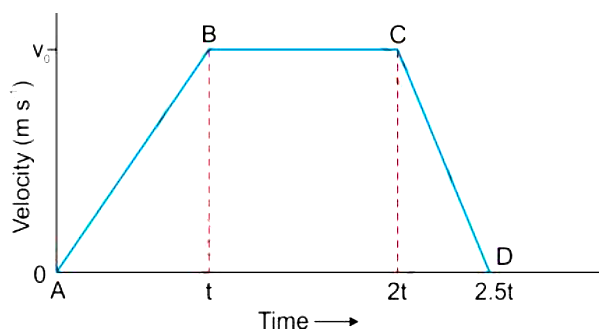
Figure given below shows a velocity-time graph for a car starting from rest. The graph has three parts $AB, BC$ and $CD.$

Compare the distance travelled in part BC with the distance travelled in part $AB$.
Answer
Distance travelled in part BC = Area of the rectangle tBC2t = base × height.
$= (2t - t) \times v_o$
$= v_ot$
Distance travelled in part AB = Area of the triangle ABt
$= (1/2) \times $ base × height
$= (1/2) \times t \times v_o$
$= (1/2) v_o t$
Therefore, distance travelled in part BC:distance travelled in part $AB :: 2:1.$
View full question & answer
Question 73 Marks
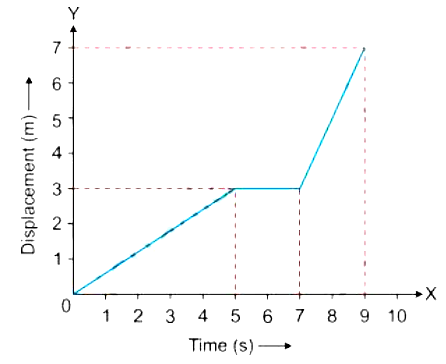
Figure shows the displacement of a body at different times .
Calculate the velocity of the body as it moves for time interval :
(i) $0$ to $5 s,$
(ii) $5$ s to $7 s$
(iii) $7$ s to $9 s.$
Answer
(a) (i) Velocity from 0 to $5 s=$ Displacement $ \times =(3 / 5) m / s =0.6 m / s ^{-1}$
(ii) Velocity from 5 s to $7 s=$ Displacement $ \times =(0 / 2) m / s =0 m / s ^{-1}$.
(iii) Velocity from 7 s to $9 s=$ Displacement $ \times =(7-3) /(9-7) m / s =(4 / 2) m / s =2 m / s ^{-1}$
View full question & answer
Question 83 Marks
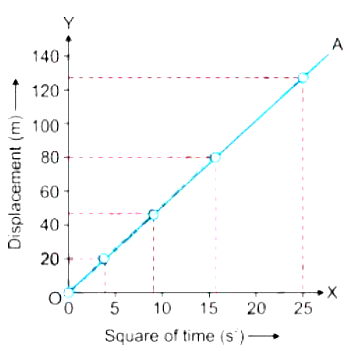
A body falls freely from a certain height. Show graphically the relation between the distance fallen and square of time. How will you determine g from this graph?
Answer

The value of acceleration due to gravity (g) can be obtained by doubling the slope of the $S - t^2$ graph for a freely falling body.
View full question & answer
Question 93 Marks
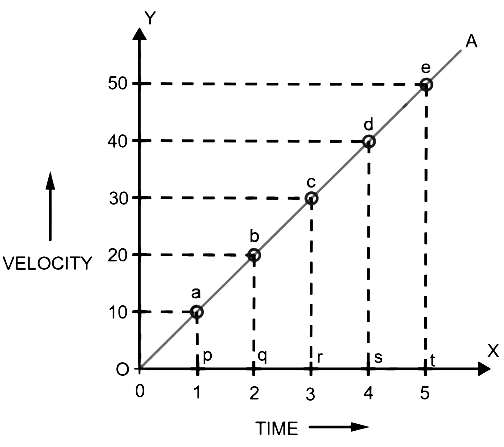
Draw a velocity-time graph for the free fall of a body under gravity starting from rest. Take $g = 10m s^{-2}$
Answer
Below is the velocity-time graph for the free fall of a body under gravity, starting from rest:
View full question & answer
Question 103 Marks
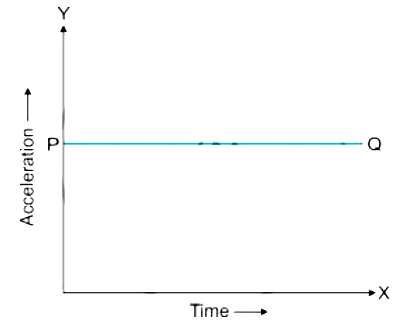
Draw a graph for acceleration against time for a uniformly accelerated motion. How can it be used to find the change in speed in a certain interval of time?
Answer

The area enclosed between the straight line and time axis for each interval of time gives the value of change in speed in that interval of time.
View full question & answer
Question 113 Marks
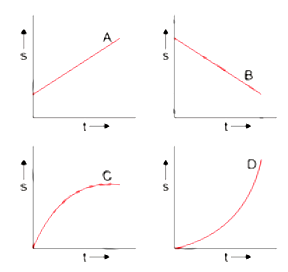
The figure shows the displacement - time graph for four bodies A, B C and D. In each case state what information do you get about the acceleration (zero, positive or negative).
Answer
For body A: The graph is a straight line. So, the slope gives constant velocity. Hence, the acceleration for body A is zero. For body B: The graph is a straight line. So, the slope gives constant velocity. Hence, the acceleration for body B is also zero. For body C: The slope of the graph is decreasing with time. Hence, the acceleration is negative. For body D: The slope of the graph is increasing with time. Hence, the acceleration is positive.
View full question & answer
Question 123 Marks
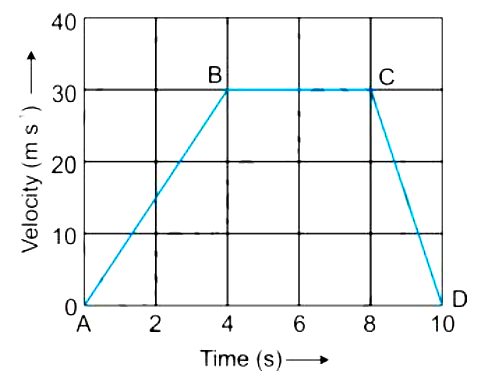
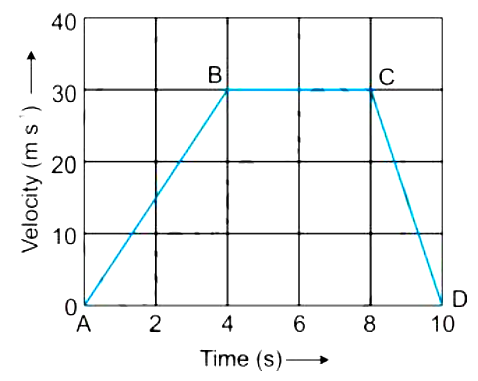
The velocity-time graph of a moving body is given below in Figure

Displacement in each part AB, BC and CD.
Answer
Displacement of part AB = Area of ΔAB4 = (1/2) (4) (30) = 60 m Displacement of part BC = Area of rectangle 4BC8 = (30) × (4) = 120 m Displacement of part CD = Area of ΔC8D = (1/2) (2) (30) = 30 m
View full question & answer
Question 133 Marks
The velocity-time graph of a moving body is given below in Figure

The acceleration in parts $AB, BC$ and $CD.$
Answer
Acceleration in the part $AB =$ Slope of $AB$
$= tan (\angle BAD)$
$= (30/4) ms-2$
$= 7.5 ms-2$
Acceleration in the part $BC = 0 ms^{-2}$
Acceleration in the part CD = slope of $CD = -\tan (\angle CDA)$
$= -(30/2) ms^{-2}$
$= -15 ms^{-2}$​​​​​​​
View full question & answer
Question 143 Marks
A train takes 2 h to reach station B from station A, and then 3 h to return from station B to station A. The distance between the two stations is 200 km. Find:
The average speed,
The average velocity of the train.
Answer
Here, total distance $=(200+200) km =400 km$
Total time taken $=(2+3) h =5 h$
(i) Average speed = Total distance travelled/total time taken = $\frac{400 km }{5 h }=80 km h ^{-1}$
(ii) Average velocity of the train is zero because the train stops at the same point from where it starts, i.e. the displacement is zero.
View full question & answer
Question 153 Marks
Differentiate between the scalar and vector quantities, giving two examples of each.
Answer

Scalar

Vector

They are expressed only by their magnitudes.

They are expressed by magnitude as well as direction.

They can be added, subtracted, multiplied, or divided by simple arithmetic methods.

They can be added, subtracted, or multiplied following a different algebra.

They are symbolically written in an English letter.

They are symbolically written by their English letter with an arrow on top of the letter.

Example: mass, speed

Example: force, velocity
View full question & answer
Question 163 Marks
A bicycle initially moving with a velocity $5.0 m s^{-1} $accelerates for 5 s at a rate of $2 m s^{-2}. $What will be its final velocity?
Answer
Initial velocity of the bicycle, $u = 5 m/s$
Acceleration $= 2 m/s^2$
Given time, $t = 5 s$
Let 'v' be the final velocity.
We know that, acceleration = Rate of change of velocity/time
= (Final velocity - Initial velocity)/time
Or $2 = (v - 5)/5$
Or, $10 = (v - 5)$
Or, $v = 5 + 10$
Or, $v = 15$ m/s
View full question & answer
Question 173 Marks
A car is moving with a velocity $20 m s^{-1}.$ The brakes are applied to retard it at a rate of $2 m s^{-2}.$ What will be the velocity after $5 s$ of applying the brakes?
Answer
Initial velocity of the car, $u=20 m / s$
Retardation $=2 m / s ^2$
Given time, $t=5 s$
Let ' $v$ ' be the final velocity.
We know that, Acceleration = Rate of change of velocity/time
$=($ Final velocity - Initial velocity)/time
$ \Rightarrow-2=\frac{ v -20}{5}$
$\Rightarrow-2 \times 5= v -20$
$\Rightarrow-10= v -20$
$\Rightarrow-10+20= v$
$\Rightarrow v =10 m / s $
Hence, final velocity $=10 m s ^{-1}$.
View full question & answer
[3 Mark Question Answer] - PHYSICS STD 9 Questions - Vidyadip