Question
A bullet initially moving with a velocity $20 \ m/s$ strikes a target and comes to rest after penetrating a distance $10 \ cm$ into the target. Calculate the retardation caused by the target.

Answer

Initial velocity$ u = 20 m/s$
Final velocity $v = 0$
Distance travelled $s = 10 cm = 0.1 m$
Let acceleration be 'a'.
Using the third equation of motion,
$v^2- u^2= 2as$
We get,
$(0)^2 - (20)^2 = 2(a) (0.1)$
$a = -(400/0.2) m/s^2$
$a = -2000 m/s^2$​​​​​​​
Thus, retardation $= 2000 m/s^{-2}​​​​​​​$​​​​​​​

Need a full question paper?

Generate a complete, print-ready paper with questions like this in minutes — across 16+ boards, with answer keys.
Start Generating Free

Similar questions

A measuring cylinder is filled with water upto a level of 30 ml . A solid body is immersed in it so that the level of water rises to 37 ml . Now solid body is tied with a cork and then immersed in water so that the water level rises to 40 ml . Find the volume of solid body and the cork.
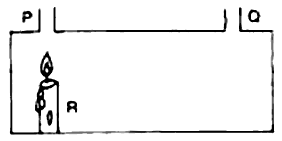
The following figure shows a rectangular box with two tubes P and Q at the top. A burning candle R is placed under the tube P. The candle burns brightly.

Explain: (i) How is the air in the box circulating?
(ii) What will happen if the opening Q is closed?
A cylinder made of copper and aluminium floats in mercury of density $13.6 gem ^{-3}$, such that 0.26 th part of it is below mercury. Find the density of solid.
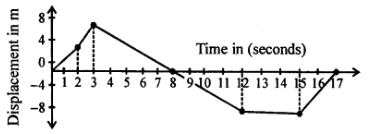
From the displacement - time graph shown given below calculate : -
1. Average velocity in first three seconds.
2. Displacement from initial position at the end of 13 s .
3. Time after which the body is at the initial position,
4. Average velocity after 8 s .
Image
QUESIION Assuming the density of air to be $1.295 kg m ^{-3}$, find the fall in barometric height in mm of Hg at a height of 107 m above the sea level. Take density of mercury $=13.6 \times 10^3 kg m ^{-3}$.
State Newton's third law of motion. Explain, the motion of a rocket with the help of Newton's third law of motion.
State the laws of liquid pressure.
A man weighs 800 N the at the equator. How does the weight of man change at the following places?
(a) At poles
(b) 100 km up in space
(c) 10 km down in a mine.
A sinker is found to weigh 56.7 gf in water. When the sinker is tied to a cork of weight 6 gf , the combination is found to weigh 40.5 gf in water. Calculate R.D. of cork.
(a) What do you understand by the term electric potential?
(b) Define electric potential in terms of energy spent.
(c) State the unit of electric potential and define it.